Intrauterine Insemination (IUI): A Comprehensive Guide to Artificial Insemination

Medically reviewed by Dr. Baraa Alnahhal, MD · Last reviewed: October 2026
Intrauterine insemination (IUI) is a fertility treatment in which washed, concentrated sperm are placed directly into the uterus around the time of ovulation. By bypassing the cervix and shortening the distance sperm must travel, it increases the likelihood of fertilization. It is often tried before more invasive treatments such as IVF, for example for unexplained infertility, low sperm count, or cervical mucus problems [1].
Quick Answer
What is intrauterine insemination (IUI)? IUI is a medical procedure in which a healthcare provider inserts specially prepared sperm directly into the uterus using a thin catheter. The timing is matched to ovulation, which helps healthy sperm reach the fallopian tubes more easily and improves the chance of pregnancy for people facing certain types of infertility. The procedure is brief, is usually done in an office setting, and needs minimal recovery time [1].
Key points at a glance:
IUI places washed sperm into the uterus through a thin catheter, timed to ovulation [1].
The whole process takes about four weeks from preparation to a pregnancy test, but the insemination itself takes only a few minutes [1].
IUI is often tried before IVF because it is less invasive and less expensive [1].
Success depends mainly on the cause of infertility and the age of the birth parent, and rates tend to be higher in people under 38 [1].
Most pregnancies from IUI happen within the first three to four cycles [1].
A pregnancy test is usually done about two weeks after the procedure [1].
The main risk, especially when fertility drugs are used, is a multiple pregnancy (twins, triplets, or more) [1].
What the research says
Six cycles of IUI with ovarian stimulation produced a healthy child about as often as IVF. In a randomized non-inferiority trial of 602 couples with unexplained or mild male subfertility (women aged 18 to 38), a healthy child was born to 47% (97/207) of couples after six cycles of IUI with controlled ovarian hyperstimulation, compared with 52% (104/201) after three cycles of IVF with single embryo transfer and 43% (83/194) after six cycles of modified natural cycle IVF. Multiple pregnancy rates per ongoing pregnancy were 7%, 6%, and 5%, respectively (Bensdorp et al., BMJ, 2015 [2]).
Stronger fertility drugs raised the chance of multiples along with the chance of a birth. A meta-analysis of 8 randomized trials (2,989 patients, 6,590 cycles) of IUI after ovarian stimulation for unexplained infertility found that gonadotropin injections, compared with oral agents, had a relative risk of 1.09 for live birth and 1.06 for multiple gestation. The authors concluded that for every birth gained, a similar increase in multiple gestation occurred (Zolton et al., Fertil Steril, 2020 [3]).
A WHO-commissioned review found that the evidence for IUI is uneven. The review assessed 13 prioritized clinical questions about IUI with and without ovarian stimulation and produced 20 recommendations. The quality of the evidence ranged from very low to high, and higher-order multiple pregnancy after IUI with ovarian stimulation was highlighted as the most notable complication (Cohlen et al., Hum Reprod Update, 2018 [4]).
Understanding Intrauterine Insemination (IUI)
Intrauterine insemination (IUI) is a form of artificial insemination designed to make conception easier by improving how sperm are delivered. In natural conception, sperm must travel from the vagina through the cervix into the uterus and on to the fallopian tubes, where they meet the egg. IUI simplifies that journey by placing concentrated sperm directly into the uterine cavity, which increases the number of functional sperm that reach the egg [1].
Because IUI cuts down the time and distance the sperm have to travel, it makes it easier for them to reach an egg [1]. It is frequently used as an early step in fertility care because it is less invasive and costs less than advanced options such as in vitro fertilization (IVF) [1].
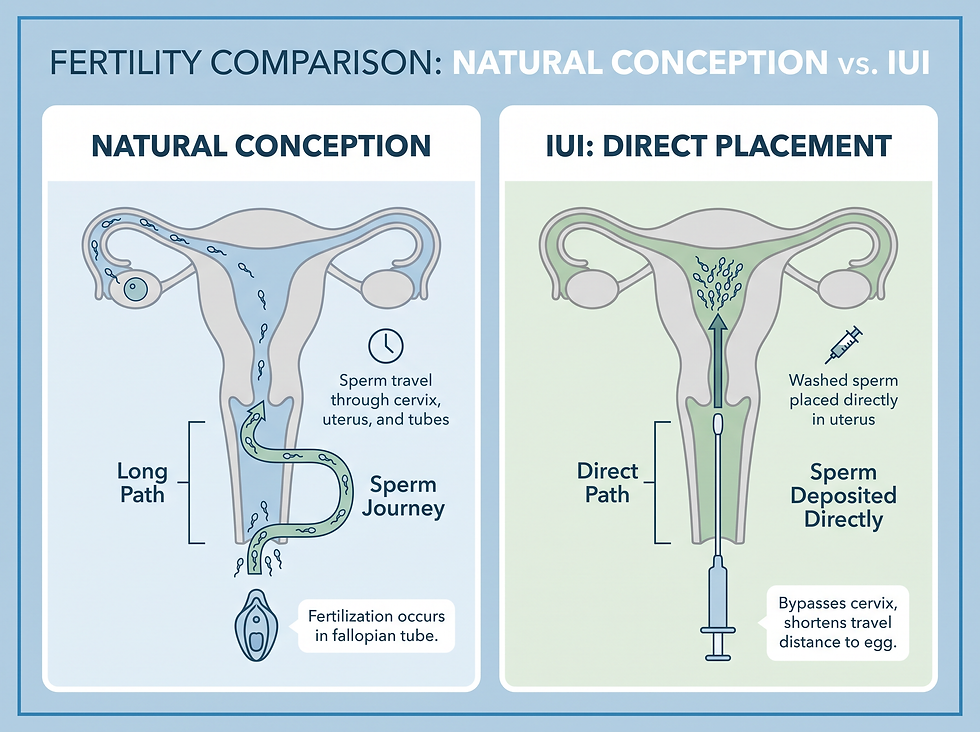
Natural conception versus IUI: washed sperm are placed directly in the uterus, bypassing the cervix and shortening the journey to the egg.
Common Indications for IUI
Healthcare providers recommend IUI for several fertility challenges. It works best for barriers that keep sperm from reaching the egg naturally [1].
Indication | Description |
|---|---|
Cervical mucus problems | Thick or hostile mucus that makes it hard for sperm to move through the cervix. |
Sperm quality | Low sperm count, poor motility, or abnormal sperm shape. |
Unexplained infertility | No specific cause for infertility is found after testing. |
Semen allergy | Rare cases in which proteins in semen cause an allergic reaction (the proteins are removed during sperm washing). |
Donor sperm use | Helping individuals or couples become pregnant with donor samples. |
Ejaculation or erection problems | Difficulty with ejaculation or erections that prevents natural insemination. |
The IUI Procedure Timeline
The IUI process usually follows a standard menstrual cycle and takes about four weeks from initial preparation to the final pregnancy test [1].
Preparation and Monitoring
Before the procedure, you will have evaluations such as a pelvic exam, ultrasounds, and blood tests to check your reproductive health, and your partner will have a semen analysis. Many people take fertility medicine to stimulate the ovaries and encourage the release of one or more eggs, either by mouth for five days or by injection for up to two weeks [1].
Ovulation and Timing
Timing is critical. Providers track ovulation with at-home luteinizing hormone (LH) kits, blood tests, or transvaginal ultrasound. Insemination usually takes place within 24 to 36 hours after an LH surge is detected or after a human chorionic gonadotropin (hCG) “trigger” injection [1].
Step-by-Step Insemination Process
The insemination itself is a straightforward office procedure that takes only a few minutes [1].
Semen washing: The sperm sample is processed in a laboratory to pull out a concentrated amount of healthy, active sperm in a small volume of fluid.
Catheter insertion: Using a speculum for visibility, the provider passes a thin, flexible catheter through the cervix and into the uterus.
Sperm injection: The washed sperm are slowly injected through the catheter directly into the uterine cavity.
Rest period: You may be asked to lie down for 10 to 30 minutes afterward.
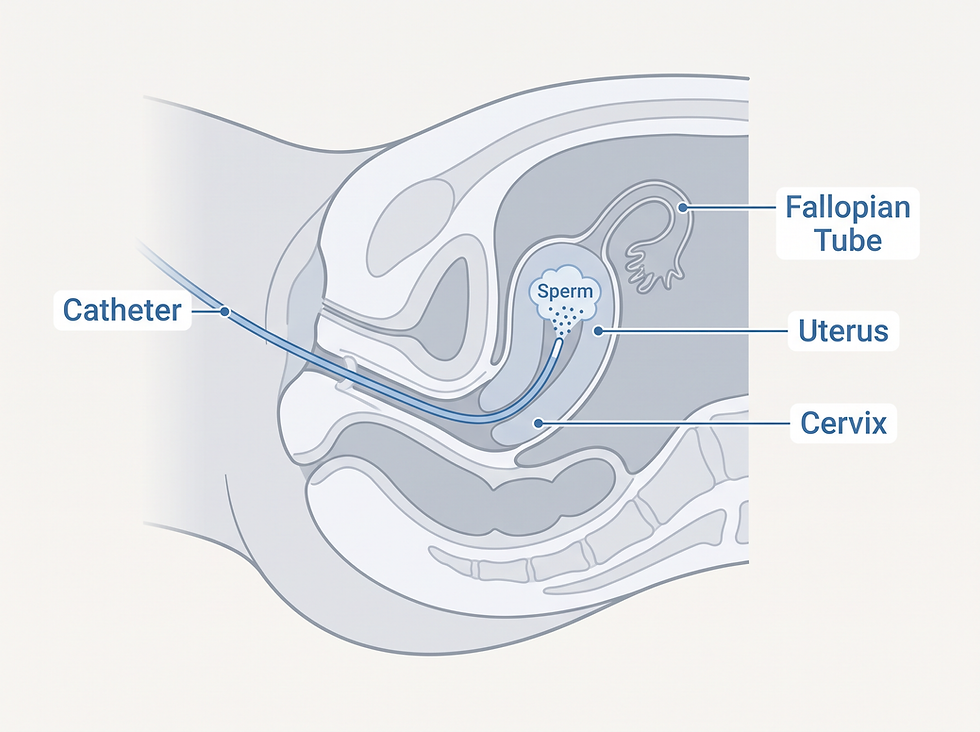
How IUI is done: a thin catheter passes through the cervix and releases washed sperm inside the uterus.
Recovery and Success Factors
Recovery from IUI is immediate for most people. Mild cramping or light spotting can last one to two days, but you can usually go back to your normal activities right away [1].
The chance of success depends on several factors, including the age of the birth parent, the cause of infertility, the quality of the sperm sample, and whether fertility-stimulating medication is used. A pregnancy test is usually done about two weeks after the procedure to confirm the result [1].

Post-procedure care: most people can return to normal activities, with rest if cramping or spotting is bothersome.
Safety and Risks
IUI is a low-risk procedure compared with more invasive fertility treatments such as IVF, but a few risks are worth knowing about [1].
Multiple births: Fertility drugs can cause more than one egg to be released, which raises the chance of twins, triplets, or more. Pregnancies with multiple babies carry a higher risk of preterm birth and low birth weight.
Infection: A small chance of infection after the procedure; this is rare.
Ovarian hyperstimulation syndrome (OHSS): A rare side effect of taking too much fertility medication.
Bottom Line
Intrauterine insemination (IUI) is a valuable tool in reproductive medicine. It bridges the gap between natural conception and more intensive treatments and offers a practical, effective path to pregnancy for many people.
Your next step: if you are having trouble conceiving, talk with a fertility specialist about whether IUI is a suitable option for your specific health needs and family goals.
Frequently Asked Questions
What is the difference between IUI and IVF?
IUI places sperm directly into the uterus so fertilization happens naturally, whereas IVF involves retrieving eggs, fertilizing them in a lab, and then transferring the resulting embryo into the uterus.
Does the IUI procedure hurt?
Most people describe the procedure as similar to a Pap smear, with mild discomfort or cramping during catheter insertion, but it is generally not painful.
How many times can you try IUI?
Most providers recommend about three IUI cycles before moving on to IVF, and sometimes up to six, depending on your age, the cause of infertility, and your individual circumstances.
Can I exercise after an IUI?
Yes. Most people can return to their normal activities and exercise routine right away, although you should avoid anything that causes significant discomfort.
What is “sperm washing”?
Sperm washing is a laboratory process that separates a concentrated amount of healthy sperm from the rest of the sample, removing chemicals, mucus, and non-functional sperm before insemination.
Is IUI effective for low sperm count?
IUI is designed to help with mild to moderate sperm problems by concentrating the best sperm and placing them closer to the egg. If the sperm count is very low, your provider may suggest going straight to IVF.
Do I need to take medication for IUI?
Not always. Many IUI cycles use fertility drugs to increase egg production, but a “natural cycle” IUI can be done without medication if ovulation is regular.
What are the signs of a successful IUI?
There are no immediate signs. The only way to confirm success is a pregnancy test about two weeks after the procedure.
Can I use donor sperm for IUI?
Yes. IUI is a common method for individuals or couples using donor sperm to achieve pregnancy.
What should I do if I experience heavy bleeding after IUI?
Light spotting for a day or two is normal. Contact your healthcare provider if you have heavy bleeding or severe pain after the procedure.
References
Cleveland Clinic. IUI (Intrauterine Insemination). Cleveland Clinic. February 10, 2026. https://my.clevelandclinic.org/health/treatments/22456-iui-intrauterine-insemination
Bensdorp AJ, Tjon-Kon-Fat RI, Bossuyt PMM, et al. Prevention of multiple pregnancies in couples with unexplained or mild male subfertility: randomised controlled trial of in vitro fertilisation with single embryo transfer or in vitro fertilisation in modified natural cycle compared with intrauterine insemination with controlled ovarian hyperstimulation. BMJ. 2015;350:g7771. PMID 25576320. https://doi.org/10.1136/bmj.g7771
Zolton JR, Lindner PG, Terry N, et al. Gonadotropins versus oral ovarian stimulation agents for unexplained infertility: a systematic review and meta-analysis. Fertility and Sterility. 2020;113(2):417-425.e1. PMID 31973903. https://doi.org/10.1016/j.fertnstert.2019.09.042
Cohlen B, Bijkerk A, Van der Poel S, et al. IUI: review and systematic assessment of the evidence that supports global recommendations. Human Reproduction Update. 2018;24(3):300-319. PMID 29452361. https://doi.org/10.1093/humupd/dmx041
This article is for informational purposes only and is not a substitute for professional medical advice, diagnosis, or treatment. The clinical information in this guide reflects source material last reviewed in February 2026.


Comments