Dopamine Antagonists: Uses, Types, Side Effects, and Risks

Updated: 6 days ago
Written and medically reviewed by Dr. Baraa Alnahhal, MD · Last reviewed: October 2026 · How we review
Quick Answer: What are dopamine antagonists?
Dopamine antagonists are medicines that block dopamine receptors so dopamine can't switch on certain cells in your brain and body. Blocking receptors slows the activity those cells control. They mainly treat psychosis-related conditions such as schizophrenia and bipolar disorder, and some treat severe nausea and vomiting. Movement-related side effects are common, and neuroleptic malignant syndrome is rare but life-threatening. [1]
What the research says
Long-term treatment cuts relapse by more than half. In a review of 65 trials with 6,493 people with schizophrenia, 27% of those who stayed on antipsychotics relapsed within a year, compared with 64% on placebo; hospital readmission fell from 26% to 10%. (Leucht et al., Lancet, 2012) [2]
Tardive dyskinesia is common, but less so with newer drugs. Across 41 studies of 11,493 patients, about 1 in 4 (25.3%) had tardive dyskinesia: 20.7% on second-generation antipsychotics versus 30.0% on first-generation ones. (Carbon et al., J Clin Psychiatry, 2017) [3]
Adding olanzapine improves nausea control during strong chemotherapy. In a trial of 380 patients, 37% on olanzapine had no nausea over 5 days, compared with 22% on placebo; 5% had severe sleepiness on day 2. (Navari et al., N Engl J Med, 2016) [4]
Key takeaways
Dopamine antagonists block dopamine receptors instead of activating them. [1]
There are two main classes: antipsychotics and antiemetics (anti-nausea drugs). Several medicines belong to both. [1]
They are a key treatment for psychosis and schizophrenia and can help with dangerous nausea, such as after chemotherapy or surgery. [1]
Side effects range from sleepiness and restlessness to heart rhythm changes and, rarely, neuroleptic malignant syndrome. [1]
What is a dopamine antagonist?
A dopamine antagonist is a drug that stops dopamine from activating certain cells in your brain and body. In simple terms, it is a dopamine receptor blocker. [1]
Dopamine is a neurotransmitter, a chemical your brain uses to send messages and control certain processes. [1]
Think of it like a lock and key:
Receptors sit on the surface of nerve cells, like locks.
Neurotransmitters such as dopamine are the keys. Each has a very specific shape.
When dopamine fits into its receptor, it "unlocks" the cell and switches it on.
A dopamine antagonist fits into the same lock but doesn't turn it. It simply holds the spot, so dopamine can't get in. [1]
It works like a reserved card on a chair at an event. Nobody is sitting there, but you still can't take the seat.

What do dopamine antagonists do in the body?
Dopamine antagonists slow down the activity of the cells they target. That calming effect is what makes them useful for conditions driven by too much brain activity, and for stopping severe nausea. [1]
Which effect you get depends on which receptors a drug targets. Many of these drugs act on several receptor types. Some even activate certain receptors while blocking others. [1]
What conditions do dopamine antagonists treat?
Dopamine antagonists mainly treat mental health conditions that involve excessive brain activity, especially psychosis and schizophrenia. Some also treat severe nausea and vomiting. [1]
Condition group | Examples | Drug class used |
Schizophrenia spectrum | Schizophrenia, schizoaffective disorder, schizophreniform disorder | Antipsychotics |
Mood disorders | Bipolar disorder, mania, major depressive disorder (with or without psychotic features) | Antipsychotics |
Other psychosis-related conditions | Delusional disorder, substance-induced psychotic disorder | Antipsychotics |
Behaviour and personality | Severe agitation, borderline personality disorder | Antipsychotics |
Nausea and vomiting | Chemotherapy-related nausea, nausea after general anesthesia | Antiemetics |
Source for table: [1]
What are the main types of dopamine antagonists?
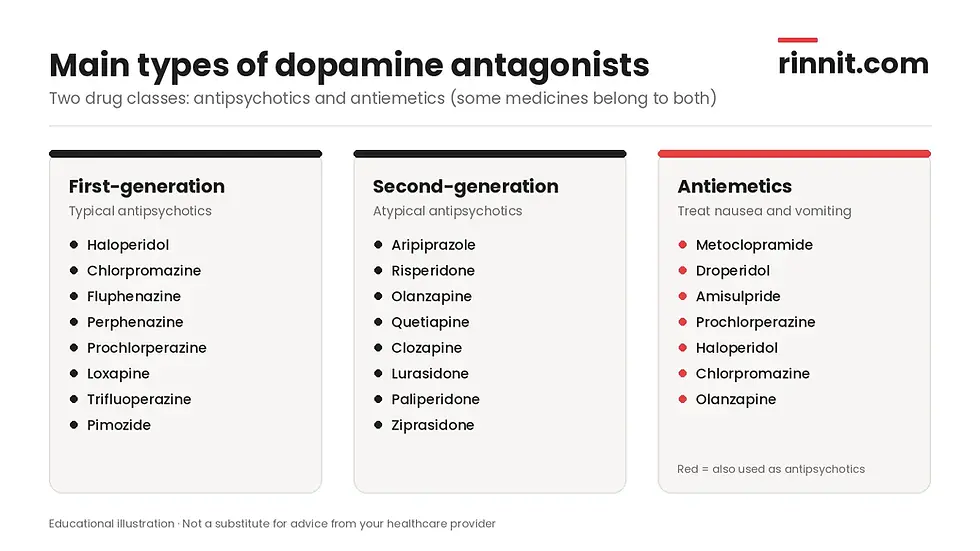
Dopamine antagonists fall into two broad classes: antipsychotic drugs and antiemetic drugs. Many can treat both psychosis and nausea, though not all are widely used for both. [1]
Antipsychotic dopamine antagonists
Antipsychotics are split into two generations. [1]
First-generation (typical) | Second-generation (atypical) |
Chlorpromazine | Aripiprazole |
Fluphenazine | Asenapine |
Haloperidol | Brexpiprazole |
Loxapine | Cariprazine |
Molindone | Clozapine |
Perphenazine | Iloperidone |
Pimozide | Lumateperone |
Prochlorperazine | Lurasidone |
Thiothixene | Olanzapine |
Thioridazine | Paliperidone |
Trifluoperazine | Pimavanserin (acts on serotonin, not dopamine) |
Quetiapine | |
Risperidone | |
Ziprasidone |
Some older brand names are no longer sold in the U.S., but generic versions remain available. [1]
Antiemetic dopamine antagonists
These drugs treat nausea and vomiting by blocking dopamine receptors. Several are also, or mainly, used as antipsychotics. [1]
Amisulpride
Metoclopramide
Droperidol
Haloperidol
Chlorpromazine
Prochlorperazine
Olanzapine
A note on domperidone: domperidone is also a dopamine antagonist. The U.S. FDA restricted it in 2004, but it may be allowed for rare digestive-tract conditions through case-by-case requests. [1]
What are the benefits of dopamine antagonists?
Dopamine antagonists can be extremely helpful, and even lifesaving, because they slow down overactive cells. The benefit depends on the class of drug. [1]
For psychosis
Psychosis-related conditions are often hard to treat with other medicines. [1]
Without these drugs, many people would need long-term or lifelong around-the-clock mental healthcare. [1]
Psychosis can leave people vulnerable to being taken advantage of, and less commonly can put them or others at risk. Antipsychotics reduce that vulnerability and help keep people safer. [1]
For nausea and vomiting
For some people, nausea is more than unpleasant. It can become dangerous. [1]
Cancer treatments, especially chemotherapy, can cause nausea severe enough to be harmful. Dopamine antagonists are an option when other drugs don't work. [1]
They also help stop the nausea and vomiting that are common as general anesthesia wears off after surgery or procedures. [1]
What are the side effects of dopamine antagonists?
Dopamine antagonist side effects depend mostly on the specific medicine, along with your health history and other factors. Movement-related symptoms are among the most common. [1]
Side effect | What it means |
Akathisia | An inner restlessness that makes it hard to hold still |
Involuntary muscle contractions or spasms | |
Repetitive, involuntary movements | |
Heart rhythm changes | Changes similar to long QT syndrome |
Low blood pressure when you stand up suddenly, causing dizziness or fainting | |
Sedation | Feeling tired or sleepy |
Prolactin changes | Can cause missed periods (amenorrhea) or breast discharge when not breastfeeding (galactorrhea) |
Restless legs | Can make restless legs syndrome symptoms worse |
Rare, but life-threatening |
Source for table: [1]
Your healthcare provider can tell you which side effects you are most likely to have, and how to reduce or avoid them. Antipsychotics carry an FDA boxed warning: older adults with dementia-related psychosis have a higher risk of death. Metoclopramide has a boxed warning for tardive dyskinesia and should not be used for more than 12 weeks. [1]

How long can you stay on dopamine antagonists?
How long you take a dopamine antagonist depends on why it was prescribed. [1]
Drug class | Typical use pattern |
Antiemetics | Needed only in certain situations, such as chemotherapy or recovery after anesthesia |
Antipsychotics | Can be taken for years or indefinitely |
Source for table: [1]
Can you work or drive while taking dopamine antagonists?
Whether you can work or drive on a dopamine antagonist varies from person to person. Several of these medicines cause tiredness or sleepiness, which can make your usual routine harder. [1]
Your healthcare provider is the best person to tell you whether it is safe to drive or work, and what to keep in mind while you do. [1]
How common are dopamine antagonist prescriptions?
Dopamine antagonist prescriptions are common. Millions of adults in the U.S. have a prescription for a medicine in this class. [1]
Conclusion
Dopamine antagonists play a major role in treating psychosis, schizophrenia and related mental health conditions, and they help control severe nausea, especially during chemotherapy. [1] They do commonly cause side effects, particularly movement-related ones, but these can usually be managed or kept from affecting your daily life. [1]
If you or someone you care for has been prescribed one of these medicines, write down any new movements, dizziness or sleepiness and bring the list to your next appointment. Your healthcare provider can adjust the dose or the drug to fit you.
Keep learning: explore our guides on tardive dyskinesia, neuroleptic malignant syndrome and bipolar disorder to understand the conditions and side effects linked to these medicines.
FAQ
What are dopamine antagonists?
Dopamine antagonists are medicines that block dopamine receptors, so dopamine can't activate certain cells. This slows the activity those cells control. They are also called dopamine receptor blockers. [1]
What conditions do dopamine antagonists treat?
Dopamine antagonists mainly treat psychosis-related conditions such as schizophrenia, schizoaffective disorder, bipolar disorder, delusional disorder and mania. Some are also used for severe nausea and vomiting. [1]
Are antipsychotics and dopamine antagonists the same thing?
Many antipsychotics are dopamine antagonists, but not every dopamine antagonist is used as an antipsychotic. Some, such as metoclopramide and droperidol, are used mainly for nausea and vomiting. [1]
What are the most common side effects of dopamine antagonists?
Common side effects include sleepiness, restlessness (akathisia), muscle spasms (dystonia) and dizziness when standing up. Some people also notice prolactin-related changes such as missed periods or breast discharge. [1]
Is neuroleptic malignant syndrome an emergency?
Yes. Neuroleptic malignant syndrome is a rare but life-threatening reaction to dopamine antagonists, so get emergency care right away if it is suspected. [1]
How long can I take a dopamine antagonist?
It depends on the reason you take it. Antiemetic dopamine antagonists are usually needed only in certain situations, while antipsychotics may be taken for years or indefinitely. [1]
Can I drive while taking a dopamine antagonist?
It depends on the medicine and how it affects you. Several dopamine antagonists cause tiredness or sleepiness, so ask your healthcare provider whether it is safe for you to drive or work. [1]
Do newer antipsychotics cause less tardive dyskinesia?
Research suggests they do. A meta-analysis of 41 studies found tardive dyskinesia in 20.7% of people taking second-generation antipsychotics, compared with 30.0% of those taking first-generation drugs. [3]
Do dopamine antagonists cause weight gain?
Some do, especially certain newer antipsychotics. They can also raise blood sugar and cholesterol, so your provider may check your weight and blood tests regularly.
Can dopamine antagonists raise prolactin levels?
Yes. Blocking dopamine can raise prolactin, which can cause breast swelling, milk leaking from the nipples, missed periods or sexual problems. Tell your provider if you notice these changes.
Related Reading
Antipsychotic Medications: A Guide to Treatment and Recovery explains how antipsychotic medicines work and their side effects.
Tardive Dyskinesia: Symptoms, Causes, Treatment and Outlook explains the movement disorder linked to long-term dopamine blockers.
Neuroleptic Malignant Syndrome: Causes, Symptoms, and Emergency Care describes the warning signs of this rare antipsychotic emergency.
Dopamine Agonists: How They Work, What They Treat, and Their Risks explains the opposite drug class, which activates dopamine receptors.
References
Cleveland Clinic. Dopamine Antagonist: What It Is, Uses, Side Effects & Risks. Cleveland Clinic. Last updated May 9, 2023. https://my.clevelandclinic.org/health/treatments/24962-dopamine-antagonists
Leucht S, Tardy M, Komossa K, et al. Antipsychotic drugs versus placebo for relapse prevention in schizophrenia: a systematic review and meta-analysis. Lancet. 2012;379(9831):2063-71. PMID: 22560607. https://doi.org/10.1016/S0140-6736(12)60239-6
Carbon M, Hsieh CH, Kane JM, et al. Tardive Dyskinesia Prevalence in the Period of Second-Generation Antipsychotic Use: A Meta-Analysis. J Clin Psychiatry. 2017;78(3):e264-e278. PMID: 28146614. https://doi.org/10.4088/JCP.16r10832
Navari RM, Qin R, Ruddy KJ, et al. Olanzapine for the Prevention of Chemotherapy-Induced Nausea and Vomiting. N Engl J Med. 2016;375(2):134-42. PMID: 27410922. https://doi.org/10.1056/NEJMoa1515725
Medical disclaimer
This article is for general educational purposes only and does not replace professional medical advice, diagnosis or treatment. Always talk to your doctor or another qualified healthcare provider about your medicines, and never start, stop or change a prescribed medicine without their guidance. If you think you may be having a medical emergency, call your local emergency number right away.



Comments