Delusional Disorder: Types, Symptoms, and How It Is Treated

Updated: 3 days ago
Medically reviewed by Dr. Baraa Alnahhal, MD · Last reviewed: October 2026
Quick Answer
Delusional disorder is a psychotic disorder whose main symptom is one or more delusions, unshakable beliefs in something untrue that almost everyone else recognizes as false [1]. It usually begins around age 40 [1]. Unlike schizophrenia, no other psychotic symptoms are present and daily functioning usually remains intact [1]. Treatment combines psychotherapy with antipsychotic medication, and about half achieve full recovery [1].
What the research says
Antipsychotics help about one in three people reach a good response — and the evidence is limited. A systematic review of six studies (437 patients, 318 of them on second-generation antipsychotics) found that antipsychotics achieved a good response, defined as 50% or greater improvement, in 32.3% of patients. First-generation drugs were only marginally better than second-generation ones, and pimozide did not seem to offer an advantage in most subtypes (PubMed: Muñoz-Negro et al., Int Clin Psychopharmacol, 2020 [2]).
High-quality treatment trials are still missing. A Cochrane review screened 141 citations and found only one eligible randomized trial — a small study in which 17 people completed a comparison of CBT with supportive psychotherapy. The authors concluded there is currently insufficient evidence to make evidence-based recommendations for any type of treatment (PubMed: Skelton et al., Cochrane Database Syst Rev, 2015 [3]).
In older adults, most cases are persecutory and many improve with treatment. In 55 patients aged 65 and over seen at an Australian old age psychiatry service, 87% had the persecutory type and delusional disorder was significantly associated with social isolation. Over an average follow-up of 36.6 months, 20% had sustained recovery and a further 35% improved; 96% of those who improved had received atypical antipsychotics (PubMed: Nagendra and Snowdon, Int Psychogeriatr, 2019 [4]).
What Is Delusional Disorder?
Delusional disorder is a type of psychotic disorder. Its main symptom is the presence of one or more delusions [1].
A delusion is an unshakable belief in something that is untrue [1]. The belief is not part of the person's culture or subculture, and almost everyone else knows this belief to be false [1].
People with delusional disorder often experience non-bizarre delusions. These involve situations that could possibly occur in real life, such as being followed, deceived, or loved from a distance [1]. The delusions usually involve misinterpreting perceptions or experiences — the situations are either untrue or highly exaggerated [1].
Non-bizarre delusions differ from bizarre delusions. Bizarre delusions are beliefs that are impossible in our reality — for example, believing someone has removed an organ from your body with no physical evidence of the procedure [1].
An important feature sets this condition apart from other psychotic disorders. People with delusional disorder often continue to socialize and function well, apart from the subject of their delusion [1]. They generally do not behave in an odd or unusual manner. In some cases, however, people become so preoccupied with their delusions that their lives are disrupted [1].
Key Concept | What It Means |
Delusion | An unshakable belief in something untrue, outside the person's culture, recognized as false by nearly everyone else |
Non-bizarre delusion | Belief in a situation that could happen in real life (being followed, deceived, loved from a distance) |
Bizarre delusion | Belief that is impossible in reality (organ removed without any physical evidence) |
Daily functioning | Usually preserved, unlike in many other psychotic disorders |
Prevalence | Approximately 0.05% to 0.1% of the adult population [1] |

Symptoms and Causes
The Six Types of Delusional Disorder
The types of delusional disorder are determined by the main theme of the delusions a person experiences. The persecutory type is the most common — when someone believes others are out to harm them despite evidence to the contrary [1].
Type | Core Delusion | Possible Behaviors |
Erotomanic | Another person — often important or famous — is in love with them [1] | Attempting to contact the person; stalking behavior [1] |
Grandiose | Overinflated sense of self-worth, power, knowledge, or identity | Believing they have a great talent or made an important discovery [1] |
Jealous | Spouse or sexual partner is unfaithful without any concrete evidence [1] | — |
Persecutory (most common) | Someone or something is mistreating, spying on, or attempting to harm them (or someone close) [1] | Making repeated complaints to legal authorities [1] |
Somatic | Having a physical issue or medical problem, such as a parasite or a bad odor [1] | — |
Mixed | Two or more of the types above [1] | — |
Recognizing the Signs
The most obvious sign of delusional disorder is the presence of delusions, and these vary based on the type.
A defining characteristic is the lack of self-awareness. The person often does not realize their delusions are problematic. They cannot accept that their delusions are irrational or inaccurate — even if they recognize that other people would describe their delusions that way [1].
Anger and violent behavior may be present in people experiencing persecutory, jealous, or erotomanic delusions [1]. People may also develop anxiety and/or depression as a result of the delusions [1].
Early symptoms can be subtle. Watch for feelings of being exploited, preoccupation with the loyalty or trustworthiness of friends, a tendency to read threatening meanings into benign remarks or events, persistently holding grudges, and a readiness to respond and react to perceived slights [1].
Stage | Warning Signs |
Early symptoms | Feelings of exploitation; preoccupation with friends' loyalty; reading threat into benign remarks; holding grudges; reacting strongly to perceived slights |
Established disorder | One or more unshakable false beliefs; no insight that beliefs are problematic |
Emotional impact | Anger; possible violent behavior (persecutory, jealous, erotomanic types); anxiety; depression |

What Causes Delusional Disorder?
As with many other psychotic disorders, researchers do not yet know the exact cause of delusional disorder [1]. Researchers are, however, studying several factors that may contribute to its development.
Genetic factors play a possible role. Delusional disorder is more common in people who have family members with delusional disorder or schizophrenia, suggesting a genetic factor may be involved [1]. Researchers believe a tendency to develop the condition might be passed from parents to their biological children [1].
Biological factors are also under study. Researchers are examining how abnormalities in certain areas of the brain might contribute. An imbalance of certain brain chemicals called neurotransmitters has been linked to the formation of delusional symptoms [1].
Environmental and psychological factors can trigger or contribute to the condition. Stress may trigger delusional disorder [1]. Alcohol use disorder and substance use disorder might contribute [1]. Some psychodynamic theories point to hypersensitivity and ego defense mechanisms like reaction formation, projection, and denial [1]. Social isolation, envy, distrust, suspicion, and low self-esteem are additional psychological factors that may lead someone to form a delusion as a solution for unexplained feelings [1].
Contributing Factor | What Researchers Know |
Genetic | More common in families with delusional disorder or schizophrenia; tendency may be inherited |
Biological | Possible brain area abnormalities; neurotransmitter imbalance linked to delusional symptoms |
Environmental | Stress may trigger it; alcohol use disorder and substance use disorder might contribute |
Psychological | Hypersensitivity, ego defense mechanisms (reaction formation, projection, denial), social isolation, envy, distrust, suspicion, low self-esteem |
Diagnosis and Tests
Who Does Delusional Disorder Affect?
Before diagnosis, it helps to know the typical profile. Delusional disorder most often occurs in middle to late life, with the average age of onset being 40 years [1].
The persecutory and jealous types are more common in men [1]. The erotomanic type is more common in women [1].
People who tend to be socially isolated are more likely to develop delusional disorder. These populations include immigrants who have language barriers, people who are deaf, people who are visually impaired, and people over 65 [1].
Risk Factor | Details |
Average age of onset | 40 years (middle to late life) |
Men | Higher rates of persecutory and jealous types |
Women | Higher rates of erotomanic type |
Social isolation | Increases likelihood; includes immigrants with language barriers, deaf individuals, visually impaired individuals, and people over 65 |
How Is Delusional Disorder Diagnosed?
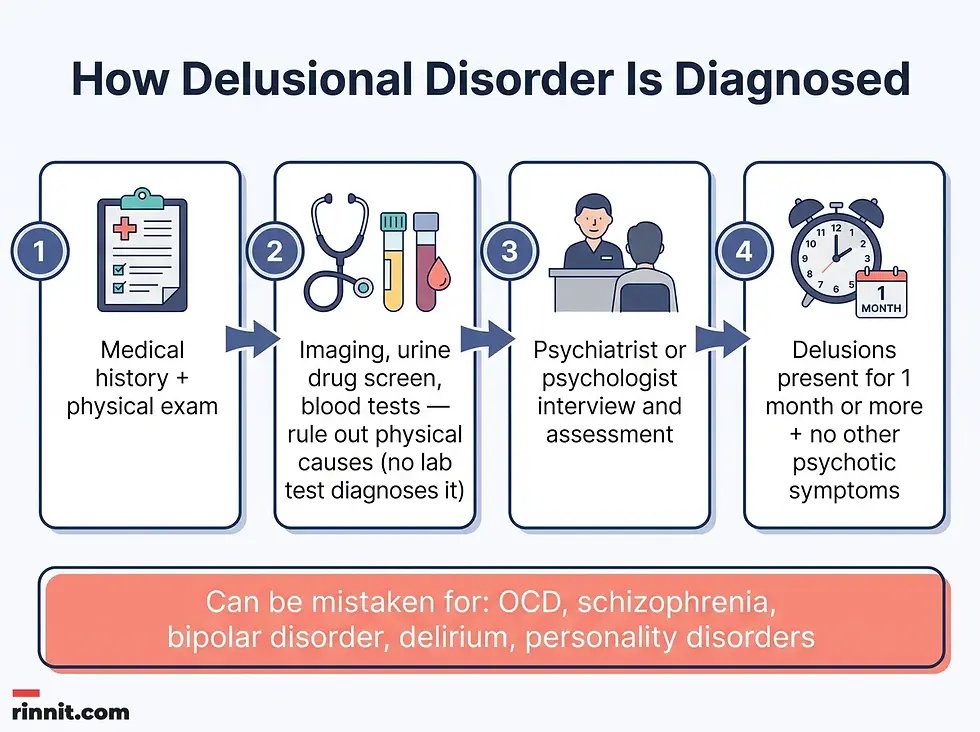
Mental health professionals diagnose delusional disorder when a person has one or more delusions for one month or more that cannot be explained by any other condition [1]. The person must also not have the characteristic symptoms of other psychotic disorders, such as schizophrenia [1].
If someone is experiencing signs and symptoms, a healthcare provider performs a complete medical history and physical examination. There are no laboratory tests that diagnose delusional disorder [1]. Instead, providers may use diagnostic tests — imaging tests, a urine drug screen, and blood tests — to rule out physical conditions, medications, or substances that could be causing the symptoms [1].
If no physical reason is found, a consultation with a psychiatrist or psychologist is likely. These specialists use specially designed interview and assessment tools to evaluate a person for a psychotic disorder [1]. They ask questions about the delusions and assess mental status. They may also interview family members and friends to gather details about the delusions and a timeline of the symptoms [1].
Diagnostic Step | Purpose |
Medical history and physical exam | Rule out physical causes |
Imaging tests, urine drug screen, blood tests | Rule out physical conditions, medications, or substances causing symptoms |
Psychiatric/psychological interview | Specially designed tools to assess for a psychotic disorder |
Family and friend interviews | Provide details about delusions and symptom timeline |
Conditions It Can Be Confused With
Delusional disorder can be misdiagnosed because other mental health conditions can also cause delusions. Providers carefully assess for other symptoms before settling on this diagnosis.
Possible Misdiagnosis |
Obsessive-compulsive disorder (OCD) |
Schizophrenia |
Delirium / major neurocognitive disorder |
Bipolar disorder |
Personality disorders, especially borderline personality disorder and paranoid personality disorder [1] |
Delusional Disorder vs. Schizophrenia
Schizophrenia is a spectrum of conditions involving psychotic symptoms that include disorganized speech or behavior and negative symptoms — a decrease in emotion in facial expressions and motivation [1].
Delusional disorder differs from schizophrenia because there are no other psychotic symptoms besides delusions [1]. Delusional disorder is also relatively rare, and daily functioning is not as impaired as it is in schizophrenia [1].
Management and Treatment
How Is Delusional Disorder Treated?
Treatment most often includes psychotherapy (talk therapy) and medication. It is important to understand one reality: delusional disorder is highly resistant to treatment with medication alone [1].
People with delusional disorder often do not seek treatment on their own, because most do not realize their delusions are problematic or incorrect. They are more likely to seek help due to other mental health conditions, such as depression or anxiety [1]. People with severe symptoms, or who are at risk of hurting themselves or others, might need hospital admission until the condition is stabilized [1].
Psychotherapy Options
Psychotherapy is a term for treatment techniques that help people identify and change troubling emotions, thoughts, and behaviors. Working with a mental health professional — a psychologist or psychiatrist — provides support, education, and guidance to the person and their family.
Through therapy, people can learn to manage their symptoms, identify early warning signs of relapse, and develop relapse prevention plans [1].
Therapy Type | How It Helps |
Individual psychotherapy | Helps recognize and correct distorted underlying thinking [1] |
Cognitive behavioral therapy (CBT) | Structured, goal-oriented; examines how thoughts affect actions; unlearn negative thoughts and behaviors; adopt healthier thinking patterns and habits [1] |
Family-focused therapy | Psychoeducation about delusional disorder, communication improvement training, and problem-solving skills training for the person and family [1] |
Medication Options
The primary medications used are antipsychotics (neuroleptics). These come in two generations.
First-generation ("typical") antipsychotics have been used since the mid-1950s. They work by blocking dopamine receptors in the brain — dopamine is a neurotransmitter believed to be involved in the development of delusions [1]. Examples include chlorpromazine (Thorazine®), fluphenazine (Prolixin®), haloperidol (Haldol®), thiothixene (Navane®), trifluoperazine (Stelazine®), perphenazine (Trilafon®), and thioridazine (Mellaril®) [1].
Second-generation ("atypical") antipsychotics are newer and also effective. They block both dopamine and serotonin receptors [1]. Examples include risperidone (Risperdal®), clozapine (Clozaril®), quetiapine (Seroquel®), ziprasidone (Geodon®), and olanzapine (Zyprexa®). These medications are usually better tolerated than first-generation antipsychotics [1].
Healthcare providers might also prescribe anxiolytics — helpful if the person has very high anxiety and/or sleep problems [1] — and antidepressants, which treat the depression that often occurs in people with delusional disorder [1].
Medication Class | How It Works | Examples |
First-generation ("typical") antipsychotics | Block dopamine receptors; in use since the mid-1950s | Chlorpromazine (Thorazine®), fluphenazine (Prolixin®), haloperidol (Haldol®), thiothixene (Navane®), trifluoperazine (Stelazine®), perphenazine (Trilafon®), thioridazine (Mellaril®) |
Second-generation ("atypical") antipsychotics | Block dopamine and serotonin receptors; usually better tolerated | Risperidone (Risperdal®), clozapine (Clozaril®), quetiapine (Seroquel®), ziprasidone (Geodon®), olanzapine (Zyprexa®) |
Anxiolytics | Help very high anxiety and/or sleep problems | — |
Antidepressants | Treat depression, which often accompanies delusional disorder | — |
Outlook / Prognosis
What to Expect
The prognosis varies depending on several factors: the type of delusional disorder, the severity of the delusions, and the person's life circumstances — including the availability of support and a willingness to stick with treatment [1].
Delusional disorder does not usually significantly affect daily functioning, but the severity of the delusion may gradually get worse [1]. Most people can remain employed as long as their work does not involve things related to their delusions [1].
The prognosis is better if the person sticks to their treatment plan. Almost 50% of people have a full recovery, more than 20% report a decrease in symptoms, and less than 20% report minimal to no change in symptoms [1].
Treatment Adherence Outcome | Percentage of People |
Full recovery | Almost 50% |
Decrease in symptoms | More than 20% |
Minimal to no change | Less than 20% |
Unfortunately, many people with this condition do not seek help. It is often difficult for people with mental health conditions to recognize they are not well. They may also be too embarrassed or afraid to seek treatment [1]. Without treatment, delusional disorder can be a life-long condition [1].
Possible Complications
If left untreated, delusional disorder might lead to depression — often as a consequence of difficulties associated with the delusions — social isolation, legal issues (for example, stalking or harassing the person involved with the delusion could lead to arrest), and self-harm or harm to others, which is more common in the jealous and persecutory types [1].
Complication | Notes |
Depression | Often a consequence of difficulties tied to the delusions |
Social isolation | — |
Legal issues | Stalking or harassing the person in the delusion could lead to arrest |
Self-harm or harm to others | More common in the jealous and persecutory types |
Prevention
There is no known way to prevent delusional disorder. However, early diagnosis and treatment can help decrease the disruption to the person's life, family, and friendships [1].
Living With Delusional Disorder
How to Help Someone
If you know someone with delusional disorder, you can help by providing support and encouragement for them to seek help and treatment.
People with delusional disorder who feel pressured or repeatedly criticized will likely experience stress, which may worsen their symptoms. Because of this, a positive approach is usually more helpful and effective [1].
The friends and family members of people with delusional disorder often experience stress, depression, grief, and isolation [1]. It is important for caregivers to take care of their own mental health and seek help if they are experiencing these symptoms.
Key Takeaways
Delusional disorder is a rare psychotic condition marked by one or more unshakable false beliefs held for at least a month, in a person who otherwise functions well. It begins around age 40 on average, affects roughly 0.05% to 0.1% of adults [1], and comes in six types — with the persecutory type being the most common [1]. Unlike schizophrenia, no other psychotic symptoms are present, which is why diagnosis requires careful ruling out of other conditions. Treatment pairs psychotherapy (individual, CBT, or family-focused) with antipsychotic medication, since medication alone is highly resistant to producing results. Prognosis is better with treatment adherence: almost half of people achieve full recovery [1].
Take the Next Step
If you or someone you know holds fixed beliefs that others recognize as false — or shows early signs like persistent grudges and reading threat into everyday remarks — reach out to a mental health professional. Early diagnosis and treatment reduce disruption to life, family, and friendships, and a positive, supportive approach makes treatment more effective.
Related reading: antipsychotic medications
Frequently Asked Questions
1. What is delusional disorder?
Delusional disorder is a type of psychotic disorder whose main symptom is one or more delusions — unshakable beliefs in something untrue that are not part of the person's culture and that almost everyone else recognizes as false.
2. How common is delusional disorder?
Delusional disorder is rare. Approximately 0.05% to 0.1% of the adult population has delusional disorder, although delusions can also appear as a symptom of more common disorders such as schizophrenia.
3. What are the types of delusional disorder?
There are six types based on the delusion's main theme: erotomanic (someone loves them), grandiose (inflated self-worth or talent), jealous (partner is unfaithful), persecutory (being harmed or spied on — the most common), somatic (a physical or medical problem), and mixed (two or more types).
4. At what age does delusional disorder usually begin?
Delusional disorder most often occurs in middle to late life, with an average age of onset of 40 years. The persecutory and jealous types are more common in men, while the erotomanic type is more common in women.
5. How is delusional disorder different from schizophrenia?
Delusional disorder has no psychotic symptoms other than delusions, while schizophrenia includes additional symptoms such as disorganized speech or behavior and negative symptoms like reduced emotion. Delusional disorder is also rarer, and daily functioning is less impaired.
6. What are the early warning signs?
Early symptoms may include feelings of being exploited, preoccupation with friends' loyalty, reading threatening meanings into benign remarks, persistently holding grudges, and reacting strongly to perceived slights.
7. What causes delusional disorder?
The exact cause is unknown. Contributing factors may include genetics (it runs in families with delusional disorder or schizophrenia), biological factors like neurotransmitter imbalances, environmental triggers such as stress or substance use, and psychological factors like social isolation, envy, and low self-esteem.
8. How is delusional disorder diagnosed?
Providers diagnose it when a person has one or more delusions for at least one month that cannot be explained by another condition, with no other psychotic symptoms. There are no lab tests for it, so imaging, urine drug screens, and blood tests rule out physical causes before a psychiatrist or psychologist conducts the assessment.
9. Can delusional disorder be treated with medication alone?
No. Delusional disorder is highly resistant to treatment with medication alone. The most common approach combines psychotherapy with antipsychotic medication.
10. What psychotherapy options help?
Three types are used: individual psychotherapy to correct distorted thinking, cognitive behavioral therapy (CBT) as a structured goal-oriented approach to change thought patterns, and family-focused therapy covering psychoeducation, communication training, and problem-solving skills.
11. What is the prognosis?
Prognosis is better when people stick with their treatment plan. Almost 50% achieve a full recovery, more than 20% report decreased symptoms, and less than 20% report minimal to no change. Without treatment, delusional disorder can be a life-long condition.
12. How can family and friends help?
Offer support and encouragement to seek treatment, and use a positive approach — pressure and criticism create stress that can worsen symptoms. Caregivers should also protect their own mental health, as they often experience stress, depression, grief, and isolation.
References
Cleveland Clinic. Delusional Disorder. Cleveland Clinic. May 22, 2022. https://my.clevelandclinic.org/health/diseases/9599-delusional-disorder
Muñoz-Negro JE, Gómez-Sierra FJ, Peralta V, González-Rodríguez A, Cervilla JA. A systematic review of studies with clinician-rated scales on the pharmacological treatment of delusional disorder. Int Clin Psychopharmacol. 2020;35(3):129-136. doi:10.1097/YIC.0000000000000306. PMID: 32097136.
Skelton M, Khokhar WA, Thacker SP. Treatments for delusional disorder. Cochrane Database Syst Rev. 2015;2015(5):CD009785. doi:10.1002/14651858.CD009785.pub2. PMID: 25997589.
Nagendra J, Snowdon J. An Australian study of delusional disorder in late life. Int Psychogeriatr. 2019;32(4):453-462. doi:10.1017/S1041610219000966. PMID: 31354123.
National Institute of Mental Health. Schizophrenia. National Institute of Mental Health (NIMH). December 2024. https://www.nimh.nih.gov/health/topics/schizophrenia
Medical Disclaimer
This article is for informational purposes only and does not constitute medical advice. Always seek the advice of your physician or other qualified health provider with any questions you may have regarding a medical condition. Never disregard professional medical advice or delay in seeking it because of something you have read here.



Comments