Tardive Dyskinesia: Symptoms, Causes, Treatment and Outlook

Updated: 3 days ago
Medically reviewed by Dr. Baraa Alnahhal, MD · Last reviewed: October 2026
Quick Answer: What is tardive dyskinesia?
Tardive dyskinesia (TD) is a delayed movement disorder that causes involuntary movements of the face, tongue, neck, trunk and limbs, often after long-term use of an antipsychotic medicine. Symptoms vary widely, and treatment may reduce them without always reversing the condition. If TD makes breathing difficult, call 911 or go to the nearest emergency room as soon as possible. [1]
What the research says
TD affects a minority of people taking antipsychotics, and estimates vary. A systematic review and meta-analysis of 15 observational studies found a pooled prevalence of tardive dyskinesia of 7% (95% CI 4–9%) among people taking antipsychotics, compared with 20% for parkinsonism and 11% for akathisia. The authors noted signs of publication bias in the TD and akathisia estimates (Ali et al., PLoS One, 2021). [2]
Two VMAT2 inhibitors outperformed placebo in randomized trials. A meta-analysis of randomized trials found that deutetrabenazine (2 trials, 413 patients) and valbenazine (4 trials, 421 patients) both reduced Abnormal Involuntary Movement Scale (AIMS) scores more than placebo (standardized mean difference −0.40 and −0.58). Responder rates (at least a 50% score reduction) were higher with deutetrabenazine (RR 2.13, 95% CI 1.10–4.12) and valbenazine (RR 3.05, 95% CI 1.81–5.11). After valbenazine was withdrawn, symptoms returned toward baseline within 4 weeks (Solmi et al., Drug Des Devel Ther, 2018). [3]
A larger network meta-analysis supports valbenazine and deutetrabenazine, and warns against abrupt antipsychotic washout. Pooling 46 randomized trials (2,844 participants), the review found that, among treatments with adequate trial evidence, valbenazine (SMD −0.69, 95% CI −1.00 to −0.37) and vitamin E (SMD −0.49, 95% CI −0.87 to −0.11) were superior to placebo, with low or very low confidence in most findings. Antipsychotic washout and switching to molindone worsened TD in small trials (Solmi et al., Mol Psychiatry, 2025). [4]

What does "tardive dyskinesia" mean?
"Tardive" means delayed or late. "Dyskinesia" means involuntary movement. The name reflects that symptoms often do not begin immediately after a medicine is started. Many people take a medicine for years before TD develops, although some older adults may develop symptoms after shorter use. [1]
Cleveland Clinic notes that researchers estimate at least 20% of people who take first-generation, or typical, antipsychotic medicines develop TD. The risk is lower with newer second-generation, or atypical, antipsychotics, but it can still occur. The exact risk for a particular medicine is difficult to determine because studies examine different groups and use different methods. [1]
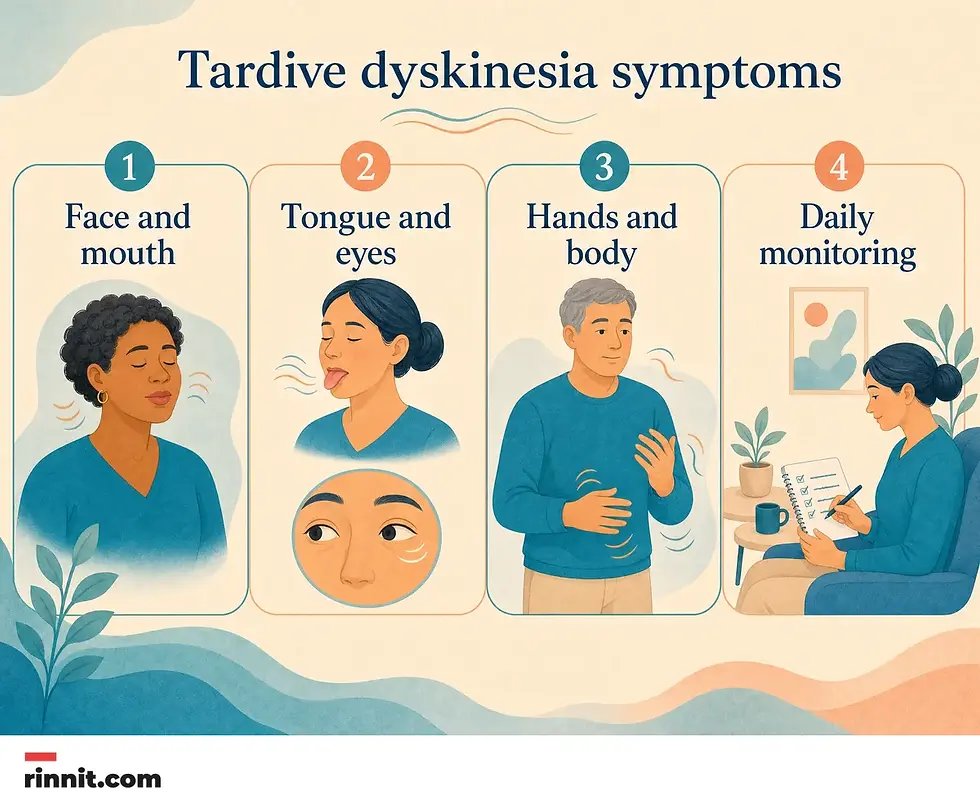
What are the symptoms of tardive dyskinesia?
TD causes involuntary movements that may affect the facial muscles, tongue, neck, trunk muscles and limbs. Symptoms can be mild and barely noticeable or severe and disabling. [1]
Area or pattern | Examples |
Face and mouth | Lip-smacking, sucking motions, grimacing, frowning or chewing movements. |
Tongue and cheeks | Sticking the tongue out or pressing it against the inside of the cheek; puffing the cheeks. |
Eyes | Rapid eye blinking, also called blepharospasm. |
Fingers and hands | Repetitive movements that resemble playing the piano. |
Pelvis and trunk | Thrusting or rocking movements. |
Walking | A duck-like gait. |
Restlessness | An inability to remain physically still, also called akathisia. |
Providers may use related terms to describe movements that look similar to TD. Dystonia means uncontrolled muscle contractions. Myoclonus means brief, sudden muscle jerks. Buccolingual stereotypy means repetitive mouth or tongue movements. Tics are repeated muscle movements, often in the face. Akathisia is a strong feeling of restlessness that makes it hard to sit still. [1]
What causes tardive dyskinesia?
The exact cause of TD is not known. The leading theory involves dopamine, a brain chemical that helps control movement. Some medicines block dopamine receptors in the brain. Over time, the receptors may become overly sensitive, which may contribute to repetitive, uncontrolled movements. [1]
Other brain chemicals, including serotonin, acetylcholine and GABA, may also play a role. This may help explain why medicines other than antipsychotics can sometimes cause TD. [1]
Which medicines can cause tardive dyskinesia?
TD is most often associated with first- and second-generation antipsychotics, metoclopramide and other medicines used to treat nausea, and some antidepressants. Rare links have also been reported with lithium, antiseizure medicines, certain antihistamines and antimalarial medicines. [1]
Medicine group | What to know |
Antipsychotics | First-generation medicines cause TD more often than second-generation medicines, but almost any antipsychotic can cause it. |
Nausea medicines | Metoclopramide is strongly linked to TD. |
Antidepressants | Direct causation remains debated; TD occurs much less often than with antipsychotics. |
Other medicines | Rare links include lithium, antiseizure medicines, certain antihistamines and antimalarial medicines. |
Antipsychotics are used for psychosis, schizophrenia, depression, bipolar disorder, severe agitation and sometimes insomnia. Clozapine and quetiapine carry a lower risk than most other antipsychotics, but almost any antipsychotic can cause TD. [1]
Metoclopramide and TD risk
Metoclopramide can be used for chronic acid reflux and diabetes-related gastroparesis. Factors linked to a higher risk of metoclopramide-related TD include being 65 or older, being female, having diabetes and taking metoclopramide for 12 or more weeks.
Antidepressants and TD
Experts continue to debate whether antidepressants directly cause TD. When TD occurs in people taking antidepressants, it appears more often in adults over 65, possibly because of age-related brain changes. Overall, antidepressants cause TD much less often than antipsychotic medicines. [1]
What are the risk factors for tardive dyskinesia?
Risk may increase with age, particularly after age 40, and is highest in adults over 65. Risk is also slightly higher in females, differs across racial and ethnic groups, and is higher among people with bipolar disorder who take antipsychotic medicines. Researchers are also studying genetic factors. [1]
Risk factor | Context |
Age | Risk increases after 40 and is highest over 65, possibly because of age-related brain changes. |
Sex | Females have a slightly higher risk than males. |
Race and ethnicity | Studies report higher frequency in Black Americans than white Americans; Filipino and Asian descent appear lower than white Americans. |
Bipolar disorder | Risk may be higher when antipsychotic medicines are used. |
Genetics | Genetic factors that may alter risk are being studied. |
Risk factors do not determine whether a particular person will develop TD. A prescribing clinician should assess the benefits and risks of each medicine.
Can tardive dyskinesia affect daily life?
Uncontrolled movements can be uncomfortable and can affect social and emotional well-being. TD may affect mental health and make everyday tasks more difficult. TD generally is not fatal, but severe TD affecting the larynx and diaphragm can very rarely cause breathing problems that may be life-threatening. For general information on mental health conditions and support, see our guide: Understanding Mental Health Disorders: Types, Symptoms, and Support. [1]
How is tardive dyskinesia diagnosed?
A provider reviews symptoms, medical history and medication history. If you take a medicine known to cause TD, the provider may suspect it. A physical exam and neurological exam are also part of the evaluation. Depending on the situation, you may be referred to a neurologist, movement-disorder specialist or psychiatrist. [1]
DSM-5 diagnostic criteria require that symptoms last at least one month after the medicine is stopped, and that the medicine was taken for at least three months if the person is 40 or younger or at least one month if the person is over 40.
Laboratory work or brain CT or MRI may be used to rule out other conditions that can cause similar symptoms, such as Huntington's disease. TD is usually a clinical diagnosis based on history and examination. [1]
Diagnostic step | Purpose |
Medication history | Identify medicines that may be linked to TD. |
Symptom history | Review the type, timing and persistence of movements. |
Physical exam | Observe movements and other physical findings. |
Neurological exam | Assess movement and nervous-system function. |
Specialist referral | Obtain movement-disorder, neurological or psychiatric assessment when needed. |
Lab work or imaging | Rule out other conditions with similar symptoms. |
How is tardive dyskinesia treated?
Treatment varies from person to person. In some cases, symptoms improve when the provider lowers the dose of an antipsychotic medicine or stops it. Symptoms can continue after the medicine is stopped. [1]
Stopping a medicine is not always an option because it may worsen the condition the medicine treats. Any decision to stop, switch or adjust a medicine must be made with the prescribing clinician. If TD develops while taking a first-generation antipsychotic, a provider may switch to a second-generation medicine. Clozapine and quetiapine carry a lower risk of causing or worsening TD than many other antipsychotics. [1]
VMAT2 inhibitors
VMAT2 inhibitors have the strongest evidence for treating TD. They include deutetrabenazine and valbenazine, the two FDA-approved for TD; tetrabenazine is sometimes used off-label. A provider may prescribe one when TD is moderate to severe and affects quality of life.
Botulinum toxin injections
Botulinum toxin injections may treat certain symptoms, such as frequent eye blinking or muscle spasms in the neck, trunk or limbs. [1]
Deep brain stimulation
In selected cases, a provider may consider deep brain stimulation surgery when severe symptoms do not improve with medicine or injections. [1]

Is tardive dyskinesia reversible?
Sometimes symptoms improve or go away after the medicine that caused them is stopped, especially when it is stopped early. However, some cases become chronic. Medicines can help manage symptoms but do not always cure or reverse the condition. [1]
Because stopping a medicine may worsen the condition it treats, do not make medication changes without the prescribing clinician.
How can tardive dyskinesia be prevented or found early?
TD is not always preventable, and not everyone who takes a medicine linked to TD develops it. If you have risk factors, a provider may prescribe a different medicine. Providers may also reduce risk by using the lowest effective antipsychotic dose for the shortest time possible and choosing medicines with a lower TD risk when appropriate. [1]
Regular screening for movement symptoms may help identify TD early. Most experts recommend screening every three to six months after starting a medicine that can cause TD. [1]
How can you live with tardive dyskinesia?
A provider may adjust the treatment plan over time. If TD affects mental or social health, seeking support from a mental-health professional may help.
Ongoing care step | Why it matters |
Routine assessment | Movement symptoms can be reviewed every three to six months. |
Symptom tracking | New or changing movements can be reported to the provider. |
Physical activity | Exercise may relieve some movement symptoms. |
Function check-in | Daily activities and quality of life can be discussed. |
Mental-health support | Professional support may help when TD affects mental or social health. |
When is tardive dyskinesia an emergency?
If tardive dyskinesia makes it difficult to breathe, call your local emergency number (911 in the US) or go to the nearest emergency room as soon as possible. Severe TD affecting the larynx and diaphragm can very rarely cause life-threatening breathing problems. [1]
Conclusion: Recognize the movements and review medicines with a clinician
Tardive dyskinesia is a delayed movement disorder that can cause uncontrolled movements of the face, tongue, neck, trunk and limbs. It most often follows long-term use of antipsychotic medicines, but other medicines can also be linked to it. [1]
Diagnosis usually depends on medication and symptom history plus physical and neurological exams. Treatment may include clinician-guided medicine changes, VMAT2 inhibitors, botulinum toxin injections or, in selected cases, deep brain stimulation. Symptoms may improve after the causative medicine is stopped, but some cases are chronic. [1]
Do not stop or change a prescription medicine on your own. Talk with the prescribing clinician about new or worsening movements, regular screening and the effect of symptoms on daily life. If breathing becomes difficult, seek emergency care immediately.
Frequently Asked Questions
What is tardive dyskinesia?
Tardive dyskinesia is a neurological condition that causes involuntary movements, often after long-term use of an antipsychotic medicine.
What are common TD symptoms?
Symptoms can include lip-smacking, sucking or chewing movements, grimacing, tongue movements, puffed cheeks, rapid eye blinking, repetitive finger movements, pelvic rocking, a duck-like gait and difficulty remaining still.
Can tardive dyskinesia start years after taking a medicine?
Yes. Symptoms often appear after a delay, and many people take the medicine for years before TD develops. Some older adults may develop it after shorter use.
Which medicines are most often linked to TD?
Antipsychotic medicines are most often linked. Metoclopramide, some antidepressants and, more rarely, lithium, antiseizure medicines, certain antihistamines and antimalarial medicines may also be linked.
Should I stop the medicine that may be causing TD?
Do not stop or change it without talking with the prescribing clinician. Stopping the medicine may worsen the condition it treats.
Is tardive dyskinesia reversible?
Sometimes symptoms improve or disappear after the causative medicine is stopped, especially when it is stopped early. Some cases become chronic.
How is TD diagnosed?
A provider reviews the medication and symptom history and performs physical and neurological exams. Lab work or brain imaging may rule out other conditions.
What treatments are available?
Treatment may include clinician-guided medication changes, VMAT2 inhibitors, botulinum toxin injections and, in selected severe cases, deep brain stimulation.
How often should TD screening occur?
Most experts recommend screening every three to six months after starting a medicine that can cause TD.
Can TD affect breathing?
Very rarely, severe TD affecting the larynx and diaphragm can cause life-threatening breathing problems. If breathing is difficult, seek emergency care immediately.
Related guides
References
Cleveland Clinic. Tardive Dyskinesia (TD): What It Is, Symptoms & Treatment. Cleveland Clinic. Updated July 10, 2024. https://my.clevelandclinic.org/health/diseases/6125-tardive-dyskinesia
Ali T, Sisay M, Tariku M, et al. Antipsychotic-induced extrapyramidal side effects: A systematic review and meta-analysis of observational studies. PLoS One. 2021;16(9):e0257129. PMID 34506552. https://doi.org/10.1371/journal.pone.0257129
Solmi M, Pigato G, Kane JM, et al. Treatment of tardive dyskinesia with VMAT-2 inhibitors: a systematic review and meta-analysis of randomized controlled trials. Drug Des Devel Ther. 2018;12:1215-1238. PMID 29795977. https://doi.org/10.2147/DDDT.S133205
Solmi M, Fornaro M, Caiolo S, et al. Efficacy and acceptability of pharmacological interventions for tardive dyskinesia in people with schizophrenia or mood disorders: a systematic review and network meta-analysis. Mol Psychiatry. 2025;30(3):1207-1222. PMID 39695322. https://doi.org/10.1038/s41380-024-02733-z
Medical disclaimer
This article is for general educational purposes and is not a substitute for professional medical advice, diagnosis or treatment. Always seek the advice of a qualified healthcare professional with any questions about a medical condition or treatment.



Comments