Dental Cleaning: Types, What to Expect and How Often

Updated: 2 days ago
Written and medically reviewed by Dr. Baraa Alnahhal, MD · Last reviewed: November 2026 · How we review
Quick Answer
A dental cleaning is a professional cleaning by a dentist or dental hygienist that removes bacteria, plaque and tartar a toothbrush can't reach. It helps prevent cavities and gum disease. Most dentists recommend a cleaning every six months. Most cleanings take 30 to 60 minutes and shouldn't hurt.
What the research says
Regular scale and polish mainly reduces tartar: a Cochrane review of 2 UK trials with 1,711 adults found routine 6- or 12-monthly scale and polish made little or no difference to gum inflammation or quality of life over 2 to 3 years, but modestly reduced tartar buildup (Lamont T et al., Cochrane Database of Systematic Reviews, 2018) [2]
Check-ups can be timed to your risk: in a Cochrane review of 2 trials with 1,736 people, those whose check-up intervals were based on their risk had the same cavities, gum bleeding and quality of life over 4 years as those seen every 6 months (Fee PA et al., Cochrane Database of Systematic Reviews, 2020) [3]
Key takeaways
A dental cleaning removes plaque and tartar that brushing misses.
Most dentists recommend a cleaning every six months.
The three types are routine cleaning, gross debridement and deep cleaning.
A cleaning usually takes 30 to 60 minutes.
Sensitivity afterward usually goes away within a few days.
What is a dental cleaning?
A dental cleaning is done by a dentist or dental hygienist. It removes plaque and hardened tartar from your teeth. Your dentist may also offer preventive treatments such as sealants or fluoride. Sources: [1]
Why it's done
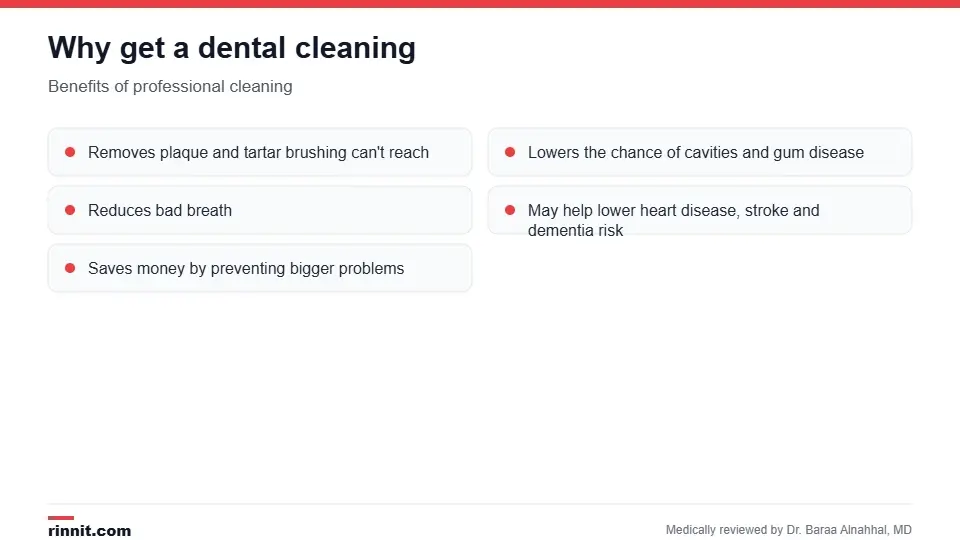
Most dentists recommend a cleaning every six months.
Removes buildup that brushing alone can't reach.
May lower your chance of cavities and gum disease.
Reduces bad breath.
May help reduce the risk of heart disease, stroke and dementia.
Saves money by preventing bigger dental problems. Sources: [1]
Types of dental cleanings

Routine cleaning is the most common type.
Type | Who it's for | What happens |
Routine cleaning (prophylaxis) | Healthy teeth and gums | The most common type |
Gross debridement | People who haven't seen a dentist recently or have heavy plaque | A deeper cleaning to remove heavy buildup |
People with gum disease | Cleans under the gums and around tooth roots, after numbing |
Sources: [1]
What happens during a cleaning
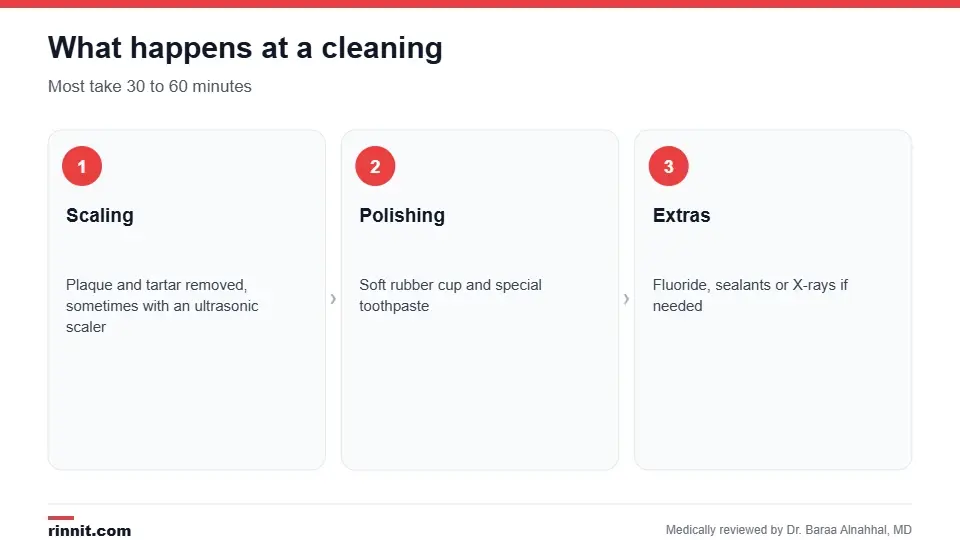
Most cleanings take 30 to 60 minutes.
Scaling: Your hygienist removes plaque and tartar, sometimes with an ultrasonic scaler. You may hear scraping sounds, but it shouldn't hurt.
Polishing: A soft rubber cup and special toothpaste smooth your teeth.
Extras: Your dentist may add fluoride, sealants for deep grooves or dental X-rays. Sources: [1]
If you feel anxious, tell your dentist. Many dentists offer sedation to help you feel calm. Sources: [1]
Side effects
Dental cleanings are safe. You may have sensitive teeth or sore gums afterward, which usually go away within a few days. Acetaminophen (Tylenol) or ibuprofen (Advil) can help. Sources: [1]
How often you need a cleaning
Most dentists recommend a cleaning every six months. Ask about more frequent visits if you have gum disease, a family history of cavities or a weakened immune system, or you're dealing with illness or stress. Sources: [1, 3]
When to see your dentist sooner
Bleeding or swollen gums.
Loose teeth.
Toothaches. Sources: [1]
Conclusion
A professional dental cleaning removes buildup that brushing misses and helps protect your teeth and gums. Pairing regular cleanings with good daily brushing and flossing gives you the best results.
Keep learning: read about oral hygiene and deep dental cleaning.
Frequently asked questions
What is a dental cleaning?
A professional cleaning that removes plaque and tartar from your teeth.
How often should I get my teeth cleaned?
Most dentists recommend every six months.
How long does a dental cleaning take?
Usually 30 to 60 minutes.
Does a dental cleaning hurt?
It shouldn't hurt, though you may hear scraping sounds.
What is prophylaxis?
A routine cleaning for healthy teeth and gums.
What is a deep cleaning?
Scaling and root planing, which cleans under the gums for gum disease.
What is gross debridement?
A deeper cleaning to remove heavy plaque buildup.
Is it normal for teeth to feel sensitive afterward?
Yes. It usually goes away within a few days.
Can I get sedation for a cleaning?
Many dentists offer sedation if you feel anxious.
When should I see my dentist sooner?
For bleeding or swollen gums, loose teeth or a toothache.
Related Reading
Dental Bonding: What It Fixes, Procedure and How Long It Lasts explains cosmetic dental bonding.
Scaling and Root Planing: What a Deep Dental Cleaning Is, What to Expect and How Fast You Recover a deeper cleaning for gum disease.
Oral Hygiene: How to Brush, Floss and Protect Your Teeth and Gums Every Day daily care between cleanings.
Tartar on Teeth: Causes, Removal, Symptoms, and Prevention the buildup cleanings remove.
Dental Sealants: A Complete Guide to Preventive Protection a protective coating for deep grooves.
References
Cleveland Clinic. What Happens During a Dental Cleaning? Cleveland Clinic. Last updated January 5, 2026. https://my.clevelandclinic.org/health/treatments/11187-dental-check-up
Lamont T, Worthington HV, Clarkson JE, et al. Routine scale and polish for periodontal health in adults. Cochrane Database of Systematic Reviews. 2018;12(12):CD004625. PMID 30590875. https://doi.org/10.1002/14651858.CD004625.pub5
Fee PA, Riley P, Worthington HV, et al. Recall intervals for oral health in primary care patients. Cochrane Database of Systematic Reviews. 2020;10(10):CD004346. PMID 33053198. https://doi.org/10.1002/14651858.CD004346.pub5
Medical disclaimer
This article is for general education only and does not replace advice from a qualified healthcare professional. Talk to your doctor about your own diagnosis and treatment, and seek emergency care right away for severe or sudden symptoms.



Comments