Dental Sealants: A Complete Guide to Preventive Protection

Updated: 3 days ago
Medically reviewed by Dr. Baraa Alnahhal, MD · Last reviewed: October 2026
Quick Answer: What are dental sealants?
Dental sealants are preventive treatments consisting of thin resin or glass ionomer coatings applied to the chewing surfaces of molars and premolars [1]. They seal deep grooves where food and bacteria get trapped, significantly reducing the risk of tooth decay [1] [2]. They are most effective when applied as soon as permanent teeth erupt, typically between ages 6 and 14 [1].
What the research says
Resin-based sealants substantially reduce decay in children's first permanent molars. A Cochrane review of 38 trials involving 7,924 children found that, at 24 months, second-, third- and fourth-generation resin-based sealants lowered the odds of caries in first permanent molars of 5- to 10-year-olds (odds ratio 0.12, 95% CI 0.08-0.19; 7 trials; moderate-quality evidence). The benefit was still seen at longer follow-up, though the quality and quantity of evidence fell, and the evidence was insufficient to judge glass ionomer sealants (PubMed: Ahovuo-Saloranta et al., Cochrane Database Syst Rev, 2017 [2]).
Sealants and fluoride varnish both help — it is not yet clear which is better. A Cochrane review of 11 trials with 3,374 children aged 5 to 10 could not say whether resin-based sealants or fluoride varnish works better for preventing decay in first permanent molars at 2 to 3 years (OR 0.67, 95% CI 0.37-1.19; very low certainty). Five trials with 1,801 participants reported no adverse events from sealants or varnish (PubMed: Kashbour et al., Cochrane Database Syst Rev, 2020 [3]).
Material matters for how long a sealant stays on. A meta-analysis of randomized trials in 6- to 13-year-olds found that hydrophilic resin-based sealants were lost less often than glass ionomer sealants at 6 months (RR 0.59, 95% CI 0.40-0.86; 4 trials) and performed similarly to hydrophobic resin-based sealants. The evidence was rated very low to low quality (PubMed: Kapoor et al., Evid Based Dent, 2023 [4]).
Understanding Dental Sealants
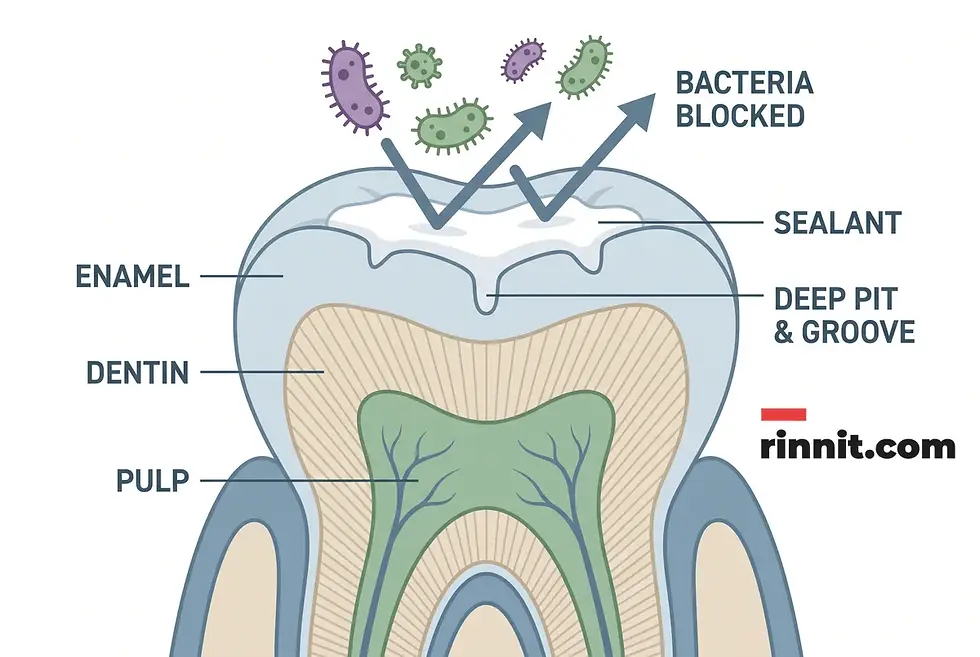
Dental sealants serve as a proactive defense mechanism for oral health, functioning much like a raincoat for the teeth. These thin, liquid coatings are painted onto the enamel of the back teeth — specifically the molars and premolars [1]. Once applied, the material is cured and hardened, creating a durable shield that protects the vulnerable chewing surfaces from harmful bacteria and plaque [1].
The primary purpose of sealants is to address the natural anatomy of the back teeth. These teeth feature deep pits and fissures that are often too narrow for toothbrush bristles to reach effectively. Over time, food particles and bacteria accumulate in these nooks, leading to the formation of cavities [1]. Sealants smooth out these surfaces, making them easier to clean and significantly less prone to decay.
Materials Used in Sealants
Manufacturers utilize specialized, medical-grade materials to ensure both safety and durability. The two most common types of sealant materials include:
Material Type | Composition and Characteristics |
Resin-Based | Derived from plant or synthetic resins; known for high durability and strong bonding. |
Glass Ionomer | A combination of glass powder and water-soluble acid; often releases fluoride for extra protection. |

The Application Process
Applying dental sealants is a straightforward, non-invasive, and entirely painless procedure that can be completed during a routine dental visit. The entire process for a single tooth typically takes only a few minutes [1] and does not require any anesthesia or drilling.
The procedure follows a specific sequence to ensure a proper bond between the sealant and the tooth enamel. First, the dentist or dental hygienist thoroughly cleans the target teeth to remove any surface debris or bacteria. The teeth are then dried, and a small amount of acid etching solution is applied to roughen the surface slightly [1]. This step is critical as it helps the sealant material adhere securely to the tooth. After rinsing and drying the tooth again, the sealant is painted onto the enamel and hardened using a specialized curing light [1].
Who Should Consider Sealants?
While dental sealants are most frequently associated with pediatric dentistry, they offer benefits to a wide range of patients. The timing of application is often a key factor in their effectiveness, as they provide the most protection when applied shortly after a tooth erupts [1].
Pediatric Candidates
Children and teenagers are the primary candidates for sealants because their permanent molars and premolars are most vulnerable to decay during the developmental years. Statistics indicate that approximately 42% of children aged 6 to 11 and 48% of adolescents aged 12 to 19 in the United States have dental sealants [1]. Children aged 6 to 11 who don't have sealants are three times more likely to develop tooth decay [1].
Adult Candidates
Adults who do not have existing decay or fillings in their molars can also benefit from sealants [1]. For individuals prone to tooth decay or those with naturally deep grooves in their teeth, sealants provide an additional layer of protection that can prevent the need for more invasive dental work, such as fillings or crowns, later in life [1].
Benefits and Considerations
The decision to get dental sealants involves weighing the significant preventive benefits against a few practical considerations. In most clinical cases, the advantages of preventing tooth decay far outweigh the minor maintenance required for the sealants themselves.
Benefit | Description |
Cavity Prevention | Shields the deep pits and grooves of the back teeth, where most decay occurs. |
Cost-Effective | Generally less expensive than treating a cavity with a filling. |
Painless | Requires no drilling or needles, making it ideal for anxious patients. |
Long-Term Savings | Reduces the likelihood of needing more invasive dental work, such as fillings or crowns, in the future. |
Despite these benefits, patients should be aware that sealants are not permanent. They typically last about five years [1] and must be monitored during regular dental checkups. If a sealant becomes chipped or worn, it can be easily replaced. Additionally, sealants cannot be placed on teeth that already have cavities or existing dental restorations [1].

Recovery and Maintenance
One of the most appealing aspects of dental sealants is the lack of any recovery period. Patients can resume their normal activities, including eating and drinking, immediately following the appointment [1]. There are no restrictions on physical activity or speech.
To maintain the integrity of the sealants, patients should continue practicing diligent oral hygiene, including twice-daily brushing and daily flossing. While sealants are durable, extremely hard, sticky, or crunchy foods should be consumed in moderation to avoid chipping the material [1]. Regular dental visits every six months are essential [1], as they allow the dentist to inspect the sealants and ensure they are still providing optimal protection.
Conclusion and Next Steps
Dental sealants represent a powerful and accessible tool in the field of preventive dentistry. By providing a physical barrier against bacteria in the most vulnerable areas of the mouth, they offer a simple way to maintain long-term oral health and avoid the discomfort and expense of tooth decay. Whether for a child getting their first permanent molars or an adult looking to enhance their preventive care, sealants are a worthwhile investment in a healthy smile. If you are interested in this treatment, the best next step is to consult with your dentist during your next routine cleaning to determine if sealants are right for you.
Frequently Asked Questions
1. What is the primary goal of dental sealants?
The main objective is to prevent tooth decay by sealing the deep pits and grooves on the chewing surfaces of the back teeth, effectively blocking out food particles and cavity-causing bacteria.
2. Are dental sealants only for children?
No, while they are most common in children and teens, adults with healthy, unfilled molars can also benefit from the added protection sealants provide.
3. Does the application process hurt?
The process is entirely painless and non-invasive. It involves cleaning and painting the tooth, requiring no drilling or anesthesia.
4. How long do dental sealants typically last?
Sealants generally last for about five years, though they can last longer with proper care. They should be checked regularly by a dentist and replaced if they become worn or chipped.
5. Can I eat right after getting sealants?
Yes, you can eat and drink immediately after the procedure, as the sealant material is hardened with a curing light before you leave the office.
6. What materials are sealants made from?
Most sealants are made from medical-grade resins or glass ionomers, both of which are safe and designed to bond securely to tooth enamel.
7. Will sealants make my teeth feel different?
You might notice a slight change in the way your bite feels initially, but this sensation usually disappears quickly as the sealant settles.
8. Can sealants be placed over a cavity?
No, sealants are a preventive measure and cannot be placed on teeth that already have decay or existing fillings.
9. How much do sealants cost compared to fillings?
Sealants are generally less expensive than dental fillings. Insurance coverage varies by plan, so check with your provider.
10. Do I still need to brush if I have sealants?
Yes, sealants only protect the chewing surfaces. Brushing and flossing are still necessary to protect the other surfaces of the teeth and maintain overall gum health.
Related Reading
Dental Cleaning: Types, What to Expect and How Often explains what happens during a professional dental cleaning.
Dental Fillings: Types, Procedure and How Long They Last explains how dental fillings repair cavities.
References
Cleveland Clinic. Sealants. Cleveland Clinic. Mar. 27, 2023. https://my.clevelandclinic.org/health/treatments/10912-sealants
Ahovuo-Saloranta A, Forss H, Walsh T, Nordblad A, Mäkelä M, Worthington HV. Pit and fissure sealants for preventing dental decay in permanent teeth. Cochrane Database Syst Rev. 2017;7(7):CD001830. doi:10.1002/14651858.CD001830.pub5. PMID: 28759120.
Kashbour W, Gupta P, Worthington HV, Boyers D. Pit and fissure sealants versus fluoride varnishes for preventing dental decay in the permanent teeth of children and adolescents. Cochrane Database Syst Rev. 2020;11(11):CD003067. doi:10.1002/14651858.CD003067.pub5. PMID: 33142363.
Kapoor V, Kumar A, Manjunath BC, Yadav V, Sabbarwal B. Comparative evaluation of retention and cariostatic effect of glass ionomer, hydrophobic and hydrophilic resin-based sealants: a systematic review and meta-analysis. Evid Based Dent. 2023;24(1):41-42. doi:10.1038/s41432-023-00850-2. PMID: 36882497.
Medical Disclaimer
This article is for informational purposes only and does not constitute medical advice. Always seek the advice of your physician or other qualified health provider with any questions you may have regarding a medical condition. Never disregard professional medical advice or delay in seeking it because of something you have read here.



Comments