Corneal Cross-Linking (CXL): Purpose, Procedure, Risks and Recovery

Updated: 3 days ago
Written and medically reviewed by Dr. Baraa Alnahhal, MD · Last reviewed: November 2026 · How we review
Quick Answer: What is corneal cross-linking?
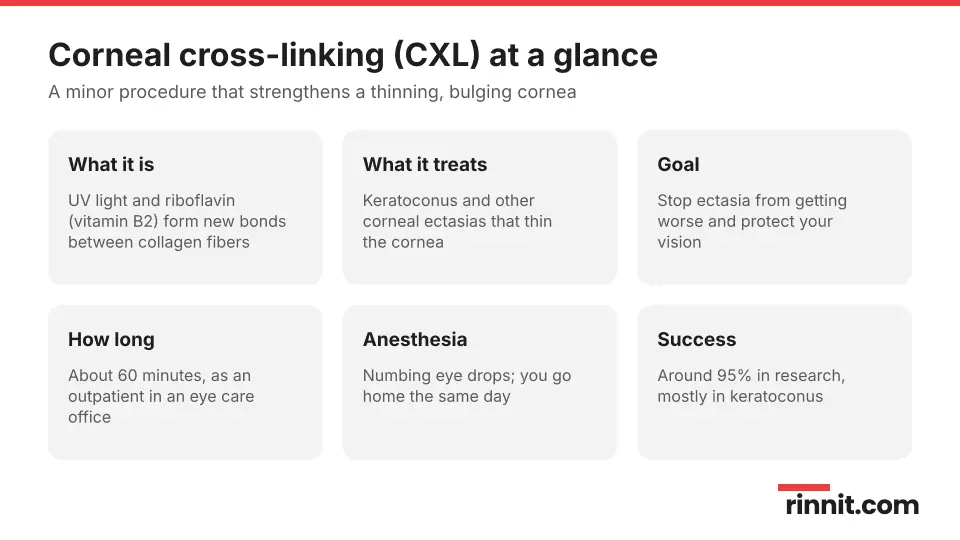
Corneal cross-linking (CXL) is a minor eye procedure that strengthens the cornea using riboflavin (vitamin B2) eye drops and focused ultraviolet (UV) light. It's used to stop keratoconus and other conditions in which the cornea thins and bulges from getting worse. The procedure takes about 60 minutes, and success rates are around 95%. [1]
What the research says
Cross-linking may slow keratoconus compared with no treatment, but early trials were small. A review of 3 randomized trials with 219 analyzed eyes found that, in one trial, treated eyes had a cornea about 2 diopters less steep and uncorrected vision about 2 lines (10 letters) better at 12 months than untreated eyes. In that trial, eyes given cross-linking were much less likely to steepen by 2 diopters or more over 36 months. Side effects were not uncommon but were mostly temporary, and the overall quality of evidence was very low. (Sykakis et al., Cochrane Database of Systematic Reviews, 2015) [2]
Keeping the top layer of the cornea on has not clearly beaten the standard method. A review of 13 randomized trials with 723 eyes found no important difference in corneal steepness at 12 months or later between "epithelium-on" (transepithelial) and standard "epithelium-off" cross-linking (5 studies, 177 eyes; very low certainty evidence). Epithelium-off cross-linking caused slightly more corneal haze or scarring (4 studies, 221 eyes; moderate certainty evidence). (Ng et al., Cochrane Database of Systematic Reviews, 2021) [3]
Standard cross-linking flattened the cornea a little more than faster "accelerated" versions. A pooled analysis of 11 trials found that standard epithelium-off cross-linking reduced maximum corneal steepness (Kmax) more than accelerated cross-linking, which uses stronger UV light for a shorter time. Accelerated cross-linking caused less thinning of the cornea and less loss of endothelial cells, while other vision and refraction outcomes did not differ significantly. (Wen et al., Investigative Ophthalmology & Visual Science, 2018) [4]
Key takeaways
Corneal cross-linking uses riboflavin (vitamin B2) drops and UV light to strengthen a thin, bulging cornea. [1]
Its main goal is to stop keratoconus and other corneal ectasias from getting worse. [1]
The procedure takes about 60 minutes, uses numbing eye drops and is done as an outpatient, so you go home the same day. [1]
A bandage and temporary contact lens stay on for about a week, and vision usually settles within two to three months. [1]
Success rates are around 95%. Serious problems such as infection and permanent haze are rare. [1] [2]
What is corneal cross-linking?
Corneal cross-linking (CXL) is a minor procedure that reinforces and strengthens your cornea. The cornea is the clear, dome-shaped layer at the front of your eye, and its strength comes from fibers of a protein called collagen. You can learn more about its structure in our guide to understanding the cornea. [1]
During cross-linking, riboflavin (vitamin B2) drops are placed on the eye and then activated with UV light. This sets off a reaction that forms new bonds between the collagen fibers, which makes the cornea stiffer and more stable. [1]
Why is corneal cross-linking done?
Cross-linking treats corneal ectasia, a condition in which the cornea becomes thin and bulges outward. As the cornea changes shape, your vision becomes distorted. Corneal ectasia tends to get worse over time, and cross-linking aims to stop that progression before it causes lasting damage to your vision. [1]
Your eye care provider may recommend cross-linking if you have corneal ectasia caused by: [1]
Keratoconus
Pellucid marginal degeneration
Terrien marginal degeneration
Ectasia after LASIK or PRK (laser vision correction surgery)
Ectasia after a corneal transplant
Researchers are also studying cross-linking for infectious keratitis (a corneal infection), bullous keratopathy (corneal swelling with blisters) and myopia (nearsightedness), but results are not yet available. [1]
Who should not have corneal cross-linking?
Cross-linking may not be right for you if you have: [1]
Severe thinning of the cornea
Severe scarring or clouding of the cornea
A history of herpes infection of the eye (ocular herpes)
An autoimmune disease
What are the types of corneal cross-linking?
The difference between methods is what happens to the epithelium, the thin top layer of the cornea. Only this small part of the procedure is surgical: the epithelium is removed or loosened so the riboflavin can reach the deeper layers. [1]
Feature | Epithelium-off (epi-off) | Epithelium-on (epi-on) |
What happens to the top layer | It is removed completely | It is kept intact |
Approval in the U.S. | The original, FDA-approved method | An epi-on system (Epioxa) was FDA-approved in October 2025 |
How the research compares them | The standard method used in most studies | Has not clearly outperformed epi-off in trials |
How do you prepare for corneal cross-linking?
You do not need any special preparation for cross-linking. The main thing to do is arrange for someone to drive you home, because your eye will be treated and covered afterward. [1]
Arrange a ride. You will not be able to drive yourself home after the procedure.
Plan for a short visit. Cross-linking is done as an outpatient, usually in an eye care office, and most people go home the same day.
Ask about your eye drops. You will use prescription drops afterward, so ask your provider how and when to use them.
Sources: [1]
What happens during corneal cross-linking?
An ophthalmologist (eye surgeon) performs the procedure. The whole process takes about 60 minutes. [1]

Your eye is numbed with anesthetic eye drops.
The epithelium (top layer of the cornea) is removed or loosened.
Riboflavin drops are applied and left to soak into the cornea for about 30 minutes.
Focused UV light is aimed at your cornea for about 30 minutes.
Antibiotic and steroid eye drops are placed in your eye.
Your eye is covered with a temporary contact lens and a bandage.
Sources: [1]
Corneal cross-linking at a glance
Item | Typical detail |
Usual setting | Outpatient, usually an eye care office |
Who performs it | An ophthalmologist |
Anesthesia | Numbing eye drops |
How long it takes | About 60 minutes |
Hospital stay | None; you go home the same day |
Bandage and contact lens | Stay on for about a week |
Vision stabilizes | Usually within two to three months |
Sources: [1]
Is corneal cross-linking painful?
Your eye is numbed, so the procedure itself should not hurt. Pain after the procedure can range from mild to severe. Your provider will give you prescription eye drops to keep you comfortable. Use them as directed, and tell your provider if they are not controlling your pain. [1]
What happens after corneal cross-linking?
You go home the same day with a bandage and temporary contact lens over your eye. These stay in place for about a week. You may also continue using steroid eye drops after the procedure. [1]
How long does recovery from corneal cross-linking take?
Expect your vision to get worse before it gets better. Full recovery of your vision happens gradually over a few months. [1]

First week: The bandage and contact lens stay on for about a week, which is roughly how long it takes the epithelium to grow back.
First few weeks: You may have mild irritation, a gritty feeling as if something is in your eye, sensitivity to light, dry eye, corneal swelling (edema) and blurred vision.
Two to three months: Your vision usually stabilizes. At this point, you may need new glasses or contact lenses.
Three to six months: Corneal haze (clouding) can appear. It is usually temporary.
Sources: [1]
What are the risks of corneal cross-linking?
Complications of cross-linking are rare. Possible risks include: [1]
Complication | What it means |
Infection | An infection in the treated eye |
Scarring | Scar tissue forming on the cornea |
Temporary corneal haze | Clouding that usually lasts a few weeks to a few months |
Permanent corneal haze | Lasting clouding, which affects up to 10% of people |
Worse vision during recovery | Vision gets worse for a while before it improves |
Sources: [1]
If corneal haze becomes permanent, you may eventually need a corneal transplant. However, ectasia that is not treated would likely lead to a transplant too, so the possible outcome is similar either way. [1]
How effective is corneal cross-linking?
Cross-linking is the only procedure that can stop corneal ectasia from progressing. Success rates are around 95%. Most of the research has been done in people with keratoconus, and similar results are expected for other types of ectasia. [1]
By stopping the cornea from thinning further, cross-linking may also prevent corneal hydrops, a sudden swelling of the cornea, and the need for a corneal transplant. Early treatment may help you avoid more invasive procedures later. [1]
When should you call your provider after corneal cross-linking?
Contact your provider if you have any of these during recovery: [1]
Sudden changes in your vision (call right away)
Pain that is not relieved by your prescribed medicines or eye drops
Questions to ask your provider
Is my corneal ectasia getting worse, and is cross-linking right for me?
Will you use the epithelium-off or epithelium-on method?
How should I use my eye drops after the procedure?
When can I expect my vision to settle?
Will I need new glasses or contact lenses afterward?
Conclusion
Corneal cross-linking strengthens a thin, bulging cornea by using riboflavin drops and UV light to form new bonds between collagen fibers. It is the only procedure that can stop keratoconus and other corneal ectasias from progressing, it takes about 60 minutes as an outpatient, and success rates are around 95%. [1]
Recovery takes patience: a bandage stays on for about a week, vision gets worse before it gets better, and it usually settles within two to three months. Serious complications are rare, and treating ectasia early may spare you more invasive surgery, such as a corneal transplant, later on. [1] [2]
Keep learning: Read our guides to understanding the cornea, corneal disease and corneal hydrops. For more on keratoconus and its treatment, see the American Academy of Ophthalmology guide to keratoconus.
FAQ
What is corneal cross-linking?
Corneal cross-linking is a minor procedure that uses riboflavin (vitamin B2) eye drops and UV light to strengthen the cornea and stop it from thinning and bulging further.
Why is corneal cross-linking done?
It is done to stop keratoconus and other corneal ectasias, such as ectasia after LASIK or PRK, from getting worse and damaging your vision.
How long does corneal cross-linking take?
The procedure takes about 60 minutes, including about 30 minutes for riboflavin drops and about 30 minutes of UV light.
Is corneal cross-linking painful?
Numbing drops prevent pain during the procedure. Pain afterward can range from mild to severe, and prescription eye drops help keep you comfortable.
Do I need to prepare for corneal cross-linking?
You do not need special preparation, but you must arrange for someone else to drive you home.
Will I stay in the hospital after corneal cross-linking?
No. Cross-linking is an outpatient procedure, usually done in an eye care office, and most people go home the same day.
How long does it take to recover from corneal cross-linking?
The bandage and contact lens stay on for about a week, and your vision usually stabilizes within two to three months.
What are the risks of corneal cross-linking?
Risks are rare and include infection, scarring and corneal haze. Haze is usually temporary but is permanent in up to 10% of people.
How successful is corneal cross-linking?
Success rates are around 95%. It is the only procedure that can stop corneal ectasia from progressing.
When should I call my doctor after corneal cross-linking?
Call right away for sudden changes in your vision, and call if your pain is not relieved by your prescribed medicines.
Related Reading
Cornea Transplant: Types, Surgery, Risks and Recovery explains cornea transplant surgery.
Learn more in our guide to Corneal Disease: Symptoms, Causes, Diagnosis, Treatment and Prevention — What You Need to Know.
Learn more in our guide to Corneal Hydrops: Sudden Eye Swelling Caused by a Split in the Cornea.
Corneal Topography: Mapping the Cornea and Reading the Results explains the eye test that maps the shape of the cornea.
References
Cleveland Clinic. Corneal Cross-Linking: Procedure, Recovery & Success Rate. Cleveland Clinic. Last updated July 22, 2024. https://my.clevelandclinic.org/health/procedures/corneal-cross-linking
Sykakis E, Karim R, Evans JR, et al. Corneal collagen cross-linking for treating keratoconus. Cochrane Database Syst Rev. 2015;2015(3):CD010621. PMID 25803325. https://doi.org/10.1002/14651858.CD010621.pub2
Ng SM, Ren M, Lindsley KB, et al. Transepithelial versus epithelium-off corneal crosslinking for progressive keratoconus. Cochrane Database Syst Rev. 2021;3(3):CD013512. PMID 33765359. https://doi.org/10.1002/14651858.CD013512.pub2
Wen D, Li Q, Song B, et al. Comparison of Standard Versus Accelerated Corneal Collagen Cross-Linking for Keratoconus: A Meta-Analysis. Invest Ophthalmol Vis Sci. 2018;59(10):3920-3931. PMID 30073363. https://doi.org/10.1167/iovs.18-24656
Medical disclaimer
This article is for general education only and does not replace advice from a qualified healthcare professional. Talk to your doctor about your own diagnosis and treatment, and seek emergency care right away for severe or sudden symptoms.



Comments