Cornea Transplant: Types, Surgery, Risks and Recovery

Updated: 2 days ago
Written and medically reviewed by Dr. Baraa Alnahhal, MD · Last reviewed: November 2026 · How we review
Quick Answer
A cornea transplant (keratoplasty) is surgery that replaces a damaged cornea, the clear front layer of the eye, with healthy tissue from a deceased donor. It treats conditions like Fuchs' dystrophy, keratoconus and corneal scars. You'll use eye drops for at least a year to prevent rejection, and vision improves over three to 12 months.
What the research says
DMEK and DSAEK had similar graft survival: in 11 studies of 723 eyes, the two inner-layer transplant types had similar graft failure and rejection rates, but partial graft detachment was more common with DMEK, which gave better vision at 6 months and higher satisfaction (Pavlovic I et al., Cornea, 2017) [2]
Most full-thickness grafts lasted 10 years: in 1,090 full-thickness transplants for inner-layer disease, 77% of grafts from donors aged 12 to 65 and 71% from donors aged 66 to 75 were still working at 10 years (Mannis MJ et al., Ophthalmology, 2013) [3]
Key takeaways
A cornea transplant replaces damaged corneal tissue with donor tissue.
Surgeons can replace all layers or just some.
Surgery takes less than two hours.
Eye drops for at least a year help prevent rejection.
Most people see more clearly afterward.
What is a cornea transplant?
The cornea focuses light into your eye. A transplant is also called corneal grafting or keratoplasty. All donor corneas come from deceased donors and are tested for safety. About 185,000 cornea transplants are done worldwide each year. Sources: [1]
Why it's done
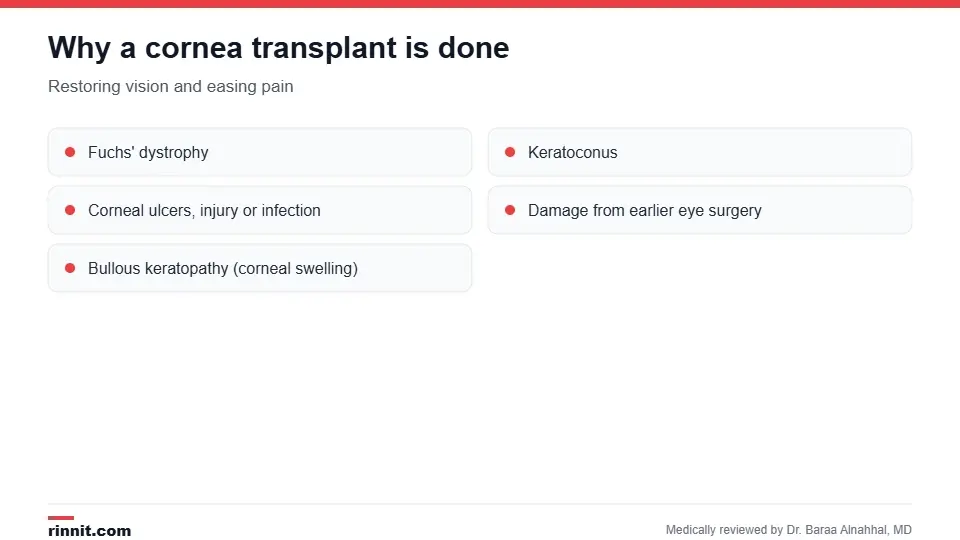
The goal is to restore vision and ease pain.
Keratoconus.
Corneal ulcers or damage from injuries, inflammation or infections.
Damage from earlier eye surgery.
Bullous keratopathy, blister-like corneal swelling. Sources: [1]
Types of cornea transplant

Endothelial transplants use fewer stitches and an air bubble.
Type | Layers replaced |
Penetrating keratoplasty (PK) | Full thickness |
Deep anterior lamellar keratoplasty (DALK) | Outer and middle layers, when the inner layer is healthy |
Endothelial keratoplasty (DSAEK or DMEK) | Only the inner layer; DMEK uses thinner tissue |
Endothelial transplants use fewer stitches and an air bubble to hold the tissue in place. Sources: [1, 2]
How to prepare
Your surgical and anesthesia teams review your history.
You'll learn which medicines to stop and when to stop eating and drinking.
Arrange a ride home; you can't drive afterward. Sources: [1]
What happens during surgery
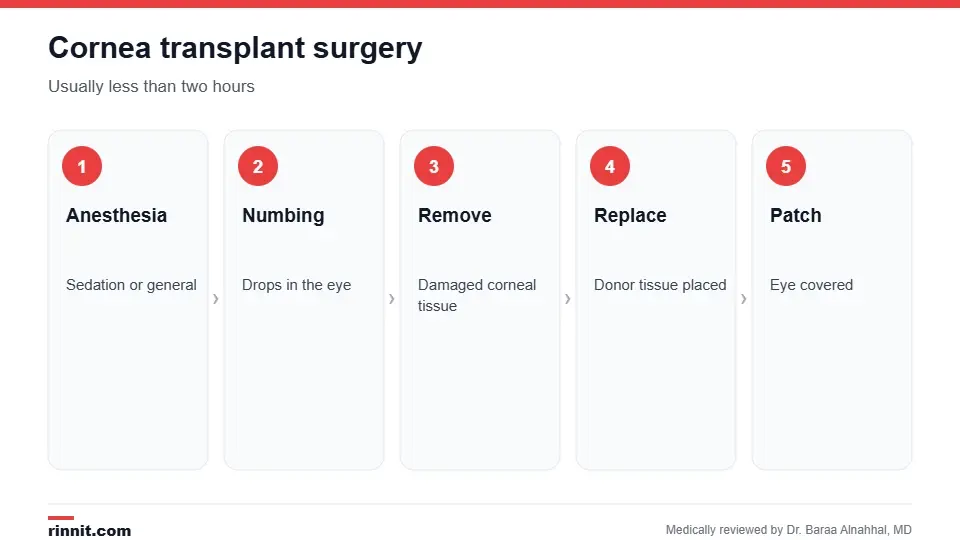
Surgery usually takes less than two hours.
You get sedation or general anesthesia.
Numbing medicine is applied to your eye.
The surgeon removes damaged tissue and places the donor tissue.
Your eye is covered with a patch. Sources: [1]
Surgery typically takes less than two hours. Sources: [1]
Risks
Rejection, the most serious complication.
Infection or bleeding.
Glaucoma (high eye pressure).
Fluid leakage or graft detachment.
Detached retina.
Vision problems from an irregular corneal curve (astigmatism). Sources: [1, 2]
Redness, irritation and light sensitivity are common for the first few days. Sources: [1]
Recovery
Wear your eye patch as directed; follow-up is usually within 24 to 48 hours.
Use prescription eye drops, usually antibiotics and steroids, for at least a year.
After an endothelial transplant, lie face up for a few days.
Wear protective eyewear and don't rub your eyes.
Return to work in a few days to a few weeks. Sources: [1]
You may need glasses, contacts or scleral lenses afterward, especially after PK or DALK. Sources: [1]
Outlook
Most people see more clearly and have less pain. Full vision can take up to 12 months after a full-thickness transplant, while DMEK or DSAEK may give good vision within three months. An artificial cornea is an option if transplants are rejected. Sources: [1, 3]
When to call your provider
Signs of rejection: eye pain, redness, hazy vision or light sensitivity.
Other vision problems.
Signs of infection, such as fever or eye drainage. Sources: [1]
Conclusion
A cornea transplant can restore clear vision and relieve pain when the cornea is damaged. Using your eye drops and reporting rejection signs right away help protect your new cornea.
Keep learning: read about the cornea and Fuchs' dystrophy.
Frequently asked questions
What is a cornea transplant?
Surgery that replaces a damaged cornea with donor tissue.
Where do donor corneas come from?
From deceased donors; each is tested for safety.
What conditions does it treat?
Fuchs' dystrophy, keratoconus, corneal scars, ulcers and swelling.
What is DMEK?
A transplant that replaces only the thin inner layer of the cornea.
How long does surgery take?
Less than two hours.
Will I be awake?
You'll have sedation or general anesthesia.
How long will I use eye drops?
At least a year.
What are signs of rejection?
Eye pain, redness, hazy vision and light sensitivity.
When will my vision improve?
Within three months after DMEK or DSAEK, or up to 12 months after a full transplant.
When can I drive?
Not on the day of surgery; ask your surgeon when it's safe.
Related Reading
Understanding the Cornea: The Eye’s Protective Shield how the cornea works.
Fuchs Dystrophy: Why Your Vision Is Blurrier in the Morning — and What Treatments Can Do About It a common reason for transplant.
Corneal Disease: Symptoms, Causes, Diagnosis, Treatment and Prevention — What You Need to Know corneal diseases.
Corneal Cross-Linking (CXL): Purpose, Procedure, Risks and Recovery a treatment for keratoconus.
Keratitis: Symptoms, Causes & Treatment Guide corneal infection.
References
Cleveland Clinic. Cornea Transplant: What It Treats, What Happens, Risks & Benefits. Cleveland Clinic. Last updated March 9, 2023. https://my.clevelandclinic.org/health/treatments/17714-cornea-transplant
Pavlovic I, Shajari M, Herrmann E, et al. Meta-analysis of postoperative outcome parameters comparing Descemet membrane endothelial keratoplasty versus Descemet stripping automated endothelial keratoplasty. Cornea. 2017;36(12):1445-1451. PMID 28957976. https://doi.org/10.1097/ICO.0000000000001384
Mannis MJ, Holland EJ, Gal RL, et al. The effect of donor age on penetrating keratoplasty for endothelial disease: graft survival after 10 years in the Cornea Donor Study. Ophthalmology. 2013;120(12):2419-2427. PMID 24246825. https://doi.org/10.1016/j.ophtha.2013.08.026
Medical disclaimer
This article is for general education only and does not replace advice from a qualified healthcare professional. Talk to your doctor about your own diagnosis and treatment, and seek emergency care right away for severe or sudden symptoms.



Comments