Understanding Scleral Lenses for Vision and Eye Health

Updated: 3 days ago
Medically reviewed by Dr. Baraa Alnahhal, MD · Last reviewed: October 2026
Scleral lenses are large, rigid gas-permeable contact lenses that vault over the cornea and rest on the white part of the eye (sclera). [1] They create a fluid-filled reservoir that protects the eye surface and provides superior vision correction for conditions like keratoconus and severe dry eye. While they require a specialized fitting process and a learning curve for daily care, they offer a secure, comfortable alternative to traditional lenses and can sometimes delay the need for surgery. [1]
Quick Answer: What are scleral lenses?
Scleral lenses are large-diameter rigid contact lenses that vault over the entire cornea and rest on the white of the eye, the sclera. [1] They create a fluid-filled reservoir that keeps the eye hydrated and masks irregular corneal shapes. They are mainly used for severe dry eye, keratoconus and complex refractive errors that standard lenses cannot correct. [1]
What the research says
Scleral lenses are linked to far fewer corneal transplants in keratoconus. A retrospective review of 2,806 eyes with keratoconus or corneal ectasia found that scleral lens use was associated with a much lower risk of corneal transplantation than no contact lens use (hazard ratio 0.19, 95% CI 0.09–0.39), compared with 0.30 for rigid gas-permeable lenses. Because the study was observational, it shows an association rather than proof of cause (Ling et al., Cornea, 2021) [2].
Surface-treated lenses can improve comfort for wearers with dry eye. In a double-masked crossover study of 21 scleral lens wearers with dry eye and lens discomfort, lenses with a polyethylene glycol (PEG) surface treatment gave better comfort (P = 0.003), fewer dry eye symptoms (P = 0.004) and longer comfortable wear time (P = 0.002) than untreated lenses of the same design after 30 days of wear (Mickles et al., Eye & Contact Lens, 2021) [3].
Eye-pressure readings during wear depend on the instrument used. In 20 healthy adults who each wore a 15.2 mm and an 18.0 mm scleral lens for one hour, pneumatonometry showed no significant change in intraocular pressure from baseline, while transpalpebral tonometry did (P < 0.005). The authors advised clinicians to keep monitoring optic nerve structure and function in scleral lens wearers (Fogt et al., Optometry and Vision Science, 2020) [4].

How do scleral lenses work?
The primary distinction of a scleral lens lies in its size and where it makes contact with the eye. While standard contact lenses rest directly on the sensitive cornea, scleral lenses extend beyond this area to rest on the less sensitive sclera. [1] This "vaulting" effect ensures that the lens does not touch the corneal surface at all [1], which is critical for patients with damaged or highly sensitive corneas.
The space between the cornea and the lens is filled with a sterile saline solution during insertion. This reservoir serves two purposes: it provides a constant source of hydration for the eye, making it an ideal treatment for severe dry eye, and it compensates for surface irregularities, such as those caused by scarring or keratoconus. Because the edges of the lens sit securely under the eyelids, there is a minimal risk of the lens falling out [1] or debris becoming trapped underneath.
Feature | Standard Corneal Lenses | Scleral Lenses |
Primary Support | Cornea | Sclera (white of the eye) |
Material | Mostly soft hydrogel | Rigid gas-permeable (RGP) |
Corneal Contact | Direct contact | No contact (vaults over) |
Hydration | Relies on natural tears | Integrated fluid reservoir |
Stability | May shift or dislodge | Highly stable under eyelids |
Vision Quality | Good for standard errors | Superior for complex irregularities |
What conditions are treated with scleral lenses?
Eye specialists prescribe these lenses for a wide range of conditions that affect the surface of the eye or vision quality. They are particularly effective when standard vision correction methods fail or when the eye surface requires constant protection and hydration.
Corneal Ectasia: Conditions like keratoconus (where the cornea bulges into a cone shape) and pellucid marginal degeneration. [1]
Severe Dry Eye: Chronic conditions that do not respond to traditional drops or treatments.
Eye Surface Disorders: Issues resulting from Stevens-Johnson syndrome, graft vs. host disease (GvHD), or various types of keratitis. [1]
Corneal Damage: Scarring or irregularities caused by injuries [1] or previous surgeries.
Severe Refractive Errors: High levels of astigmatism or other errors that exceed the correction limits of soft lenses.

What are the advantages and drawbacks of scleral lenses?
The most significant advantage of scleral lenses is their ability to provide clear vision and comfort where other options cannot. By providing a smooth optical surface and a hydrating environment, they can significantly improve the quality of life for those with chronic eye issues. In some cases, they may even serve as an alternative to surgical interventions for corneal diseases.
However, potential users should be aware of the unique requirements associated with these lenses. The fitting process is more complex than standard lenses, often requiring two or three visits to achieve the perfect fit. [1] Additionally, there is a learning curve for daily insertion, removal, and maintenance. [1] Because they are custom-made and require specialized equipment for fitting, the initial cost is generally higher than that of standard contact lenses. [1]
How do you use and care for scleral lenses every day?
Proper care is essential to maintain eye health and the longevity of the lenses, which typically last between one and two years. [1] Users often start by wearing the lenses for a few hours a day, gradually increasing the duration to 10 hours or more as they become accustomed to the sensation. [1]
Insertion and Removal
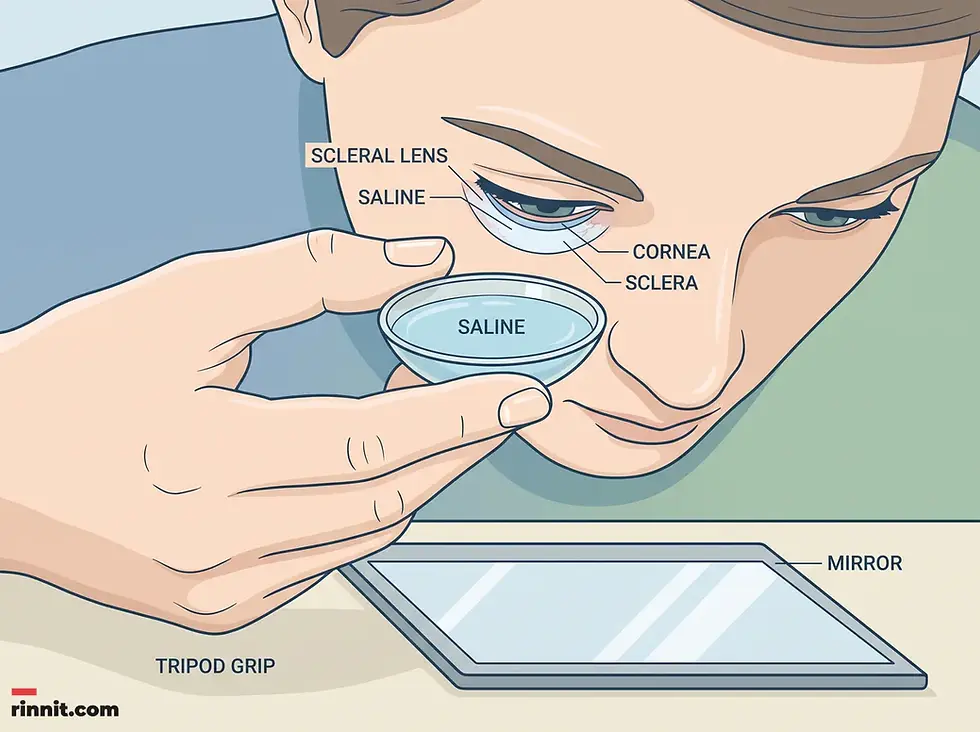
Inserting a scleral lens requires a specific technique. The lens must be overfilled with a recommended saline solution to ensure no air bubbles are trapped against the cornea. [1] Most users employ a "tripod" grip, balancing the lens on three fingers while leaning forward so the face is parallel to the floor. [1] The eyelids are pulled wide, and the lens is brought directly upward until it settles on the eye. [1] Removal is typically done using a small specialized plunger or a specific eyelid manipulation technique.
Cleaning and Safety
Lenses must be cleaned daily using only the solutions recommended by an eye care provider. It is critical to never use tap water or saliva, as these can introduce bacteria and lead to serious eye infections. [1] If the vision becomes blurry during the day due to debris in the fluid reservoir, the lens should be removed, cleaned, refilled with fresh saline, and reinserted.
Conclusion
Scleral lenses offer a transformative solution for individuals struggling with complex vision issues and chronic eye surface conditions. By combining superior vision correction with a protective, hydrating environment, they provide comfort and clarity that standard lenses cannot match.
Next step: If you have been told you are a "difficult fit" for contacts or suffer from severe dry eye or corneal irregularities, consulting with an eye specialist about scleral lenses is a vital next step.
Frequently Asked Questions
Are scleral lenses hard or soft?
Scleral lenses are rigid gas-permeable (RGP) lenses, often referred to as "hard" lenses. They maintain their shape to provide a smooth optical surface, but they are specially designed to allow oxygen to pass through to the eye.
How long do scleral lenses last?
With proper care and maintenance, a pair of scleral lenses typically lasts between one and two years. Your eye specialist will monitor the condition of the lenses during regular check-ups to determine when a replacement is necessary.
Can I sleep in my scleral lenses?
No, you should not sleep in scleral lenses unless explicitly instructed otherwise by your eye care provider. Removing them overnight allows your eyes to rest and reduces the risk of infections and other complications.
Why are scleral lenses more expensive?
The higher cost is due to the specialized manufacturing process and the complex fitting procedure. Each lens is custom-made for the individual wearer, and the fitting often requires multiple visits and advanced diagnostic equipment.
Is it hard to put in scleral lenses?
There is a learning curve, as the process differs from standard contact lenses. However, with practice and guidance from your eye specialist, most people become proficient in the "tripod" insertion method within a short period.
Can scleral lenses fall out of my eye?
A scleral lens falling out is very unlikely. Because scleral lenses are larger and their edges sit securely underneath the upper and lower eyelids, they are much more stable than standard contact lenses and rarely dislodge.
What should I do if my lens feels uncomfortable?
While a new lens may feel odd at first, it should not cause pain or persistent discomfort. If you experience pain, redness, or significant irritation, remove the lens immediately and contact your eye care provider.
Do I still need to use eye drops with scleral lenses?
The fluid reservoir provides significant hydration, but some users with severe dry eye may still benefit from supplemental drops. Always consult your eye specialist before using any drops while wearing your lenses.
How many hours a day can I wear them?
Daily wear time varies by individual. Most people can work up to wearing them for 10 or more hours a day, though you may need to remove and clean them once during the day to maintain clarity.
Can scleral lenses treat keratoconus?
Yes, scleral lenses are a primary treatment for keratoconus. By vaulting over the irregular, cone-shaped cornea, they provide a smooth surface that significantly improves vision and can sometimes delay the need for surgery.
Related Reading
Corneal Cross-Linking (CXL): Purpose, Procedure, Risks and Recovery explains how this procedure strengthens a thin, bulging cornea.
Dry Eyes: Symptoms, Causes, Treatment & Relief — Complete Guide covers the causes of dry eyes and ways to get relief.
Corneal Disease: Symptoms, Causes, Diagnosis, Treatment and Prevention — What You Need to Know outlines common cornea problems and how they are treated.
Cornea Transplant: Types, Surgery, Risks and Recovery describes when a damaged cornea is replaced and how recovery goes.
References
Cleveland Clinic. Scleral Lenses. Cleveland Clinic. Last updated May 28, 2024. https://my.clevelandclinic.org/health/treatments/scleral-lenses
Ling JJ, Mian SI, Stein JD, et al. Impact of scleral contact lens use on the rate of corneal transplantation for keratoconus. Cornea. 2021;40(1):39-42. PMID 32452985. https://doi.org/10.1097/ICO.0000000000002388
Mickles CV, Harthan JS, Barnett M. Assessment of a novel lens surface treatment for scleral lens wearers with dry eye. Eye & Contact Lens. 2021;47(5):308-313. PMID 33156128. https://doi.org/10.1097/ICL.0000000000000754
Fogt JS, Nau CB, Schornack M, et al. Comparison of pneumatonometry and transpalpebral tonometry measurements of intraocular pressure during scleral lens wear. Optometry and Vision Science. 2020;97(9):711-719. PMID 32941336. https://doi.org/10.1097/OPX.0000000000001574
Medical disclaimer
The information provided in this article is for educational purposes only and should not be used as a substitute for professional medical advice, diagnosis, or treatment. Always seek the advice of your physician or other qualified health provider with any questions you may have regarding a medical condition.



Comments