Understanding the Cornea: The Eye’s Protective Shield

Updated: 3 days ago
Medically reviewed by Dr. Baraa Alnahhal, MD · Last reviewed: October 2026
The cornea is the clear, dome-shaped outer layer at the front of the eye [1]. It acts as a protective shield and as a key part of the eye’s focusing system [1]. Made of six layers, it filters some ultraviolet (UV) rays and keeps debris and germs out [1]. Safety eyewear and prompt care for injuries help protect it [1].
Quick Answer: What is the cornea?
The cornea is the transparent, dome-shaped covering at the front of each eye [1]. It keeps out debris and germs and bends light so you can focus [1]. It has six layers and is prone to scratches, infections, burns and diseases such as keratoconus, though minor injuries heal within hours [1]. Any eye pain, vision change or injury should be checked [1].
What the research says
The pre-Descemet’s layer is a recent discovery. In 2013, researchers examining 31 human donor sclerocorneal discs described a strong, acellular layer about 10.15 microns thick (±3.6) made of 5 to 8 lamellae of mostly type-1 collagen (Dua et al., Ophthalmology, 2013) [2]. Some experts still debate whether it is a separate layer or part of the stroma [1].
Keratoconus is uncommon, and eye rubbing is a key risk factor. A meta-analysis of 29 studies with 7,158,241 participants from 15 countries estimated a prevalence of 1.38 per 1,000 people, with higher odds in people who rub their eyes (odds ratio 3.09) or have a family history of keratoconus (odds ratio 6.42), as well as allergy, asthma, and eczema (Hashemi et al., Cornea, 2020) [3].
The right eyewear matters. A systematic review of 29 studies of racket sports found that, in a subgroup analysis, a median of 93% of eye injuries occurred when no eyewear was worn, and only eyewear meeting ASTM (or similar) standards was associated with no eye injuries (Mazarelo et al., The Physician and Sportsmedicine, 2024) [4].
What is the anatomy of the cornea?
The cornea is the clear, dome-shaped covering at the front of each eye [1]. Cleveland Clinic compares it to your eye’s version of a windshield: it keeps debris, germs, and more out, and its specific shape plays a key role in how your eyesight works [1]. It also filters some ultraviolet (UV) rays [1].
Your cornea sits just in front of the anterior chamber, a fluid-filled chamber of the eye that contains aqueous humor [1]. Behind that chamber are the iris and pupil, followed by the lens, and the sclera (the white of the eye) surrounds the cornea [1]. Because the cornea is the first line of defense for the surface of the eye, it is prone to injury and damage [1]. Fortunately, it also has fast, effective self-repair abilities [1].
What are the six layers of the cornea?
The cornea is not a single membrane. Each of its six layers has a specific job, but its true strength comes from how the layers work together, much like the laminated safety glass in a car windshield [1].
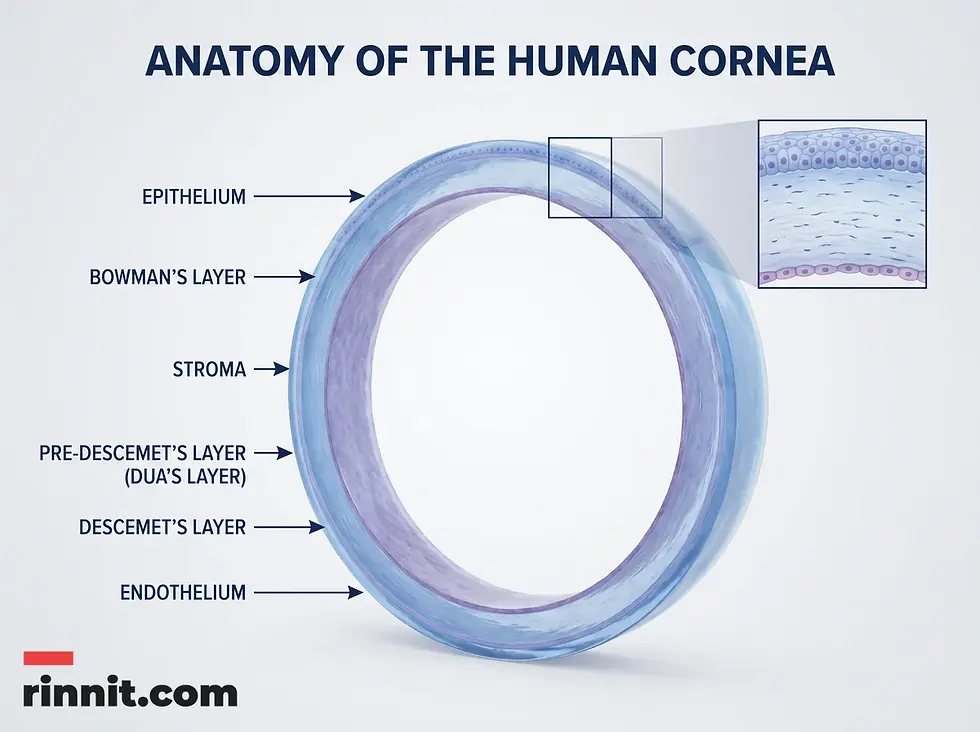
1. Epithelium
The epithelium is the outermost layer and a physical barrier between the inside of your eye and the outside world [1]. It is incredibly sensitive to pain, which is protective: it makes you react strongly to stop or remove whatever is hurting your eye [1].
2. Bowman’s Layer
Bowman’s layer is a tough layer made mostly of collagen. It provides structure and helps the cornea hold its shape [1].
3. Stroma
The stroma is the thickest layer of the cornea [1]. It strengthens the cornea’s structure and helps bend (refract) light and focus it onto the retinas [1].
4. Pre-Descemet’s Layer (Dua’s Layer)
Research indicates this layer is airtight, which makes it a very strong barrier separating the fluid inside your eye from the air outside [1]. It is a relatively recent discovery: the first research paper describing it came out in 2013 [1]. Experts still disagree about whether it is a layer of its own or part of the stroma, but eye surgeons now take it into account when planning corneal surgeries [1].
5. Descemet’s Layer
Descemet’s layer is thin and stretchy but remarkably strong. It is important to the structure of the eye and helps protect the inside of the eye from injury and infection [1].
6. Endothelium
The endothelium is mainly responsible for fluid balance in the cornea and the inside of the eye [1]. It helps make sure there is just enough water and fluid in the stroma for the cornea to work as it should [1].
What are common conditions of the cornea?
Your corneas are vulnerable to injuries, infections, and other diseases [1]. Examples include the following.

Condition | What it involves |
Dry eye | The epithelium needs tear fluid for lubrication and to absorb oxygen from the air. Dry eye is painful and can disrupt your eyesight [1]. |
Infections | Damage to the cornea’s surface makes it easier for viruses, bacteria, fungi, and parasites to cause infection. One example is the parasitic infection acanthamoeba keratitis [1]. |
Cornea inflammation (keratitis) | Many conditions can cause it, including infections, injuries, and diseases [1]. |
Injuries | Scratches (abrasions), lacerations (rips), sores (ulcers), and erosions (worn-away areas) from outside objects and events [1]. |
Environmental damage | Extreme cold and heat, corneal burns from heat or ultraviolet radiation, and chemicals in liquid or gas form [1]. |
Structural diseases (dystrophies) | More than 20 diseases that affect the structure of the cornea, including keratoconus and Fuchs’ dystrophy [1]. |
Keratoconus is a disease in which the cornea thins and bulges into a cone shape, distorting vision. Avoiding rubbing your eyes is one of the habits that protects the surface of the cornea [1].
How are cornea problems treated, and how is vision corrected?
Treatments range from simple over-the-counter remedies to advanced surgery [1]. Which one is right depends on your specific condition, medical history, and personal circumstances, so an eye care specialist is the best person to advise you [1].
Treatment type | Examples |
Over-the-counter remedies | Simple treatments from a pharmacy or grocery store for eye irritation or dry eyes [1], such as lubricating drops |
Medications | Ointments, eye drops, or pills, especially for infections [1] |
Coverings or wearable treatments | An eye patch, scleral lenses, bandage contact lenses, and amniotic membrane grafts [1] |
Laser surgeries | Vision correction surgeries that use a laser to change the shape of the cornea so it refracts light differently, such as LASIK [1] |
Eye surgeries | Procedures that repair damage or correct certain corneal conditions [1] |
Cornea transplant or artificial cornea | Surgery to replace a cornea that has become severely cloudy or stopped refracting light correctly [1] |
How can you protect your corneas?
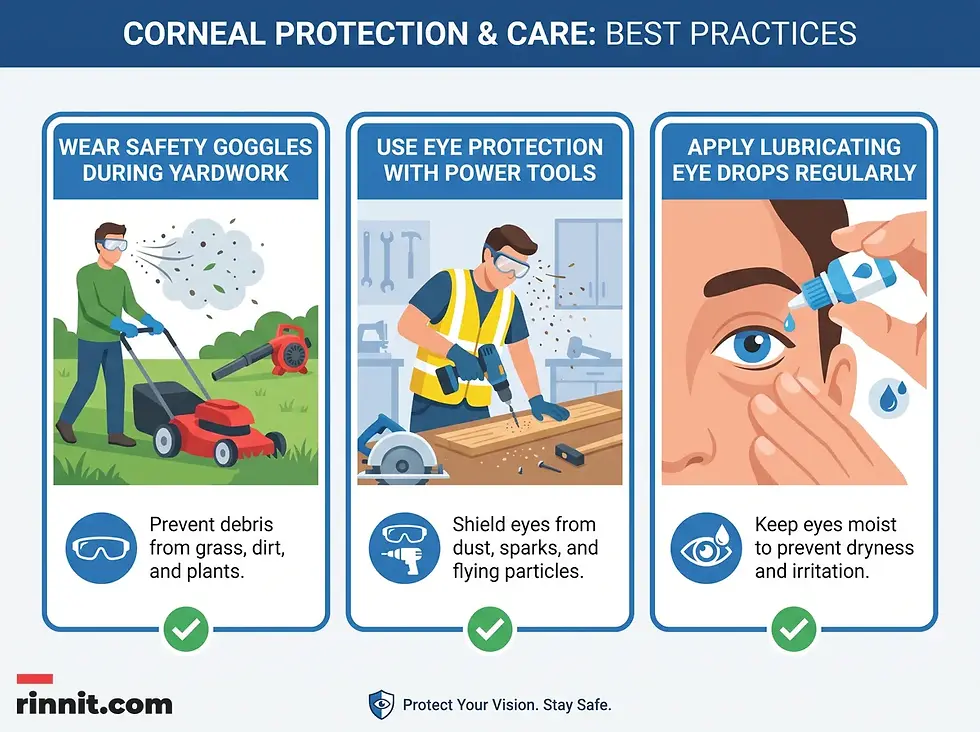
The most important way to protect your corneas from injury is to use safety glasses or goggles, even if you only need them for a moment or two [1]. A split second is all it takes for an eye injury to happen [1]. Wear eye protection any time you are:
Working with tools and machines. This includes simple hand tools and power tools alike [1].
Doing yardwork and gardening. Leaves, grass clippings, pebbles, and dirt are hazards, as are mowers, string trimmers, and leaf blowers [1].
Using compressed air or water. Pressure can turn grit, debris, or dust into a hazard [1].
Using chemicals at home or work. Common chemicals such as bleach or drain cleaner can splash into your eyes even if you are careful [1].
Working around heat sources and open flames. The pain receptors in your eyes are more sensitive to heat than the receptors in your skin [1].
Exposed to UV radiation. Water and snow-covered surfaces can reflect UV rays and burn your corneas [1].
Playing sports. Protective eyewear can shield you from fast-moving objects in sports such as baseball, tennis, hockey, and racquetball [1].
Keeping Your Corneas Healthy
Get regular eye exams, which may catch problems before symptoms develop [1].
Wash your hands often to keep germs away from your eyes [1].
Do not share cosmetics and similar items, which can spread eye infections [1].
Wear, store, and maintain contact lenses properly to avoid serious infections [1].
Avoid rubbing or touching your eyes, including through your eyelids [1].
When should you get medical care for a cornea problem?
See an eye care specialist for cornea problems such as vision changes, sudden vision loss, a foreign object sensation, eye pain or redness, or a direct hit or wound to the eye [1].
Vision changes, including double vision, clouding, blurring, or distortion [1].
Sudden vision loss [1].
A foreign object sensation, with or without a visible object [1].
Eye pain, watery eyes, light sensitivity, redness, or irritation [1].
A direct hit on or around your eye, or a visible puncture, tear, or wound on your eye [1].
Burns to and around your eyes always need medical attention [1], and you should not drive if you have vision changes or symptoms that could be due to an injury; if a chemical splashes into your eye, rinse it right away with clean, lukewarm water for at least 15 minutes, then get emergency care [1]. When in doubt, err on the side of caution [1].
Conclusion
Your corneas protect the inner parts of your eyes and help you see. They are packed with nerve endings and have tremendous repair abilities, recovering from many injuries in days or even hours [1]. They cannot do that if you do not do your part in caring for them.
Next step: If you have persistent eye pain, blurred vision, or an eye injury, consult an eye care specialist, and get regular eye exams to keep your corneas healthy.
Frequently Asked Questions
What does the cornea do?
The cornea acts as a protective shield for the eye and helps focus light so you can see clearly. It keeps debris and germs out and filters some UV rays.
How many layers does the cornea have?
Six: the epithelium, Bowman’s layer, the stroma, the pre-Descemet’s layer (Dua’s layer), Descemet’s layer, and the endothelium. Experts still debate whether the pre-Descemet’s layer is a separate layer or part of the stroma.
Is the cornea sensitive?
Yes. Researchers estimate the cornea has about 300 to 600 times as many pain receptors as your skin, so you react strongly to stop or remove whatever is hurting your eye.
Can a scratched cornea heal?
Yes. Minor corneal injuries heal within hours and some take a few days. Because surface damage makes infection easier, see an eye care specialist for any eye injury.
What is keratitis?
Keratitis is inflammation of the cornea. Many conditions can cause it, including infections, injuries, and diseases.
What is LASIK?
LASIK is a common laser vision correction surgery that changes the shape of the cornea so it refracts light differently.
Can you transplant a cornea?
Yes. When a cornea becomes severely cloudy or stops refracting light correctly, surgery can replace it with a cornea transplant or an artificial cornea.
How can I protect my cornea?
Wear safety glasses or goggles when you use tools or machines, do yardwork, use compressed air or water, handle chemicals, work near heat or flames, are exposed to UV radiation, or play sports.
What causes dry eye in the cornea?
The epithelium needs tear fluid for lubrication and to absorb oxygen from the air. Dry eye is painful and can disrupt your eyesight.
What is keratoconus?
Keratoconus is a corneal disease in which the cornea thins and bulges into a cone shape, distorting vision. It is one of the structural corneal diseases.
Related Reading
Cornea Transplant: Types, Surgery, Risks and Recovery explains cornea transplant surgery.
Corneal Topography: Mapping the Cornea and Reading the Results explains the eye test that maps the shape of the cornea.
References
Cleveland Clinic. Cornea: what it is, common disorders & preventing injury. Cleveland Clinic. Last updated January 9, 2024. https://my.clevelandclinic.org/health/body/21562-cornea
Dua HS, Faraj LA, Said DG, Gray T, Lowe J. Human corneal anatomy redefined: a novel pre-Descemet’s layer (Dua’s layer). Ophthalmology. 2013;120(9):1778-1785. PMID: 23714320. DOI: 10.1016/j.ophtha.2013.01.018
Hashemi H, Heydarian S, Hooshmand E, et al. The prevalence and risk factors for keratoconus: a systematic review and meta-analysis. Cornea. 2020;39(2):263-270. PMID: 31498247. DOI: 10.1097/ICO.0000000000002150
Mazarelo JFD, Winter SL, Fong DTP. A systematic review on the effectiveness of eyewear in reducing the incidence and severity of eye injuries in racket sports. The Physician and Sportsmedicine. 2024;52(2):115-124. PMID: 37070274. DOI: 10.1080/00913847.2023.2196934
Medical disclaimer
The information provided in this article is for educational purposes only and should not be used as a substitute for professional medical advice, diagnosis, or treatment. Always seek the advice of your physician or other qualified health provider with any questions you may have regarding a medical condition.



Comments