Clear Braces: How They Work, Pros and Cons, and How to Care for Them

Updated: 6 days ago
Written and medically reviewed by Dr. Baraa Alnahhal, MD · Last reviewed: October 31, 2026 · How we review
Quick Answer: What are clear braces?
Clear braces are fixed orthodontic appliances that straighten teeth using tooth-colored ceramic brackets and a frosted, tooth-colored wire instead of metal. They correct crooked, crowded or gapped teeth and bite problems as effectively as metal braces, but they are more fragile, can stain, usually cost more and may take 12 to 36 months. [1]
What the research says
Young people rate ceramic braces as more attractive than hybrid braces, but prefer clear aligners most. In a survey of 194 participants aged 9 to 17, standard ceramic brackets scored a median attractiveness rating of 7, compared with 4 for hybrid brackets and 8 for clear aligners; aligners were acceptable to 80% of participants. (Alansari, Patient Preference and Adherence, 2020)
Ceramic brackets do not distort MRI scans the way steel brackets can. A systematic review of 18 studies found ceramic and plastic brackets caused no relevant MRI artifacts, while stainless steel brackets and wires produced artifacts in the face and head region. Heating and debonding during MRI were not hazardous. (Dobai et al., BMC Oral Health, 2022)
Removing brackets can leave tiny enamel cracks. A meta-analysis of lab studies on metal and ceramic brackets found the number of enamel microcracks rose by a mean of 3.5 after bracket removal (3 studies), with strong evidence that their number is likely to increase. (Dumbryte et al., European Journal of Orthodontics, 2018)
Key takeaways
Clear braces use the same parts as metal braces: brackets, a wire, bands and elastics.
They are just as effective as metal braces at straightening teeth.
They are far less noticeable, which is the main reason people choose them.
They are more fragile, more likely to stain, and usually more expensive.
Treatment typically takes 12 to 36 months, depending on how misaligned the teeth are.
Good brushing, flossing and avoiding hard, sticky and dark foods protect both the braces and your teeth.

What are clear braces?
Clear braces are a type of orthodontic treatment that straightens your teeth. They are also called ceramic braces. [1]
They are made from tooth-colored materials, so they are much less noticeable than metal braces. They are not invisible, but they blend in with your natural smile. [1]
Many orthodontists offer clear braces to both teens and adults. [1]
How are clear braces different from metal braces?
Clear braces differ from metal braces only in their materials: they use ceramic brackets and a frosted wire that match the shade of your teeth, while metal braces use stainless steel bands, brackets and wires. [1]
Because ceramic is not as strong as steel, clear braces may take slightly longer to straighten your teeth. [1]
Feature | Clear (ceramic) braces | Metal braces |
Brackets | Tooth-colored ceramic | Stainless steel |
Wire | Frosted, tooth-colored | Metal |
How noticeable | Far less noticeable | Clearly visible |
Strength | More fragile, break more often | Stronger |
Staining | More prone to staining | Less prone to staining |
Cost | Usually higher | Usually lower |
Average treatment time | 12 to 36 months | About 20 months on average |
Are clear braces the same as clear aligners?
Clear braces are not the same as clear aligners. Clear braces are bonded to your teeth and use brackets and wires like metal braces. Clear aligners are removable plastic trays that fit snugly over your teeth. [1]
Both options have pros and cons. A dentist or orthodontist can tell you which one suits your teeth best. [1]
Are clear braces as effective as metal braces?
Clear braces are just as effective as metal braces at straightening teeth. The only difference is the material, which can make treatment take a little longer. [1]
What problems can clear braces fix?
Clear braces can fix the same misalignment problems as metal braces. [1] These include:
Malocclusion — when your bite is "off"
Underbite
Crossbite — when your lower teeth sit on the outside of your upper teeth
Open bite — when your upper and lower front teeth don't touch or overlap
Crowding
Gaps or spaces
Overlapping teeth
Why does straightening your teeth matter for oral health?
Straightening your teeth matters because crooked, crowded or overlapping teeth are harder to clean, which raises your risk of cavities and gum disease. [1]
Proper alignment also lowers your risk of chewing problems. And for many people, a straighter smile boosts confidence and self-esteem. [1]
Learn more about how your teeth are built and what keeps them healthy in our guide to teeth anatomy, functions and care.
What happens before you get clear braces?
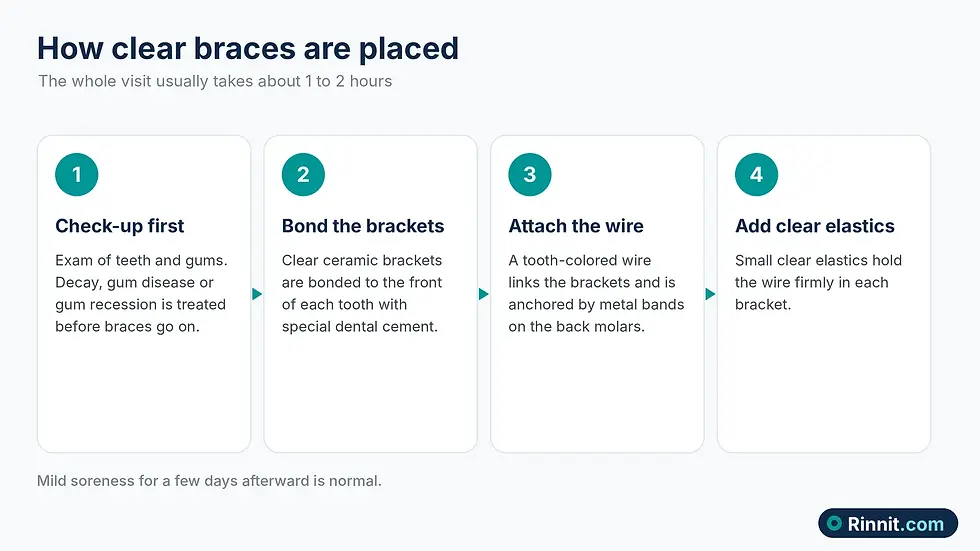
Before you get clear braces, a dentist or orthodontist examines your teeth and gums to check whether you are a good candidate. [1]
If you have extensive tooth decay, gum disease or gum recession, those problems are treated first. Putting braces on unhealthy teeth can lead to other dental problems. [1] If your gums need care, see our guides to gum disease treatment and periodontitis.
If you are a candidate, your dentist will usually refer you to an orthodontist, a dentist who specializes in straightening teeth. [1]
How are clear braces put on?
Clear braces are put on in one visit that usually takes about 1 to 2 hours. [1]
Bonding: The orthodontist bonds clear ceramic brackets to the front of your teeth with a special dental cement.
Wiring: A tooth-colored wire is attached to the brackets and anchored with metal bands on your back molars.
Securing: Clear elastics are added to the brackets to hold the wire firmly in place. [1]
What can you expect after clear braces are placed?
After clear braces are placed, mild tenderness and discomfort are normal and usually fade within a few days. [1]
Over-the-counter pain relievers such as acetaminophen (paracetamol) or ibuprofen can ease the soreness. Always follow the dose on the label. [1]
You will also need to avoid hard, crunchy and sticky foods, which can loosen or break ceramic brackets. Your orthodontist will give you a list. [1]
What are the benefits and risks of clear braces?
The main benefit of clear braces is that they are far less noticeable than metal braces; the main drawbacks are that they stain and break more easily and usually cost more. [1]
Benefits | Drawbacks |
Far less noticeable than metal braces | More prone to staining |
Just as effective at straightening teeth | More fragile and break more often |
Fix the same range of bite and alignment problems | Usually more expensive |
Suitable for teens and adults | Repairs can add to the cost |
— | Treatment may take slightly longer |
Do clear braces stain or turn yellow?
Clear braces stain more easily than metal braces. [1] You can lower the risk if you:
Limit dark foods and drinks such as coffee, tea, red wine and tomato sauce.
Brush and floss every day to reduce plaque and tartar.
Don't smoke.
Visit your dentist regularly for exams and cleanings. [1]
Do clear braces break more easily than metal braces?
Clear braces break more easily than metal braces because ceramic brackets are more fragile. Following your orthodontist's food rules is the best way to protect them. [1]
Are clear braces more expensive than metal braces?
Clear braces are usually more expensive than metal braces because of the materials used. Because they are more fragile, you may also pay more for repairs over time. [1]
How long do you have to wear clear braces?
Most people wear clear braces for 12 to 36 months. Metal braces take about 20 months on average. Your exact time depends on how misaligned your teeth are. [1]
What foods should you avoid with clear braces?
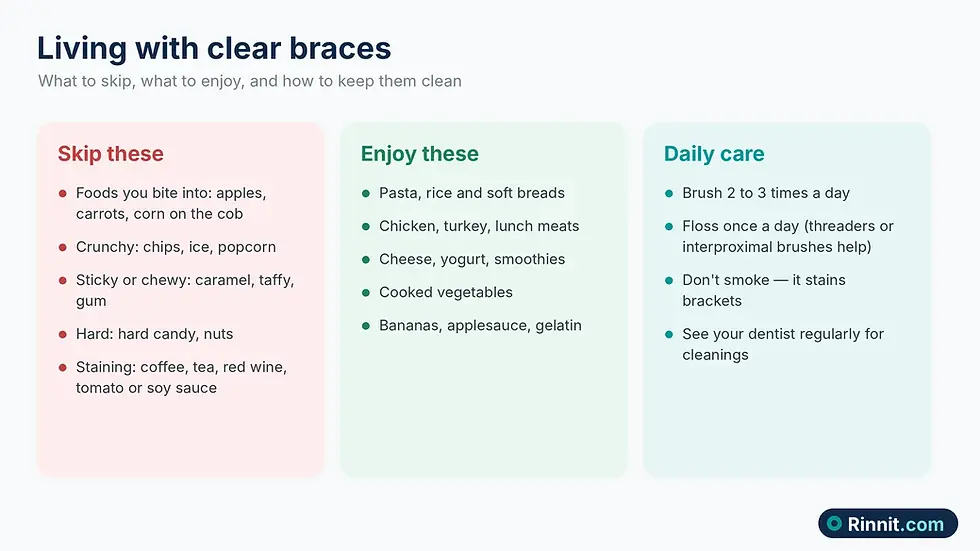
With clear braces, you should avoid foods that are hard, crunchy, sticky, chewy or likely to stain. [1]
Avoid | Examples |
Foods you bite into | Apples, carrots, corn on the cob |
Crunchy foods | Chips, ice, popcorn |
Chewy or sticky foods | Caramels, taffy, licorice, chewing gum |
Hard foods | Hard candy, nuts |
Foods that stain | Coffee, tea, red wine, tomato sauce, soy sauce |
What can you eat with clear braces?
With clear braces, you can still enjoy many soft foods. [1] Good choices include:
Pasta, rice and soft breads
Chicken, turkey and lunch meats
Cheese and yogurt
Cooked vegetables
Bananas and applesauce
Smoothies and gelatin
How do you clean your teeth with clear braces?
To clean your teeth with clear braces, brush 2 to 3 times a day and floss once a day. [1]
Brush 2 to 3 times every day.
Floss once a day. Floss threaders and interproximal (between-the-teeth) brushes make it easier to clean around brackets — ask your orthodontist which ones to use.
Limit dark foods and drinks like coffee, tea, red wine and tomato-based sauces.
See your dentist regularly for exams and cleanings. [1]
Keeping your gums healthy during treatment matters too. Read more about gingivitis and how daily care reverses it.
When should you see a dentist about clear braces?
You should see a dentist if you are worried or self-conscious about crooked teeth or a misaligned bite. A dentist can explain your options and help you choose the treatment that fits your oral health goals. [1]
Clear braces are not right for everyone, so a consultation is the best first step. [1] For general information on treatment options, see these orthodontics basics and this overview of how braces work.
Clear braces at a glance
Question | Answer |
What they are | Braces with tooth-colored ceramic brackets and wire |
Who they're for | Teens and adults |
What they fix | Crowding, gaps, overlapping, overbite, underbite, crossbite, open bite |
Placement time | About 1 to 2 hours |
Treatment time | 12 to 36 months |
Main advantage | Far less noticeable |
Main drawbacks | Stain and break more easily, cost more |
Conclusion
Clear braces give you the same results as metal braces with a much more discreet look. They suit teens and adults who want straighter teeth without a mouth full of metal.
The trade-off is extra care. Ceramic brackets break and stain more easily, so food choices and daily cleaning matter more. Treatment can also cost more and take a little longer.
Thinking about straightening your teeth? Book a consultation with a dentist or orthodontist to find out whether clear braces, metal braces or aligners suit you best. Then keep learning with our trusted, doctor-reviewed oral health guides on Rinnit.com — starting with overbite treatment options and dental veneers.
FAQ
Are clear braces invisible?
No. Clear braces are not invisible, but their tooth-colored brackets and wire make them far less noticeable than metal braces. [1]
Do clear braces work as well as metal braces?
Yes. Clear braces are just as effective as metal braces. They may take slightly longer because ceramic is not as strong as metal. [1]
How long does it take to put clear braces on?
Placing clear braces usually takes about 1 to 2 hours in a single visit. [1]
Do clear braces hurt?
You may feel mild tenderness for a few days after placement. Over-the-counter pain relievers such as acetaminophen or ibuprofen can help. [1]
Can I drink coffee with clear braces?
Coffee, tea and red wine can stain ceramic brackets, so it is best to avoid or limit them and brush regularly. [1]
Can adults get clear braces?
Yes. Many orthodontists offer clear braces to both adults and teens. [1]
What's the difference between clear braces and Invisalign-style aligners?
Clear braces are bonded to your teeth and use brackets and wires. Aligners are removable plastic trays that fit over your teeth. [1]
How long do I need to wear clear braces?
Treatment typically takes 12 to 36 months, depending on how misaligned your teeth are. Your orthodontist will give you an estimate at the start.
What should I do if a clear bracket breaks or comes loose?
Call your orthodontist to have it fixed. Until then, orthodontic wax can cover sharp edges, and you should avoid hard or sticky foods.
Will I need a retainer after clear braces?
Yes. A retainer keeps your teeth from moving back after the braces come off. Wear it as your orthodontist tells you.
Related Reading
Teeth Braces: Types, Timeline, Pain Relief and Aftercare Guide compares braces types, treatment time, discomfort and aftercare.
Clear Aligners: How Invisible Braces Work, Who They Suit, and What to Expect explains how removable clear aligners straighten teeth.
Teeth Retainer: Types, How Long to Wear One, and How to Care for It covers retainer types, how long to wear them and cleaning.
Orthodontics: Braces, Clear Aligners, Retainers, and What to Expect gives an overview of orthodontic treatment options for all ages.
References
Cleveland Clinic. Clear Braces: Types, Benefits & How To Clean. Cleveland Clinic Health Library. Last updated July 25, 2022. https://my.clevelandclinic.org/health/treatments/23568-clear-braces
American Dental Association. Braces. MouthHealthy. Accessed October 30, 2026. https://www.mouthhealthy.org/all-topics-a-z/braces/
American Dental Association. Orthodontics. MouthHealthy. Accessed October 30, 2026. https://www.mouthhealthy.org/all-topics-a-z/orthodontics/
Alansari RA. Youth Perception of Different Orthodontic Appliances. Patient Preference and Adherence. 2020;14:1011-1019. PMID 32606617. https://doi.org/10.2147/PPA.S257814
Dobai A, Dembrovszky F, Vízkelety T, et al. MRI compatibility of orthodontic brackets and wires: systematic review article. BMC Oral Health. 2022;22(1):298. PMID 35854295. https://doi.org/10.1186/s12903-022-02317-9
Dumbryte I, Vebriene J, Linkeviciene L, et al. Enamel microcracks in the form of tooth damage during orthodontic debonding: a systematic review and meta-analysis of in vitro studies. European Journal of Orthodontics. 2018;40(6):636-648. PMID 29474541. https://doi.org/10.1093/ejo/cjx102
Medical disclaimer
This article is for general educational purposes only and is not a substitute for professional dental or medical advice. Talk to a dentist or orthodontist about your own teeth and treatment options.



Comments