Cheek Filler: Types, Procedure, Recovery, Risks and How Long It Lasts

Updated: 6 days ago
Written and medically reviewed by Dr. Baraa Alnahhal, MD · Last reviewed: October 31, 2026 · How we review
Quick Answer: What is cheek filler?
Cheek filler is a nonsurgical treatment in which a healthcare provider injects dermal filler around and above the cheekbones to add volume and definition. Injections usually take 15 to 30 minutes; results usually show right away and last one to several years. Bruising and swelling are common; rarely, filler entering a blood vessel causes serious harm, such as vision loss. [1]
What the research says
Most people see a measurable lift in cheek volume. In a controlled trial of 235 adults aged 35 to 65 with age-related midface volume loss, 75.5% to 83.2% improved by at least one point on a midface volume scale at 6 months, depending on the cheek area treated. About 2.0 mL of hyaluronic acid filler gave correction lasting 15 to 24 months. (Glaser et al., Dermatologic Surgery, 2015)
Results can hold for up to two years. In a randomized, double-blind, split-face trial in Korean adults, 69 people followed to 104 weeks still had response rates of about 72% to 74% with two hyaluronic acid fillers, and no one had a serious adverse event. (Jung et al., Dermatologic Therapy, 2021)
Blood-vessel complications are rare but serious. A systematic review of 243 published cases of filler-related loss of blood flow to facial skin found vision loss in 39% of cases when skin supplied by the eye's main artery was affected, compared with 0.8% when it was not. (Soares et al., Plastic and Reconstructive Surgery, 2023)
Key takeaways
Cheek filler adds volume and defines the cheekbones without surgery. [1]
Hyaluronic acid is the most common filler; results range from about a year to several years depending on the type. [1]
The injections take about 15 to 30 minutes, and most people return to daily activities right away. [1]
Bruising, swelling and tenderness are common and usually fade within a week or two. [1]
Call your provider if swelling, bruising or unevenness lasts more than a week, and get emergency help for signs of a severe allergic reaction. [1]
What is cheek filler and why do people get it?
Cheek filler is a nonsurgical cosmetic procedure that injects dermal filler around and above the cheekbones to make the cheeks look fuller and more defined. Your provider recommends a filler based on your treatment goals. [1]
People choose cheek filler to:
Define and enhance the cheekbones
Add volume to the cheeks
Look more youthful
Plump up wrinkles
Smooth lines
Cheek filler is very common. More than 3 million people in the United States choose dermal fillers every year. [1] If you want to understand how fillers work in general, the U.S. FDA's dermal filler guide and the American Academy of Dermatology's fillers overview are useful starting points.
What types of cheek filler are there?
The four main types of cheek filler are hyaluronic acid, calcium hydroxylapatite, poly-L-lactic acid and polymethylmethacrylate. Each one works differently and lasts a different length of time. [1]
Filler type | What it is | How providers use it in the cheeks | Typical duration |
Hyaluronic acid (HA) | A substance your skin makes naturally; levels drop with age | Adds volume and keeps skin hydrated; the most common choice | About 1 year |
Calcium hydroxylapatite (CaHA) | A substance found naturally in bone | Adds fullness to the cheekbones and smooths deeper lines | About 15 months |
Poly-L-lactic acid (PLLA) | A synthetic substance that helps your body make its own collagen | Usually treats deep wrinkles on the cheeks | 2 years or more |
Polymethylmethacrylate (PMMA) | Tiny collagen beads | Adds firmness and structure | Years; may need more than one injection |
Hyaluronic acid works by restoring a substance your skin loses as you age, which is what causes wrinkles and volume loss. [1] Poly-L-lactic acid takes a different route: it prompts your body to build collagen, so results appear gradually. Read more in our guide to collagen-stimulating fillers.

Who should not get cheek filler?
You should not get cheek filler if you are pregnant or breastfeeding, or if you have a condition that raises the risk of complications. [1] These include:
Allergies to synthetic substances found in some dermal fillers
A bleeding disorder, such as hemophilia or von Willebrand disease
Certain autoimmune conditions
Certain infections, such as an abscessed tooth, ear, nose or throat infections, or stomach flu (gastroenteritis)
Certain skin diseases
Tuberculosis
What happens before a cheek filler procedure?
Before cheek filler, you have a consultation where the provider examines your face, asks about your goals and recommends the most suitable filler. [1] You may want to see a dermatologist or plastic surgeon who specializes in dermal filler injections. They may also suggest other cosmetic procedures to go with the filler. [1]
Your provider will ask about your medical history. Be ready to discuss:
Tell your provider about | Why it matters |
Allergies | Some allergies mean you should avoid cheek filler |
Autoimmune conditions | Conditions such as dermatomyositis, lupus and rheumatoid arthritis can lead to complications |
Gastrointestinal conditions | Rarely, lumpy swelling occurs in people with Crohn's disease or ulcerative colitis |
Medicines and supplements | NSAIDs, blood thinners and some supplements raise the risk of bleeding and bruising |
Previous fillers or injections | They affect the amount and type of filler used |
Skin conditions or sensitive skin | You may need to avoid cheek filler |
Smoking | Smoking can slow healing |
Bone marrow or organ transplant | Infection risk may be higher |
Recent vaccinations | Some vaccinations are linked to swelling |
Your provider will explain possible side effects and recovery time. They may mark your face to show where the injections will go and take photos to record before-and-after results. [1]
What happens during a cheek filler procedure?
During a cheek filler procedure, the provider cleans your skin, numbs it, and injects small amounts of filler beneath the skin with a thin needle. [1] Numbing can be a lotion, cream, spray or cold packs, and some fillers already contain a numbing agent. [1]
The provider may inject filler in several areas of the cheek. You may feel a small pinch or sting, but the procedure doesn't usually cause pain. A cheek filler procedure usually takes about 15 to 30 minutes. [1]
Step | What happens |
1. Clean | The skin is cleaned |
2. Numb | Cream, lotion, spray or cold packs, or a filler with numbing agent |
3. Inject | Small amounts of filler go beneath the skin with a thin needle, often in several spots |
4. Cool | Cool packs may be applied to the injection areas right afterward |

What happens after cheek filler injections?
After cheek filler, most people see some results right away, but full results can take several days and sometimes several months. [1] Your provider may apply cool packs to the injection areas right after the procedure. [1]
For a few days afterward, you may have:
Bruises
Discomfort
Swelling
Timing differs by filler. Poly-L-lactic acid results can take up to two to three weeks to appear. With a PMMA filler, you need to massage the treated areas for about 5 minutes several times a day for one to two weeks. [1]
What is the recovery time after cheek filler?
Recovery after cheek filler is usually quick, and any bruising or swelling should go away in a few days. [1] Most people can return to work, school, driving and eating right away. [1]
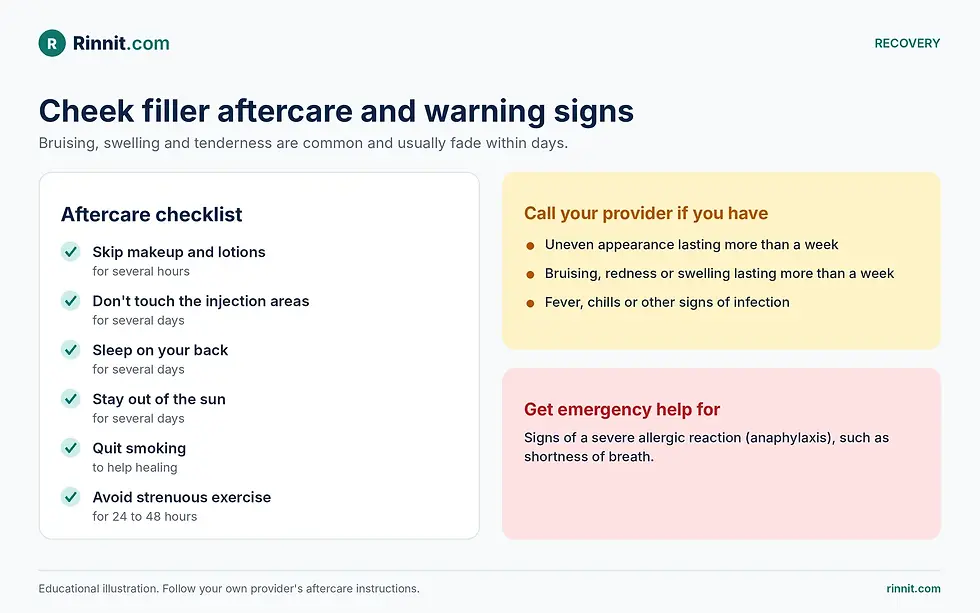
To support healing and protect your results, your provider may suggest the following for several days:
Aftercare step | How long |
Skip makeup and lotions | Several hours |
Avoid touching the injection areas | Several days |
Sleep on your back so the filler isn't disturbed | Several days |
Stay out of the sun | Several days |
Quit smoking | During recovery |
Avoid strenuous exercise | 24 to 48 hours |
What are the benefits of cheek filler?
Compared with more invasive cosmetic surgery, the main benefits of cheek filler are fast results, a quick recovery and lower cost. [1] The advantages include:
Immediate or near-immediate results
Less expense
Low risk of complications
Non-permanent results, so changes are possible
A quick procedure and recovery with little or no downtime
What are the risks and side effects of cheek filler?
Cheek filler is a low-risk procedure, and most side effects are temporary, usually clearing within a week or two. [1] Less often, more serious problems occur.
How often | Side effects | What to know |
Common and temporary | Bleeding, bruising, acne-like bumps, hives, itching, redness, nodules, swelling and tenderness | Usually go away within a week or two |
Possible | Filler moving to another part of the face, causing a lopsided (asymmetrical) or lumpy look | A provider can often dissolve the filler with another injection |
Less common, more serious | Allergic reaction, infection, filler leakage, numbness, severe swelling (edema), skin damage or scars, skin discoloration | Contact your provider promptly |
Very rare | Filler injected into a blood vessel, injuring arteries or veins and causing tissue death or vision loss | Can cause permanent damage |
The most serious complication, blocked blood flow from filler, is covered in detail in our guide to vascular occlusion after dermal fillers.
When should you call a doctor after cheek filler?
Call your healthcare provider after cheek filler if a problem lasts more than a week or you notice signs of infection. [1] Contact them if you have:
An uneven (asymmetrical) appearance that lasts more than a week
Bruising, redness or swelling that lasts more than a week
Signs of infection, such as fever or chills
Get emergency help right away (call your local emergency number) if you have symptoms of a severe allergic reaction (anaphylaxis), such as shortness of breath. Also get help right away for vision changes, severe pain, or skin that turns white, dusky or blotchy near the injection site, because filler may be blocking a blood vessel. [1]
How does cheek filler compare with fat grafting?
Cheek filler uses an injectable product and lasts months to years, while facial fat grafting moves your own fat into the cheeks and can be permanent. [1] Fat grafting is a surgical procedure, also called autologous fat injection. [1]
Feature | Cheek filler | Facial fat grafting |
Material | Dermal filler (HA, CaHA, PLLA or PMMA) | Your own fat, taken from another part of the body |
Type of procedure | Nonsurgical injections | Surgical procedure |
Procedure time | About 15 to 30 minutes | One to two hours |
How long results last | Months to years | Can be permanent |
Learn more in our guide to fat transfer.
Conclusion
Cheek filler can give your cheeks a fuller, more defined look without surgery, usually in a single short appointment with little downtime. [1] The right filler depends on your goals: hyaluronic acid lasts about a year, while other types can last two years or longer. [1] Share your full medical history at your consultation, follow your aftercare plan, and contact your provider about any side effect that lasts more than a week. If you are comparing treatments for other areas, see our guides to jawline filler and lip fillers.
Explaining cosmetic treatments to your patients or followers? Clear visuals build trust. Browse the infographic and social media templates in the Rinnit.com marketplace to create professional graphics that explain treatment steps, recovery and safety.
FAQ
How long does cheek filler last?
It depends on the filler. Hyaluronic acid usually lasts about one year, calcium hydroxylapatite about 15 months, poly-L-lactic acid two years or more, and PMMA can last for years. [1]
Does cheek filler hurt?
Most people feel only a small pinch or sting. The skin is usually numbed first, and some fillers contain a numbing agent. [1]
How long does the cheek filler procedure take?
The injections usually take about 15 to 30 minutes. [1]
When will I see results from cheek filler?
Most people see some results right away. Full results can take several days and sometimes several months; poly-L-lactic acid results can take up to two to three weeks to appear. [1]
How long does swelling last after cheek filler?
Bruising and swelling usually go away in a few days. Call your provider if they last more than a week. [1]
Can I exercise after cheek filler?
Your provider may suggest avoiding strenuous exercise for 24 to 48 hours. Most other daily activities can resume right away. [1]
How should I sleep after cheek filler?
Sleep on your back for several days so the filler isn't disturbed. [1]
Can cheek filler be reversed?
If filler moves and causes a lopsided or lumpy look, a provider can often use another injection to dissolve it. [1]
Who should not get cheek filler?
People who are pregnant or breastfeeding, and those with certain allergies, bleeding disorders, autoimmune conditions, active infections, skin diseases or tuberculosis. [1]
What is the most serious risk of cheek filler?
Very rarely, filler injected into a blood vessel can injure the vessel and cause tissue death or vision loss. [1]
Related reading
Buccal Fat Removal: Procedure, Recovery and Results explains cheek reduction surgery.
References
Cleveland Clinic. Cheek Filler: Benefits, Risks & What To Expect. Cleveland Clinic. Last updated October 1, 2022. https://my.clevelandclinic.org/health/treatments/24260-cheek-filler
Glaser DA, Kenkel JM, Paradkar-Mitragotri D, et al. Duration of effect by injection volume and facial subregion for a volumizing hyaluronic acid filler in treating midface volume deficit. Dermatologic Surgery. 2015;41(8):942-949. PMID 26218727. https://doi.org/10.1097/DSS.0000000000000416
Jung JM, Lee WS, Yoon J, et al. A multicenter, randomized, double-blind comparison of two hyaluronic acid fillers in mid-face volume restoration in Asians: A 2-year extension study. Dermatologic Therapy. 2021;34(2):e14787. PMID 33476068. https://doi.org/10.1111/dth.14787
Soares DJ, Bowhay A, Blevins LW, et al. Patterns of Filler-Induced Facial Skin Ischemia: A Systematic Review of 243 Cases and Introduction of the FOEM Scoring System and Grading Scale. Plastic and Reconstructive Surgery. 2023;151(4):592e-608e. PMID 36477154. https://doi.org/10.1097/PRS.0000000000009991
Medical disclaimer
This article is for informational purposes only and is not medical advice. Always consult a qualified healthcare professional about your individual situation before choosing a cosmetic treatment.



Comments