Buccal Fat Removal: Procedure, Recovery and Results

Updated: 2 days ago
Written and medically reviewed by Dr. Baraa Alnahhal, MD · Last reviewed: November 2026 · How we review
Quick Answer
Buccal fat removal (cheek reduction) is a cosmetic surgery that removes the buccal fat pads, pockets of fat in the lower cheeks, to make the face look slimmer. The cuts are inside the cheeks, so there are no visible scars. You go home the same day and heal in about three weeks. Final results take several months.
What the research says
About 1 in 4 people have a complication, mostly minor: in 12 studies of 308 patients, about 25% had a problem after surgery, mostly swelling, trouble opening the mouth, pain or asymmetry; facial nerve injury occurred in about 1% (Albuquerque MC et al., J Craniomaxillofac Surg, 2025) [2]
Most patients like the result: in a review of 134 cheek-slimming procedures, 85% of patients rated their facial contour much better and the rest rated it better, though long-term data are limited (Traboulsi-Garet B et al., Med Oral Patol Oral Cir Bucal, 2021) [3]
Key takeaways
Buccal fat removal slims the lower cheeks.
The cuts are inside the mouth, so there are no visible scars.
It's usually done under local anesthesia, and you go home the same day.
Healing takes about three weeks; final results take months.
Fat naturally decreases with age, so it isn't right for everyone.
What is buccal fat removal?
Buccal fat pads sit in the hollow of each cheek and help shape your face. Everyone has them, but their size varies. Removing them can make the cheeks look less full. Because buccal fat naturally shrinks with age, removing too much can make the face look hollow later in life. It's one of many cosmetic procedures for the face. Sources: [1]
Who it's for
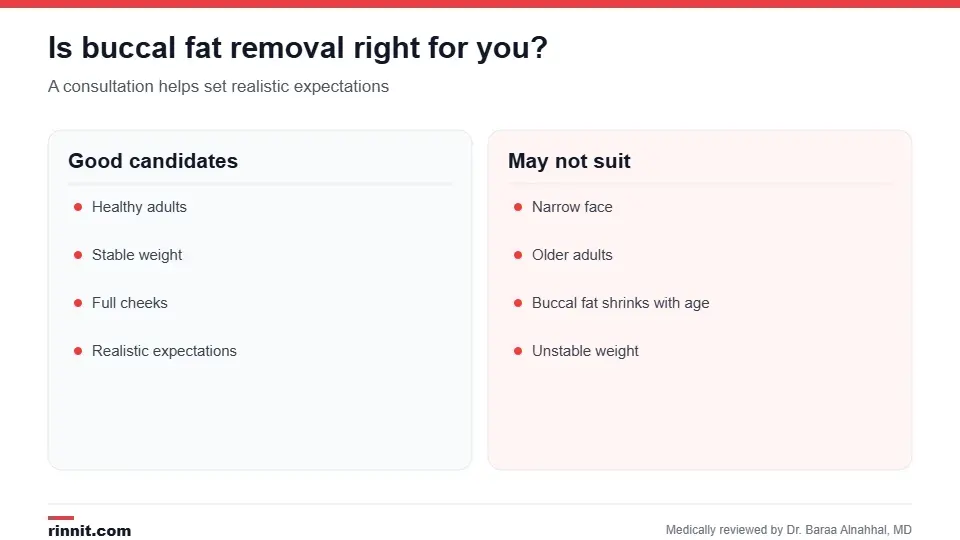
A consultation helps you set realistic expectations.
Good candidates are healthy, at a stable weight and bothered by full cheeks.
It may not suit people with a narrow face.
It may not suit older adults, since buccal fat naturally decreases with age. Sources: [1]
How to prepare
Meet with a board-certified surgeon to discuss your goals, expectations and risks.
Expect an exam, face photos, a health history and a blood pressure check.
Tell your surgeon about all medicines, herbs and supplements.
You may be asked to stop smoking before surgery. Sources: [1]
What happens during surgery
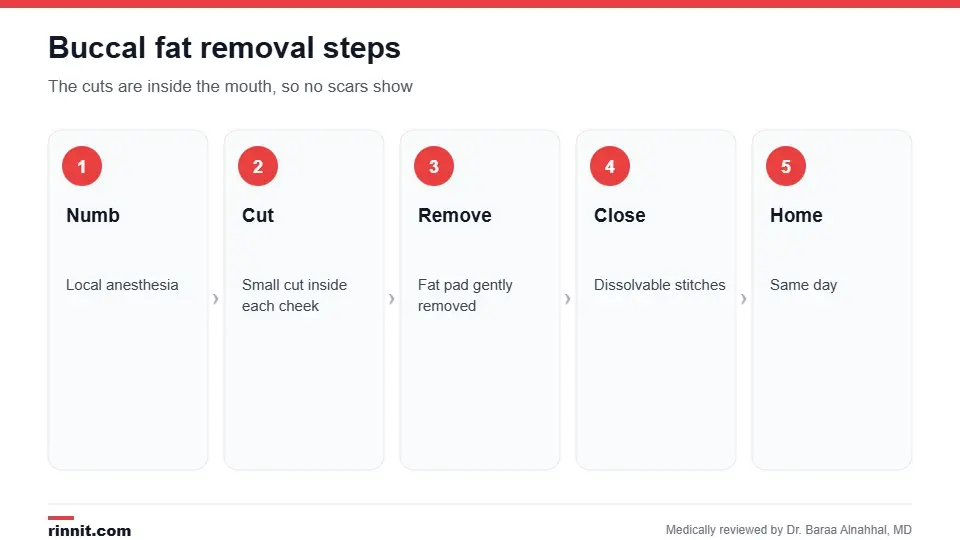
The cuts are inside the mouth, so no scars show.
You get local anesthesia and stay awake; general anesthesia may be used if you're having other procedures.
The surgeon makes a small cut inside your mouth on each cheek.
Gentle pressure brings the fat pad into view, and it's carefully removed.
The cuts are closed with stitches, which often dissolve.
You go home the same day. Sources: [1]
Risks
Risk | Notes |
Swelling, bruising, numbness | Expected at first |
Infection | At the cuts inside the mouth |
Facial nerve injury | Uncommon |
Salivary duct injury | Uncommon |
Asymmetry | Uneven cheeks |
The procedure is generally safe. In studies, most problems were minor and temporary. Sources: [1, 2]
Recovery
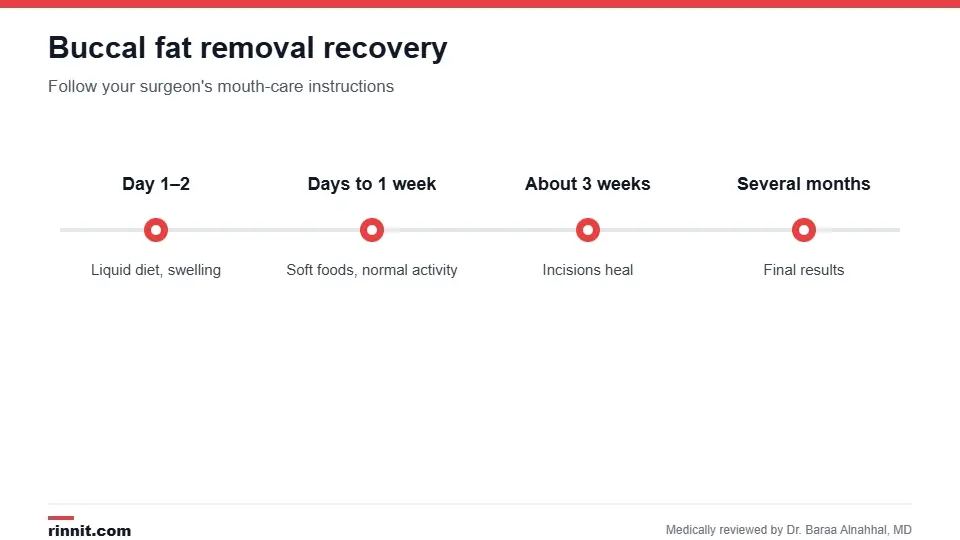
Follow your surgeon's mouth-care instructions.
When | What to expect |
First day or two | Liquid diet; swelling and bruising; special mouth rinse if prescribed |
After a few days to a week | Soft foods; most people return to normal activities |
About 3 weeks | Incisions heal |
Several months | Final results visible |
Sources: [1]
When to call your surgeon
Heavy bleeding.
Signs of infection, such as warmth, redness, pus or fever.
Uneven results or poor healing.
An unusual taste or signs of salivary gland damage.
Call 911 for shortness of breath, chest pain or an irregular heartbeat. Sources: [1]
Conclusion
Buccal fat removal is a quick, scarless way to slim full cheeks for the right candidate. Choosing an experienced surgeon and having realistic expectations about how your face will change with age lead to the best results.
Keep learning: read about cheek fillers and cheek implants.
Frequently asked questions
What is buccal fat removal?
Surgery that removes fat pads from the lower cheeks to slim the face.
Does buccal fat removal leave scars?
No visible scars; the cuts are inside the mouth.
Is it painful?
It's done with numbing medicine; expect soreness and swelling afterward.
How long is recovery?
Most people return to normal activities in a few days to a week.
When will I see results?
Final results take several months.
What can I eat after surgery?
Liquids for a day or two, then soft foods.
What are the risks?
Swelling, infection, numbness, nerve or salivary duct injury and asymmetry.
Who is a good candidate?
Healthy adults at a stable weight with full cheeks.
Is buccal fat removal permanent?
The fat doesn't grow back, but your face continues to change with age.
Can it make my face look hollow?
It can over time, since buccal fat naturally shrinks with age.
Related Reading
Brow Lift: Types, Procedure, Recovery and Results explains forehead and brow lift options.
Cheek Filler: Types, Procedure, Recovery, Risks and How Long It Lasts a nonsurgical way to change cheek shape.
Cheek Implants implants that add volume to the cheeks.
Cheek Lift surgery to lift sagging cheeks.
Facelift Surgery: A Comprehensive Guide to Facial Rejuvenation a surgery to tighten the face.
Cosmetic Surgery: A Guide to Aesthetic Procedures an overview of cosmetic procedures.
References
Cleveland Clinic. Buccal Fat Removal: What It Is, Recovery & Before & After. Cleveland Clinic. Last updated June 17, 2022. https://my.clevelandclinic.org/health/treatments/23396-buccal-fat-removal
Albuquerque MC, Arruda KAR, Xavier Junior GF, et al. Prevalence of complications of buccal fat removal: a systematic review and meta-analysis. J Craniomaxillofac Surg. 2025;53(4):363-369. PMID 39809616. https://doi.org/10.1016/j.jcms.2024.12.014
Traboulsi-Garet B, Camps-Font O, Traboulsi-Garet M, et al. Buccal fat pad excision for cheek refinement: a systematic review. Med Oral Patol Oral Cir Bucal. 2021;26(4):e474-e481. PMID 34023838. https://doi.org/10.4317/medoral.24335
Medical disclaimer
This article is for general education only and does not replace advice from a qualified healthcare professional. Talk to your doctor about your own diagnosis and treatment, and seek emergency care right away for severe or sudden symptoms.



Comments