Cheek Lift

Updated: 3 days ago
Medically reviewed by Dr. Baraa Alnahhal, MD · Last reviewed: October 2026
Quick Answer
A cheek lift is a cosmetic surgery that lifts and smooths the upper cheeks and lower eyelid areas by repositioning the malar fat pads and securing them with internal sutures. Unlike a traditional facelift, it focuses solely on the midface. Most people who choose it are in their 40s and 50s, and the procedure typically takes about two hours.
What the research says
Benefits of an endoscopic midface lift were still measurable years later. In a retrospective review of 143 patients who had an endoscopic preperiosteal midface lift, the median measure of midfacial height (WIZDOM-MC) decreased by 3.4 mm after surgery, and a 2.1 mm decrease was still present 5 to 15 years later. The improvement in the hollow under the eye was also sustained beyond 5 years, while gains in cheek fullness were maintained at 3 to 5 years and tended to return to baseline after 5 years. It was a single-surgeon, retrospective review (PubMed: Shtraks et al., JAMA Facial Plast Surg, 2019) [2].
A needle-assisted endoscopic technique reported stable results and high satisfaction. In a series of 75 patients who had an endoscopic midface lift using a percutaneous-needle suspension method, all cases showed satisfactory, symmetrical and stable elevation of the midface, patient satisfaction was high, and no patient needed a second surgery. This was a technique description from one center without a comparison group, and the abstract does not state the length of follow-up (PubMed: Askeroglu et al., Aesthetic Plast Surg, 2021) [3].
Traditional facelift techniques have not clearly improved the midface. A systematic review of 17 articles on deep-layer (SMAS) facelift techniques found patient satisfaction and improved facial contour across studies, but medially based "deep plane" techniques had not been shown to significantly improve the appearance of the midface or the longevity of results. The review looked at facelift techniques rather than cheek lifts themselves (PubMed: Schultz et al., Plast Reconstr Surg, 2026) [4].
What is a cheek lift procedure?
A cheek lift, clinically known as a midface lift, is a specialized cosmetic surgery targeting the central region of the face. As we age, the fat pads in our cheeks naturally descend, leading to a flattened appearance and deeper nasolabial folds, commonly known as smile lines. This procedure specifically addresses these changes by elevating the malar fat pads back to their youthful position.
While a traditional facelift focuses on the lower face, jawline, and neck, the cheek lift concentrates on the area between the lower lashes and the corners of the mouth. Many surgeons utilize an endoscope (a small camera) to guide the procedure, allowing for smaller incisions and more precise adjustments. This technique is often referred to as an endoscopic midface lift.
Feature | Cheek Lift (Midface Lift) | Traditional Facelift |
Target Area | Upper cheeks, lower eyelid area | Lower face, jawline, neck |
Primary Goal | Restore midface volume, lift smile lines | Address jowls, sagging neck skin |
Typical Age | 40s and 50s | 50s, 60s, and beyond |
Recovery Time | Generally shorter | Generally longer |
Who is a good candidate for a cheek lift, and how do you prepare?
Ideal candidates for a cheek lift are individuals in good physical and mental health who have realistic expectations about the surgical outcome. Common reasons for seeking this procedure include heavy or sagging cheeks and a hollow appearance beneath the eyes. It is crucial for candidates to be non-smokers, as smoking can significantly impair the body's ability to heal after surgery.
Preparation involves a thorough consultation with a board-certified plastic surgeon. During this time, the surgeon evaluates the patient's medical history, preexisting conditions, and aesthetic goals. Patients must disclose all medications and supplements, as certain substances like aspirin can increase the risk of bleeding during and after the procedure.

What happens during cheek lift surgery?
A cheek lift is typically performed under general anesthesia or conscious sedation to ensure patient comfort. The surgeon makes small incisions, which may be located in the hairline, around the ears, below the lower eyelash line, or even inside the mouth. The choice of incision depends on the patient's facial structure and the specific surgical technique employed.
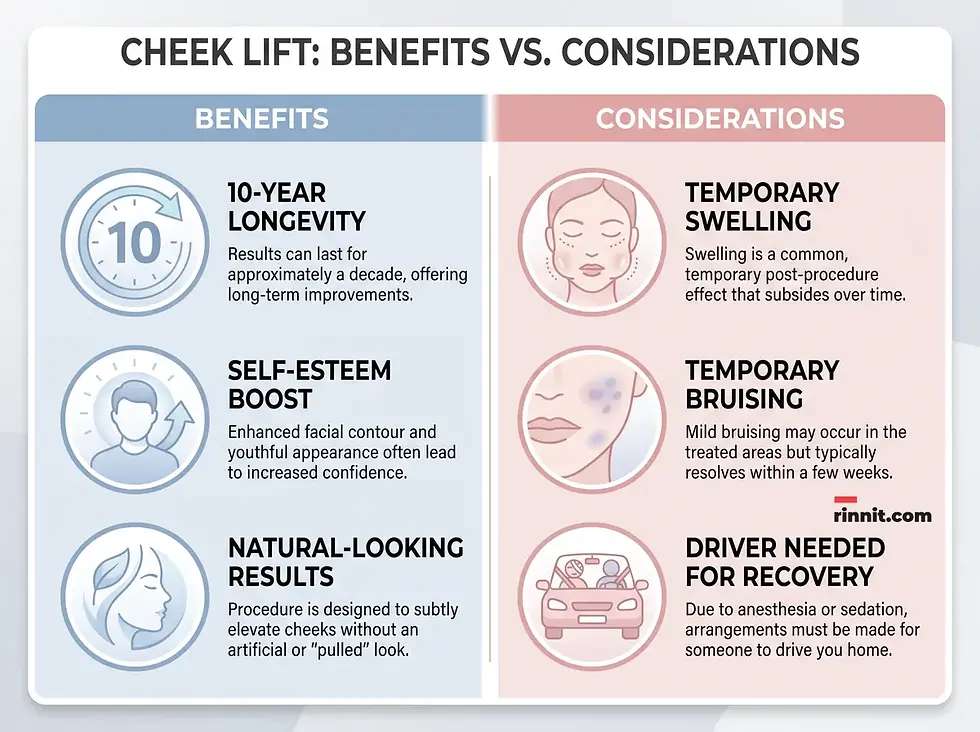
During the procedure, the surgeon carefully repositions the malar fat pads and secures them with internal sutures. This elevation smooths the skin and restores the natural contours of the cheekbones. The entire surgery usually takes approximately two hours. Most cheek lifts are outpatient procedures, allowing patients to return home the same day under the care of a companion.

What are cheek lift recovery and long-term results like?
Post-operative care is essential for a smooth recovery. Patients will initially wear bandages and may have small drainage tubes to prevent fluid buildup. Swelling and bruising are common in the first few days, and some patients may experience temporary numbness in the midface area. Most individuals can return to their normal activities within a few weeks.
One of the most significant advantages of a cheek lift is the longevity of the results. While nonsurgical treatments like fillers wear off within months, a surgical cheek lift typically lasts about 10 years. This provides a long-term solution for midface rejuvenation, helping patients maintain a youthful and refreshed appearance for a decade or more.
Conclusion
The cheek lift is a powerful tool for those seeking to address signs of aging in the middle of the face. By focusing on the cheeks and smile lines, it offers a targeted approach to rejuvenation that is both effective and long-lasting. Consulting with a qualified professional is the first step toward achieving a natural, youthful look that enhances self-esteem and facial harmony.
Consult Your Provider. If you are considering a cheek lift, ensure you choose a board-certified plastic surgeon. Discuss all potential risks and benefits, and follow all pre- and post-operative instructions to ensure the best possible outcome for your recovery.
Frequently Asked Questions
1. What is a cheek lift?
A cheek lift, or midface lift, is a cosmetic surgery that lifts and smooths the upper cheeks and the area around the lower eyelids.
2. How does it differ from a traditional facelift?
A cheek lift focuses on the middle of the face, while a traditional facelift targets the lower face, jawline, and neck.
3. What are the main benefits?
Benefits include immediate and long-lasting results (typically about 10 years), a self-esteem boost, and a relatively quick recovery compared to a full facelift.
4. Who is a good candidate for this surgery?
Ideal candidates are healthy non-smokers with sagging cheeks or hollow areas under the eyes who have realistic expectations.
5. How long does the procedure take?
Most cheek lift surgeries are completed in approximately two hours.
6. What kind of anesthesia is used?
Surgeons typically use either general anesthesia or conscious sedation so that you do not feel pain during the procedure.
7. Where are the incisions made?
Incisions can be made in the hairline, around the ears, below the lower eyelashes, or inside the mouth, depending on the technique.
8. What is the recovery process like?
Patients may experience temporary swelling and bruising. Most return home the same day and can resume normal activities within a few weeks.
9. Are the results permanent?
While not permanent, the results are long-lasting, typically enduring for about 10 years.
10. What are the common risks?
Risks include bruising, swelling, and temporary numbness under the eyes. Less common risks include hematoma, blood clots, infection, hair loss along the incision, and facial asymmetry.
11. How do I prepare for a cheek lift?
Start by choosing an experienced plastic surgeon who is board-certified by the American Board of Plastic Surgery, and ask about their accreditation, hospital privileges and how many cheek lifts they've performed. [1] Tell your provider about any allergies and every prescription, over-the-counter and herbal product you use, because aspirin, anti-inflammatory drugs and some supplements raise your bleeding risk. [1] Don't change your medications unless a healthcare provider approves it. [1] Arrange for someone to drive you home and care for you for the first 24 hours after surgery. [1]
12. When should I call my doctor after a cheek lift?
The first several days after a cheek lift are often the most uncomfortable, and swelling around your cheeks can last up to six weeks. [1] Keep your scheduled follow-up appointments so your provider can check your incisions, bruising and swelling and remove your stitches. [1] Contact your provider immediately if you have bleeding that seeps through your bandages, extreme swelling, a fever, pus or other abnormal discharge from your incisions, extreme pain, or stitches that come out before their removal date. [1]
Related Reading
Buccal Fat Removal: Procedure, Recovery and Results explains cheek reduction surgery.
References
Cleveland Clinic. Cheek Lift (Midface Lift): Surgery, Recovery, What To Expect. Cleveland Clinic. Nov. 17, 2023. https://my.clevelandclinic.org/health/procedures/17232-cheek-lift
Shtraks JP, Fundakowski C, Yu D, Hartstein ME, Sarcu D, Lu X, Wulc AE. Investigation of the longevity of the endoscopic midface lift. JAMA Facial Plast Surg. 2019;21(6):535-541. PMID 31621793. https://doi.org/10.1001/jamafacial.2019.1015
Askeroglu U, Kayadibi T, Pilanci O. Trinity lift: a unique technique for endoscopic midface and lower periorbital unit lift. Aesthetic Plast Surg. 2021;45(3):992-1001. PMID 33452544. https://doi.org/10.1007/s00266-021-02126-5
Schultz KP, Sherif R, Ganesh Kumar N, Stuzin JM, Rohrich RJ. Demystifying deep layer face-lift techniques: a systematic review of superficial musculoaponeurotic system techniques. Plast Reconstr Surg. 2026;157(4):615-620. PMID 41100833. https://doi.org/10.1097/PRS.0000000000012526
Medical Disclaimer
This article is for informational purposes only and does not constitute medical advice. Always seek the advice of your physician or other qualified health provider with any questions you may have regarding a medical condition. Never disregard professional medical advice or delay in seeking it because of something you have read here.



Comments