Bullectomy: Procedure Details, Risks & Recovery

Updated: 2 days ago
Written and medically reviewed by Dr. Baraa Alnahhal, MD · Last reviewed: November 2026 · How we review
Quick Answer
A bullectomy is surgery to remove one or more bullae, large pockets of trapped air in the lungs, most often from bullous emphysema. Bullae can squeeze healthy lung, make breathing harder and cause a collapsed lung. The operation takes about 90 minutes to over 2 hours, and most people stay in the hospital at least 3 days.
What the research says
In a population-based study of giant bullae, average FEV1 (how much air you can blow out in one second) rose from 1.0 L to 1.75 L one month after surgery, with no operative deaths (Gunnarsson et al., Scandinavian Journal of Surgery, 2012) [2].
The same study found prolonged air leak in 75% of patients and pneumonia in 17%, and lung function gains slowly declined toward baseline over the following years [2].
For spontaneous pneumothorax, recurrence after a chest tube alone was 26.1% to 50.1%, compared with 0% to 3.2% after VATS with talc pleurodesis (Hallifax et al., Thorax, 2017) [3].
Key takeaways
Bullectomy removes air-filled bullae so healthy lung can expand.
It can ease shortness of breath and treat or prevent a collapsed lung.
Most surgeons use minimally invasive VATS or robotic surgery.
An air leak lasting more than a week is the most common complication.
Results tend to be best when there's one bulla or the bullae are in one area [1].
What is a bullectomy?
A bulla is a thin-walled pocket of trapped air inside the lung. It forms when the walls of tiny air sacs break down. Bullae don't help with breathing. Instead, they take up space and press on the healthy lung around them [1].
During a bullectomy, a thoracic (chest) surgeon removes most of the bulla wall and staples the remaining edge closed. This gives the healthy lung more room to work. Surgeons use one of three approaches [1]:
Approach | How it's done | Notes |
VATS | Several small incisions, a camera and thin tools | Most common approach |
Robotic surgery | Small incisions; the surgeon controls robotic arms | Minimally invasive |
Thoracotomy | One larger incision between the ribs | Open surgery; used less often |
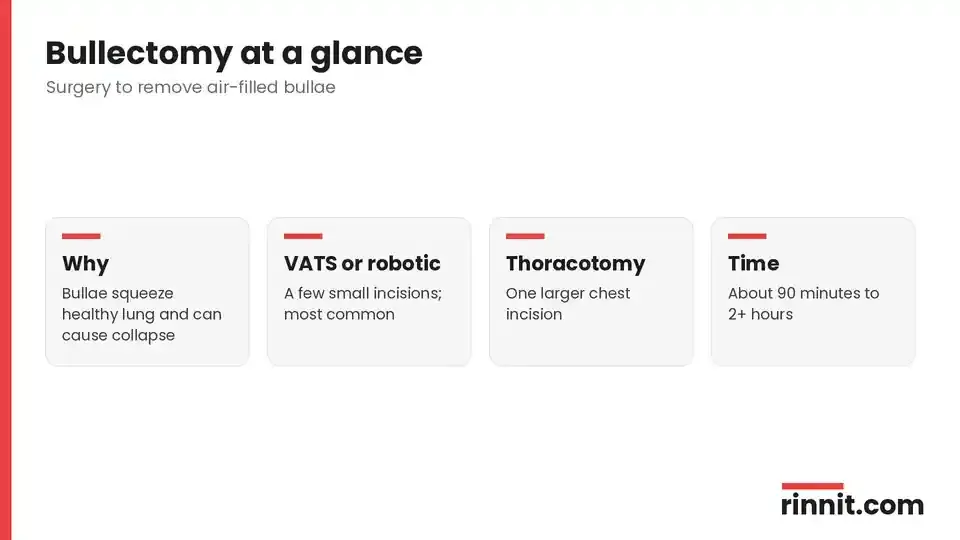
Most bullectomies today use a minimally invasive approach.
Who might need a bullectomy?
Your doctor may recommend a bullectomy if bullae are [1]:
Compressing healthy lung tissue and causing shortness of breath
Causing a collapsed lung (pneumothorax), especially if it comes back
Linked to repeat infections
Raising concern because of their size or growth
Bullae are often linked to COPD and smoking. If you have bullae in both lungs, your surgeon may operate on the second side many months after the first [1].
How to prepare
Before surgery, your care team will check how well your lungs and heart work. Common tests include [1]:
Chest X-ray and CT scan to show the size and location of bullae
Pulmonary function tests
Cardiopulmonary exercise testing
A six-minute walk test
Your team may also ask you to stop smoking, use inhalers (bronchodilators) and join a pulmonary rehab program to get your lungs as strong as possible before surgery [1].
How is bullectomy done?
You'll be fully asleep under general anesthesia. The surgical team then [1]:
Performs a bronchoscopy to clear the airway.
Uses a breathing tube and ventilator to breathe for the lung that isn't being operated on.
Deflates the lung being treated.
Opens the bulla and removes most of its wall.
Staples the remaining wall (about 2 to 3 cm) to the base of the bulla.
Places a chest tube, in most cases, to help the lung re-expand.
Re-inflates the lung, then removes the breathing tube.
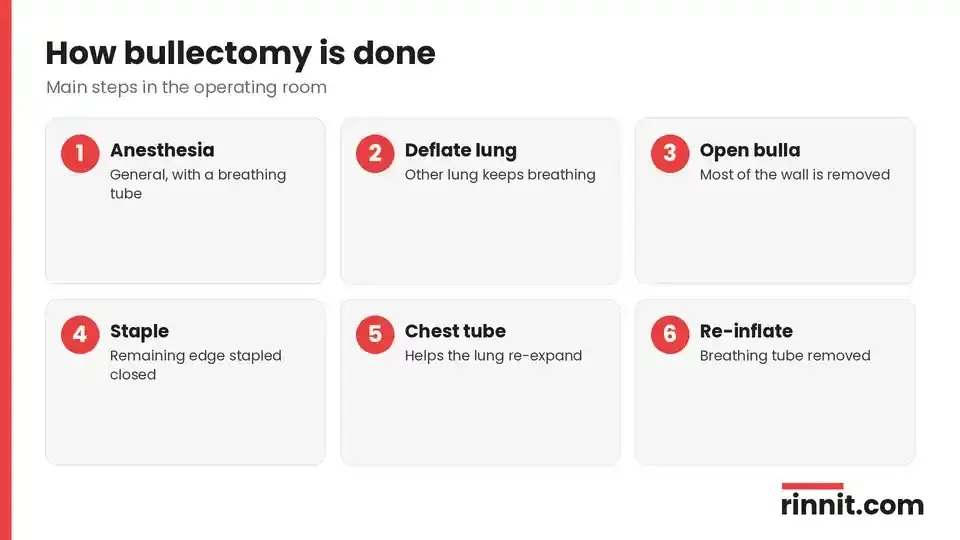
The median operating time is about 90 minutes to over 2 hours.
If your surgeon uses VATS, you can learn more in our guide to video-assisted thoracic surgery.
Recovery after bullectomy
Most people stay in the hospital for at least 3 days. A chest tube drains air and fluid and is usually removed before you go home [1].
When | What to expect |
Surgery day | Pain medicine, supplemental oxygen, getting out of bed as soon as possible |
Day 1 | Physical therapy begins |
Day 3 or later | Chest tube removed; discharge home |
First few weeks | Chest X-ray and follow-up visits |
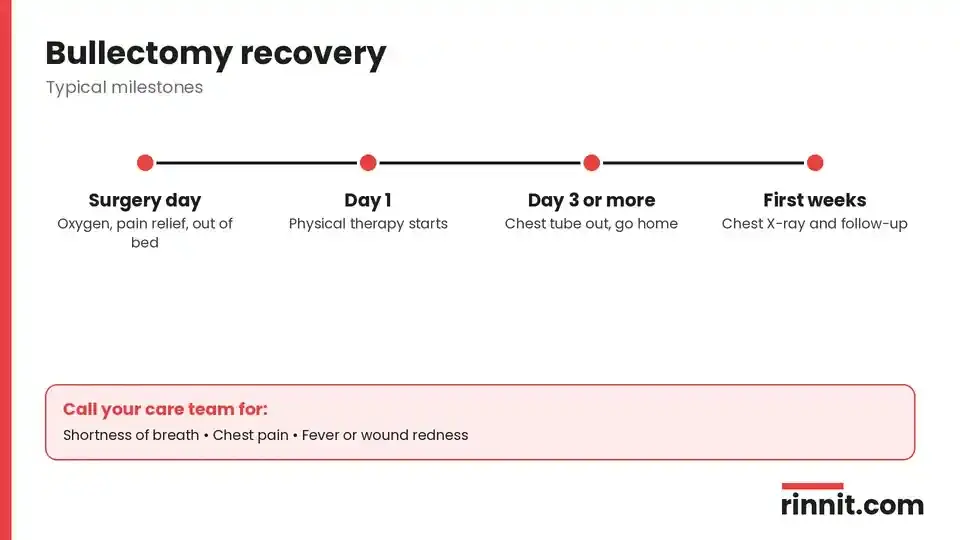
If you had surgery for a collapsed lung, an X-ray confirms your lung has re-expanded [1].
Benefits
For the right person, bullectomy can help the lungs work better for many years. Many people can walk farther or climb more stairs than before surgery [1]. Other treatments exist, but their results may not last as long.
Risks and complications
The most common complication is an air leak lasting more than a week [1]. Other risks include:
Heart rhythm problems
Pneumonia
Bleeding
Fluid in the lungs (pulmonary edema)
Air trapped under the skin (subcutaneous emphysema)
Chronic pain
Rarely, people with very weak lungs can develop lung failure, which can be fatal [1]. Your surgeon will weigh these risks against the expected benefit.
When to call your doctor
Contact your provider right away if you have new or worsening shortness of breath or chest pain after surgery [1]. Also call for fever, or redness or drainage at the incision.
Conclusion
Bullectomy can free up space for healthy lung, ease breathlessness and prevent repeat lung collapse. Recovery usually starts with a few days in the hospital and a chest tube. If you have large bullae or a collapsed lung that keeps coming back, ask your pulmonologist or thoracic surgeon whether a bullectomy is right for you.
FAQ
What is a bullectomy?
It's surgery to remove large air-filled pockets (bullae) from the lung so healthy lung tissue has more room to work [1].
Is bullectomy a major surgery?
Yes. It's done under general anesthesia and usually needs a hospital stay of at least 3 days, though most are minimally invasive [1].
How long does a bullectomy take?
The median operating time is about 90 minutes to over 2 hours [1].
How long is recovery after a bullectomy?
Most people go home after 3 or more days, with a chest X-ray and follow-up visits in the first few weeks [1].
Does bullectomy improve breathing?
It can. In one study, average FEV1 rose from 1.0 L to 1.75 L one month after surgery for giant bullae [2].
What is the most common complication of bullectomy?
An air leak lasting more than a week is the most common complication [1].
Can bullectomy prevent a collapsed lung?
It can help. In studies, VATS surgery with talc pleurodesis had recurrence rates of 0% to 3.2% [3].
What's the difference between VATS and thoracotomy?
VATS uses several small incisions and a camera, while thoracotomy uses one larger chest incision [1].
Can bullae come back after surgery?
New bullae can form if lung damage continues, which is why quitting smoking is important.
Who is a good candidate for bullectomy?
People whose bullae compress healthy lung or cause repeat collapse, especially with one bulla or bullae in one area [1].
How do I prepare for a bullectomy?
Before surgery, you'll usually have a chest X-ray and CT scan to show the size and location of the bullae, and you may also have pulmonary function tests, cardiopulmonary exercise testing and a six-minute walk test [1]. Your team may ask you to stop smoking, use a bronchodilator or inhaler, and join a pulmonary rehab program first [1].
Does a bullectomy hurt, and what anesthesia is used?
You're given anesthesia so you sleep through the operation and feel no pain [1]. Afterward you receive pain medicine, and chronic pain is one of the possible complications [1].
When should I call my doctor after a bullectomy?
Contact your provider if you have shortness of breath or chest pain after surgery [1]. You'll also have follow-up visits and may need a chest X-ray within the first few weeks [1].
Related Reading
Learn more in our guide to Bullous Emphysema.
Learn more in our guide to COPD.
Learn more in our guide to Pneumothorax (Collapsed Lung).
Learn more in our guide to Video-Assisted Thoracic Surgery (VATS).
Learn more in our guide to Thoracostomy (Chest Tube Insertion).
References
Cleveland Clinic. Bullectomy: Procedure Details & Recovery. Cleveland Clinic. Last updated September 9, 2026. https://my.clevelandclinic.org/health/procedures/bullectomy
Gunnarsson SI, Johannesson KB, Gudjonsdottir M, et al. Incidence and outcomes of surgical resection for giant pulmonary bullae: a population-based study. Scand J Surg. 2012;101(3):166-169. PMID 22968239. https://doi.org/10.1177/145749691210100305
Hallifax RJ, Yousuf A, Jones HE, et al. Effectiveness of chemical pleurodesis in spontaneous pneumothorax recurrence prevention: a systematic review. Thorax. 2017;72(12):1121-1131. PMID 27803156. https://doi.org/10.1136/thoraxjnl-2015-207967
Medical disclaimer
This article is for general education only and does not replace advice from a qualified healthcare professional. Talk to your doctor about your own diagnosis and treatment, and seek emergency care right away for severe or sudden symptoms.


Comments