Biofeedback Therapy: What It Is, How It Works, and Who It Helps

Updated: 6 days ago
Written and medically reviewed by Dr. Baraa Alnahhal, MD · Last reviewed: October 2026 · How we review
Quick Answer: What is biofeedback therapy?
Biofeedback therapy is a mind-body treatment that teaches you to control body functions that usually run on autopilot, such as heart rate, breathing and muscle tension. Painless skin sensors show these signals in real time while a trained provider coaches relaxation skills. It may help anxiety, chronic pain, migraine, high blood pressure and incontinence, and has no known side effects. [1]
What the research says
Heart rate biofeedback is linked to a large drop in stress and anxiety. A meta-analysis of 24 studies with 484 participants found that heart rate variability biofeedback produced a large reduction in self-reported stress and anxiety compared with control groups (effect size g = 0.83), and the benefit held regardless of the number of sessions. (Goessl et al., Psychological Medicine, 2017)
Biofeedback reduces how often and how badly migraines hit. A 2025 meta-analysis of randomized trials (9 studies, 558 adults) found biofeedback significantly cut headache frequency and severity compared with waiting-list groups. In 3 trials with 278 adults, it showed no significant difference in headache frequency compared with active treatments such as medication or cognitive behavioral therapy. (Paudel et al., Complementary Therapies in Medicine, 2025)
In children with voiding problems, biofeedback improves bladder emptying. A meta-analysis of randomized trials in children with non-neurological dysfunctional voiding found biofeedback improved urine flow, lowered leftover urine after peeing, and cut urinary tract infection risk by more than half (RR 0.43), with effects lasting over a year. (Li et al., Journal of Pediatric Urology, 2024)
Key takeaways
Biofeedback turns invisible body signals into feedback you can see, hear, or feel.
You learn skills during sessions, then practice them at home without equipment.
It supports treatment for anxiety, pain, headaches, bladder and bowel problems, and more.
It is a complement to medical care. Keep taking prescribed medicines.
Choose a provider certified in biofeedback before you start.
What is biofeedback?
Biofeedback (also called biofeedback therapy) is a mind-body approach that teaches you to change the way your body works. It may improve both physical and mental health.
Many body functions happen without you thinking about them. Your heart speeds up, your breathing gets shallow, and your muscles tighten when you feel stressed. These are called involuntary functions.
Biofeedback makes these functions visible. Once you can see them, you can learn to influence them on purpose.
Providers rarely use biofeedback as the only treatment. It usually works best as one part of a wider plan.
Who offers biofeedback?
Several types of healthcare providers offer biofeedback, including:
Psychologists
Physical therapists
Primary care providers
Look for a provider certified by the Association for Applied Psychophysiology and Biofeedback (AAPB). Check their certification before your first session.
How does biofeedback work?
Biofeedback works through operant conditioning, a form of learning in which a clear signal rewards you for doing the "right" thing and encourages you to repeat it.
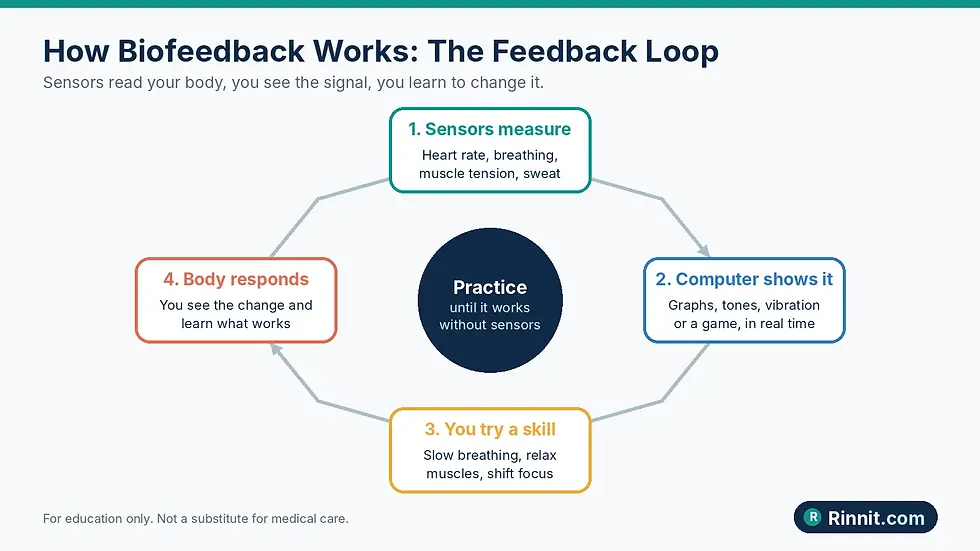
Here is how the loop works, step by step:
Sensors measure a body signal. For example, your heart rate or how tense a muscle is.
A computer shows you the signal right away. It may appear as a graph, a tone, or a game.
You try a skill. Your provider may ask you to slow your breathing or relax a muscle group.
You see your body respond. The feedback changes as your body changes.
You repeat until it sticks. Over time, the skill becomes automatic and you no longer need the equipment.
Most people don't notice how their body reacts to pain, stress, or anxiety. Biofeedback builds that awareness first, then teaches you to change the reaction.
What are the types of biofeedback?
Biofeedback types include breathing, heart rate, muscle, sweat, brain and skin temperature biofeedback, and each uses a different painless sensor. Your provider picks the one that fits your condition.

Type | What it measures | How it's measured |
Breathing | Breathing rate and pattern | Bands with sensors around the chest and belly |
Heart rate | Pulse and heart rhythm | Pulse sensor or electrocardiogram (EKG) sensors |
Muscle (sEMG) | Muscle movement and tension | Surface electromyography sensors on the skin over a muscle |
Sweat (GSR) | Sweat gland activity | Galvanic skin response sensors on the fingertips or palm |
Brain (neurofeedback) | Electrical brain activity | Electroencephalogram (EEG) sensors on the scalp |
Skin temperature | Skin warmth | A temperature sensor on the skin |
Muscle biofeedback (EMG) is common for muscle-related problems because it lets you "see" a muscle tighten and relax.
How do you receive biofeedback signals?
Feedback style | What it looks or feels like |
Visual | Changing graphs, patterns, or images on a screen |
Auditory | Tones that rise and fall, or music that gets louder or softer |
Haptic | Vibrations from a wearable device |
Virtual reality | An interactive video game, which is especially helpful for children |
What conditions can biofeedback help?
Biofeedback may help manage symptoms of many conditions, including anxiety, chronic pain, migraine, incontinence and high blood pressure.

Area | Conditions |
Mental health | |
Pain | Chronic low back pain, chronic pelvic pain, fibromyalgia, other pain syndromes |
Headache | |
Bladder and bowel | |
Heart and circulation | High blood pressure, Raynaud's syndrome |
Brain and nerves | Epilepsy, tinnitus, motion sickness |
Other | Chronic fatigue syndrome |
For most of these conditions, biofeedback is used together with other treatments, such as medication or talk therapy (psychotherapy).
How is biofeedback used for bladder control in children?
Biofeedback is often used for urinary incontinence and bedwetting in children. Here is how it can work:
With consent, a provider places a small sensor near the child's anus and another on the leg.
A pelvic floor specialist teaches the child pelvic floor exercises.
The exercises are built into a video game. For example, the child squeezes their pelvic floor muscles to help a character jump over obstacles.
The child also practices the exercises at home.
Over time, this can strengthen the pelvic floor and reduce leaks.
What happens during a biofeedback session?
During a biofeedback session, a certified provider places painless sensors on your body, and a computer reads the signals and reports them back to you within seconds.
Your provider explains what the feedback means. Then they suggest ways to change how your body is working. These may include:
Strategy | What you do | How it may help |
Change your posture | Sit, stand, or move differently | Eases muscle tension |
Alter your breathing | Use slower, steadier breathing patterns | Calms anxiety and lowers heart rate |
Relax your muscles | Focus on relaxing specific muscle groups | May relieve pain and help with sleep |
Use mindfulness and focus | Shift what you are thinking about | Helps control breathing and slow heart rate |
Take a stress test | Solve a math problem or riddle | Shows how stress affects your body |
As you try each strategy, you watch, hear, or feel the effect in real time. With practice, you can create the same changes without the device or your provider's prompts.
Can you do biofeedback at home?
Yes. Once you learn the exercises with a certified provider and monitoring equipment, you can practice them on your own at home.
How many biofeedback sessions do you need?
Biofeedback needs multiple sessions plus practice between them, and the exact number varies widely from person to person. It is often seen as training rather than a one-time treatment.
The number of sessions depends on:
The condition you are managing
How severe your symptoms are
How your body responds
How much you practice between sessions
Your provider can suggest a schedule that fits your needs.
What are the benefits and risks of biofeedback?
Biofeedback can relieve stress, ease aches and pains and help you feel more in control of your health, and it has no known side effects or complications.
What to know | |
Benefits | Helps you feel more in control of your health. Can relieve stress, ease aches and pains, and improve performance. |
What it takes | You must take an active part and stay motivated to learn and practice. |
Risks | Biofeedback is noninvasive. There are no known side effects or complications. |
When should you see a doctor instead of relying on biofeedback?
Biofeedback supports medical care and does not replace it, so you should see a doctor for any health problem even if biofeedback is helping. Most people use it alongside other treatments. For example, a person with chronic pain may take medication and also learn biofeedback.
Keep these points in mind:
Don't delay seeing a doctor for a health problem, even if biofeedback is helping.
Keep taking your prescribed medicines, no matter how well biofeedback works for you.
Tell your doctor if your symptoms change or get worse.
Conclusion
Biofeedback gives you a window into your own body. By turning heart rate, breathing, muscle tension, and other signals into clear feedback, it helps you learn skills that can calm stress, ease pain, and improve control over bladder and bowel function. It is safe and noninvasive, but it takes practice and works best as part of a full treatment plan.
Thinking about biofeedback? Talk with your doctor about whether it fits your condition, and choose a certified provider. Keep exploring Rinnit.com for clear, doctor-reviewed guides on the conditions biofeedback can help manage, from anxiety to migraine.
Frequently asked questions
What is biofeedback in simple terms?
Biofeedback is a therapy that uses sensors to show you what your body is doing, like your heart rate or muscle tension, so you can learn to change it on purpose.
Is biofeedback painful?
No. The sensors sit on your skin and are painless. Biofeedback is noninvasive.
Does biofeedback have side effects?
Biofeedback has no known side effects or complications.
What is neurofeedback?
Neurofeedback is a type of biofeedback that uses EEG sensors on the scalp to measure electrical brain activity.
Can biofeedback replace medication?
No. Biofeedback complements medical care. Keep taking your prescribed medicines and follow your doctor's advice.
How long does it take for biofeedback to work?
It varies. Results depend on your condition, how severe it is, how your body responds, and how much you practice between sessions.
Can children have biofeedback?
Yes. Children often use biofeedback for bladder problems and bedwetting, and game-based feedback can make sessions easier for them.
Who is qualified to provide biofeedback?
Psychologists, physical therapists, and primary care providers can offer it. Look for certification from the Association for Applied Psychophysiology and Biofeedback (AAPB).
How many biofeedback sessions will I need?
It varies widely from person to person. Biofeedback usually takes several sessions plus practice at home, because it works more like training than a one-time treatment.
Can I do biofeedback at home?
Yes. Once you learn the exercises with a certified provider, you can practice them on your own at home.
Related Reading
Anorectal Manometry: Why It's Done, How to Prepare, What Happens and What Results Mean explains the pressure test that finds muscle and nerve causes of constipation and incontinence.
References
Cleveland Clinic. Biofeedback: What It Is, Purpose, Procedure, Risks & Benefits. Cleveland Clinic. Last updated October 27, 2023. https://my.clevelandclinic.org/health/treatments/13354-biofeedback
Goessl VC, Curtiss JE, Hofmann SG. The effect of heart rate variability biofeedback training on stress and anxiety: a meta-analysis. Psychological Medicine. 2017;47(15):2578-2586. PMID: 28478782. https://doi.org/10.1017/S0033291717001003
Paudel P, Sah A. Efficacy of biofeedback for migraine: a systematic review and meta-analysis. Complementary Therapies in Medicine. 2025;90:103153. PMID: 40064357. https://doi.org/10.1016/j.ctim.2025.103153
Li F, Feng L, Yang Y, et al. The effect of biofeedback on nonneurological dysfunctional voiding in children: a meta-analysis and systematic review. Journal of Pediatric Urology. 2024;20(4):565-580. PMID: 38997937. https://doi.org/10.1016/j.jpurol.2024.06.042
Medical disclaimer
This article is for general educational purposes and is not a substitute for professional medical advice, diagnosis or treatment. Always talk with your doctor or another qualified healthcare provider about your symptoms and whether biofeedback is right for you.



Comments