Anorectal Manometry: Why It's Done, How to Prepare, What Happens and What Results Mean

Updated: 2 days ago
Written and medically reviewed by Dr. Baraa Alnahhal, MD · Last reviewed: November 2026 · How we review
Quick Answer
Anorectal manometry is a test that measures how well the muscles and nerves of the rectum and anus work. A thin catheter with pressure sensors and a small balloon is placed in the rectum while you squeeze, relax and push. It takes about 30 minutes and is used to find the cause of chronic constipation and fecal incontinence.
What the research says
The test is underused but changes treatment: an expert roundtable review concludes that anorectal manometry remains underused despite being the key test for identifying dyssynergic defecation and sphincter weakness, conditions that respond to biofeedback therapy (Rao SSC et al., Clinical Gastroenterology and Hepatology, 2023) [2]
Artificial intelligence can read the tracings: a multicenter study of 1,214 manometry studies across three systems found a video-based deep-learning model classified defecation patterns with areas under the curve of 0.99, 0.90 and 0.79, suggesting interpretation can become more consistent between centers (Azher Z et al., Clinical Gastroenterology and Hepatology, 2026) [3]
Reporting is becoming standardized: after a national position paper on anorectal manometry, 87% of centers changed their practice to include standardized reporting and consistent normal values, which makes results easier to compare between hospitals (Mazor Y et al., European Journal of Gastroenterology & Hepatology, 2025) [4]
Key takeaways
Measures resting and squeeze pressure, rectal sensation, reflexes and coordination during a push.
Preparation: an enema about 2 hours before and no food for 2 hours; tell staff about latex allergy.
You lie on your left side; the catheter is thinner than a finger and insertion is briefly uncomfortable, not painful.
A balloon expulsion test is usually included.
Results are classified with the London Classification and often lead to biofeedback therapy.
What is anorectal manometry?
The anorectum has two sphincter muscles, a reflex that relaxes the inner sphincter when stool arrives, sensory nerves that signal fullness, and pelvic floor muscles that must relax to let stool out. Manometry tests each of these parts. High-resolution systems display pressures as a color map, so a provider can see whether the muscles squeeze, relax and coordinate normally. Sources: [1]
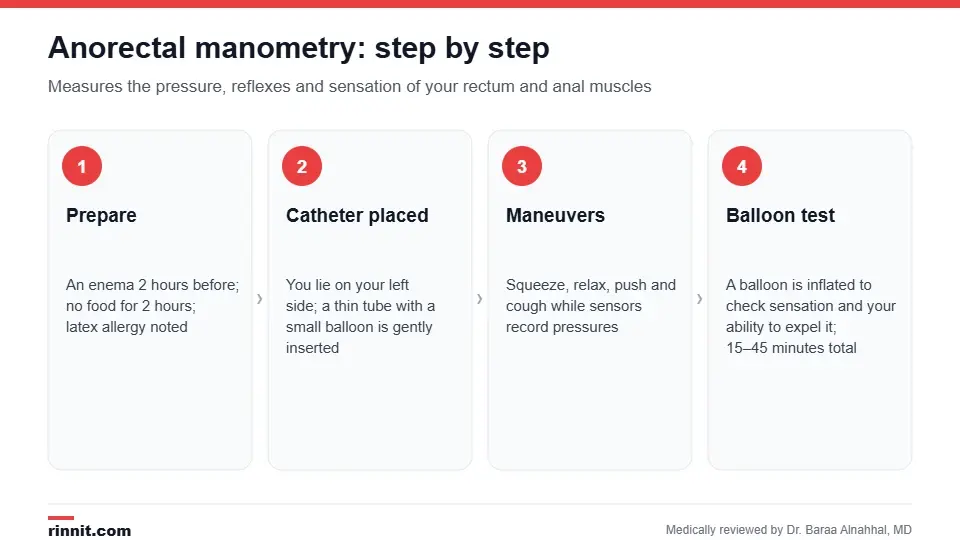
The test takes 15–45 minutes and is done on your left side.
Why is it done?
Chronic constipation that has not responded to diet, fluids and laxatives.
Fecal incontinence (leakage of stool or gas).
Suspected dyssynergic defecation (anismus), where the pelvic floor tightens instead of relaxing.
Suspected Hirschsprung disease in children (absence of the recto-anal inhibitory reflex).
Before and after surgery on the anus or rectum, or after childbirth injury.
Planning and monitoring biofeedback therapy. Sources: [1]
How do I prepare?
Use an enema about 2 hours before the test, as instructed, so the rectum is empty.
Do not eat for 2 hours beforehand; you can usually take your regular medicines.
Tell the team if you are allergic to latex, because some balloons contain it.
Wear comfortable clothing; you will undress from the waist down and be covered with a sheet. Sources: [1]
What happens during the test?
You lie on your left side with your knees bent.
A thin, lubricated catheter with pressure sensors and a deflated balloon at the tip is gently inserted a few centimeters into the rectum.
Resting pressure is recorded while you relax.
You are asked to squeeze as if holding in gas, hold the squeeze, then cough, then push as if having a bowel movement.
The balloon is inflated in steps; you say when you first feel it, when you feel an urge, and when it becomes uncomfortable.
For the balloon expulsion test, you sit on a commode and try to pass a water-filled balloon within a set time.
The catheter is removed; you can go home and eat normally. Sources: [1]
The average test takes about 30 minutes (15–45). You may feel pressure, mild cramping or a brief urge to have a bowel movement. Sources: [1]
What it measures

Each measurement maps to a specific muscle or nerve function.
Measurement | What it tests | Abnormal result may suggest |
Resting pressure | Internal anal sphincter tone | Low: incontinence; high: anal fissure or hypertonic pelvic floor |
Squeeze pressure | External sphincter strength and endurance | Weakness after childbirth injury or nerve damage |
Push maneuver | Coordination of rectal push and pelvic floor relaxation | Dyssynergic defecation (paradoxical contraction) |
Rectal sensation | Nerve signaling of fullness | Reduced sensation in constipation; heightened sensation in urgency |
Recto-anal inhibitory reflex | Inner sphincter relaxation when the rectum fills | Absent in Hirschsprung disease |
Cough reflex | Reflex sphincter contraction | Nerve injury if absent |
Balloon expulsion | Ability to pass stool | Failure supports dyssynergia |
Sources: [1]
Understanding your results
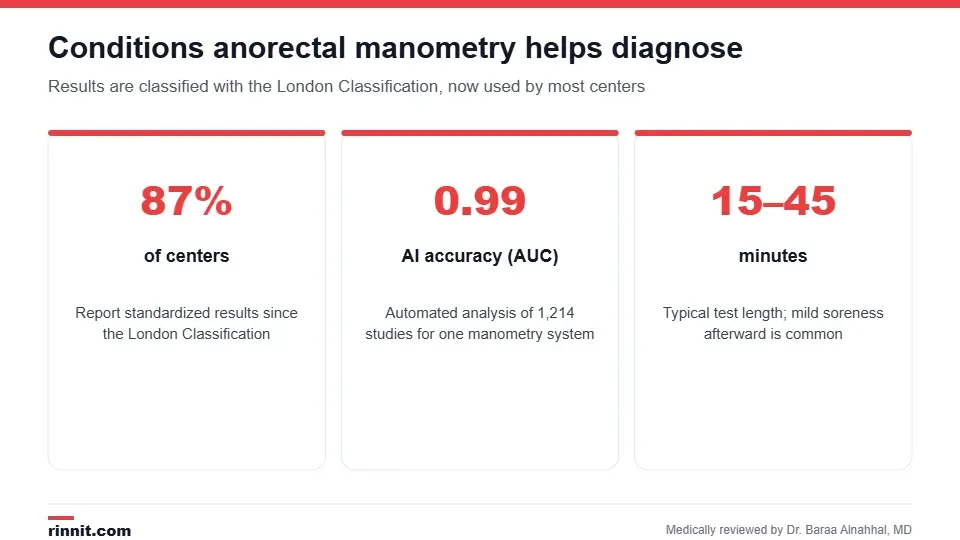
Standardized reporting and AI are making results more consistent between centers.
Your provider classifies the pattern using the London Classification, which groups disorders of the anal sphincter (weak or overactive), rectal sensation (reduced or heightened) and defecation (dyssynergia or poor propulsion). Many results are normal; the test is as useful for ruling out a muscle or nerve cause as for finding one. Sources: [1]
Standardization has improved: 87% of surveyed centers now use a standardized protocol after a national position paper, and AI models can classify defecation patterns with an AUC up to 0.99. An expert roundtable emphasizes that manometry remains underused even though it identifies dyssynergia, a condition that responds to biofeedback rather than more laxatives. Sources: [2, 3, 4]
What happens next?
Depending on the result, your provider may recommend biofeedback therapy, pelvic floor physical therapy, changes in laxative or fiber use, sphincter-strengthening exercises, or further tests such as defecography, colonic transit studies or endoanal ultrasound. Sources: [1]
Risks
Anorectal manometry is very safe. Mild soreness, a small amount of bleeding from hemorrhoids, or brief cramping can occur. A latex reaction is possible if you are allergic and the team is not told. Sources: [1]
Conclusion
Anorectal manometry turns a vague problem like "I can't go" or "I can't hold it" into a specific diagnosis of which muscle or nerve is not doing its job. The test is brief and safe, and its results often open the door to biofeedback, a treatment that cannot be chosen without it. If you have long-standing constipation or incontinence, ask whether manometry is appropriate for you.
Keep learning: read about pelvic floor muscles and rectal prolapse.
Frequently asked questions
Does anorectal manometry hurt?
No. The catheter is thin and lubricated. Most people feel pressure, mild cramping or an urge to have a bowel movement, but not pain.
How long does the test take?
About 30 minutes on average, with a range of 15–45 minutes including the balloon expulsion test.
Do I need an enema?
Yes, usually about 2 hours before, so the rectum is empty and the sensors can measure accurately.
Can I eat before the test?
Do not eat for about 2 hours beforehand. Regular medicines are usually fine; ask your provider about laxatives.
What is the balloon expulsion test?
A water-filled balloon is placed in the rectum and you try to pass it while sitting on a commode. Difficulty passing it supports a diagnosis of dyssynergic defecation.
What does an abnormal result mean?
It depends on the pattern: weak sphincters point to incontinence causes, paradoxical contraction during a push suggests dyssynergia, and an absent reflex suggests Hirschsprung disease.
What is the London Classification?
An international system for reporting anorectal manometry results, grouping disorders of the sphincter, rectal sensation and defecation.
Is the test used in children?
Yes. It is a standard way to check for Hirschsprung disease by looking for the recto-anal inhibitory reflex.
What treatment follows?
Often biofeedback or pelvic floor physical therapy; sometimes medication changes or further imaging.
Are there risks?
Minimal. Mild soreness or spotting from hemorrhoids can occur. Tell the team if you have a latex allergy.
Related Reading
Constipation: Symptoms, Causes, Diagnosis and Treatment — What You Need to Know the most common reason anorectal manometry is ordered.
Fecal Incontinence: Symptoms, Causes, and Treatment how sphincter weakness found on manometry is treated.
Anismus (Dyssynergic Defecation): Causes, Symptoms, Diagnosis, and Biofeedback Treatment the coordination disorder manometry is best at detecting.
Biofeedback Therapy: What It Is, How It Works, and Who It Helps the treatment that manometry results most often lead to.
Pelvic Floor Muscles: Anatomy, Function, Dysfunction and Care the muscles whose function this test measures.
References
Cleveland Clinic. Anorectal Manometry: What It Is, Procedure Details & Results. Cleveland Clinic. Last updated September 6, 2023. https://my.clevelandclinic.org/health/diagnostics/12760-anorectal-manometry
Rao SSC, Ahuja NK, Bharucha AE, et al. Optimizing the utility of anorectal manometry for diagnosis and therapy: a roundtable review and recommendations. Clinical Gastroenterology and Hepatology. 2023;21(11):2727-2739.e1. PMID 37302444. https://doi.org/10.1016/j.cgh.2023.05.025
Azher Z, Ginnebaugh BD, Levinthal DJ, et al. Multicenter validation of video-based deep learning to evaluate defecation patterns on 3-dimensional high-definition anorectal manometry. Clinical Gastroenterology and Hepatology. 2026;24(1):232-240. PMID 40706732. https://doi.org/10.1016/j.cgh.2025.06.038
Mazor Y, Mari A, Lysy J, et al. Enhancing standardization in anorectal manometry testing: the impact of a national position paper. European Journal of Gastroenterology & Hepatology. 2025;37(7):810-814. PMID 40359272. https://doi.org/10.1097/MEG.0000000000002987
Medical disclaimer
This article is for general education only and does not replace advice from a qualified healthcare professional. Talk to your doctor about your own diagnosis and treatment, and seek emergency care right away for severe or sudden symptoms.

Comments