Barbiturates: Types, Uses, Side Effects, and Overdose Warning Signs

Updated: 6 days ago
Written and medically reviewed by Dr. Baraa Alnahhal, MD · Last reviewed: October 2026 · How we review
Quick Answer
Barbiturates are sedative-hypnotic medicines that calm the brain by boosting GABA, its natural slow-down signal. Doctors use them to prevent and stop seizures, ease people into anesthesia, lower high pressure inside the skull and, less often, treat insomnia and headaches. Get emergency help for trouble breathing, confusion, fainting, or blue lips or fingernails. [1]
What the research says
Phenobarbital controls newborn seizures about as well as a newer drug, but with more side effects. A 2026 meta-analysis of 26 studies covering 9,854 newborns found no meaningful difference in seizure control between phenobarbital and levetiracetam. Babies given phenobarbital, however, had significantly more side effects, especially low blood pressure and breathing depression. (Moawad et al., BMC Pediatrics, 2026) [2]
Phenobarbital changes how other medicines work, sometimes for weeks. A 2026 systematic review of 50 studies found that 86% showed phenobarbital affecting other drugs, including blood thinners, antimicrobials and immune-suppressing medicines. The effect began anywhere from 6 hours to 30 days after starting it and took 2 to 8 weeks to wear off after stopping. (Ghattas et al., Pharmacotherapy, 2026) [3]
In intensive care, phenobarbital-based alcohol withdrawal plans shortened ICU stays slightly. A 2026 review of 16 nonrandomized studies found ICU stays about 0.6 days shorter with phenobarbital-based plans than with benzodiazepine-based ones, with no clear difference in the need for a breathing tube. The authors rated the certainty of this evidence as very low. (Rizwan et al., Pharmacotherapy, 2026) [4]

What are barbiturates?
Barbiturates are medicines that help you relax or feel drowsy, and they can also stop or prevent convulsions and seizures. [1]
They belong to a drug class called sedative-hypnotics:
Sedatives calm you down and help you relax.
Hypnotics make you drowsy. The name comes from hypnos, the Greek word for sleep.
Barbituric acid was first made in the 1860s, and barbiturates have been used as medicines since the early 1900s, giving them more than a century of medical history. [5]
How do barbiturates work in the brain?
Barbiturates work by increasing the effect of gamma-aminobutyric acid (GABA), the chemical messenger your brain uses to quiet nerve activity. [5]
The result is slower brain-cell activity, which brings:
Relaxation and lower anxiety
Drowsiness and sleep
Fewer or shorter seizures
What do barbiturates treat?
Barbiturates treat seizures and epilepsy, short-term insomnia, high pressure inside the skull and certain headaches, and they help people fall asleep calmly before anesthesia. [1]
In the past, barbiturates were a routine part of general anesthesia because they ease a person into deep sleep. Newer medicines now do that job better, but barbiturates are still proven treatments for several conditions.
Condition | How barbiturates help |
|---|---|
Seizures and epilepsy | Prevent seizures, or stop one that is happening, especially when first-line seizure medicines fail |
Insomnia | Short-term help falling asleep (rarely used today) |
Before anesthesia | Help a person fall asleep quickly and calmly, and reduce anxiety |
High pressure inside the skull (intracranial hypertension) | Lower raised pressure from the fluid around the brain |
Headaches | Butalbital, combined with other pain relievers, treats migraine and tension headaches |
Some of these uses are less common in certain countries. In the United States, for example, barbiturates are rarely used before anesthesia, because newer drugs work better and cause fewer side effects. If you take butalbital pills often, read about rebound headaches, which can follow frequent use of headache medicines.
What are the types of barbiturates?
The main barbiturates are amobarbital, butalbital, methohexital, pentobarbital, phenobarbital, primidone and secobarbital, though not all of them are available in every country. Thiopental, for example, is no longer available in the United States. [1]
Barbiturate | Main uses |
|---|---|
Amobarbital | Short-term insomnia; some brain-function (neurological) tests |
Butalbital | Part of combination pills with aspirin, acetaminophen (paracetamol), caffeine or codeine for migraine and tension headaches |
Methohexital | Anesthesia for short procedures, including electroconvulsive therapy (ECT) |
Pentobarbital | Sedation before anesthesia; stopping seizures as they happen |
Phenobarbital | Preventing seizures and stopping active ones |
Primidone | Preventing convulsions and seizures |
Secobarbital | Insomnia; rarely used, and many doctors avoid prescribing it |
How long do barbiturates last?
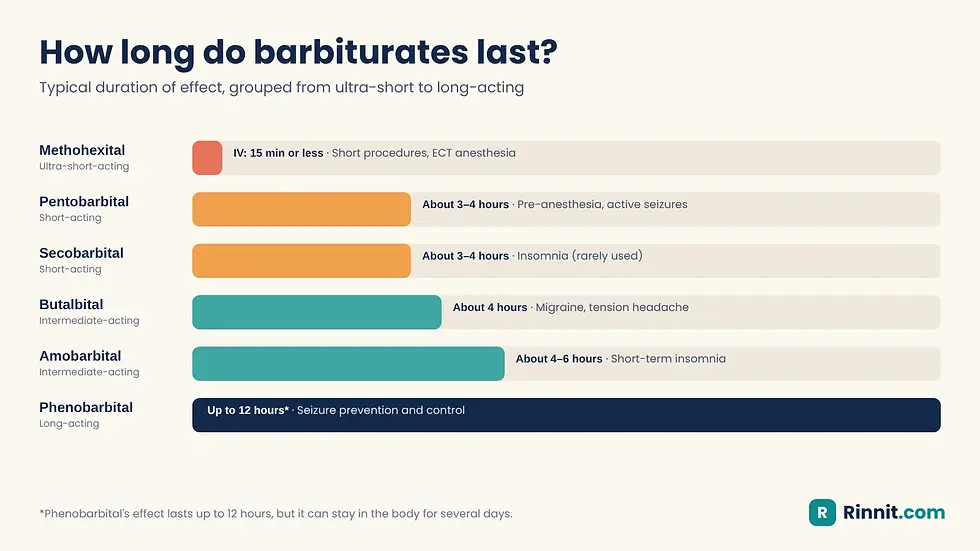
Barbiturates last anywhere from 15 minutes or less to about 12 hours, and doctors group them by how long their effect lasts. [5]
This matters: a very short-acting drug suits a brief procedure, while a long-acting one can protect against seizures all day.
Group | Example | How long the effect lasts |
|---|---|---|
Ultra-short-acting | Methohexital | 15 minutes or less by IV; 45 to 60 minutes as a rectal suppository |
Short-acting | Pentobarbital, secobarbital | About 3 to 4 hours |
Intermediate-acting | Amobarbital | About 4 to 6 hours |
Intermediate-acting | Butalbital | About 4 hours |
Long-acting | Phenobarbital | Up to 12 hours, but it can stay in the body for several days |
What are the benefits of barbiturates?
Barbiturates are well-studied older medicines that can act as a reliable backup when first-line treatments do not work. [1]
Decades of research. As older medicines, their effects are well studied.
A reliable backup. They can work when first-line treatments don't.
Flexible timing. Some act for only minutes (useful for short procedures); others last hours or days, which is why they're still used to prevent seizures.
Work well in combination. For example, with acetaminophen (paracetamol) for certain headaches.
What are the risks and side effects of barbiturates?
Barbiturates carry higher side-effect risks than newer medicines, including tolerance, dependence, addiction, slowed breathing and drug interactions, which is the main reason they are used less today. [1]
Risk | What it means for you |
|---|---|
Tolerance | Your body gets used to the drug, so the same dose works less well |
Dependence | Your body relies on the drug; stopping too fast causes unpleasant or dangerous symptoms |
Addiction | Compulsive use despite harm, a mental health condition that disrupts daily life |
Slower heart and breathing | Lower heart rate and blood pressure; too much can stop breathing, a life-threatening emergency |
Drug interactions | The liver processes some other medicines too quickly, making them less effective |
Pregnancy and breastfeeding | May affect a developing baby and passes into breast milk; if you are pregnant or planning pregnancy, talk to your doctor and do not stop a seizure medicine on your own |
Phenobarbital in particular can change how blood thinners, antimicrobials and immune-suppressing medicines work, and this effect can last for weeks after stopping it. [3] Barbiturates must not be used by people with porphyria, a rare inherited blood disorder, so mention any personal or family history of porphyria to your doctor.
What is barbiturate dependence and withdrawal?
Barbiturate dependence happens when the body comes to rely on the drug over time, and stopping it suddenly can cause withdrawal symptoms. [1]
Withdrawal symptoms can include:
Agitation and nervousness
Tremor or shaking, especially in the hands
Confusion or delirium
Severe seizures
Barbiturate withdrawal can be dangerous, even deadly in severe cases. Never ignore these symptoms, and never stop a barbiturate on your own.
Dependence is common with these medicines, so there's no reason to feel embarrassed. Telling your doctor lets them lower your dose gradually until symptoms settle. This also helps prevent misuse and addiction.
What is the difference between barbiturates and benzodiazepines?
Barbiturates and benzodiazepines are different drug classes that do similar jobs, but benzodiazepines cause fewer side effects and are usually tried first. [1]
Both can stop seizures, ease anxiety, and help you fall asleep before general anesthesia.
Feature | Barbiturates | Benzodiazepines |
|---|---|---|
Stop seizures | Yes | Yes |
Calm anxiety and cause sleep | Yes | Yes |
Side effects | More | Fewer |
Overall safety | Lower | Higher |
Risk of misuse | Higher | Lower |
Usual order of use | Usually tried second | Usually tried first |
Never combine barbiturates and benzodiazepines unless your doctor specifically prescribes them together, because the combination can be very dangerous.
Can you drink alcohol while taking barbiturates?
You should not drink alcohol while taking barbiturates, because together they produce a much stronger effect. [1]
Combining them can cause:
Severe drowsiness
Passing out
Trouble breathing
Severe organ damage or death in serious cases
If alcohol is hard for you to cut out, our guide to alcohol use disorder explains the signs and treatment options.
What are the warning signs of a barbiturate overdose?
A barbiturate overdose can look a lot like heavy alcohol intoxication and is a medical emergency. [1] [6]
Call 911 or your local emergency number right away if you notice:
Trouble breathing (dyspnea)
Confusion or trouble thinking
Passing out or fainting
Slow pulse, or a fast, weak pulse
Dizziness or vertigo
Nausea and vomiting
Low body temperature (hypothermia)
Muscle weakness
Feeling very thirsty
Blue lips or fingernails (cyanosis)
Unfocused or rapidly shifting eyes, or very small or very large pupils

For a related emergency guide, see how to recognize and respond to an opioid overdose.
When should you see your doctor about barbiturates?
You should see your doctor at every scheduled follow-up while taking a barbiturate, because most barbiturates are not meant for long-term use. [1]
Also see your doctor:
If the medicine doesn't seem to be working as it should
If side effects are disrupting your usual routine
If you notice withdrawal symptoms when you miss or stop a dose
At follow-up visits, your doctor can decide whether you still need the medicine or whether another option would work better.
How should you store barbiturates safely?
Barbiturates should be kept locked away in a secure place at home, out of reach of children and teenagers. [1]
This helps prevent accidental poisoning and recreational misuse, both of which can be deadly.
Conclusion
Barbiturates are some of medicine's oldest calming and anti-seizure drugs. Newer, safer options have replaced them for most uses, but they still matter: phenobarbital for stubborn seizures, methohexital for short procedures, and butalbital combinations for certain headaches.
The key to using them safely is simple: take them exactly as prescribed, never mix them with alcohol or other sedatives, never stop them suddenly, and know the overdose warning signs.
Have questions about a barbiturate you've been prescribed? Bookmark this guide, share it with someone who takes one, and bring it to your next appointment. For more clear, research-backed health guides, explore the Rinnit.com health library.
Frequently Asked Questions
What are barbiturates used for today?
Barbiturates are mainly used to prevent and stop seizures, to sedate patients before anesthesia, and to lower high pressure inside the skull. They are used less often for insomnia and, in combination pills, for migraine and tension headaches.
What are common examples of barbiturates?
Common barbiturates include phenobarbital, butalbital, pentobarbital, primidone, methohexital, amobarbital and secobarbital.
Are barbiturates the same as benzodiazepines?
No. They're different drug classes with similar effects. Benzodiazepines are usually tried first because they have fewer side effects, are safer, and are less likely to be misused.
Can I drink alcohol while taking barbiturates?
No. Alcohol strengthens their effect and can cause severe drowsiness, passing out, trouble breathing, organ damage or death.
Are barbiturates dangerous?
Barbiturates carry real risks, including dependence and overdose. Those risks are kept low when you take the medicine exactly as prescribed and follow up with your doctor.
What happens if you stop barbiturates suddenly?
Withdrawal can cause agitation, shaking, confusion, delirium and severe seizures. It can be life-threatening, so dose reductions should always be supervised by a doctor.
Can I take barbiturates while pregnant or breastfeeding?
Barbiturates can affect a developing baby, so they are generally avoided in pregnancy unless the benefit, such as seizure control, outweighs the risk. Never stop one on your own. They also pass into breast milk, so talk to your doctor about safer options.
How long does phenobarbital stay in your system?
Phenobarbital's effects last up to 12 hours, but the drug can remain in the body for several days.
What are the signs of a barbiturate overdose?
Signs include trouble breathing, confusion, passing out, and a very slow pulse or a fast, weak pulse. An overdose can look like heavy drunkenness and is an emergency, so call 911 right away.
Are barbiturates addictive?
Yes. Barbiturates can cause tolerance, dependence and addiction, which is one reason doctors use them less today. Take them exactly as prescribed and talk with your doctor before making any changes.
Related Reading
Stomach Pumping (Gastric Lavage): Why It's Done and What Happens explains stomach pumping.
References
Cleveland Clinic. Barbiturates: Definition, Types, Uses, Side Effects & Abuse. Cleveland Clinic. Last updated June 14, 2022. https://my.clevelandclinic.org/health/treatments/23271-barbiturates
Moawad MHED, Elettreby AM, Alkhawaldeh IM, et al. Levetiracetam versus phenobarbital as first-line therapy for neonatal seizures: a comprehensive systematic review and meta-analysis with meta-regression of 26 studies involving 9,854 neonates. BMC Pediatr. 2026;26(1):222. PMID: 41668002. https://doi.org/10.1186/s12887-026-06539-6
Ghattas K, Liu JT, Elsamadisi P, et al. A systematic review of clinically significant drug-drug interactions with phenobarbital and primidone. Pharmacotherapy. 2026;46(4):e70133. PMID: 41833537. https://doi.org/10.1002/phar.70133
Rizwan ZM, Brown D, Barry S, et al. Phenobarbital versus benzodiazepine-based pathways for alcohol withdrawal syndrome in critically ill adults: a systematic review and meta-analysis. Pharmacotherapy. 2026;46(9):e70197. PMID: 42634386. https://doi.org/10.1002/phar.70197
Skibiski J, Patel P, Abdijadid S. Barbiturates. In: StatPearls [Internet]. Treasure Island (FL): StatPearls Publishing; updated January 29, 2024. https://www.ncbi.nlm.nih.gov/books/NBK539731/
Suddock JT, Kent KJ, Regina AC, et al. Barbiturate Toxicity. In: StatPearls [Internet]. Treasure Island (FL): StatPearls Publishing; updated February 28, 2024. https://www.ncbi.nlm.nih.gov/books/NBK499875/
Medical disclaimer
This article is for general education and does not replace advice from your own doctor. Always talk to a qualified healthcare provider before starting, changing or stopping any medicine.



Comments