Stomach Pumping (Gastric Lavage): Why It's Done and What Happens

Updated: 2 days ago
Written and medically reviewed by Dr. Baraa Alnahhal, MD · Last reviewed: November 2026 · How we review
Quick Answer
Stomach pumping (gastric lavage or gastric suctioning) is a procedure that removes what's in the stomach through a tube passed through the nose or mouth. In an emergency, it can remove swallowed poison or pills before they're absorbed. Today it's used less often for overdose. Anyone with a suspected poisoning should get emergency care right away.
What the research says
Pumping didn't improve most overdose outcomes: in a trial of 876 adults with an oral overdose who all received activated charcoal, adding stomach emptying didn't improve outcomes, even within an hour, and delayed charcoal by about 36 minutes (Pond SM et al., Medical Journal of Australia, 1995) [2]
It helped in one type of poisoning: seven trials in aluminum phosphide poisoning found stomach washing with paraffin oil lowered the risk of death in the hospital by about 41% compared with standard care (Hafez ASAF et al., Critical Reviews in Toxicology, 2024) [3]
Key takeaways
Stomach pumping removes stomach contents through a tube.
It can remove some poisons before they're absorbed.
It's also used for blockages and stomach bleeding.
It's no longer routine for overdose.
Get emergency care right away for any suspected poisoning.
What is stomach pumping?
A tube goes through your nose (nasogastric) or mouth (orogastric) into your stomach. Water or saline is added and then drawn back out. Saline helps prevent loss of electrolytes, especially in children. Sources: [1]
Why it's done

It's also used during some surgeries and tests.
Removing a swallowed poison or overdose before it's absorbed.
Relieving pressure from gastroparesis or a stomach blockage.
Small bowel obstruction.
Severe nausea and vomiting that won't stop.
Upper digestive bleeding. Sources: [1]
During abdominal surgery, it collects fluid and lowers the risk of choking or inhaling stomach contents. Sources: [1]
When it's not used
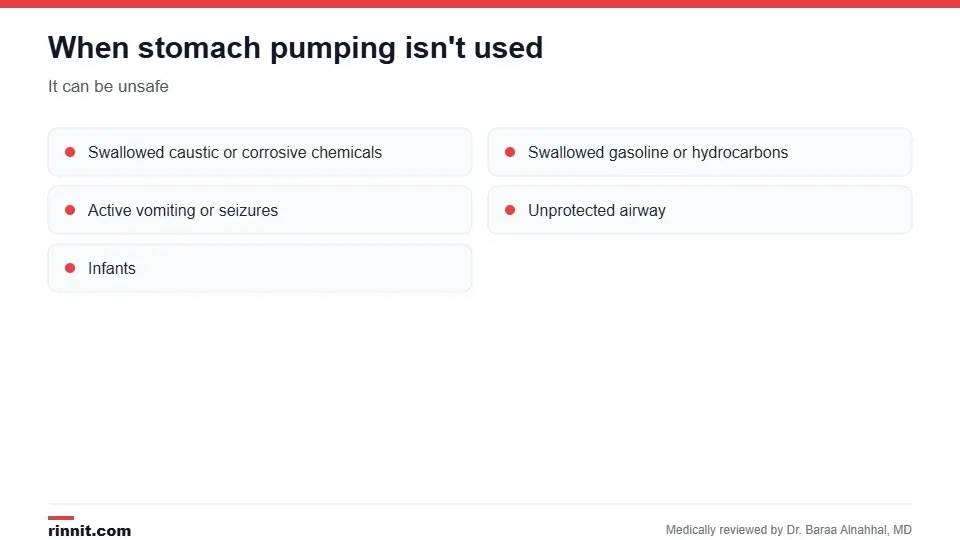
Activated charcoal or other treatments may be safer.
Swallowing something caustic or corrosive.
Swallowing a hydrocarbon such as gasoline.
Actively vomiting or having seizures.
Being drowsy or unconscious without a protected airway.
Swallowing the poison several hours earlier.
Infants. Sources: [1]
Toxicology experts discourage routine use. Activated charcoal, antidotes or whole bowel irrigation may be safer or more effective. Sources: [1, 2]
What happens during the procedure

Activated charcoal may be given through the tube at the end.
Your vital signs are monitored, and a breathing tube may be placed to protect your airway.
Your throat is numbed with a spray.
The tube is passed through your nose or mouth into your stomach.
Placement is confirmed with an X-ray or by testing stomach fluid.
Small amounts of fluid are added, then drawn out after one to two minutes.
This repeats until the fluid comes back clear. Sources: [1]
A child gets about 10 mL of fluid at a time, and an adult up to 300 mL. Sources: [1]
Risks
Injury to the stomach or esophagus.
Inhaling stomach contents if you vomit.
The tube going into the airway by mistake.
Irregular heartbeat. Sources: [1]
With good technique, complications should be minimal. Sources: [1]
After the procedure
The tube is removed unless surgery is planned. You'll be watched for several hours for complications of the procedure and of the poisoning. Sources: [1]
Other treatments for poisoning
Activated charcoal.
Specific antidotes.
Whole bowel irrigation.
IV fluids or breathing support.
Seizure medicines.
Mental health and addiction treatment when needed. Sources: [1]
When to get emergency care
Dizziness, nausea or vomiting.
Heart palpitations or trouble breathing.
Burns around the mouth or a chemical smell on the breath.
Seizures, agitation or confusion.
Drowsiness or loss of consciousness. Sources: [1]
If you suspect poisoning without symptoms, call Poison Control at 1-800-222-1222 (in the U.S.) for advice. Call 911 if the person has serious symptoms. Don't treat it at home without guidance. Sources: [1]
Conclusion
Stomach pumping can remove some swallowed poisons or relieve a blocked stomach, but it's no longer a routine overdose treatment. Fast emergency care is the most important step in any poisoning.
Keep learning: read about acetaminophen overdose and opioid overdose.
Frequently asked questions
What is stomach pumping?
A procedure that removes stomach contents through a tube.
Why is someone's stomach pumped?
To remove poison or pills, relieve a blockage or clear blood.
Does stomach pumping hurt?
The pumping shouldn't hurt, but the tube can be uncomfortable.
Is it still used for overdose?
Less often; it's not routine anymore.
What's used instead?
Activated charcoal, antidotes or whole bowel irrigation.
How does the tube go in?
Through the nose or mouth.
What fluid is used?
Water or saline.
When isn't it safe?
After swallowing caustic chemicals or gasoline, or in infants.
What are the risks?
Injury, inhaling stomach contents or a misplaced tube.
What should I do if someone swallowed poison?
Get emergency care right away.
Related Reading
Understanding Opioid Overdose: Recognition, Emergency Response, and Prevention recognizing opioid overdose.
Gastroparesis: Symptoms, Causes, Diet & Treatment — Complete Guide a slow-emptying stomach.
Nicotine Poisoning: A Complete Guide to Symptoms and Emergency Care another poisoning emergency.
Barbiturates: Types, Uses, Side Effects, and Overdose Warning Signs sedatives and overdose.
References
Cleveland Clinic. What Happens When You Get Your Stomach Pumped? Cleveland Clinic. Last updated January 10, 2023. https://my.clevelandclinic.org/health/treatments/24587-stomach-pumping
Pond SM, Lewis-Driver DJ, Williams GM, et al. Gastric emptying in acute overdose: a prospective randomised controlled trial. Med J Aust. 1995;163(7):345-349. PMID 7565257. https://doi.org/10.5694/j.1326-5377.1995.tb124625.x
Hafez ASAF, Elgazzar FM, Sobh ZK, et al. Gastrointestinal decontamination using oil-based solutions in patients with acute aluminum phosphide poisoning: a systematic review and meta-analysis. Crit Rev Toxicol. 2024;54(4):235-251. PMID 38656260. https://doi.org/10.1080/10408444.2024.2329624
Medical disclaimer
This article is for general education only and does not replace advice from a qualified healthcare professional. Talk to your doctor about your own diagnosis and treatment, and seek emergency care right away for severe or sudden symptoms.



Comments