Arterial Line (A-Line): What It Is, Why It's Used, Placement, Risks and Aftercare

Updated: 2 days ago
Written and medically reviewed by Dr. Baraa Alnahhal, MD · Last reviewed: November 2026 · How we review
Quick Answer: What is an arterial line?
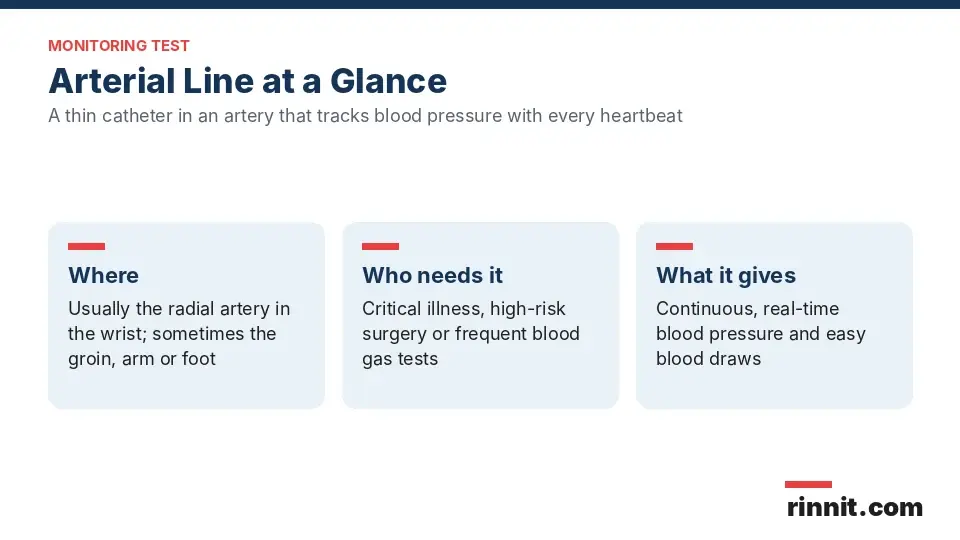
An arterial line, or A-line, is a thin catheter placed in an artery, usually in the wrist, to measure blood pressure continuously. It's used for people who are critically ill, having high-risk surgery or needing frequent arterial blood gas tests. Common side effects such as soreness, bruising or minor bleeding are temporary, and serious problems are rare.
What the research says
Ultrasound guidance helps place a wrist arterial line on the first try. A meta-analysis of 12 randomized trials with 2,432 adults found that ultrasound-guided radial artery access raised first-attempt success (risk ratio 1.35) and lowered failure (risk ratio 0.52) compared with feeling for the pulse, with no significant difference in bruising. (Moussa Pacha et al., American Heart Journal, 2018) [2]
Serious arterial line complications are uncommon. A review of studies covering 19,617 radial, 3,899 femoral and 1,989 axillary artery catheters found that major complications occurred in fewer than 1% of cases, with similar rates at all three sites. (Scheer et al., Critical Care, 2002) [3]
Key takeaways
An arterial line is a thin catheter in an artery that measures blood pressure continuously [1].
It is usually placed in the radial artery at the wrist, but the groin and other arm or foot arteries can also be used [1].
It is used for critically ill people, high-risk surgery and frequent arterial blood gas testing [1].
The line also lets your care team draw blood to check oxygen, carbon dioxide and pH levels [1].
Placement uses sterile technique, local anesthesia and usually ultrasound guidance [1].
Soreness, bruising and minor bleeding are common and temporary; infection, clots and nerve or artery damage are rare [1].
What is an arterial line?
An arterial line is a thin catheter inserted into an artery so your care team can measure and monitor your blood pressure in real time [1]. It is also called direct blood pressure measurement or arterial catheterization [1].
In certain situations, an arterial line is more accurate than a blood pressure cuff on your arm [1]. Because the readings are continuous, your providers can spot a sudden drop in blood pressure and respond quickly [1]. The line can also be used to draw blood for testing [1].
Why you might need an arterial line
Arterial lines are not part of routine care [1]. Providers use them when a person:
They are often used in emergencies and during high-risk operations, when every change in blood pressure matters [1].
How an arterial line works
The catheter stays inside an artery, typically in the wrist, where it senses pressure changes [1]. With each heartbeat, your blood pressure rises briefly and then falls [1].
These signals travel through tubing to a device called a transducer, which turns them into a graph, or waveform, on a monitor [1]. The waveform shows the pressure change with every heartbeat and helps the care team judge how well your heart is pumping blood [1].
Arterial line vs blood pressure cuff
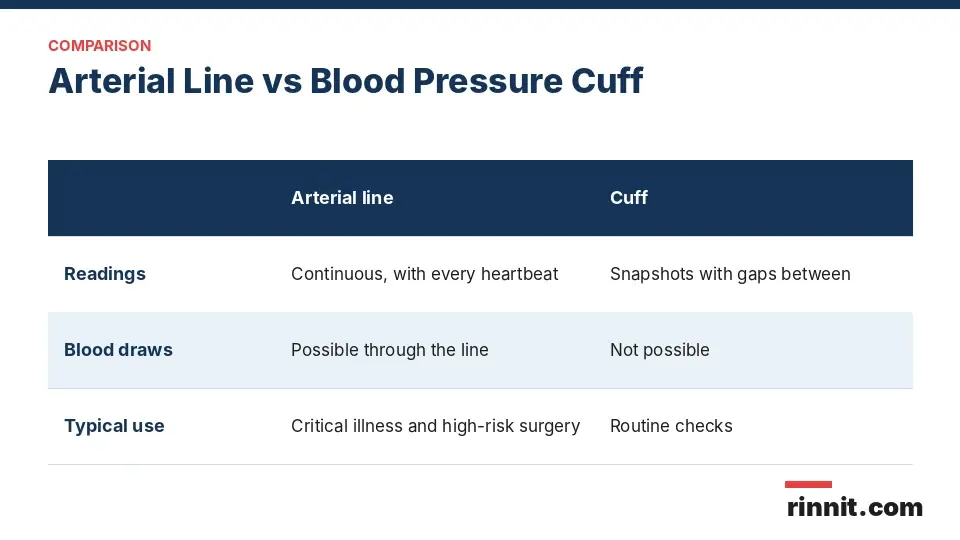
Feature | Arterial line | Blood pressure cuff |
How it measures | A catheter inside an artery senses pressure directly [1] | A cuff squeezes the arm from the outside |
Readings | A continuous stream with every heartbeat [1] | Snapshots taken at intervals, with gaps between them [1] |
Blood draws | Can be used to draw blood for tests [1] | Not possible |
Typical use | Critical illness, high-risk surgery, frequent blood gas tests [1] | Routine checks |
Sources: [1]
Where an arterial line is placed
The radial artery in the wrist is the usual choice for most people because it is easy to reach and has a low risk of infection [1]. Other options include the femoral artery in the groin and other arteries in the arm or foot [1].
What happens during arterial line placement
Placement uses sterile technique, including sterile drapes, masks and caps, to lower the risk of infection [1]. If you are awake, a local anesthetic numbs the skin [1]. Ultrasound is usually used to guide the needle to the artery [1].
For a wrist line, your hand is turned palm up and supported, and the provider then [1]:

Risks of an arterial line
Most side effects are minor and temporary [1]:
Serious complications are rare but can include [1]:
What to expect after placement
Monitoring with an arterial line can last for days or even weeks [1]. The line may be changed every few days to lower the risk of infection [1]. When it is no longer needed, it is removed and a bandage is placed over the site [1].
You usually do not see the results yourself. Your provider reads the waveform and adjusts your care as needed [1].
When to call a healthcare provider
After you go home, contact a provider if you notice [1]:
Conclusion
An arterial line gives your care team a constant, beat-by-beat view of your blood pressure and an easy way to draw blood when you are seriously ill or having high-risk surgery. It is usually placed in the wrist with numbing medicine and ultrasound guidance.
Side effects are usually mild and short-lived. After the line comes out, watch the site and call your provider about fever, chills, swelling, drainage or skin changes.
Keep learning: Read our guide to the arterial blood gas (ABG) test or our overview of how ultrasound works. For more background, see the StatPearls overview of arterial lines on PubMed.
FAQ
What is an arterial line?
It is a thin catheter placed in an artery, usually in the wrist, to measure blood pressure continuously.
Why would someone need an arterial line?
It is used for people who are critically ill, having high-risk surgery or needing frequent arterial blood gas tests.
Where is an arterial line usually placed?
Most often in the radial artery at the wrist. The groin and other arm or foot arteries are other options.
Is an arterial line more accurate than a cuff?
In certain situations, yes. It gives continuous readings with every heartbeat instead of snapshots.
Can blood be drawn from an arterial line?
Yes. The line lets the care team draw blood to check oxygen, carbon dioxide and pH levels.
Does arterial line placement hurt?
A local anesthetic numbs the skin if you are awake. Soreness, tingling or bruising afterward is common and temporary.
How long does an arterial line stay in?
Monitoring can last days or even weeks, and the line may be changed every few days to lower infection risk.
What are the risks of an arterial line?
Minor pain, bruising and bleeding are common. Infection, major bleeding, clots, air embolism and artery or nerve damage are rare.
Do I see the results from an arterial line?
Usually not. Your provider reads the blood pressure waveform and adjusts your care.
When should I call a doctor after an arterial line is removed?
Call for fever, chills, skin irritation or color change, drainage or swelling at the site.
Related Reading
Sepsis: Complete Guide to Symptoms, Causes, Risks, and Treatment explains a serious infection response in which an arterial line is often used to track blood pressure.
Cardiogenic Shock: The Heart-Failure Emergency Where Minutes Matter — Plain-English Guide covers a heart emergency that needs close, beat-by-beat blood pressure monitoring.
Understanding Hypovolemic Shock: Causes, Symptoms, and Emergency Treatment explains shock from blood or fluid loss, a situation where continuous readings guide care.
Respiratory Failure: Symptoms, Causes, and Management covers breathing failure, where frequent arterial blood gas tests are often drawn from an arterial line.
Low Blood Pressure (Hypotension): Numbers, Symptoms, Causes, and When It Needs Treatment explains low blood pressure, the sudden drops an arterial line helps the care team catch quickly.
References
Cleveland Clinic. Arterial Line: Uses, Placement & Benefits. Cleveland Clinic. Last updated January 21, 2026. https://my.clevelandclinic.org/health/diagnostics/arterial-line
Moussa Pacha H, Alahdab F, Al-Khadra Y, et al. Ultrasound-guided versus palpation-guided radial artery catheterization in adult population: A systematic review and meta-analysis of randomized controlled trials. Am Heart J. 2018;204:1-8. PMID 30077047. https://doi.org/10.1016/j.ahj.2018.06.007
Scheer B, Perel A, Pfeiffer UJ. Clinical review: complications and risk factors of peripheral arterial catheters used for haemodynamic monitoring in anaesthesia and intensive care medicine. Crit Care. 2002;6(3):199-204. PMID 12133178. https://doi.org/10.1186/cc1489
Medical disclaimer
This article is for general education only and does not replace advice from a qualified healthcare professional. Talk to your doctor about your own diagnosis and treatment, and seek emergency care right away for severe or sudden symptoms.



Comments