Williams Syndrome: Symptoms, Causes, and Developmental Care

Updated: 2 days ago
Medically reviewed by Dr. Baraa Alnahhal, MD · Last reviewed: October 2026
Quick Answer
Williams syndrome is a rare neurodevelopmental genetic condition caused by the deletion of a small piece of chromosome 7 [1]. It affects about 1 in 10,000 U.S. births and causes distinctive facial features, narrowing of the heart and blood vessels and mild to moderate intellectual challenges, often with strong verbal skills [1]. Treatment manages symptoms with a team of specialists.
What the research says
Surviving heart surgery is common for children with Williams-Beuren syndrome. In a registry study of 200 children who had a first heart intervention, 5 (2.5%) died in hospital and the overall 30-year survival rate was 90%, ranging from 96.1% for isolated left or right heart obstructive lesions to 83.4% for combined disease (Zinyandu et al., Am J Cardiol, 2022) [2].
Heart rhythm problems occur in a meaningful minority, which supports routine rhythm monitoring. In 74 patients with Williams syndrome who had ambulatory ECG monitoring, arrhythmias were present in 9 (12%), most often atrial tachycardia, and sudden cardiac death is reported to occur 25 to 100 times more often than in the general population (Deitch et al., Am J Cardiol, 2023) [3].
Language skills are a relative strength compared with other disabilities, but not always on par with peers. A meta-analysis of 38 studies (1,878 participants, 92 effect sizes) found worse morpho-syntactic (grammar) abilities in people with Williams syndrome than in typically developing people matched by age or mental age, but better performance than people with other disabilities (Almería-Morena and Romero-Rivas, Acta Psychol, 2026) [4].
What is Williams Syndrome?
Williams syndrome, also known as Williams-Beuren syndrome, is a rare genetic condition that impacts multiple systems in the body [3] [4]. It is primarily characterized by unique physical features, delayed development, cognitive challenges, and cardiovascular abnormalities [1].
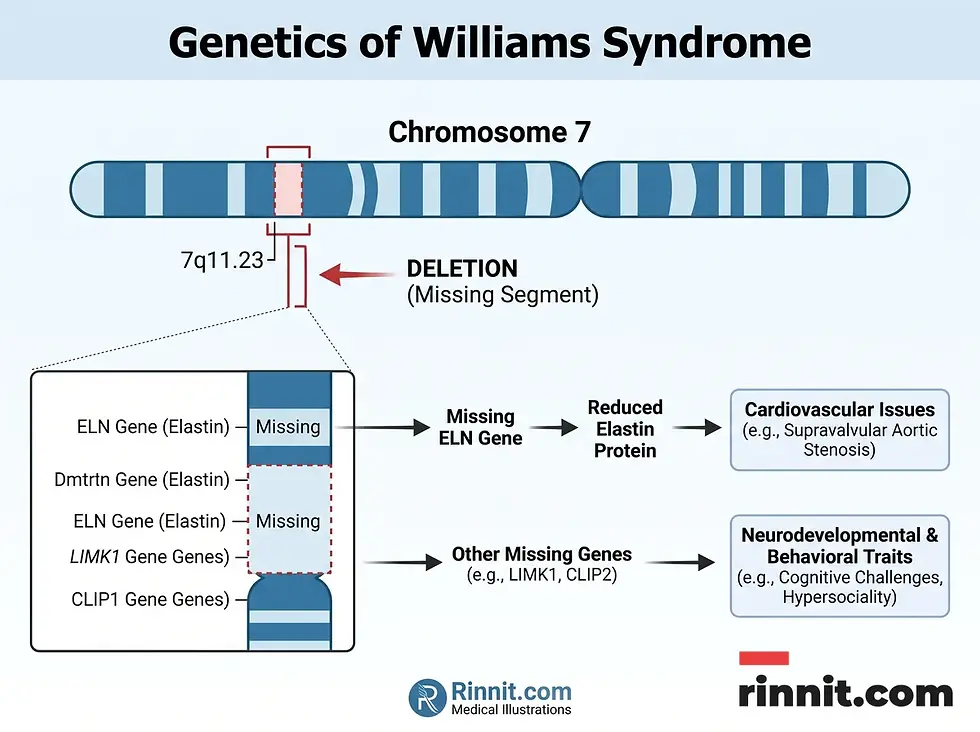
Most individuals with Williams syndrome are missing a small piece of chromosome 7 [1], which contains genes that act as the body's instruction manual. When these "pages" are missing, the body forms and functions differently, leading to the symptoms associated with the condition.

What are the symptoms of Williams syndrome?
The symptoms of Williams syndrome can vary in severity from person to person. They generally fall into three categories: physical characteristics, developmental delays, and medical complications.
Physical Characteristics
These features are often present at birth and include:
Developmental and Cognitive Signs
Children with Williams syndrome often reach milestones like sitting and walking later than their peers, partly due to hypotonia (low body tone) and loose joints [1].
Medical Complications
How is Williams syndrome diagnosed?
Williams syndrome is typically diagnosed in infancy or early childhood, often with a genetic blood test that finds a specific deletion on chromosome 7 [1]. If a healthcare provider suspects the condition based on physical features or heart irregularities, they will recommend:
Genetic Testing: A blood test to identify the specific deletion on chromosome 7 [1].
Cardiac Evaluation: An EKG or echocardiogram (ultrasound) to check for vessel narrowing or arrhythmias [1].
Renal and Metabolic Checks: Blood and urine tests to monitor kidney function [1] and calcium levels.
Blood Pressure Monitoring: Regular checks to detect hypertension early [1].
How is Williams syndrome managed and treated?
Williams syndrome has no cure, but a multidisciplinary approach including cardiology care, early intervention therapies and genetic counseling can manage symptoms and support development [1].
Specialized Care
Cardiology: Regular evaluations are critical to monitor and treat heart or blood vessel issues [1].
Early Intervention: Enrollment in therapies (physical, occupational, speech) and special education programs to address developmental delays [1].
Metabolic Management: Working with a nutritionist or nephrologist to manage elevated calcium levels [1] through diet or medication.
Genetic Counseling: Helping families understand the diagnosis and the 50% chance of passing the condition to future generations [1].

What is the outlook for Williams syndrome?
Most people with Williams syndrome have a normal life expectancy. However, complications like severe cardiovascular disease can reduce longevity in some cases [1]. As they grow into adults, many individuals will continue to need support with daily activities and medical management [1]. Early and consistent treatment is the key to helping children reach their full potential [1].
Frequently Asked Questions
1. Is Williams syndrome inherited?
Most cases are not inherited; they occur as a random deletion during the formation of reproductive cells. However, an individual with Williams syndrome has a 50% chance of passing it to their children.
2. What are the "elfin" features often mentioned?
The term "elfin" is an older term used to describe the unique facial features like full cheeks, a wide mouth, and an upturned nose, though medical professionals now prefer more specific anatomical descriptions.
3. Can Williams syndrome be prevented?
Since it is caused by a random chromosomal change, there is typically no way to prevent it. Genetic counseling can help prospective parents understand their risks.
4. Why are children with Williams syndrome so friendly?
The condition affects brain development in a way that often results in an extremely social and outgoing personality, sometimes called "hypersociability."
5. Do they have special talents?
Many individuals have excellent verbal skills and a strong long-term memory, which can sometimes mask their underlying cognitive challenges.
6. What is the most serious complication?
Cardiovascular disease, specifically the narrowing of blood vessels (stenosis), is the most serious and common medical issue. Because sudden cardiac death is much more common in Williams syndrome, especially around sedation and anesthesia, make sure any surgical or dental team knows about the diagnosis beforehand.
7. Can individuals with Williams syndrome live independently?
While many need some level of support as adults, the degree of independence varies depending on the severity of their cognitive and medical challenges.
8. How common is it?
Williams syndrome occurs in approximately 1 in every 10,000 births in the United States.
9. When should I see a doctor?
See a provider if your child misses developmental milestones, has frequent ear infections, or experiences feeding difficulties in infancy.
10. What is the life expectancy?
Most people have a normal life expectancy, though it can be shortened by severe heart complications.
11. Is there a cure?
No, there is no cure, but symptoms are highly manageable with the right medical and educational support.
12. What genes are missing?
The deletion on chromosome 7 involves several genes, including the elastin gene, which is responsible for the elasticity of blood vessels and tissues.
13. Do they need a special diet?
Some may need a diet low in calcium if they have hypercalcemia (high blood calcium), as directed by a nutritionist or nephrologist.
14. Can they go to regular school?
Many benefit from special education programs or individualized education plans (IEPs) tailored to their specific learning needs.
15. What is hypercalcemia?
Hypercalcemia is a condition where calcium levels in the blood are too high, which can cause irritability and other health issues in infants with Williams syndrome.
Trusted External Resources
Williams Syndrome Association (WSA) - comprehensive support and resources for families and individuals
National Organization for Rare Disorders (NORD) - detailed medical information and research on Williams syndrome
American Heart Association - information on congenital heart defects and vessel narrowing
Related Reading
Aortic Stenosis: Narrowed Heart Valve Symptoms, Causes & Treatment explains narrowing of the aortic valve area, a common heart issue in Williams syndrome.
Hypercalcemia: Symptoms, Causes & Treatment — A Complete Guide covers high blood calcium, which can occur in infants with Williams syndrome.
Developmental Delay in Children: Signs, Types, Causes, and What Early Intervention Can Do explains developmental delays and how early support helps children.
Congenital Heart Defects in Children: Symptoms, Causes, and Treatment covers heart defects present at birth and how they are treated.
References
Cleveland Clinic. Williams syndrome. Cleveland Clinic. Accessed October 8, 2026. https://my.clevelandclinic.org/health/diseases/15174-williams-syndrome
Zinyandu T, Montero AJ, Thomas AS, et al. Thirty-year survival after cardiac surgery in children with Williams-Beuren syndrome (from the Pediatric Cardiac Care Consortium Study). Am J Cardiol. 2022;187:48-53. PMID: 36459747. https://doi.org/10.1016/j.amjcard.2022.10.037
Deitch AM, Giacone HM, Chubb H, et al. Arrhythmias in Williams syndrome. Am J Cardiol. 2023;195:91-97. PMID: 37037070. https://doi.org/10.1016/j.amjcard.2023.03.004
Almería-Morena M, Romero-Rivas C. A systematic review and meta-analysis of morphosyntactic skills in Williams syndrome. Acta Psychol (Amst). 2026;263:106325. PMID: 41576806. https://doi.org/10.1016/j.actpsy.2026.106325
Medical Disclaimer
This content is for informational purposes only and does not constitute medical advice. Always seek the advice of a physician or other qualified health provider with any questions regarding a medical condition.



Comments