Visual Acuity Test (Snellen Chart): How It Works and What 20/20 Means

Updated: 2 days ago
Written and medically reviewed by Dr. Baraa Alnahhal, MD · Last reviewed: November 2026 · How we review
Quick Answer
A visual acuity test is the eye-chart test that measures how clearly you can see details at a distance. You stand 20 feet from a chart, cover one eye and read rows of letters that get smaller. The result is written as a fraction like 20/20 (typical vision). It's the first step in diagnosing nearsightedness, farsightedness and astigmatism.
What the research says
Home vision tests show promise but need care: a systematic review of pragmatic trials of self-administered visual acuity tests found that a few digital tests were about as accurate as clinic testing, but most were less accurate, and reporting was often incomplete, so remote tests shouldn't replace a professional exam yet (Thirunavukarasu AJ et al., PLoS One, 2023) [2]
Most vision apps haven't been validated: a systematic review of visual acuity apps on Android and iOS found wide variation in quality and functionality, and few apps had undergone clinical validation, limiting their use for professional care (Lentz PC et al., JMIR mHealth and uHealth, 2025) [3]
Key takeaways
Measures sharpness of distance vision, one eye at a time, usually at 20 feet.
Results are written as a fraction; 20/20 is typical vision, and a larger bottom number means poorer vision.
The first step in diagnosing refractive errors and deciding whether you need glasses or contacts.
Children can be tested with picture or symbol charts.
If you wear glasses or contacts, vision is checked both with and without them.
What is a visual acuity test?
Visual acuity is the clarity or sharpness of your vision. The test checks how small a letter or symbol you can identify from a set distance. It's part of every eye exam and is used to find refractive errors, problems with how the eye focuses light, including nearsightedness, farsightedness, astigmatism and presbyopia. Sources: [1]
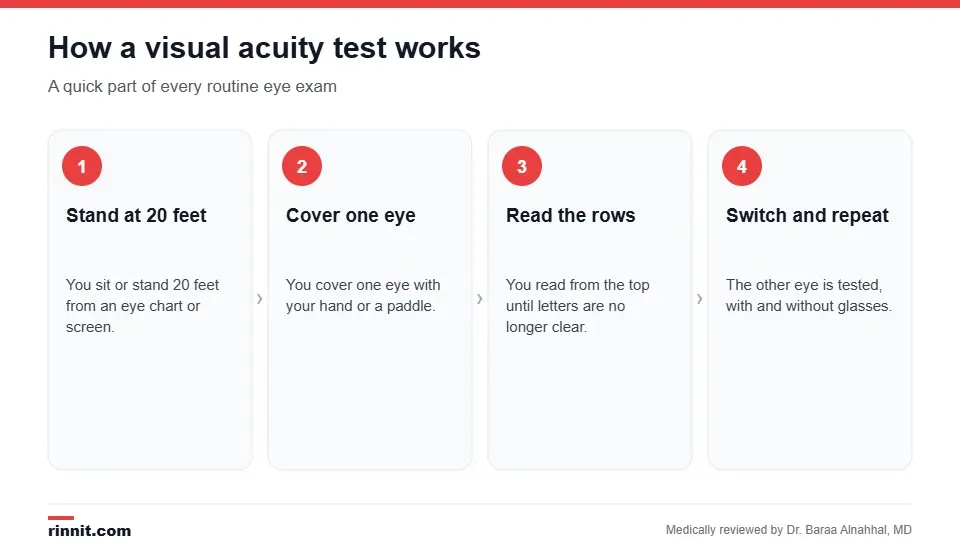
A visual acuity test takes only a few minutes.
Types of visual acuity tests

Your eye specialist chooses the test that fits you.
Snellen chart: the most common test, with large letters at the top and smaller rows below.
Random E chart: uses only the letter E, rotated in different directions, useful for young children or people who can't read the alphabet.
Children's tests: picture or symbol charts (sometimes called Cardiff tests) for children too young to name letters.
Pinhole test: you look through tiny holes; if vision improves, glasses will likely help.
Dynamic visual acuity test: checks how steady your vision is while your head moves. Sources: [1]
How is the test done?
You stand or sit 20 feet from the chart or a screen.
You cover one eye with your hand or a paddle.
You read the rows from top to bottom until the letters are no longer clear; guessing is fine, but don't squint.
The test is repeated for the other eye.
If you wear glasses or contacts, it's done both without them (uncorrected) and with them (corrected). Sources: [1]
What do the numbers mean?
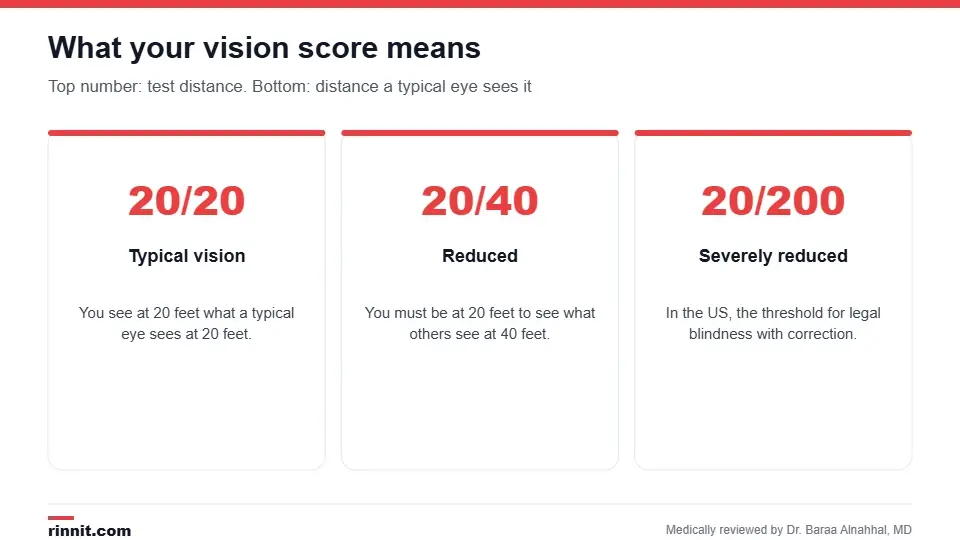
How to read a visual acuity score.
The top number is the testing distance (20 feet). The bottom number is the distance at which a person with typical vision can read the same line. So 20/40 means you need to be at 20 feet to see what most people see at 40 feet. Most people don't have 20/20 vision without correction. Sources: [1]
Score | What it means |
20/20 | Typical sharpness of distance vision |
20/15 | Sharper than typical |
20/40 | Reduced; in many US states, the minimum to drive without restrictions |
20/200 or worse with glasses | In the US, the threshold for legal blindness in the better eye |
What happens after the test?
If your vision is less than 20/20, your eye specialist will usually check your prescription (refraction) and may recommend glasses or contacts, or update your current prescription. If the pinhole test doesn't improve your vision, or other signs suggest an eye disease, you may need more tests, such as a slit lamp exam. The test can also help with checking for color blindness as part of a full exam. Sources: [1]
Children with poor vision in one eye should be checked for amblyopia (lazy eye), which is most treatable when found early. Sources: [1]
Can I test my vision at home?
Apps and printable charts exist, but research shows few have been clinically validated, and most are less accurate than testing in a clinic. They can't replace a full eye exam, which also checks eye health. Sources: [2, 3]
Conclusion
A visual acuity test is the simple, fast first step in checking your vision. Your score tells you and your eye specialist whether glasses or contacts could help, and an annual eye exam helps catch changes early. See an eye specialist promptly if your vision changes suddenly.
Keep learning: read about refractive errors and what happens in a full eye exam.
Frequently asked questions
What does 20/20 vision mean?
You can see clearly at 20 feet what a person with typical vision sees at 20 feet.
Is 20/20 perfect vision?
No. It's typical vision; some people see better, such as 20/15.
What does 20/40 mean?
You must be at 20 feet to see what a typical eye sees at 40 feet.
What is the most common eye chart?
The Snellen chart.
How are young children tested?
With picture or symbol charts, or a rotating E chart.
Do I take my glasses off for the test?
Usually vision is tested both with and without them.
How long does the test take?
Only a few minutes as part of an eye exam.
Can I check my vision with an app?
Some apps can help, but few are validated; they don't replace an eye exam.
What is the pinhole test?
Looking through small holes; if your vision improves, glasses will likely help.
How often should I have my vision checked?
An annual eye exam helps catch vision problems early.
Related Reading
Eye Exam: What Happens, Tests Included and How Often to Go the full exam that includes a visual acuity test.
Refractive Errors: Symptoms, Causes, Types, and Treatment vision problems this test helps identify.
Astigmatism: Symptoms, Causes & Treatment Options — Complete Guide a common cause of blurry vision.
Presbyopia: Complete Guide to Age-Related Near Vision Loss, Symptoms, and Treatment Options age-related difficulty seeing up close.
Lazy Eye (Amblyopia): Symptoms, Causes, Treatment & Complete Guide reduced vision in one eye found on screening.
References
Cleveland Clinic. Visual Acuity Test (Snellen Eye Test Chart): What It Is. Cleveland Clinic. Last updated June 29, 2025. https://my.clevelandclinic.org/health/diagnostics/24421-visual-acuity-test
Thirunavukarasu AJ, Hassan R, Limonard A, et al. Accuracy and reliability of self-administered visual acuity tests: systematic review of pragmatic trials. PLoS One. 2023;18(6):e0281847. PMID 37347757. https://doi.org/10.1371/journal.pone.0281847
Lentz PC, Dorairaj E, Vasu P, et al. Evaluating the quality and features of visual acuity apps using the Mobile App Rating Scale: systematic review. JMIR mHealth and uHealth. 2025;13:e65997. PMID 41385727. https://doi.org/10.2196/65997
Medical disclaimer
This article is for general education only and does not replace advice from a qualified healthcare professional. Talk to your doctor about your own diagnosis and treatment, and seek emergency care right away for severe or sudden symptoms.



Comments