Color Blind Test: Types of Color Vision Tests, What to Expect and Results

Written and medically reviewed by Dr. Baraa Alnahhal, MD · Last reviewed: November 2026 · How we review
Quick Answer: What is a color blind test?
A color blind test, more accurately called a color vision test, checks whether you have color vision deficiency and, if so, which type and how severe it is. You look at colored plates, cards or screen images and say what you see, or arrange or match colors. It is quick and painless [1].
What the research says
Printed plate tests catch nearly all inherited red-green deficiency. In 52 adults (29 color-deficient), Ishihara plates had a sensitivity of 0.97 and specificity of 1.00, while the anomaloscope scored 1.00 on both; the Farnsworth D-15 detected only 58% of color-deficient participants. (Marechal et al., Aerospace Medicine and Human Performance, 2018) [3]
Several printed tests perform equally well for screening. In 122 people classified by anomaloscope, the HRR, Ishihara and two other tests all had specificity of at least 0.99 and sensitivity of at least 0.95; the HRR reached 0.99 sensitivity and 1.0 specificity. (Almustanyir and Hovis, Aerospace Medicine and Human Performance, 2015) [4]
Not every color vision app is reliable. Among 80 adults, one smartphone app matched the Ishihara booklet closely (specificity 95.2%), but another flagged many people with normal color vision, with a specificity of only 54.8%. (Sorkin et al., Optometry and Vision Science, 2016) [5]
Key takeaways
A color vision test checks for color vision deficiency, the condition most people call color blindness [1].
Plate tests, ordering tests and the anomaloscope each measure color vision in a different way, and most people need more than one test for a full diagnosis [1, 2].
The Ishihara plate test is the most common test for adults, but it only detects red-green deficiency [1].
The tests are quick, painless and simple, and you cannot fail one [1].
Online and app-based tests are for education only and cannot diagnose color vision deficiency [1, 5].
Your provider can usually explain your results right after testing [1].
What is a color vision test used for?
A color vision test shows whether you can tell certain colors apart as expected. If you can't, it helps identify the type of color vision deficiency and how strong it is [1].
The term "color vision test" is more accurate than "color blind test." Most people with color vision problems still see many colors, and total color blindness is very rare [1].
Inherited color vision deficiency is common. It affects about 8% of males and 0.5% of females [2].
When might you need one?
Many people live with color vision deficiency for years without realizing it. A formal test is the only way to know for sure [1].
What types of color vision tests are there?
Color vision tests fall into three main groups: color plate tests, ordering (arrangement) tests and comparison tests. Each one gives a different kind of result, so eye specialists often combine them [1].

Plate tests are the usual starting point, while ordering and comparison tests add detail about type and severity.
Color plate tests
Plate tests show images made of colored dots or shapes. A number, symbol or shape is hidden in the pattern, and you name what you see or where it is [1].
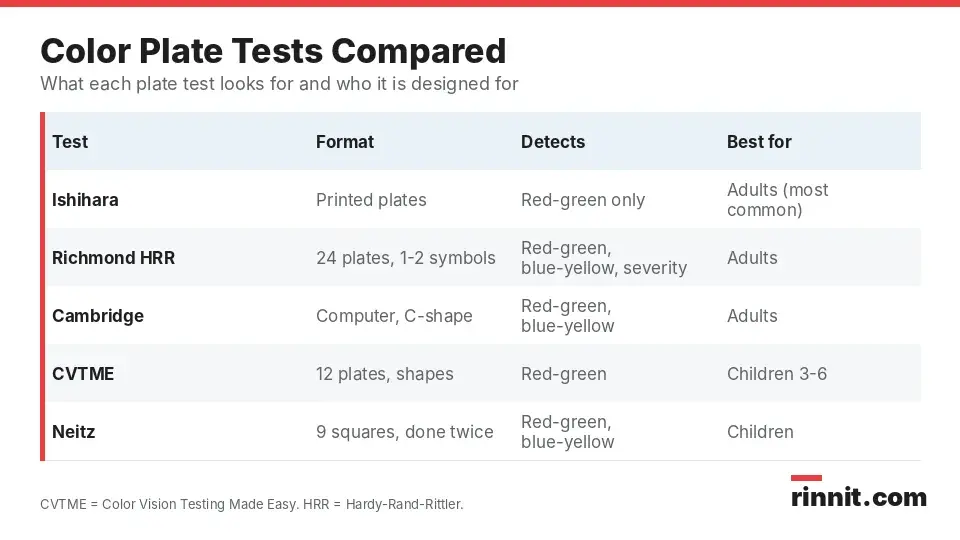
Test | How it works | What it detects | Typical use |
Ishihara | Printed plates with hidden numbers | Red-green deficiency only | The most common test for adults |
Richmond HRR | 24 plates, each with one or two symbols; you name the symbol and its position | Red-green and blue-yellow deficiency, plus severity | Adults |
Cambridge Color Vision Test | Computer-based; you say which way the opening of a "C" faces | Red-green and blue-yellow deficiency | Adults |
Color Vision Testing Made Easy (CVTME) | 12 plates: nine simple shapes and three pictures | Red-green deficiency | Children ages 3 to 6 |
Neitz Test of Color Vision | Nine squares; most children take it twice in a row | Red-green and blue-yellow deficiency | Children |
Sources: [1]
The Ishihara test is widely used but cannot detect blue-yellow deficiency. Tests such as the HRR or Cambridge test fill that gap [1].
Children's plate tests use simple shapes and pictures, so even young children who can't read numbers can take part.
Ordering (arrangement) tests
In an ordering test, you arrange colored cards or caps in order by color or shade. Mistakes in the order reveal which colors you confuse [1].
Comparison test (anomaloscope)
The anomaloscope shows a circle split in two. You turn knobs to make the color of the bottom half match the top half [1].
It is the most accurate way to diagnose red-green deficiency. However, it is complex, takes time and is rarely found in regular offices, so it is mainly used in research [1, 2].
Test | Type | What you do | What it shows |
Farnsworth-Munsell 100-Hue | Ordering | Arrange 85 cards in four groups | Red-green and blue-yellow deficiency and how well you tell colors apart |
Farnsworth-Munsell D-15 | Ordering | Arrange 15 cards | Both main types; may miss very mild cases |
Lanthony desaturated D-15 | Ordering | Arrange 15 muted cards with subtler differences | Often used as a follow-up after the D-15 |
Anomaloscope | Comparison | Turn knobs to match two halves of a circle | The most accurate red-green diagnosis |
Sources: [1, 2]
How should you prepare for a color vision test?
Color vision tests need little preparation. Tell your eye specialist about any online or at-home color tests you have already taken [1].
Results can be affected by lighting, the test conditions and how familiar you are with the test. That is one reason eye specialists test in a controlled setting [2].
What happens during a color vision test?
You look at cards, printed pictures or images on a screen. Depending on the test, you say what you see, arrange colored cards, or match colors with a device [1].

Your provider may run more than one test in the same visit to reach a specific diagnosis.
Does a color vision test hurt?
No. Every type of color vision test is painless. You only need to look at images or cards and respond [1].
How long does it take?
Color vision tests are quick and simple. If your provider needs more than one test to reach a diagnosis, the visit takes a little longer [1].
Can you fail a color vision test?
No. There are no good or bad answers. The most useful thing you can do is report honestly what you see, even if you are unsure [1].
What do color vision test results mean?
Each test reports results in its own way. Your provider should share them right after testing and explain what type of color vision deficiency you have, if any, and how severe it is [1].
Normal color vision: You identify the plates, sequences or matches as expected.
Red-green deficiency: The most common pattern; trouble telling reds and greens apart [1].
Blue-yellow deficiency: Trouble with blues and yellows, which some plate tests (such as Ishihara) cannot detect [1].
Severity: Tests such as the HRR and the 100-Hue grade how strong the deficiency is [1].
If a test shows color vision deficiency, your provider will suggest practical ways to manage it in daily life [1].
How accurate are color vision tests?
Plate tests are accurate for screening red-green deficiency. In one study, Ishihara plates correctly identified 97% of color-deficient adults and never flagged a person with normal vision [3].
The anomaloscope is regarded as the gold standard, but no single test gives a complete picture. Experts advise using at least two tests to confirm a diagnosis [2].
Shorter arrangement tests may miss mild cases. In one comparison, the Farnsworth D-15 detected only 58% of people with inherited color deficiency [3].
Are online color blind tests accurate?
Online tests are educational illustrations, not diagnostic tools. Only a test given by an eye doctor can diagnose color vision deficiency [1].
App quality also varies widely. One app matched the printed Ishihara booklet closely, while another produced many false alarms in people with normal color vision [5].
Are there any risks?
Color vision tests are noninvasive. You only look at images or handle colored cards, so the tests themselves do not carry physical risks [1].
The main limitation is a missed or incomplete diagnosis from relying on one test, especially an online one. That is why eye specialists often use more than one method [1, 2].
When should you see an eye doctor?
See an eye doctor if you have concerns about how you see colors. A proper exam can confirm whether you have color vision deficiency and what type it is [1].
Conclusion
A color vision test is a simple, painless way to find out whether you have color vision deficiency. Plate tests, ordering tests and the anomaloscope each look at color vision from a different angle, which is why more than one test is often used [1, 2].
Online tests can raise awareness, but they cannot replace a proper exam. If you have any doubts about how you see colors, an eye doctor can test you and explain your results on the same visit [1].
Keep learning: Read Color Blindness (Color Vision Deficiency): Symptoms, Causes, Diagnosis & Living Tips for a full guide to the condition, and Optic Neuritis: Symptoms, Causes, and Treatment to learn about one cause of faded color vision.
FAQ
What is a color blind test?
A color blind test, or color vision test, checks whether you can tell certain colors apart. It identifies color vision deficiency, its type and its severity [1].
Why is a color vision test done?
It may be part of a routine eye exam, or done when an eye doctor suspects color blindness. Children may also be screened at school or a pediatrician's office [1].
What is the most common color blind test?
The Ishihara plate test is the most common test for adults. It uses colored dot patterns with hidden numbers and detects red-green deficiency only [1].
How do I prepare for a color vision test?
Little preparation is needed. Tell your eye specialist about any online or at-home color tests you have taken [1].
Does a color vision test hurt?
No. All color vision tests are painless. You only look at images or cards and say what you see [1].
How long does a color vision test take?
Color vision tests are quick and simple, though you may take more than one test in the same visit [1].
Can you fail a color blind test?
No. There are no right or wrong answers. Simply report what you see honestly so your provider gets an accurate result [1].
How accurate is the Ishihara test?
It is very accurate for red-green screening. In one study, it detected 97% of people with inherited color deficiency and had no false positives [3].
What is the most accurate color vision test?
The anomaloscope is the most accurate test for red-green deficiency. It is mostly used in research, so clinics usually combine other tests instead [1, 2].
Are online color blind tests reliable?
No. Online tests are educational only and cannot diagnose color vision deficiency. See an eye doctor for a proper test [1].
Related Reading
Color Blindness (Color Vision Deficiency): Symptoms, Causes, Diagnosis & Living Tips — Complete Guide explains what color vision deficiency is, why it happens, how it is diagnosed and practical tips for living with it.
Optic Neuritis: Symptoms, Causes, and Treatment covers inflammation of the optic nerve, a condition that can make colors look less vivid than normal.
Optic Atrophy: Causes, Symptoms, and Vision Management describes optic nerve damage that can cause blurred vision and difficulty with color vision.
References
Cleveland Clinic. What To Know About Color Blindness Tests. Cleveland Clinic. Last updated September 11, 2025. https://my.clevelandclinic.org/health/diagnostics/color-blind-test
Fanlo Zarazaga A, Gutiérrez Vásquez J, Pueyo Royo V. Review of the main colour vision clinical assessment tests. Arch Soc Esp Oftalmol (Engl Ed). 2019;94(1):25-32. PMID 30361001. https://doi.org/10.1016/j.oftal.2018.08.006
Marechal M, Delbarre M, Tesson J, et al. Color Vision Tests in Pilots' Medical Assessments. Aerosp Med Hum Perform. 2018;89(8):737-743. PMID 30020059. https://doi.org/10.3357/AMHP.5009.2018
Almustanyir A, Hovis JK. Military Research ColorDx and Printed Color Vision Tests. Aerosp Med Hum Perform. 2015;86(10):852-859. PMID 26564671. https://doi.org/10.3357/AMHP.4326.2015
Sorkin N, Rosenblatt A, Cohen E, et al. Comparison of Ishihara Booklet with Color Vision Smartphone Applications. Optom Vis Sci. 2016;93(7):667-672. PMID 27092927. https://doi.org/10.1097/OPX.0000000000000873
Medical disclaimer
This article is for general education only and does not replace advice from a qualified healthcare professional. Talk to your doctor about your own diagnosis and treatment, and seek emergency care right away for severe or sudden symptoms.



Comments