Vasectomy Reversal: Procedure, Recovery and Success Rates

Updated: 5 days ago
Written and medically reviewed by Dr. Baraa Alnahhal, MD · Last reviewed: November 2026 · How we review
Quick Answer: What is a vasectomy reversal?
A vasectomy reversal is surgery that reconnects the tubes (vas deferens) that were cut during a vasectomy, so sperm can mix with semen again and you can try for a pregnancy. It takes up to four hours, you usually go home the same day, and sperm return to the semen in 60% to 95% of cases. [1]
What the research says
Most men regain sperm flow after microsurgical repair. A meta-analysis of 31 studies covering 6,633 men found a patency rate (sperm back in the semen) of 89.4% and a pregnancy rate of 73.0% after microsurgical vasovasostomy. Men who had the reversal less than 10 years after their vasectomy had higher patency and pregnancy rates. (Herrel et al., Urology, 2015) [2]
Using a microscope gives better results than operating without one. A review of 95 studies with 48,132 participants found patency rates of 94.4% with robot-assisted microsurgery, 87.5% with standard microsurgery and 83.7% without a microscope. Pregnancy rates were 47.4% after microsurgery and 43.7% without a microscope. (Seth et al., Andrology, 2024) [3]
Key takeaways
A vasectomy reversal reconnects the vas deferens so sperm can travel into the semen again. [1]
There are two types: vasovasostomy and vasoepididymostomy. [1]
Surgery takes up to four hours, and most people go home the same day. [1]
Most people return to work in five to seven days and should wait two to three weeks before sex. [1]
Sperm return in 60% to 95% of cases, and about half of couples achieve a pregnancy. [1]
Who might want a vasectomy reversal?
A vasectomy is meant to be permanent birth control, but people's circumstances change. The main reasons to seek a reversal are: [1]
Changing your mind about having biological children, as circumstances change over time
Relief from ongoing testicle pain after a vasectomy, known as post-vasectomy pain syndrome
Learn more about other causes of trouble conceiving in our guide to male infertility.
What are the types of vasectomy reversal?
The surgeon decides which type you need during the operation, after checking the fluid inside the vas deferens for sperm. [1]

The two types of vasectomy reversal.
Type | What the surgeon does | When it is used |
Vasovasostomy | Sews the two cut ends of the vas deferens back together | Sperm are found in the fluid from the vas deferens |
Vasoepididymostomy | Joins the vas deferens directly to the epididymis, the coiled tube behind the testicle where sperm mature | A blockage stops sperm from reaching the vas deferens |
Sources: [1]
How do you prepare for a vasectomy reversal?
Before surgery, your provider will review your health and explain what to expect. To prepare: [1]
Tell your provider about all the medicines, vitamins and supplements you take
Shave the hair from your scrotum or groin the night before or the morning of surgery, if asked, using a single-blade disposable razor rather than an electric one
What happens during a vasectomy reversal?
A vasectomy reversal is done under general anesthesia, so you are asleep, or under local anesthesia, so you are awake but numb. It is usually an outpatient procedure that takes up to four hours. [1]
The surgeon makes a small cut in the scrotum, usually at the site of the vasectomy scar.
The vas deferens is found and opened, and the fluid inside is checked for sperm.
The tubes are reconnected using a vasovasostomy or vasoepididymostomy, depending on what the fluid shows. The surgeon uses a special microscope to join the tiny tubes.
The cut is closed with stitches.
Sources: [1]
Vasectomy reversal at a glance
Item | Typical detail |
Anesthesia | General or local |
Surgery time | Up to 4 hours |
Hospital stay | Usually same day |
Back to work | 5 to 7 days; up to 2 weeks for physical jobs |
Sex or ejaculation | After 2 to 3 weeks |
First semen test | 6 to 8 weeks after surgery |
Sources: [1]
How long does recovery from a vasectomy reversal take?
Most people return to normal activities in about two days and to work in five to seven days, or up to two weeks if their job is physical. [1]

Typical recovery milestones after a vasectomy reversal.
Follow your surgeon's instructions. Common advice includes: [1]
Wear an athletic supporter for at least one week
Put ice on the area for up to 20 minutes at a time for at least 24 hours
Avoid strenuous activity, such as heavy lifting or sports, for at least one week
Wait two to three weeks before having sex or ejaculating
Stitches usually come out or dissolve in about a week. Your first semen analysis is usually six to eight weeks after surgery. For the test, you give a semen sample 48 to 72 hours after your last ejaculation. [1]
What is the success rate of a vasectomy reversal?
Sperm return to the semen in 60% to 95% of cases, and about half of couples achieve a pregnancy. [1]
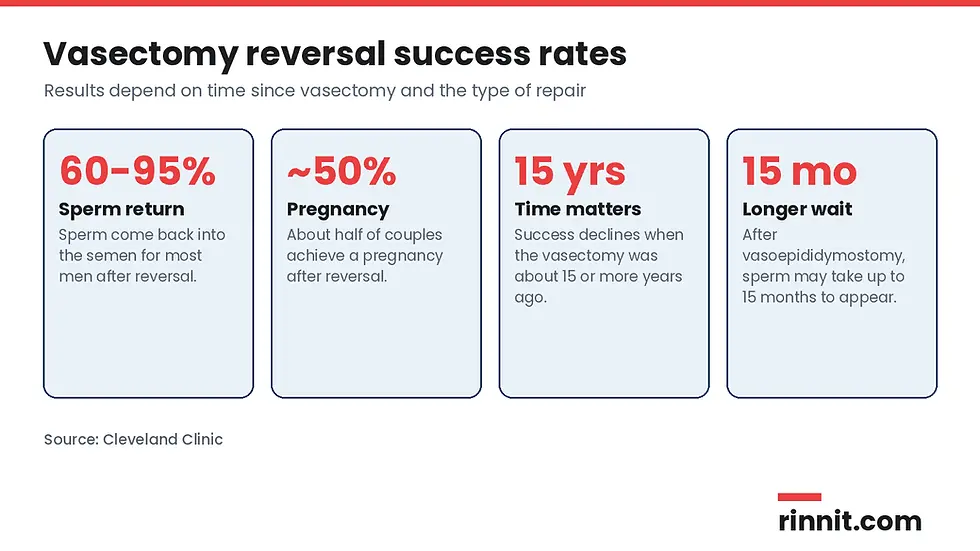
Key numbers on vasectomy reversal success.
Several things affect success: [1]
Time since the vasectomy. Success declines when the vasectomy was about 15 or more years ago. [1] Studies also show better results when the reversal is done within 10 years. [2]
Type of repair. After a vasoepididymostomy, it may take up to 15 months for sperm to appear in the semen. [1]
Surgical technique. Microsurgical repair has higher success rates than repair without a microscope. [3]
Sperm health and your partner's age. Both also affect the chance of pregnancy. [1]
A reversal can also help with pain. More than 80% of people who have a reversal for post-vasectomy pain find that their pain goes away. [1]
What are the risks of a vasectomy reversal?
A vasectomy reversal is generally safe, but as with any surgery, there are risks: [1]
Risk | What it means |
Infection | Bacteria get into the wound |
Hematoma | Bleeding inside the scrotum that causes swelling |
Swelling, bruising and scarring | Common around the cut as it heals |
Pain | Discomfort in the scrotum during recovery |
Re-blockage | Scar tissue can block the tubes again, so sperm stop reaching the semen |
Sources: [1]
Only about 3% to 6% of people who have a vasectomy later choose to reverse it. [1]
What are the alternatives to a vasectomy reversal?
If a reversal is not right for you, sperm can be retrieved directly from the testicle or epididymis and used with in vitro fertilization (IVF). [1] Learn more about MicroTESE and intracytoplasmic sperm injection (ICSI).
What follow-up care do you need after a vasectomy reversal?
Schedule a follow-up appointment with your urologist. About a week after surgery, they check the cut and remove your stitches. A semen analysis is then scheduled six to eight weeks after the reversal to see whether sperm have returned. Contact your provider if anything about your recovery worries you. [1]
Conclusion
A vasectomy reversal reconnects the tubes that carry sperm, giving many couples a chance at pregnancy again. Most people go home the same day and return to work within a week, and sperm return to the semen in most cases. [1]
Success depends on how long ago the vasectomy was done, the type of repair and your partner's fertility. Talk to a urologist about whether a reversal or sperm retrieval with IVF is the better fit for you.
Keep learning: Read our guide to vasectomy, or explore male infertility and its treatments.
FAQ
What is a vasectomy reversal?
A vasectomy reversal is surgery that reconnects the tubes (vas deferens) cut during a vasectomy, so sperm can mix with semen again and pregnancy is possible.
What are the two types of vasectomy reversal?
A vasovasostomy sews the two cut ends of the vas deferens back together. A vasoepididymostomy joins the vas deferens directly to the epididymis to get around a blockage.
How long does vasectomy reversal surgery take?
It can take up to four hours. Most people go home the same day.
Is a vasectomy reversal done under general anesthesia?
It can be done under general anesthesia, so you are asleep, or under local anesthesia, so you are awake but the area is numb.
How long is recovery after a vasectomy reversal?
Most people return to normal activities in about two days and to work in five to seven days, or up to two weeks for physical jobs.
When can I have sex after a vasectomy reversal?
Wait two to three weeks before having sex or ejaculating.
How soon will sperm come back after a vasectomy reversal?
A semen test is usually done six to eight weeks after surgery. After a vasoepididymostomy, sperm may take up to 15 months to appear.
What is the success rate of a vasectomy reversal?
Sperm return to the semen in 60% to 95% of cases, and about half of couples achieve a pregnancy. Success declines when the vasectomy was about 15 or more years ago.
What are the risks of a vasectomy reversal?
Risks include infection, bleeding into the scrotum (hematoma), swelling, bruising, scarring, pain and the tubes becoming blocked again.
What are the alternatives to a vasectomy reversal?
Sperm can be retrieved directly from the testicle or epididymis and used with in vitro fertilization (IVF).
How do I prepare for a vasectomy reversal?
Tell your provider about all the medicines, vitamins and supplements you take. If asked, shave the hair from your scrotum or groin the night before or the morning of surgery, using a single-blade disposable razor rather than an electric one [1].
When should I call my doctor after a vasectomy reversal?
Schedule a follow-up appointment with your urologist, who will check your incision and take your stitches out after about a week [1]. If you have a lot of pain, your provider may suggest a stronger pain reliever, and talk to a provider if you're still having difficulty conceiving a child after the reversal [1].
Related Reading
References
Cleveland Clinic. Vasectomy Reversal: Purpose, Procedure & Success Rate. Cleveland Clinic. Last updated April 16, 2025. https://my.clevelandclinic.org/health/treatments/15459-vasectomy-reversal
Herrel LA, Goodman M, Goldstein M, Hsiao W. Outcomes of microsurgical vasovasostomy for vasectomy reversal: a meta-analysis and systematic review. Urology. 2015;85(4):819-825. PMID 25817104. https://doi.org/10.1016/j.urology.2014.12.023
Seth I, Gibson D, Bulloch G, et al. Vasovasostomy: a systematic review and meta-analysis comparing macroscopic, microsurgical, and robot-assisted microsurgical techniques. Andrology. 2024;12(4):740-767. PMID 37804499. https://doi.org/10.1111/andr.13543
Medical disclaimer
This article is for general education only and does not replace advice from a qualified healthcare professional. Talk to your doctor about your own situation before making decisions about your health. If you think you have a medical emergency, call your local emergency number right away.



Comments