Vasectomy: Procedure, Recovery, Effectiveness and Risks

Updated: 3 days ago
Written and medically reviewed by Dr. Baraa Alnahhal, MD · Last reviewed: November 2026 · How we review
Quick Answer: What is a vasectomy?
A vasectomy is a permanent birth control procedure for men. A urologist cuts and seals the vas deferens, the two tubes that carry sperm, so sperm no longer mix into semen. It takes 15 minutes, most people recover in 8 to 9 days, and once a semen test confirms no sperm, it fails less than 1% of the time. [1]
What the research says
The no-scalpel method causes fewer complications. In a review of randomized trials, the no-scalpel approach cut the odds of a blood collection under the skin (hematoma) by about 77% (OR 0.23), roughly halved surgical bleeding (OR 0.49) and lowered wound infection (OR 0.21), with no difference in how well the vasectomy worked. (Cook et al., Cochrane Database of Systematic Reviews, 2014) [2]
Vasectomy does not raise the risk of serious prostate cancer. A meta-analysis of 53 studies found no link with high-grade, advanced or fatal prostate cancer. A weak link with any prostate cancer (rate ratio 1.05 in the best-quality cohort studies) added an estimated 0.6% to lifetime risk and is unlikely to be causal. (Bhindi et al., JAMA Internal Medicine, 2017) [3]
Key takeaways
A vasectomy blocks sperm from reaching semen but does not change testosterone, erections, orgasm or how semen looks. [1]
It is done in an office or outpatient center under local anesthesia and usually takes about 15 minutes. [1]
It is not effective right away. Sperm can stay in the tubes for weeks to months, so use other birth control until a semen test shows no sperm. [1]
Serious complications are uncommon. Ongoing pain affects about 1% to 2% of men and is treatable. [1]
It does not protect against sexually transmitted infections. [1]
How does a vasectomy work?
A vasectomy works by closing the vas deferens on both sides, so sperm made in the testicles can no longer travel out with semen. The testicles keep making sperm, and the body simply reabsorbs them. Most of the fluid in semen comes from other glands, so the amount and look of semen stay the same. [1]
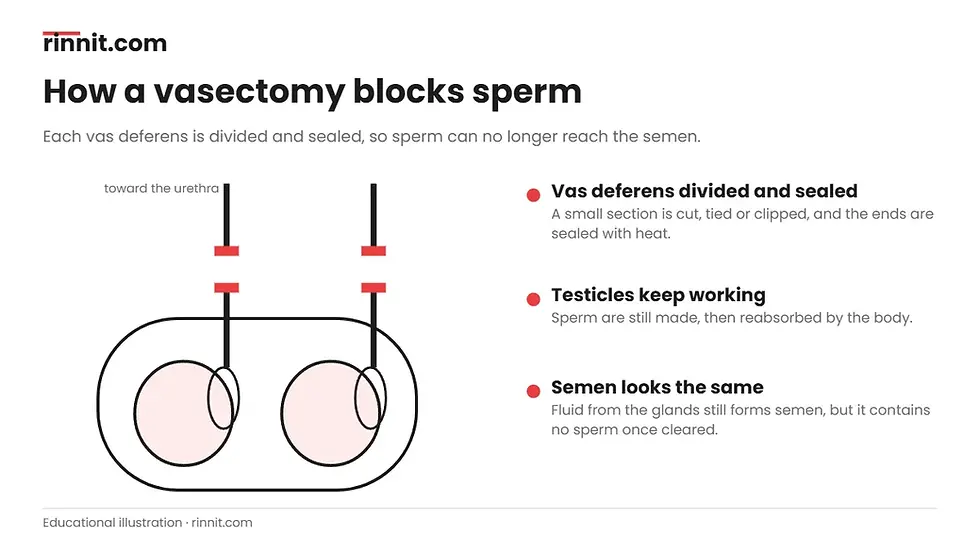
Only a small section of each vas deferens is removed; the testicles stay in place.
More than 500,000 vasectomies are performed in the United States each year. [1]
Who is a vasectomy for?
A vasectomy is for people who are sure they do not want biological children in the future. Common reasons include: [1]
Wanting very effective, long-term birth control
Not wanting more biological children
Protecting a partner for whom pregnancy would be risky
Avoiding passing on certain genetic conditions
Because a reversal does not always work, talk it through with your partner and your provider first. If you might want children later, ask about banking sperm before the procedure. [1]
What are the types of vasectomy?
There are two main types of vasectomy: the incision method and the no-scalpel method. Both are done under local anesthesia and are equally effective. [1] [2]
Feature | Incision vasectomy | No-scalpel vasectomy |
How the tubes are reached | One or two small scalpel cuts in the scrotum | A small instrument makes one tiny opening that is gently spread |
Anesthesia | Local (shot or spray) | Local (shot or spray) |
Stitches | Sometimes needed | Usually not needed |
Bleeding, bruising and infection | Slightly more common | Less common in trials [2] |
Effectiveness | Same | Same |
How do you prepare for a vasectomy?
Preparing for a vasectomy starts with a consultation where your provider makes sure you understand the procedure, its risks and that it is meant to be permanent. Tell your provider about: [1]
Bleeding disorders or blood-thinning medicines and supplements
Allergies, including to antibiotics or numbing medicines such as lidocaine
Skin conditions on the scrotum
Past groin or scrotal surgery or injury, such as a hernia repair
Past urinary tract or genital infections
Before the procedure: [1]
Shave the whole scrotum and the base of the penis the night before or the morning of surgery, using a single-blade disposable razor.
Wash the scrotum and groin with antibacterial soap and warm water the day before and the morning of surgery, then dry well.
Eat a light meal and drink fluids; do not skip food, but avoid a heavy meal.
Bring snug athletic underwear or a jockstrap to wear home.
What happens during a vasectomy?
During a vasectomy, a urologist numbs the scrotum, reaches each vas deferens through a tiny opening, then divides and seals it. The whole procedure usually takes about 15 minutes. [1]

Most vasectomies take about 15 minutes, and you go home the same day.
Local anesthetic is given as a shot or spray, so you stay awake but numb.
The urologist makes one or two small cuts, or one tiny no-scalpel opening, and gently lifts out each vas deferens.
Each tube is cut, tied or clipped, and the ends are sealed with a mild electric current.
Stitches are placed only if needed, and a bandage covers the area.
You are monitored briefly and go home once your provider says it is safe.
Sources: [1]
Vasectomy at a glance
Item | Typical detail |
Setting | Office or outpatient center |
Anesthesia | Local (you are awake) |
Time | About 15 minutes |
Back to daily activities | 48–72 hours |
Full recovery | About 8–9 days |
Semen analysis | About 2–3 months after surgery |
Effectiveness after clearance | Fails less than 1% of the time |
Sources: [1]
How long does it take to recover from a vasectomy?
Recovery from a vasectomy is quick: most people return to everyday activities within 48 to 72 hours and recover fully in about 8 to 9 days. Pain is usually moderate and eases with ice and the pain relievers your provider recommends. [1]

Keep using other birth control until a semen test confirms no sperm.
Activity | When it is usually allowed |
Walking and standing | Right away |
Desk work or school | Within a week |
Sex and ejaculation | After at least 7 days |
Lifting more than 4.5 kg (10 lb) | Avoid for several days; physical jobs may need more time off |
Strenuous exercise and contact sports | After at least 1 month |
Sources: [1]
Stop any activity that causes pain, discomfort or swelling, and give it more time. [1]
When is a vasectomy effective?
A vasectomy is effective only after a semen analysis shows no sperm, usually about 2 to 3 months after surgery. Sperm can remain in the tubes beyond the blockage for weeks or months, so pregnancy is still possible until then. [1]
Keep using another form of birth control until your provider confirms the result.
Ejaculating regularly, starting about a week after surgery, helps clear the remaining sperm.
If sperm are still present, the test is usually repeated about a month later.
Sperm can appear again in semen 3 to 6 months after surgery in 0.3% to 9% of cases. After that window, the failure rate drops below 1%. Very rarely, the cut ends grow back together (recanalization), which is why the follow-up test matters. [1]
What are the benefits and risks of a vasectomy?
The main benefit of a vasectomy is highly effective, permanent birth control. Apart from not having sex, it is one of the most effective options. Compared with tubal ligation, it is simpler, safer, cheaper and done without a hospital stay. [1]
Complications are uncommon and usually mild: [1]
Risk | What it means |
Bleeding, inflammation or infection | Uncommon and usually not serious |
Post-vasectomy pain syndrome | Ongoing pain in about 1% to 2% of men; treatable |
Sperm granuloma | A small, sometimes tender lump from leaked sperm; harmless and usually reabsorbed |
Scrotal congestion | Pressure or ache in the testicles 2–12 weeks after surgery; usually settles on its own |
Recanalization | The tubes reconnect; very rare and most often in the first 12 weeks |
Learn more in our guide to post-vasectomy pain syndrome.
Does a vasectomy affect sex or testosterone?
No. A vasectomy does not affect testosterone, sex drive, erections or orgasm, and semen looks, smells and tastes the same. The only difference is that semen no longer contains sperm. Studies suggest no significant long-term health risks, including for heart disease or cancer. [1] [3]
Can a vasectomy be reversed?
A vasectomy reversal is possible, but it does not always restore fertility and can be expensive. If you are unsure about future children, consider banking sperm before your vasectomy. Without a reversal or stored sperm, becoming a biological father is not possible. [1]
For a wider look at fertility in men, see our guide to male infertility.
When should you call a doctor after a vasectomy?
Contact your healthcare provider right away if you notice any of these after a vasectomy: [1]
Fever or chills
Heavy bleeding around the stitches
Red, brown, purple or black skin, more swelling, more pain or discharge at the incision
Pain that medicine does not control
Conclusion
A vasectomy is a quick, safe and very effective form of permanent birth control. Most people are back to normal activities within days, and it does not change hormones or sexual function. The most important step comes later: keep using other birth control until a semen analysis confirms there are no sperm.
If you are weighing a vasectomy, write down your questions about permanence, recovery and reversal, and bring them to a urologist.
Keep learning: Read our guide to male infertility to understand how sperm and fertility work, or compare other long-term options in our long-acting reversible contraception (LARC) guide. For more background, see this vasectomy overview from MedlinePlus.
FAQ
What is a vasectomy?
A vasectomy is permanent birth control surgery that closes off both vas deferens, the tubes that carry sperm, so semen no longer contains sperm.
How long does a vasectomy take?
A vasectomy usually takes about 15 minutes and is done in an office or outpatient center under local anesthesia.
Does a vasectomy hurt?
Local anesthesia keeps discomfort low during the procedure, though you may feel tugging. Pain afterward is usually moderate and eased with ice and pain relievers.
How effective is a vasectomy?
After sperm are cleared and a semen test confirms it, a vasectomy fails less than 1% of the time.
When can I stop using other birth control after a vasectomy?
Only after a semen analysis, usually 2 to 3 months after surgery, shows no sperm. Until then, keep using another method.
How long is recovery after a vasectomy?
Most people return to everyday activities within 48 to 72 hours and recover fully in about 8 to 9 days.
When can I have sex after a vasectomy?
Avoid all sexual activity, including masturbation, for at least 7 days after a vasectomy.
Does a vasectomy affect testosterone or erections?
No. A vasectomy does not change testosterone, sex drive, erections, orgasms or how semen looks.
What are the risks of a vasectomy?
Risks include bleeding, infection, inflammation, a sperm granuloma, scrotal congestion, long-lasting pain in about 1% to 2% of men and, rarely, the tubes reconnecting.
Can a vasectomy be reversed?
A vasectomy reversal is possible but does not always work and can be costly, so a vasectomy should be treated as permanent.
How do I prepare for a vasectomy?
Take any medicines your provider prescribes several hours before, and eat a light meal and drink liquids beforehand. [1] Shave the whole scrotum the night before or that morning with a single-blade disposable razor, wash the scrotum and groin with antibacterial soap the day before and the morning of, and bring a clean athletic supporter or tight athletic shorts. [1]
When should I call my doctor after a vasectomy?
Contact your provider right away for fever or chills, heavy bleeding around the stitches, red, brown, purple or black skin, more swelling, pain or discharge at the incision, or pain that your medicine doesn't control. [1]
Related Reading
Post-Vasectomy Pain Syndrome Guide: Symptoms, Causes, Diagnosis, and Treatment explains why a small number of men have lasting pain after a vasectomy and how it is treated.
Male Infertility: Causes, Symptoms, Tests, and Treatments Explained covers how sperm are made, how fertility is tested and the options available for having children.
References
Cleveland Clinic. Vasectomy: Procedure, Recovery & Effectiveness. Cleveland Clinic. Last updated April 16, 2025. https://my.clevelandclinic.org/health/procedures/4423-vasectomy
Cook LA, Pun A, Gallo MF, et al. Scalpel versus no-scalpel incision for vasectomy. Cochrane Database Syst Rev. 2014;2014(3):CD004112. PMID 24683021. https://doi.org/10.1002/14651858.CD004112.pub4
Bhindi B, Wallis CJD, Nayan M, et al. The Association Between Vasectomy and Prostate Cancer: A Systematic Review and Meta-analysis. JAMA Intern Med. 2017;177(9):1273-1286. PMID 28715534. https://doi.org/10.1001/jamainternmed.2017.2791
Medical disclaimer
This article is for general education only and does not replace advice from a qualified healthcare professional. Talk to your doctor about your own diagnosis and treatment, and seek emergency care right away for severe or sudden symptoms.



Comments