Uterus Transplant: Who Qualifies, Procedure, Pregnancy and Risks

Updated: 3 days ago
Written and medically reviewed by Dr. Baraa Alnahhal, MD · Last reviewed: November 2026 · How we review
Quick Answer: What is a uterus transplant?
A uterus transplant moves a uterus from a donor to a person with absolute uterine factor infertility (AUFI), meaning they were born without a uterus or have one that does not work. It makes pregnancy possible through IVF. Babies are delivered by C-section, and the uterus is removed after one or two births.
What the research says
More than half of U.S. recipients have had a baby. In the first five years of uterus transplants in the United States, 33 women received a uterus (64% from living donors); 74% of grafts were still working at one year, 19 of 33 recipients (58%) delivered 21 live-born children, and among women with a working uterus at one year, 83% had a baby. There were no deaths among donors or recipients. (Johannesson et al., JAMA Surgery, 2022) [2]
Pregnancies after transplant are high risk. A systematic review of 40 live births after uterus transplant found that all were delivered by C-section, 47.5% were emergency C-sections, and 52.4% of planned C-sections happened before 37 weeks, with notably high rates of placenta previa and preterm birth. (Brännström et al., Acta Obstetricia et Gynecologica Scandinavica, 2025) [3]
Robotic donor surgery is promising but still being studied. A systematic review of 29 robotic-assisted living-donor hysterectomies across five countries found no graft loss among reported cases and successful pregnancies, including ten live births in the largest program, but major donor complications such as injury to a ureter still occurred. (Baradwan et al., Journal of Robotic Surgery, 2026) [4]
Key takeaways
A uterus transplant treats absolute uterine factor infertility, when there is no uterus or the uterus does not work. [1]
The first successful uterus transplant was in Sweden in 2011; more than 100 have been done worldwide, with more than 70 live births. [1]
The donated uterus can come from a living or a deceased donor and is matched by blood type. [1]
The transplant is temporary: the uterus is removed after childbearing, and antirejection medicines then stop. [1]
What is a uterus transplant?
A uterus transplant is surgery that moves a uterus from a donor into a person with absolute uterine factor infertility (AUFI). With AUFI, pregnancy is not possible because there is no uterus or the uterus does not work. It is a recent and uncommon procedure: the first successful uterus transplant was performed in 2011 in Sweden. [1]
The whole process is much more than one operation. It is designed to lead to a live birth and includes screening, donor matching, in vitro fertilization (IVF), the transplant surgery, antirejection medicines, embryo transfer, pregnancy, a C-section and, finally, removal of the uterus. [1]

The main stages of the uterus transplant process.
Who can get a uterus transplant?
Each hospital sets its own criteria, but people who qualify for a uterus transplant generally: [1]
Have AUFI and at least one working ovary
Are of reproductive age
Are healthy enough for surgery and childbirth
Pass a psychiatric evaluation
Can take medicines that suppress the immune system
Do not have HIV, hepatitis B, hepatitis C or another active infection
Do not smoke
Can give informed consent
Many recipients were born without a uterus because of MRKH syndrome. Read more about the wider condition in our guide to uterine factor infertility.
Who can donate a uterus?
There are two types of uterus donors: [1]

Types of uterus donors.
Donor type | Who they are |
Living directed donor | A known person, often a family member such as a mother or sister |
Living non-directed donor | An anonymous person who donates without a specific recipient in mind |
Deceased donor | A person who wished to donate organs after death, usually unrelated to the recipient |
Sources: [1]
Hospitals may accept only certain donor types, and matching is based on blood type. Living donors go through extensive screening and a psychological evaluation. Criteria vary, but they may include having had at least one live birth, not wanting a future pregnancy, testing negative for HIV and hepatitis, having no major uterine surgery, and having no history of high blood pressure or diabetes. [1] For a broader look at giving organs, see our guide to organ donation and transplantation.
How do you prepare for a uterus transplant?
Preparing for a uterus transplant can take months or even years. A large team takes part, including reproductive endocrinologists, obstetrician-gynecologists, transplant and gynecologic surgeons, anesthesiologists, maternal-fetal medicine specialists, infectious disease specialists, psychiatrists or psychologists, social workers and nurse coordinators. Testing includes lab work, imaging and a psychological evaluation. [1]
What happens during a uterus transplant?
The living donor's surgery
A living donor has a hysterectomy (removal of the uterus) by open surgery (laparotomy), laparoscopy or robotic surgery; laparoscopic and robotic surgery usually use five small ports. The surgeon removes the uterus with its blood vessels, the cervix and a small amount of vaginal tissue. This surgery can take up to 10 hours, often longer than the transplant itself, because the surgeon must keep the whole uterus intact without harming nearby tissue. [1] Learn more about the operation in our guide to hysterectomy.
The recipient's surgery
Antirejection medicines start before surgery.
The surgeon connects the donated uterus to the recipient's blood vessels.
The surgeon creates a connection between the uterus and the vagina.
The fallopian tubes are not connected, so pregnancy will need IVF.
Sources: [1]
The recipient's surgery is usually done through a laparotomy, although some centers use robotic surgery, and it usually takes 6 to 8 hours. [1]
Uterus transplant at a glance
Item | Typical detail |
Recipient surgery | Usually 6 to 8 hours |
Living donor surgery | Up to 10 hours |
Embryo transfer | Within 3 to 12 months, one embryo at a time |
Delivery | C-section only |
Births allowed | Usually up to two |
Recipient healing | About 3 to 6 months |
Living donor recovery | About 4 to 6 weeks |
Sources: [1]
What happens after a uterus transplant?
After surgery, the care team checks for rejection and complications. Success depends largely on a good blood supply to the new uterus. Menstrual periods usually start a few months after a successful transplant, and embryo transfer happens within 3 to 12 months of surgery, one embryo at a time. [1]
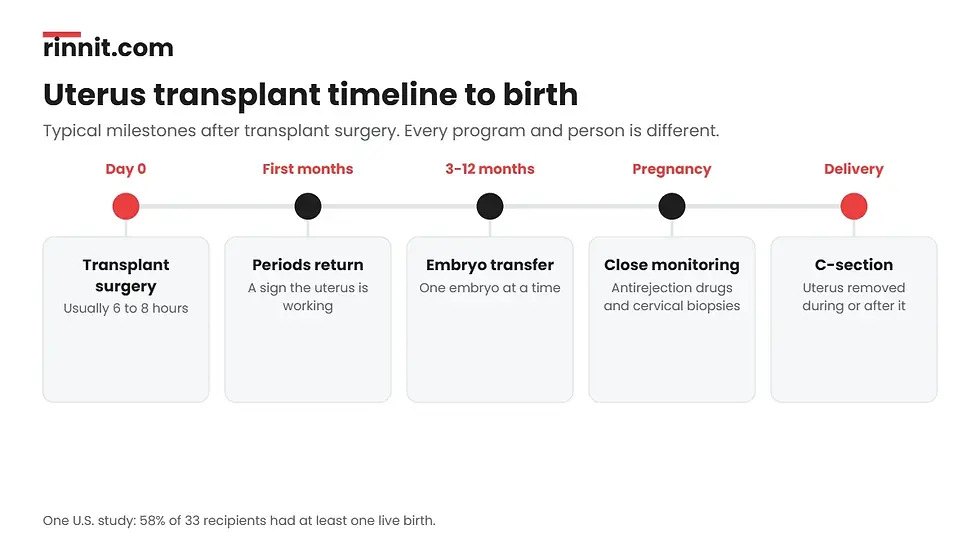
Typical milestones from transplant to birth.
Pregnancy and delivery
During pregnancy, antirejection medicines continue and a maternal-fetal medicine team watches the pregnancy closely. Cervical biopsies check for rejection. Babies are delivered by C-section only, because vaginal birth is not possible, and providers generally limit recipients to two live births with a transplanted uterus. [1]
Removing the transplanted uterus
A uterus transplant is meant to be temporary. A hysterectomy to remove the donated uterus is eventually needed, either during the C-section or later. Removal is also recommended if the uterus stops working, after several unsuccessful embryo transfers or after repeated miscarriages. Antirejection medicines are stopped after the hysterectomy. [1]
How successful is a uterus transplant?
In one U.S. study of 33 transplants, 25 (76%) were still working 30 days after surgery, and 19 of the 33 recipients (58%) had at least one live birth. A transplant does not guarantee a baby, because other factors in pregnancy can cause implantation problems or miscarriage. [1]
What are the risks of a uterus transplant?
Risks for living donors
General surgical risks, such as problems with anesthesia, infection, bleeding and blood clots
Urinary tract problems, the most common complication, including kidney swelling (hydronephrosis), a ureteric fistula and an underactive bladder
Emotional effects, including guilt if the transplant fails
Sources: [1]
Risks for recipients
Risk | What it means |
Surgical risks | Risks of the transplant, the C-section and the later hysterectomy |
Graft failure | The uterus stops working, most often from blood clots in the connected vessels |
Rejection | The immune system attacks the donated uterus |
Kidney damage | Nephrotoxicity from immunosuppressant medicines |
IVF and pregnancy risks | Complications related to fertility treatment and pregnancy |
Unknown long-term effects | The procedure is new, so long-term effects are not yet known |
Sources: [1]
How long is recovery after a uterus transplant?
The transplanted uterus takes about 3 to 6 months to heal in the recipient. Living donors usually recover in about 4 to 6 weeks, depending on how their hysterectomy was done. [1]
Is there a waiting list, and is it covered by insurance?
There is no national waiting list for uterus transplants in the United States. Individual hospitals may keep their own lists, and some offer the procedure through clinical trials or dedicated programs. Costs vary by program; in the U.S. a uterus transplant usually is not covered by insurance, although parts such as IVF or delivery may be. [1]
When should you talk to a doctor about a uterus transplant?
If you have absolute uterine factor infertility and want to carry a pregnancy, or you are thinking about donating your uterus, talk with a healthcare provider. They can explain whether a transplant program near you accepts recipients or donors and what its criteria are. [1]
Conclusion
A uterus transplant gives people born without a working uterus a chance to carry their own pregnancy. It is a long, carefully staged process, from screening and IVF to transplant, pregnancy, a C-section and finally removal of the uterus, and more than half of recipients in U.S. programs have had a baby.
Because the procedure is still new, it is offered only at specialized centers. If you are interested, start with a fertility specialist who can refer you to a transplant program.
Keep learning: Read our guide to female infertility to compare other paths to parenthood.
FAQ
What is a uterus transplant?
A uterus transplant moves a uterus from a donor to a person with absolute uterine factor infertility so they can become pregnant through IVF.
Who can get a uterus transplant?
Candidates usually have absolute uterine factor infertility, at least one working ovary, are of reproductive age, do not smoke and are healthy enough for surgery and childbirth.
Who can donate a uterus?
A uterus can come from a living donor, either a known person such as a mother or sister or an anonymous donor, or from a deceased donor.
How long does uterus transplant surgery take?
The recipient's uterus transplant surgery usually takes 6 to 8 hours, while the living donor's surgery can take up to 10 hours.
Can you get pregnant naturally after a uterus transplant?
No. The fallopian tubes are not connected during a uterus transplant, so pregnancy requires IVF and embryo transfer.
When does embryo transfer happen after a uterus transplant?
Embryo transfer happens within 3 to 12 months of uterus transplant surgery, with one embryo transferred at a time.
How is a baby delivered after a uterus transplant?
After a uterus transplant, the baby is delivered by C-section only, because vaginal birth is not possible.
Is a uterus transplant permanent?
No. A uterus transplant is temporary; the donated uterus is removed after childbearing and antirejection medicines are then stopped.
What is the success rate of a uterus transplant?
In one U.S. study, 76% of transplanted uteruses were working at 30 days and 58% of recipients had at least one live birth.
Is a uterus transplant covered by insurance?
In the U.S., a uterus transplant usually is not covered by insurance, although parts such as IVF or delivery may be.
How do I prepare for a uterus transplant?
Preparation can take months or even years and involves a large team, including transplant and gynecologic surgeons, reproductive endocrinologists, anesthesiologists, maternal-fetal medicine specialists, mental health professionals, social workers and nurse coordinators. Testing includes lab work, imaging and a psychological evaluation [1].
Related Reading
Understanding MRKH Syndrome: Symptoms, Types, and Care explains the condition behind most absent-uterus cases treated with a transplant.
What is Uterine Factor Infertility? covers the type of infertility a uterus transplant is designed to treat.
Female Infertility: Causes, Signs, and Treatment Options Explained puts uterus transplant in context with other fertility treatments.
References
Cleveland Clinic. Uterus Transplant: Purpose, Procedure, Recovery & Risks. Cleveland Clinic. Last updated June 13, 2025. https://my.clevelandclinic.org/health/procedures/uterus-transplant
Johannesson L, Richards E, Reddy V, et al. The First 5 Years of Uterus Transplant in the US: A Report From the United States Uterus Transplant Consortium. JAMA Surg. 2022;157(9):790-797. PMID 35793102. https://doi.org/10.1001/jamasurg.2022.2612
Brännström M, Bokström H, Hagberg H, et al. Maternal and perinatal outcomes of live births after uterus transplantation: A systematic review. Acta Obstet Gynecol Scand. 2025;104(3):559-578. PMID 39579025. https://doi.org/10.1111/aogs.15003
Baradwan S, Latifah HM, Hafedh B, et al. Robotic-assisted living-donor hysterectomy for uterus transplantation: a systematic review of surgical techniques, donor safety, and recipient outcomes. J Robot Surg. 2026;20(1). PMID 42900394. https://doi.org/10.1007/s11701-026-04093-y
Medical disclaimer
This article is for general education only and does not replace advice from a qualified healthcare professional. Talk to your doctor about your own diagnosis and treatment, and seek emergency care right away for severe or sudden symptoms.



Comments