Understanding Vagotomy: A Guide to Managing Stomach Acid

Updated: 3 days ago
Medically reviewed by Dr. Baraa Alnahhal, MD · Last reviewed: October 2026
Editorial note: This article is provided for educational purposes only. It is not medical advice. Always consult a qualified healthcare professional about your individual health situation.
Quick Answer: What is a vagotomy?
A vagotomy is a surgery that cuts specific branches of the vagus nerve to decrease stomach acid secretion. [1] It is mainly used for severe peptic ulcer disease that has not responded to non-surgical treatment. [1] Lowering acid helps heal ulcers and prevent recurrence. Depending on the technique, it may affect other digestive functions and require additional surgical steps. [1]
What the research says
Highly selective vagotomy caused much less diarrhea than truncal vagotomy with pyloroplasty in a randomized trial. In a prospective trial of about 137 patients with duodenal ulcer, all operated on by one surgeon and followed for a mean of 61 months, diarrhea of any severity occurred in 7% after highly selective vagotomy versus 39% after truncal vagotomy and pyloroplasty. An excellent or very good result was reported by 87% versus 70%, and proven ulcer recurrence was 1 versus 4 patients. Highly selective vagotomy took longer to perform (72 versus 44 minutes) (Fraser et al., Br J Surg, 1983) [2].
Diarrhea after vagotomy is linked to bile salts and can respond to treatment. In a small study, 6 patients with watery diarrhea after vagotomy were treated with cholestyramine and the diarrhea responded completely. The authors proposed that cutting the vagus fibers to the liver and gallbladder lets the gallbladder fill, then release large amounts of bile salts that overwhelm the small intestine (Condon et al., Br J Surg, 1975) [3].
Ulcers can come back after surgery, and smoking raises the risk. In a retrospective study of 139 patients who had laparoscopic closure of a perforated duodenal ulcer, with or without highly selective vagotomy, 13.7% had an ulcer recurrence and 6.5% a repeat perforation within 5 years. Smoking (hazard ratio 6.48, 95% CI 1.83–22.87) and older age were significant risk factors, while the type of surgery, including adding a vagotomy, was not significantly associated with recurrence (Kim et al., Ann Surg Treat Res, 2025) [4].
Overview and Mechanism
The vagus nerve serves as a critical communication pathway between the brain and the digestive system. It carries signals that trigger various functions, including the secretion of gastric acid when food is present. [1] A vagotomy is a deliberate interruption of these signals. [1] In modern medical practice, this typically means cutting the specific nerve branch responsible for telling the stomach to release acid. [1]
There are two primary types of vagotomy used today. A truncal vagotomy involves cutting the nerve at the junction where the esophagus meets the stomach. [1] This effectively reduces acid but also impacts other organs like the liver and pancreas, potentially slowing down the movement of food through the digestive tract. [1] In contrast, a highly selective vagotomy—also known as a parietal cell vagotomy—targets only the specific branches connected to acid-secreting cells. [1] This more precise approach reduces acid while preserving other nerve functions, though it is technically more challenging to perform. [1] [2]
Type of Vagotomy | Primary Target | Impact on Other Organs | Technical Difficulty |
Truncal | Main nerve trunk at the esophagus-stomach junction | Significant; affects liver, pancreas, and intestines [1] | Lower |
Highly Selective | Specific branches to acid-secreting cells | Minimal; preserves most digestive functions [1] | Higher |

Clinical Indications and Rationale
Vagotomy is not a first-line treatment for stomach ulcers. Most cases are managed successfully with medications like proton pump inhibitors or antibiotics. However, some ulcers are “refractory,” meaning they persist despite standard therapy. [1] In these instances, or when complications arise, a vagotomy may be recommended to provide a long-term solution.
Common reasons for undergoing a vagotomy include uncontrolled bleeding from ulcers, perforated ulcers that have created a hole in the stomach wall, or gastric outlet obstructions where scar tissue blocks the passage of food. [1] Because these cases are often complex, the procedure is frequently performed alongside other surgeries. [1] For example, a truncal vagotomy is almost always paired with a pyloroplasty to ensure the stomach can still empty properly after the nerve signals are interrupted. [1]
The Surgical Procedure
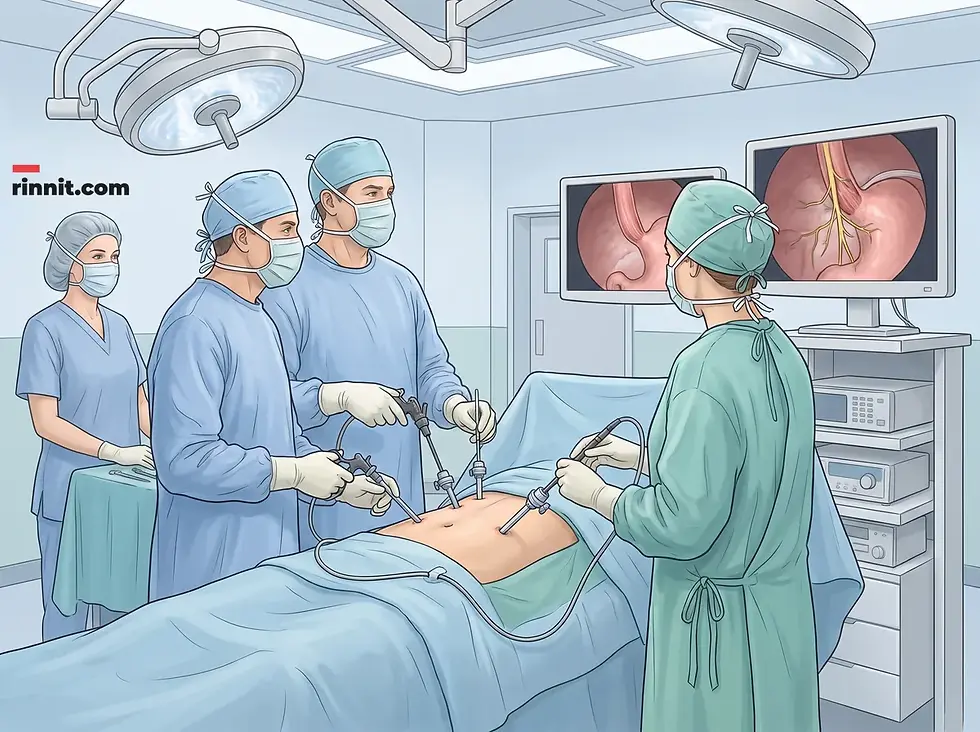
The approach to a vagotomy can be either open or laparoscopic. [1] Laparoscopic surgery is a minimally invasive method using small incisions and specialized tools, which often leads to a faster recovery. [1] Open surgery involves a larger incision, providing the surgeon with broader access, which may be necessary in emergency situations or complex cases involving significant scarring. [1]
During the procedure, the surgeon locates the gastroesophageal junction. [1] For a truncal vagotomy, segments of the two main nerve trunks are removed. [1] For a highly selective vagotomy, the trunks are left intact, and only the fine branches leading to the stomach’s acid-producing cells are severed. [1] If a truncal vagotomy is performed, the surgeon will also perform a pyloroplasty to widen the gastric outlet, ensuring that food can continue to move into the small intestine without the original nerve signals. [1]
Risks and Side Effects
While a vagotomy is effective at preventing ulcer recurrence, it does carry specific risks and potential side effects. The most common side effect following a truncal vagotomy is diarrhea, which occurs because the procedure can interfere with gallbladder contractions, leading to an excess of bile in the intestines. [1] [3] This is usually a temporary condition that can be managed with medication. [1]
Another potential complication is dumping syndrome, which often results from the accompanying pyloroplasty. [1] This condition causes the stomach to empty its contents too rapidly into the small intestine, leading to nausea, abdominal discomfort, and sometimes a sudden drop in blood sugar. [1] Most patients find that dumping syndrome is temporary and can be controlled through dietary adjustments, such as eating smaller, more frequent meals.
Recovery and Long-Term Outlook
After the surgery, patients typically remain in the hospital for several days. [1] During this time, the healthcare team monitors their stability, manages pain, and ensures they can move around comfortably. [1] The long-term outlook for patients who undergo a vagotomy is generally positive, especially for those who have struggled with chronic, painful ulcers.
The primary benefit is the significant reduction in the likelihood of ulcers returning. [1] By addressing the underlying cause of excessive acid production, the surgery provides a definitive solution when other treatments have failed. [1] Patients are encouraged to follow their surgeon’s guidance regarding diet and activity during the initial weeks of recovery to ensure the best possible outcome.

Conclusion
A vagotomy remains a vital surgical tool for managing the most severe and persistent cases of peptic ulcer disease. By precisely interrupting the nerve signals that trigger acid production, it offers a path to healing for patients who have not found relief through traditional medications. Whether performed as a truncal or highly selective procedure, it represents a definitive step toward long-term digestive health and the prevention of life-threatening complications.
Next Steps
If you are considering a vagotomy, the most important next step is to have a detailed discussion with your gastroenterologist or surgeon. They can help you understand the specific type of procedure that is best for your condition and what to expect during the recovery process. Preparing for surgery by following all pre-operative instructions, such as fasting and managing current medications, will help ensure a smooth procedure and a successful transition back to your daily life.
Sources: Cleveland Clinic — Vagotomy | Fraser et al., 1983 | Condon et al., 1975 | Kim et al., 2025
Frequently Asked Questions
1. What is a vagotomy?
A vagotomy is a surgical procedure to cut or interrupt the vagus nerve, primarily to reduce stomach acid.
2. Why is it performed?
A vagotomy is used to treat severe peptic ulcers that do not respond to medication or cause complications.
3. What are the different types?
The main types are truncal vagotomy and highly selective (parietal cell) vagotomy.
4. Is it a major surgery?
Yes, it is a significant abdominal procedure that can be performed through open or laparoscopic methods.
5. How does it stop ulcers?
By cutting the nerve signals that trigger acid release, it lowers the stomach’s acidity levels.
6. What is a truncal vagotomy?
A truncal vagotomy involves cutting the main trunks of the vagus nerve at the base of the esophagus.
7. What is a highly selective vagotomy?
A highly selective vagotomy targets only the specific nerve branches that stimulate acid-producing cells in the stomach.
8. Why is pyloroplasty often needed?
A truncal vagotomy can stop the stomach from emptying; pyloroplasty helps food pass through.
9. What are common side effects?
Diarrhea and dumping syndrome are the most frequently reported side effects.
10. What is dumping syndrome?
Dumping syndrome is a condition where food moves too quickly from the stomach to the small intestine.
11. Can it cause gallstones?
Yes, a truncal vagotomy can affect gallbladder function, potentially leading to stone formation.
12. How long is the hospital stay?
Most patients stay in the hospital for several days following the procedure.
13. Is the recovery painful?
Patients will experience some discomfort, which is managed with medication during recovery.
14. Will I need to change my diet?
Some patients may need to adjust their eating habits, especially if they experience dumping syndrome.
15. Are the results permanent?
A vagotomy markedly reduces acid production and lowers the risk of ulcers coming back, but it does not guarantee they will not return. Ulcer recurrence has been reported in some patients, so follow-up care and avoiding smoking still matter.
Related Reading
Peptic Ulcer Disease: Causes, Symptoms, Diagnosis, and Treatment explains stomach and duodenal ulcers and how they are treated today.
Pyloroplasty: Surgical Solutions for Gastric Outlet Obstruction describes widening the stomach outlet, often done with vagotomy.
Dumping Syndrome Explained: Symptoms, Causes, and the Diet Changes That Help explains rapid stomach emptying after surgery and diet changes that help.
Gastric Outlet Obstruction: Symptoms, Causes, and Clinical Management covers blockage at the stomach exit and its treatment.
References
Cleveland Clinic. Vagotomy. Cleveland Clinic. June 21, 2022. https://my.clevelandclinic.org/health/treatments/23390-vagotomy
Fraser AG, Brunt PW, Matheson NA. A comparison of highly selective vagotomy with truncal vagotomy and pyloroplasty—one surgeon’s results after 5 years. Br J Surg. 1983;70(8):485-488. PMID 6347316. https://doi.org/10.1002/bjs.1800700811
Condon JR, Robinson V, Suleman MI, et al. The cause and treatment of postvagotomy diarrhoea. Br J Surg. 1975;62(4):309-312. PMID 1131510. https://doi.org/10.1002/bjs.1800620415
Kim TH, Jeong SH, Lee YJ, et al. Impact of smoking and age on long-term recurrence after laparoscopic primary closure for duodenal ulcer perforation: a 5-year observational study. Ann Surg Treat Res. 2025;109(2):98-104. PMID 40785810. https://doi.org/10.4174/astr.2025.109.2.98
Medical disclaimer
This content is for informational purposes only and does not constitute professional medical advice, diagnosis, or treatment. Always seek the advice of your physician or other qualified health provider with any questions you may have regarding a medical condition or procedure.



Comments