Understanding Tortuous Colon: Causes, Symptoms, and Management

Updated: 2 days ago
Medically reviewed by Dr. Baraa Alnahhal, MD | Last reviewed: October 7, 2026

Quick Answer
A tortuous colon, also called a redundant colon, is a large intestine that is longer than average and forms extra twists and turns to fit in the abdomen [1]. It is not a disease itself, but the extra loops can slow stool movement, causing bloating, gas and constipation [1]. Most cases are managed with dietary changes and fiber supplements [1].
What the research says
Fiber supplements improve chronic constipation in adults. A systematic review and meta-analysis of 16 randomized trials with 1,251 participants found that 66% (311 of 473) of people responded to fiber versus 41% (134 of 329) on control (RR 1.48, 95% CI 1.17–1.88), with significant effects for psyllium and pectin, a response only at doses above 10 g a day, and more gas (flatulence) with fiber (van der Schoot et al., American Journal of Clinical Nutrition, 2022) [2].
When a redundant colon makes a colonoscopy incomplete, special tools can often finish the exam. In a retrospective single-center series of 24 patients whose colonoscopy was incomplete because of a redundant colon, a spiral overtube allowed the scope to reach the cecum in 22 patients (92%) in a median of 14.5 minutes, found significant findings in 17 of 22 patients (77%), including 1 cancer and 2 advanced polyps, and caused no complications (Schembre et al., Gastrointestinal Endoscopy, 2011) [3].
What Is a Tortuous Colon?
A tortuous colon, clinically referred to as a redundant colon, is an anatomical variation in which the large intestine is longer than typical. Because the human body has a finite amount of space in the abdominal cavity, this extra length shows up as additional loops, folds and twists. The term “tortuous” signifies these extra turns, while “redundant” highlights that the length exceeds what is strictly necessary for digestive function.
This condition can affect a single segment of the colon or its entire length [1]. While the presence of extra loops does not inherently indicate a disease, it can influence how efficiently the body processes waste. The following table summarizes the key distinctions in terminology used by healthcare professionals.
Term | Meaning in clinical context | Impact on anatomy |
Tortuous | Characterized by many twists and turns | Increased number of bends and loops |
Redundant | Exceeding what is normal or necessary | Greater overall length of the intestinal tract |
Segmental | Affecting only a specific part of the colon | Localized loops in one area (for example, the sigmoid colon) |
Symptoms and Potential Complications
Many people with a tortuous colon have no symptoms at all and only discover the anatomical difference during routine screenings. However, when symptoms do occur, they are often related to the increased time it takes for stool to travel through the longer, twistier pathway. As waste moves slowly, the colon has more time to absorb water, which can lead to drier and harder stools [1].
Common symptoms reported by people with a redundant colon include:
Beyond daily discomfort, a tortuous colon can complicate medical procedures. During a colonoscopy, a healthcare provider may find it difficult to navigate the colonoscope through the extra twists [1]. In some cases, this may result in an incomplete exam, necessitating alternative screening methods to ensure no polyps or abnormalities are missed [1].

Causes and Risk Factors
The exact cause of a tortuous colon remains a subject of clinical discussion. Healthcare providers believe it may be a combination of congenital factors and changes that occur over time. Genetics likely play a significant role in determining the initial shape and length of the colon during development.
Potential factor | Description of influence |
Genetics | Inherited traits that dictate the baseline length and form of the colon |
Chronic constipation | Long-term straining and slow-moving stool may gradually stretch the colon [1] |
Aging | Natural changes in tissue elasticity may allow the colon to elongate over time |
Management and Lifestyle Support
In most instances, a tortuous colon does not require surgical intervention or intensive medical treatment. Instead, management focuses on alleviating symptoms and ensuring that stool moves through the extra loops efficiently. The primary goal is to prevent constipation, which can worsen the discomfort associated with a redundant colon.
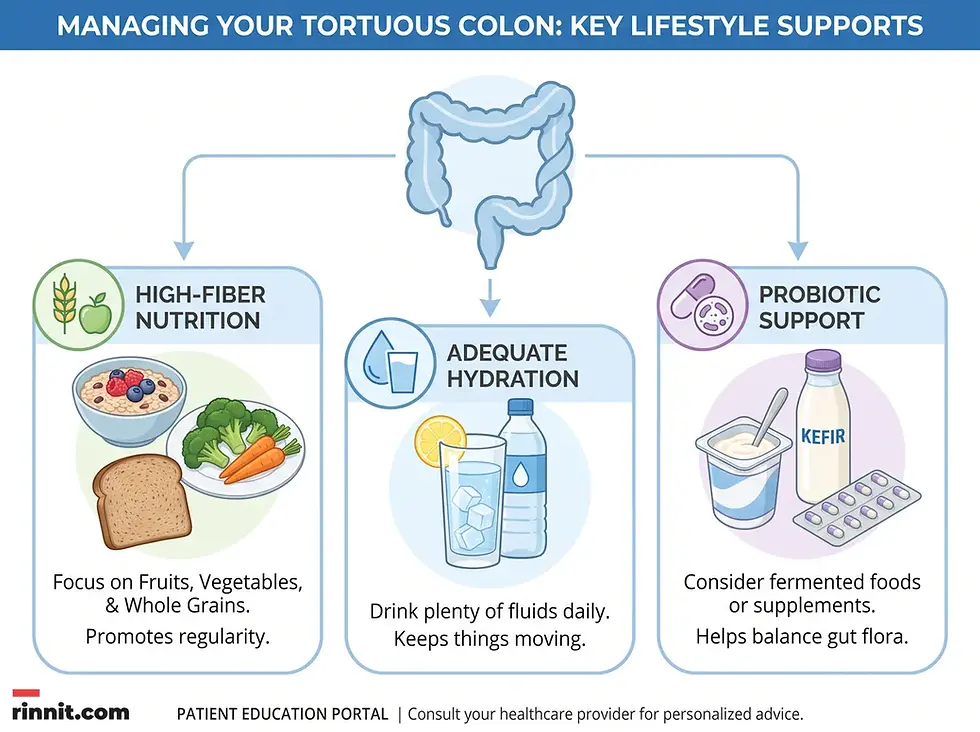
Healthcare providers typically recommend the following strategies:
Fiber intake: increasing dietary fiber or using supplements to add bulk to the stool [1]
Hydration: drinking plenty of water to prevent the colon from over-absorbing moisture
Probiotics: supporting a healthy gut microbiome to aid overall digestion
Activity: maintaining regular physical movement to stimulate intestinal transit
If these lifestyle changes do not provide sufficient relief, a provider may suggest the occasional use of laxatives [1]. Surgery is considered a last resort and is only performed if serious complications, such as a bowel obstruction or severe volvulus (twisting of the gut), occur.
Conclusion
The long-term outlook for people with a tortuous colon is generally excellent. While the discovery of an anatomical difference can be unsettling, it is often just a descriptive finding that helps explain certain digestive patterns. By adopting proactive bowel health habits, most people can manage their symptoms effectively and maintain a high quality of life.
Next Steps
If you experience persistent bloating, abdominal pain or chronic constipation, consult a healthcare professional. A thorough evaluation can confirm whether a redundant colon is a factor and help you develop a personalized care plan to keep your digestive system moving smoothly.
Frequently Asked Questions
What is a tortuous colon?
A tortuous colon is a large intestine that is longer than usual, resulting in extra loops and twists.
Is it the same as a redundant colon?
Yes. These terms are used interchangeably to describe the same anatomical variation.
Is a tortuous colon dangerous?
Generally no, but it can be associated with chronic constipation and difficult colonoscopies.
What are the main symptoms?
Bloating, gas pain and infrequent or hard stools are the most common symptoms.
Can you be born with it?
Possibly. Genetics are believed to play a significant role in the colon’s length and shape, although providers aren’t sure whether it is something you are born with, something that develops over time, or both.
Does it cause weight gain?
No. It does not directly cause weight gain, though bloating may make the abdomen feel larger.
How is it diagnosed?
A tortuous colon is most commonly found during a colonoscopy or other abdominal imaging tests.
Can it be cured?
A tortuous colon is an anatomical feature, not a disease, so it isn’t “cured,” but symptoms can be managed.
Is surgery common?
No. Surgery is rarely necessary unless a serious complication like an obstruction occurs.
What should I eat?
A high-fiber diet with plenty of fruits, vegetables and whole grains is typically recommended.
How much water should I drink?
Consistent hydration is key to preventing the colon from drying out the stool.
Do probiotics help?
Providers may suggest probiotics as part of a plan to support smoother digestion and reduce bloating.
Can it cause back pain?
While rare, severe bloating and gas associated with the condition can sometimes radiate to the back.
Will it affect my colonoscopy?
A tortuous colon can make the procedure more technically difficult for the provider, and your provider might recommend additional colon cancer screening to look for polyps that may have been missed.
When should I see a doctor?
See a healthcare provider if you have ongoing bowel issues that don’t improve with standard home remedies.
Related Reading
Colonoscopy: Purpose, Prep, Procedure, Results and Risks describes the colon exam that can be harder with a tortuous colon.
Virtual Colonoscopy (CT Colonography): Prep, Procedure, Accuracy and Results explains CT colonography, an option when standard colonoscopy is difficult.
Constipation: Symptoms, Causes, Diagnosis and Treatment — What You Need to Know explains constipation causes and treatments, a common tortuous colon symptom.
Intestinal Obstruction: Symptoms, Causes, and Treatment explains bowel blockages and the warning signs that need emergency care.
Sources
Cleveland Clinic. Tortuous Colon (Redundant Colon). Cleveland Clinic. Last updated August 21, 2025. https://my.clevelandclinic.org/health/diseases/tortuous-colon
van der Schoot A, Drysdale C, Whelan K, et al. The effect of fiber supplementation on chronic constipation in adults: an updated systematic review and meta-analysis of randomized controlled trials. Am J Clin Nutr. 2022;116(4):953-969. PMID 35816465. https://doi.org/10.1093/ajcn/nqac184
Schembre DB, Ross AS, Gluck MN, et al. Spiral overtube-assisted colonoscopy after incomplete colonoscopy in the redundant colon. Gastrointest Endosc. 2011;73(3):515-519. PMID 21353848. https://doi.org/10.1016/j.gie.2010.11.047
Medical disclaimer
This information is for educational purposes only and does not constitute medical advice. Always consult a qualified healthcare professional about any digestive concerns or symptoms.



Comments