Virtual Colonoscopy (CT Colonography): Prep, Procedure, Accuracy and Results

Updated: 4 days ago
Written and medically reviewed by Dr. Baraa Alnahhal, MD · Last reviewed: November 2026 · How we review
Quick Answer: What is a virtual colonoscopy?
A virtual colonoscopy, also called CT colonography, is a CT scan that creates detailed 2D and 3D images of your colon and rectum to look for polyps and cancer. It takes about 15 minutes, needs no sedation, and is one way to screen for colorectal cancer. If polyps are found, you need a traditional colonoscopy to remove them. [1]
What the research says
It finds most large polyps and cancers. In 2,531 adults aged 50 and older, CT colonography detected 90% of people who had adenomas or cancers 10 mm or larger. (Johnson et al., The New England Journal of Medicine, 2008) [2]
Smaller polyps are harder to see. The same trial found a per-patient sensitivity of 78% for adenomas 6 mm or larger. (Johnson et al., The New England Journal of Medicine, 2008) [2]
Cancer detection is very high. A meta-analysis of 49 studies and 11,151 patients found CT colonography detected 96.1% of colorectal cancers, similar to optical colonoscopy at 94.7%. (Pickhardt et al., Radiology, 2011) [3]
Key takeaways
A virtual colonoscopy uses a CT scanner to image the whole colon from outside the body. [1]
It takes about 15 minutes and does not need anesthesia. [1]
You still need a full bowel prep the day before. [1]
Polyps found on the scan must be removed with a traditional colonoscopy. [1]
With low risk, a repeat scan may be needed every five years. [1]
How does a virtual colonoscopy work?
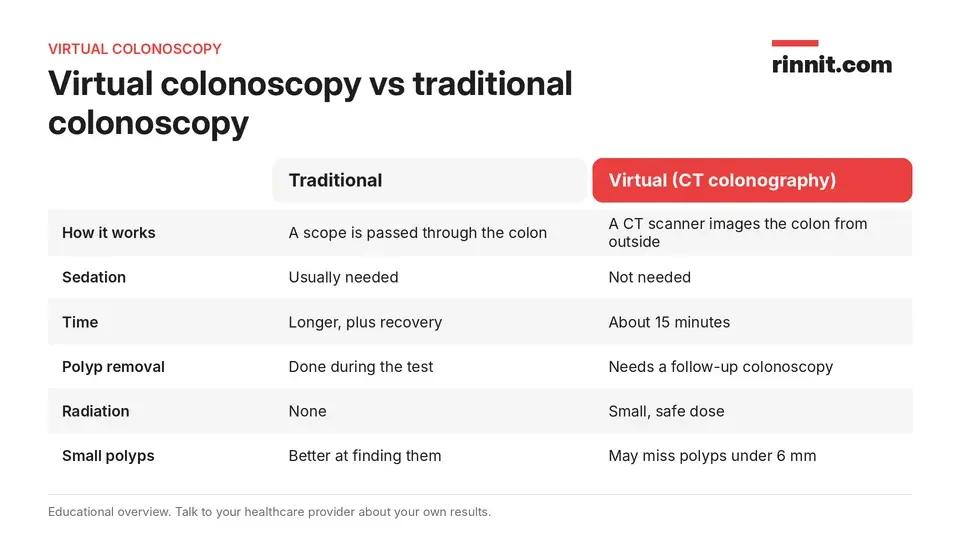
A virtual colonoscopy is a noninvasive test. A technician uses a CT scanner to take many pictures of your abdomen and pelvis, and a computer turns them into 2D and 3D images that give a "virtual tour" of your colon. [1]
A radiologist then reviews the images for polyps (growths) and other problems. Some polyps can turn into colorectal cancer over time, which is why finding them early matters. [1]
Experts recommend colorectal cancer screening for everyone starting at age 45, and sooner if you have certain risk factors. A virtual colonoscopy is one of the screening options. [1]
Who is a virtual colonoscopy a good option for?
It can be a good choice if you cannot have sedation or a traditional colonoscopy for any reason. [1]
Because it images the entire bowel, it also works well if you have a bowel obstruction or narrowed sections of bowel that a scope cannot pass. It can show problems in nearby organs such as the kidneys and liver, too. [1]
How do you prepare for a virtual colonoscopy?
You need a complete bowel prep, usually the day before, so your colon is empty and clear on the images. [1]
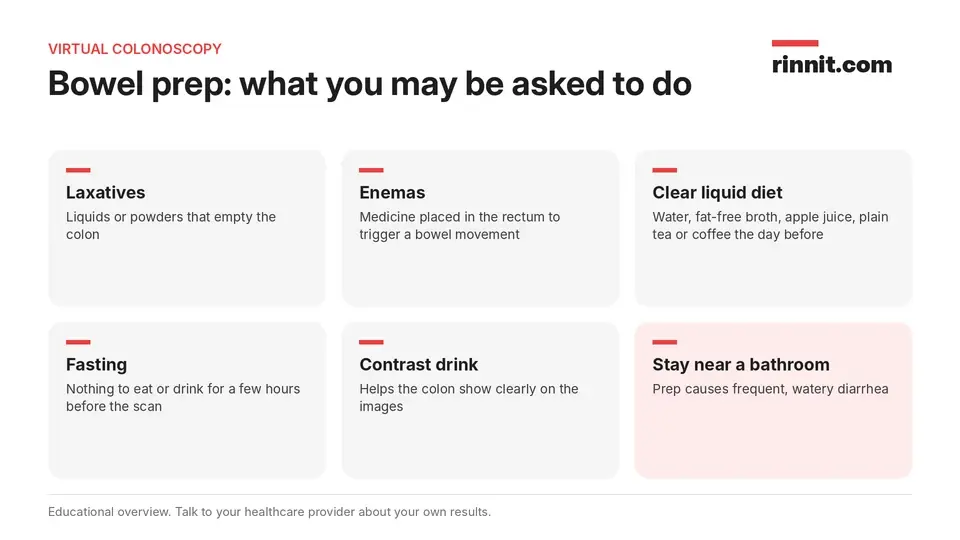
Your provider's instructions may include: [1]
Laxatives: liquids or powders that cause frequent bowel movements
Enemas: medicine placed in the rectum to trigger a bowel movement
Clear liquid diet: water, fat-free broth, apple juice and plain coffee or tea the day before
Fasting: nothing to eat or drink for a few hours before the scan
Contrast drink: a liquid that helps your colon show up clearly
Prep causes frequent, watery diarrhea, so plan to stay home near a bathroom. On the day of the test, wear comfortable clothes and no jewelry. [1]
What happens during a virtual colonoscopy?
The CT scanner looks like a large donut. The test usually follows these steps: [1]
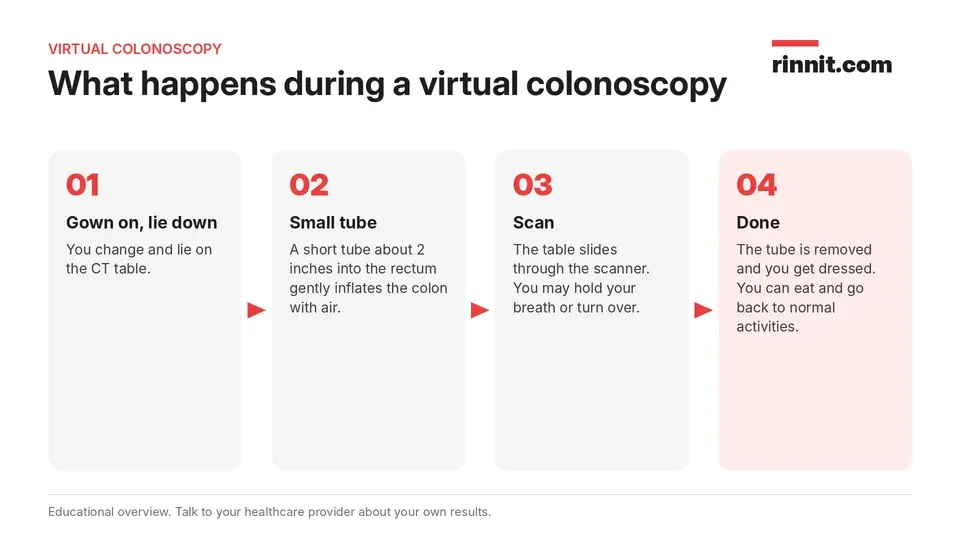
You change into a hospital gown and lie on the exam table.
A technician places a short tube about 2 inches into your rectum and gently pumps air into your colon to inflate it.
The table slides into the scanner, which buzzes or clicks as it takes pictures. You lie still and may be asked to hold your breath or change position.
The table slides out, the tube is removed and you get dressed.
Sources: [1]
The test should not be painful. You may feel pressure in your rectum or feel like you need to pass gas. [1]
Benefits and risks
Benefits | Risks and limitations |
Takes about 15 minutes | Rare bowel perforation from inflating the colon with air |
Detailed 2D and 3D images | Small, safe dose of radiation |
Faster recovery because there is no sedation | Can miss smaller polyps that colonoscopy may catch |
Less invasive, with less risk of colon injury | Polyps still need a colonoscopy to be removed |
Sources: [1]
The test is not safe for everyone, so your provider reviews your medical history and medicines first. [1]
What happens after the test?
You can return to normal activities and eat and drink as usual. Some gas, cramping or bloating from the air is normal. [1]
What do the results mean?
A polyp or abnormal area does not mean you have cancer, but you will need a follow-up colonoscopy so the polyp can be removed. Sometimes this can be done the same day, since you are already prepped. [1]
Because the scan shows other organs in the pelvis and abdomen, it may also find issues outside the colon that need more testing. [1]
If your results are normal and your risk is low, you may need a repeat virtual colonoscopy every five years. Ask your provider when your next screening is due. [1]
How accurate is it? Virtual colonoscopy finds large polyps and cancer at about the same rate as a standard colonoscopy. It is most accurate for polyps larger than 10 millimeters and slightly less effective for polyps smaller than 6 millimeters. [1]
When should you call your doctor?
Seek medical care right away after a virtual colonoscopy if you have: [1]
Blood in your stool or bleeding from the rectum
Dizziness
Fever
Severe abdominal pain
Conclusion
A virtual colonoscopy is a quick, sedation-free way to screen the whole colon for polyps and cancer. It is a strong option if you cannot or will not have a traditional colonoscopy, but any polyp it finds still needs a colonoscopy to remove.
Talk with your provider about which colorectal cancer screening test fits your risk and preferences.
Keep learning: Read our guide to colon polyps or learn about colon cancer screening and treatment. For more background, see the NIDDK guide to virtual colonoscopy.
FAQ
What is a virtual colonoscopy?
It is a CT scan, also called CT colonography, that creates 2D and 3D images of the colon and rectum to look for polyps and cancer. [1]
How long does a virtual colonoscopy take?
The scan takes about 15 minutes. [1]
Do you need sedation for a virtual colonoscopy?
No. It does not need anesthesia, so recovery is faster. [1]
Do I need bowel prep for a virtual colonoscopy?
Yes. You need a full bowel prep, usually the day before, which may include laxatives, enemas, a clear liquid diet and a contrast drink. [1]
Does a virtual colonoscopy hurt?
It should not be painful, though you may feel rectal pressure or the urge to pass gas. [1]
Is a virtual colonoscopy as accurate as a regular colonoscopy?
It finds large polyps and cancer at about the same rate, but it is slightly less effective for polyps smaller than 6 mm. [1]
What happens if polyps are found?
You need a traditional colonoscopy to remove them, sometimes on the same day. [1]
What are the risks of a virtual colonoscopy?
Risks include rare bowel perforation, a small radiation dose and missed small polyps. [1]
How often do I need a virtual colonoscopy?
If you are at low risk and the results are normal, a repeat scan may be needed every five years. [1]
When should I call my doctor after a virtual colonoscopy?
Get care right away for blood in your stool, dizziness, fever or severe abdominal pain. [1]
Related Reading
Colon Cancer: Symptoms, Screening, Diagnosis, Treatment and Support explains the cancer a virtual colonoscopy screens for.
Colon Polyps: Complete Guide to Symptoms, Causes, and Treatment covers the growths a virtual colonoscopy looks for.
References
Cleveland Clinic. Virtual Colonoscopy: Procedure Details & Results. Cleveland Clinic. Last updated May 8, 2025. https://my.clevelandclinic.org/health/diagnostics/11553-virtual-colonoscopy
Johnson CD, Chen MH, Toledano AY, et al. Accuracy of CT colonography for detection of large adenomas and cancers. N Engl J Med. 2008;359(12):1207-1217. PMID 18799557. https://doi.org/10.1056/NEJMoa0800996
Pickhardt PJ, Hassan C, Halligan S, et al. Colorectal cancer: CT colonography and colonoscopy for detection--systematic review and meta-analysis. Radiology. 2011;259(2):393-405. PMID 21415247. https://doi.org/10.1148/radiol.11101887
Medical disclaimer
This article is for general education only and does not replace advice from a qualified healthcare professional. Talk to your doctor about your own diagnosis and treatment, and seek emergency care right away for severe or sudden symptoms.



Comments