Understanding the Skeletal System: Your Body’s Foundation

Updated: 2 days ago
Medically reviewed by Dr. Baraa Alnahhal, MD · Last reviewed: October 2026
Quick Answer
The skeletal system is a framework of bones, joints, and connective tissues that provide structural support, allow movement, and shield internal organs. [1] Bone marrow produces red and white blood cells, and bones store minerals such as calcium. [1] Comprising 206 to 213 bones and more than 600 muscles in adults, [1] this system is the body’s foundation.
What the research says
Calcium and vitamin D pills do little to prevent fractures in most adults. A BMJ meta-analysis of 69 trials (153,902 participants) found vitamin D alone had no effect on any fracture (risk ratio 1.00, 95% CI 0.95–1.06), calcium alone little effect (0.91, 0.81–1.01), and the combination only a marginal one (0.91, 0.84–0.99). (Massé et al., BMJ, 2026) [2]
High-intensity, impact and strength training modestly raises bone density after menopause. A meta-analysis of 8 randomized trials (379 women) found small but significant gains at the femoral neck (effect size 0.47) and lumbar spine (0.36) in postmenopausal women, but not in premenopausal women. (Jones et al., Menopause, 2026) [3]
Adding exercise to calcium and vitamin D beats supplements alone. Across 13 randomized trials in postmenopausal women, combining exercise with calcium and vitamin D improved lumbar spine bone density (standardized mean difference 0.31, 95% CI 0.06–0.55) and femoral neck density (0.47, 95% CI 0.09–0.84) compared with supplements alone. (Bai et al., Nutrients, 2025) [4]
The Vital Functions of the Human Framework
The skeletal system performs several essential roles that are fundamental to human health and survival. While its most obvious function is providing the body with its physical shape and supporting weight, it also serves as a sophisticated protective barrier and a metabolic center.
Function | Description of Action |
|---|---|
Structural Support | Acts as the primary anchor for all bodily tissues and supports the total weight of the body. |
Organ Protection | Functions as a built-in suit of armor, with the skull shielding the brain and the ribs protecting the heart and lungs. |
Movement Facilitation | Joints, muscles, and connective tissues work in tandem to enable physical movement. |
Blood Cell Production | Bone marrow at the center of specific bones generates necessary red and white blood cells. |
Mineral Storage | Serves as a reservoir for critical minerals, including calcium. |
Anatomy and Structural Composition
The skeletal system is more than just a collection of bones; it is an integrated network of various tissues that provide both rigidity and flexibility. This system includes the axial and appendicular skeleton, supported by specialized connective structures. For a deeper look at bone itself, see our guide to human bone anatomy, structure and types.

Primary Components of the System
The human skeleton is composed of several distinct types of tissue, each contributing to the system’s overall functionality. In adults, the framework typically contains between 206 and 213 bones, [1] which serve as the main structural anchors.
Bones: The rigid organs that form the skeleton and provide the body’s primary structural support. [1]
Muscles: More than 600 muscles composed of stretchy fibers that facilitate movement, breathing, and digestion. [1]
Cartilage: Strong, flexible tissue that acts as a shock absorber within joints [1] (see our cartilage guide).
Ligaments and Tendons: Specialized cords that connect bones to other bones (ligaments) or muscles to bones (tendons). [1]
Joints: The critical intersections where two or more bones meet, [1] enabling various degrees of motion, such as the knee joint.
Common Conditions and Injury Prevalence
Because the skeletal system is central to physical activity, it is highly susceptible to a range of chronic conditions, autoimmune disorders, and acute traumas. Understanding these risks is essential for early detection and effective management.

Frequent Skeletal and Joint Disorders
Many individuals experience skeletal issues due to degenerative changes or autoimmune responses. Conditions such as arthritis, bursitis, and tendinitis cause significant inflammation and pain, while osteoporosis can lead to increased bone fragility. [1]
Condition Category | Examples and Impact |
|---|---|
Chronic/Degenerative | Osteoporosis, Arthritis, Bursitis, and Tendinitis. |
Autoimmune | Rheumatoid Arthritis (RA), Lupus, Psoriatic Arthritis, and Sjögren’s syndrome. |
Acute Trauma | Fractures, Dislocations, Muscle Strains, and Ligament Tears. |
Common symptoms of these issues include localized pain, stiffness, swelling, and a reduced range of motion. [1] In some cases, individuals may notice skin discoloration or bruising, a feeling of warmth, or hear or feel a pop or grinding during movement. [1] Tests may include X-rays, ultrasound, CT, MRI or a DXA bone density scan. [1] Learn more about dislocations and spinal fractures, or about knee gel injections for arthritis.
Essential Care Pillars for Skeletal Health
Maintaining a healthy skeletal system requires a proactive approach to nutrition, physical activity, and environmental safety. Consistent care can prevent many common injuries and slow the progression of degenerative bone diseases.
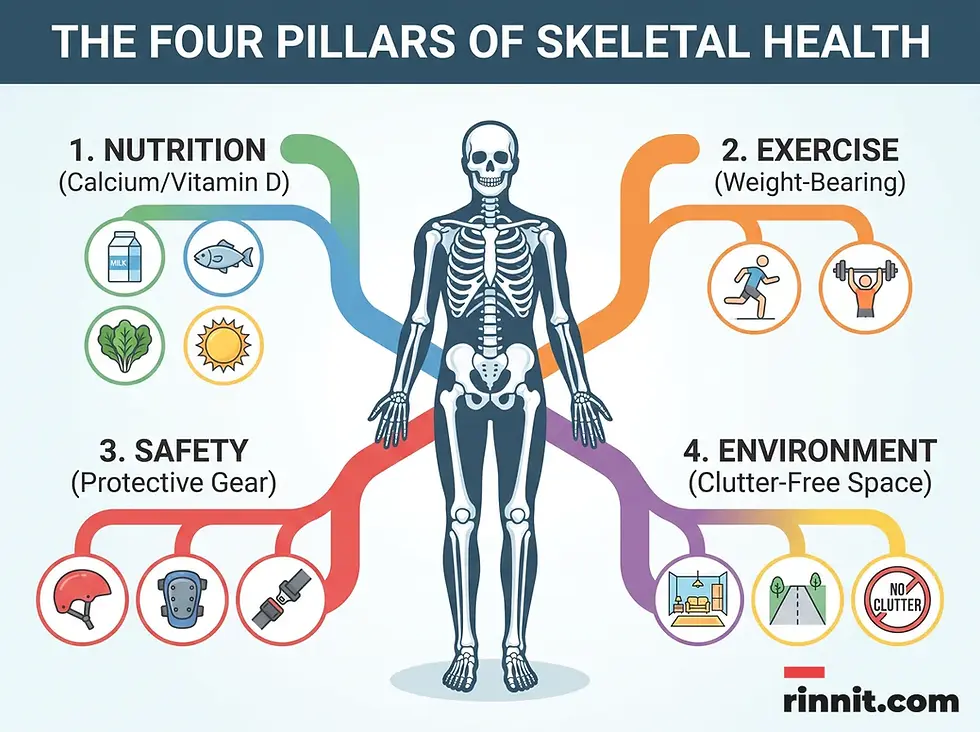
Best Practices for Maintenance
A healthy diet and exercise plan helps maintain bone and overall health, [1] and regular exercise strengthens the muscles that support the skeletal framework, reducing strain on joints and bones. Regular checkups can catch problems early. [1]
Safety first: Always wear seatbelts and use appropriate protective equipment during sports or high-risk activities. [1]
Activity preparation: Stretch and warm up before, and cool down after, intense physical exertion. [1]
Environmental awareness: Keep living and workspaces free of clutter [1] to minimize the risk of falls and related fractures.
Proper equipment: Use stable tools like step ladders instead of furniture when reaching for high objects, and use a cane or walker if you have difficulty walking or an increased fall risk. [1]
Conclusion
The skeletal system is the silent guardian of the human body, providing the stability and protection necessary for every physical action. From the microscopic production of blood cells to the macroscopic support of body weight, its functions are indispensable. By eating well, engaging in regular movement, and adhering to safety protocols, individuals can preserve their mobility and protect their vital organs throughout their lives. The muscles that move this framework are covered in our guide to the neck muscles.
Next Steps for Health
If you experience persistent bone or joint pain, unusual stiffness, or a sudden loss of mobility, consult a healthcare professional. Early diagnostic testing, such as X-rays or bone density scans, can identify issues before they lead to permanent damage or chronic disability.
Frequently Asked Questions
1. How many bones are in the adult human body?
Most adults have between 206 and 213 bones.
2. What is the main function of the skeletal system?
The skeletal system's primary roles are providing shape, enabling movement, protecting organs, and producing blood cells.
3. What is the difference between a ligament and a tendon?
Ligaments connect bones to other bones, while tendons connect muscles to bones.
4. How does the skeleton protect the brain?
The skull acts as a rigid "suit of armor" that shields the brain from impact.
5. What is bone marrow and what does it do?
Bone marrow is tissue at the center of bones that produces red and white blood cells.
6. Can the skeletal system store minerals?
Yes, bones hold your body's supply of important minerals such as calcium.
7. What is cartilage?
Cartilage is a flexible tissue that acts as a shock absorber in joints.
8. What are the symptoms of a skeletal issue?
Common signs include pain, stiffness, swelling, and a reduced range of motion.
9. What is osteoporosis?
Osteoporosis is a condition where bones become weak and brittle, increasing the risk of fractures.
10. How do joints help with movement?
Joints are the points where bones meet, allowing the body to bend and rotate.
11. Are muscles part of the skeletal system?
Yes, they are part of the musculoskeletal system and work with bones to create movement.
12. What is a bone fracture?
A fracture is a medical term for a broken bone, often caused by trauma or falls.
13. How can I improve my bone health?
Follow a healthy diet and exercise plan, see your provider for regular checkups, and avoid falls. Large trials show calcium and vitamin D supplements have little to no effect on fractures in most adults, so ask your provider before relying on them.
14. What tests are used to check bone health?
Common tests include X-rays, ultrasounds, MRIs, CT scans, and DXA (bone density) scans.
15. Why is warming up important for the skeletal system?
Stretching and warming up prepare muscles and joints for activity, reducing the risk of injury.
Related Reading
The Axial Skeleton: The Body's Central Foundation and Shield describes the skull, spine and rib cage at the body's core.
Joints: Anatomy, Types, and Health Significance explains how bones connect and move at different joint types.
Osteoporosis: Causes, Symptoms, Diagnosis and Treatment Explained covers bone thinning, fracture risk and how it is treated.
Bone Fractures: What Happens When a Bone Breaks, and How It Heals explains the types of broken bones and how they heal.
References
Cleveland Clinic. Skeletal System: What It Is, Function, Care & Anatomy. Cleveland Clinic. Last updated January 10, 2024. https://my.clevelandclinic.org/health/body/21048-skeletal-system
Massé O, et al. Calcium, vitamin D, or combined supplementation to prevent fractures and falls: systematic review and meta-analysis. BMJ. 2026;393:e088050. PMID 42161415. https://doi.org/10.1136/bmj-2025-088050
Jones E, et al. A systematic review and meta-analysis of the effects of high-intensity, impact, and strength training on bone mineral density in premenopausal and postmenopausal women. Menopause. 2026. PMID 42578477. https://doi.org/10.1097/GME.0000000000002839
Bai J, et al. Effects of combined exercise and calcium/vitamin D supplementation on bone mineral density in postmenopausal women: a systematic review and meta-analysis. Nutrients. 2025;17(24):3866. PMID 41470812. https://doi.org/10.3390/nu17243866
Medical disclaimer
The information provided in this article is for educational purposes only and is not intended as medical advice. Always seek the guidance of a qualified healthcare professional regarding any medical condition or treatment.



Comments