Dislocation: When a Bone Is Pushed Out of Its Joint — The 6 Most Commonly Dislocated Joints, Symptoms, Treatment and Recovery Time — What You Need to Know

Updated: 2 days ago
Medically reviewed by Dr. Baraa Alnahhal, MD | Last reviewed: October 7, 2026
Medical emergency: Call 911 or go to the nearest emergency room right away if you think a joint is dislocated. Never try to push or force it back in yourself, and do not let a coach, teammate or loved one try. Hold the joint as still as possible and do not put weight on it.
Quick Answer
A dislocation is when the bones of a joint are knocked or pushed out of their usual place, most often in the fingers, shoulders, knees, elbows, hips and jaws. It is painful, makes the joint hard to use and is an emergency: go to the ER and never force it back yourself. [1] [4] Most heal completely within a few weeks. [1]
What the research says
Repeat dislocations are common after a first shoulder dislocation, especially in younger people. A systematic review and meta-analysis of 10 studies with 1,324 participants found recurrent instability in 39% of people after a first traumatic anterior shoulder dislocation; the odds were much higher in people aged 40 or under (odds ratio 13.46), in men (OR 3.18) and in people with hyperlaxity (OR 2.68) (Olds et al., British Journal of Sports Medicine, 2015) [6].
In young, active patients, surgery lowers the chance of a repeat shoulder dislocation compared with a sling alone. A meta-analysis of five randomized trials (126 patients treated with surgical stabilization and 133 treated with sling immobilization only; mean follow-up about 60 months) found recurrent instability in 6.3% of surgical patients versus 46.6% of nonoperative patients (p < 0.00001), and a later stabilization operation in 4.0% versus 30.8% (Belk et al., American Journal of Sports Medicine, 2023) [7].
About one in three kneecap dislocations happen again. A meta-analysis of 17 studies found a 33.6% overall recurrence rate after a first-time lateral patellar dislocation. Risk was higher with younger age (OR 2.61), trochlear dysplasia (OR 4.15) and patella alta (OR 2.38), and rose from 7.7%–13.8% with no risk factors to 70.4%–78.5% with three risk factors (Huntington et al., American Journal of Sports Medicine, 2020) [8].
What is a dislocation?
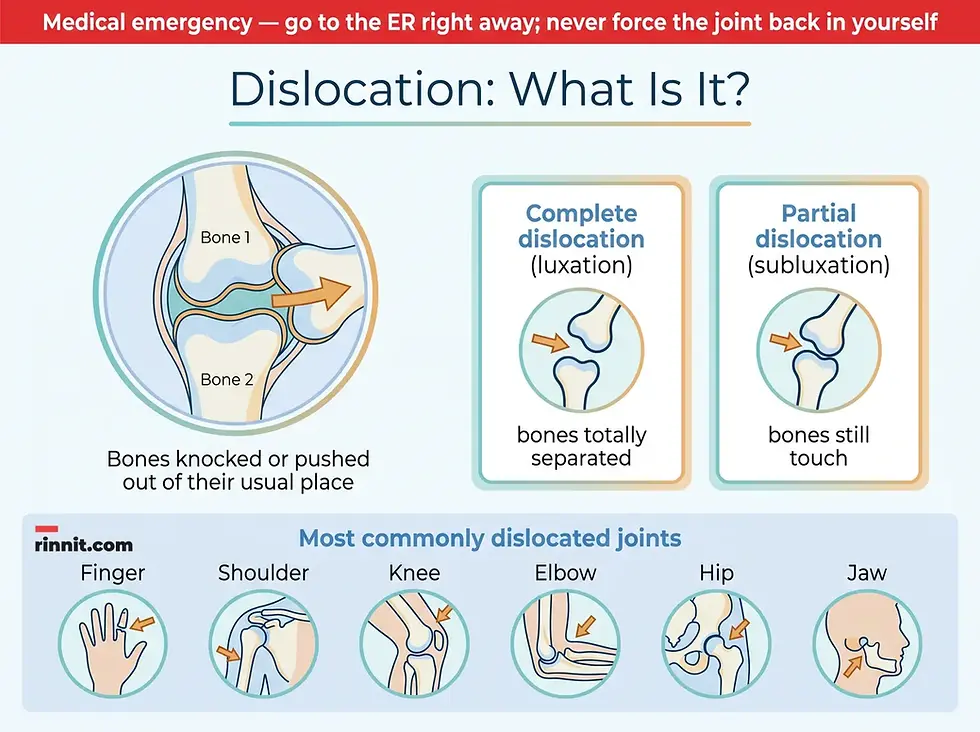
Dislocation is the medical term for bones in one of your joints being knocked or pushed out of their usual place. [1] A joint is any place in your body where two bones meet. Joints are part of your skeletal system, and the hundreds of joints in your body support you from head to toe.
Any joint in your body can be dislocated. [1] Dislocations can be painful and make it hard, or impossible, to use the affected joint. They can also strain or tear the tissues around your joints, including your muscles, nerves, tendons and blood vessels. [1]
What are the types of dislocations?
Healthcare providers classify dislocations based on how far the bones in your joints were moved. [1]
Type | What it means |
Complete dislocation (luxation) | The bones in your joint are totally separated and pushed out of place |
Subluxation (partial dislocation) | Something pulls your joint apart and the bones still touch, just not as completely as usual |
How common are dislocations?
Dislocations are very common. The most commonly dislocated joints include the fingers, shoulders, knees, elbows, hips and jaws. [1]
Joint | Good to know |
Fingers | Among the most commonly dislocated; a dislocated finger may feel back to normal in about three weeks |
Shoulders | Among the most commonly dislocated; a bigger joint that can take several months or longer to heal; higher chance of dislocating again |
Knees | Among the most commonly dislocated; higher chance of dislocating again |
Elbows | Among the most commonly dislocated |
Hips | Among the most commonly dislocated |
Jaws | Among the most commonly dislocated |
What are the symptoms of a dislocation?
The most common symptoms include pain, swelling, bruising, the joint looking noticeably different or out of place, being unable to move or use the joint, and a feeling of instability or like the joint is weaker than usual. [1] Your symptoms will vary depending on which joint is affected and which type of dislocation you experience.
Symptom | What you will notice |
Pain | Significant pain at the affected joint |
Swelling | Inflammation around the joint |
Bruising | Discoloration around the joint |
Visible deformity | The joint looks noticeably different or out of place |
Immobility | You cannot move or use the joint |
Instability | A feeling the joint is weaker than usual |
What causes a dislocation?
Any force that is strong enough to push a joint out of place can cause a dislocation. Dislocations almost always happen during traumas or sports injuries. The most common causes are car accidents, sports injuries and falls. [1]
Who is at higher risk?
Anyone can experience a dislocation, but some groups are more at risk, including people who play contact sports, people who are older than 65, and people who have Ehlers-Danlos syndrome or another health condition that weakens the connective tissues (ligaments, tendons or muscles) around joints. [1]
Risk factor | Detail |
Contact sports | Higher exposure to collision force |
Age over 65 | Increased risk, including the risk of falls |
Weakened connective tissue | Ehlers-Danlos syndrome or another condition that weakens the ligaments, tendons or muscles around joints |

What are the complications of a dislocation?
The most common complications are damage to the bones and tissues around the joint, including muscle strains, ligament and tendon sprains, nerve damage, damaged blood vessels and bone fractures (broken bones). [1]
How is a dislocation diagnosed?
A healthcare provider will diagnose a dislocation with a physical exam of your joint and the area around it. [1] Tell your provider about any symptoms you are having and what you were doing right before the injury. Your provider might also need imaging tests to find damage inside your body.
Test | Purpose |
X-rays | Basic imaging of bones and joint position; may be needed before and after a relocation to check for broken bones |
MRI (magnetic resonance imaging) | Detailed view of soft tissue damage |
CT (computed tomography) scan | Cross-sectional imaging of bone and tissue |
Ultrasound | Imaging of the surrounding soft tissues |
How is a dislocation treated?
The most important treatment is putting the joint back in its correct place. Your healthcare provider might call this a relocation, manipulation or a closed reduction. [1] They will carefully push and pull on the dislocated joint to move it back into alignment. They might give you anesthesia or sedatives (medications that make you sleepy or feel less pain) first, and you might need X-rays before and after to check for broken bones in or around the joint. [1] [5]
If you have a dislocation, go to the emergency room right away. If possible, choose the ER over an urgent care or other clinic, because the ER can get you any imaging tests and medication you will need before and after the joint is put back into alignment. [1]
Never try to reposition a dislocated joint on your own, and do not let anyone other than a healthcare provider push your joint back into place. Forcing it can hurt the joint more than it already is, make the injury worse and damage the tissue around the joint socket. [1]
Depending on which joint was dislocated, you might need other treatment as well.
Treatment | What it involves |
Immobilization | Wearing a splint, sling or brace to hold your joint in place while it heals |
Medication | Medication to reduce pain and inflammation; do not take over-the-counter pain relievers for more than 10 days in a row without talking to your provider |
Rest | Avoiding any physical activity that uses or puts stress on the affected joint |
Do I need surgery for a dislocation?
If the injury that dislocated your joint caused other damage inside your body, you might need surgery to repair it. Some people with severe dislocations need surgery to reset the joint if a closed reduction does not work. [1] [5]

What is the recovery time after a dislocation?
Most people need at least a few weeks to recover. [1] [4] How long it takes your joint to heal depends on which joint was dislocated and whether you had any other injuries.
Joint | Typical recovery |
Most dislocations | At least a few weeks |
Finger | May feel back to normal in about three weeks |
Shoulder | Could take several months or longer |
Your provider will tell you what to expect. Ask how long you need to wait before you resume physical activities: if you return to sports or working out before the joint has fully healed, you have an increased risk of reinjuring it, including dislocating it again. [1]
What is the outlook for a dislocation?
Most dislocations heal completely, and you should start to feel better as soon as the joint is back in its place. [1]
People who dislocate a knee or shoulder are more likely to dislocate it again in the future. [1] Wearing protective gear like a brace during physical activity may reduce your risk of another dislocation, and you may need to work with a physical therapist to strengthen the muscles around the joint you dislocated, which can help prevent repeated dislocations. [1] [2]
As long as your job or schoolwork does not require extra pressure on the affected joint, you should not have to miss work or school. [1] Ask your provider when you can return to sports, doing chores or lifting heavy objects.
How can I prevent a dislocation?
You cannot always prevent a dislocation, because they usually happen through accidents and traumas you cannot plan for. But there are steps you can take to reduce your risk. [1]
Safety step | Detail |
Protective equipment | Wear the right protective equipment during sports or physical activities |
Do not play through pain | Stop if one of your joints hurts during or after physical activity |
Rest and recover | Give your body time to recover after intense activity |
Warm up | Stretch and warm up before playing sports or working out |
Cool down | Cool down and stretch after physical activity |
Clear your space | Keep your home and workspace free from clutter that could trip you or others |
Reach safely | Always use proper tools or equipment to reach things; never stand on chairs, tables or countertops |
Fall prevention | Use a cane or walker if you have difficulty walking or an increased risk of falls |
What questions should I ask my doctor?
Which type of dislocation do I have?
Which treatments will I need?
How long will recovery take?
How long will I need to keep my joint immobilized?
Will I need surgery?
When can I return to playing sports or doing physical activities?
When should I go to the emergency room?
Call 911 or go to the nearest emergency room immediately if you experience trauma or think you have a dislocation, especially if the joint looks out of place, you cannot move or use it, or there is significant pain, swelling or bruising. Go to the ER rather than urgent care if possible, so imaging and medication are available before and after the joint is reset. Do not let anyone who is not a trained healthcare provider move or touch your injured joint, hold it as still as possible, and do not force yourself to use it or put weight on it.
A note from the experts: Dislocations are scary because they usually happen during traumas or accidentally during sports, and it can be shocking to see or feel a joint out of place. Resist the urge to force it back in. A coach, teammate or loved one may mean well, but they can damage the joint further and cause other complications. The good news is that most people return to the court, field and all their usual activities once the joint has healed, so ask your provider how long you will need to keep it immobilized.
The Bottom Line: What You Need to Know About a Dislocation
A dislocation is the medical term for the bones in one of your joints being knocked or pushed out of their usual place, and it can affect any joint in your body. The most commonly dislocated joints include the fingers, shoulders, knees, elbows, hips and jaws. [1] Any force strong enough to push a joint out of place can do it, most often a fall, a car accident or a sports impact.
This is an emergency. Go to the ER right away, keep the joint as still as possible, and never let yourself, a coach, a teammate or a family member force the joint back in. Only a trained healthcare provider should perform the relocation, sometimes with anesthesia or sedatives, with X-rays before and after to check for broken bones.
The good news is that most dislocations heal completely. Recovery takes at least a few weeks: a finger may feel normal in about three weeks, while a shoulder can take several months or longer. [1] People who dislocate a knee or shoulder are more likely to do it again, which is why a physical therapist and protective bracing are worth discussing, and why you should wait for your provider’s clearance before returning to sports.
Take the first step. If you suspect a dislocation, go to the emergency room now. Do not wait, do not test the joint, and do not let anyone reset it except a trained professional.
Frequently Asked Questions
What is a dislocation?
Dislocation is the medical term for bones in one of your joints being knocked or pushed out of their usual place.
Can any joint be dislocated?
Yes. Any joint in your body can be dislocated. A joint is any place where two bones meet, and you have hundreds of them from head to toe.
What are the most commonly dislocated joints?
The fingers, shoulders, knees, elbows, hips and jaws.
What does a dislocation feel like?
Painful, with swelling, bruising, the joint looking noticeably different or out of place, inability to move or use it, and a feeling of instability or weakness.
Is a dislocation an emergency?
Yes. Go to the emergency room right away if you think you have a dislocation, ideally instead of urgent care, because the ER can provide imaging and medication before and after the reset.
Can I push a dislocated joint back in myself?
No. Never try to push or force a dislocated joint back into place on your own, and do not let anyone other than a healthcare provider do it. Forcing it back can make the injury worse and damage the tissue around the joint socket.
What is the difference between luxation and subluxation?
A complete dislocation (luxation) means the bones are totally separated and pushed out of place. A subluxation is a partial dislocation: the bones were pulled apart but still touch, just not as completely as usual.
What causes a dislocation?
Any force strong enough to push a joint out of place. The most common causes are car accidents, sports injuries and falls.
Who is at higher risk for a dislocation?
People who play contact sports, people older than 65, and people with Ehlers-Danlos syndrome or another condition that weakens connective tissues (ligaments, tendons or muscles) around joints.
What are the complications of a dislocation?
Muscle strains, ligament and tendon sprains, nerve damage, damaged blood vessels and bone fractures.
How is a dislocation diagnosed?
With a physical exam of the joint and the area around it, plus imaging tests such as X-rays, MRI, CT scan or ultrasound to check for internal damage.
Why might I need X-rays before and after a relocation?
To check for broken bones in or around your joint before and after it is put back into alignment.
What is a closed reduction?
The procedure in which a healthcare provider carefully pushes and pulls the dislocated joint to move it back into alignment. It is also called a relocation or manipulation, and it is sometimes done with anesthesia or sedatives.
Do I need surgery for a dislocation?
Sometimes. Surgery may be needed if the injury caused other internal damage, or if a closed reduction does not work for a severe dislocation.
How long does it take to recover from a dislocation?
Most people need at least a few weeks. A dislocated finger may feel back to normal in three weeks, while a bigger joint like the shoulder could take several months or longer.
Why do knees and shoulders dislocate again?
People who dislocate a knee or shoulder are more likely to dislocate it again in the future. Working with a physical therapist to strengthen the muscles around the joint, and wearing protective gear like a brace during physical activity, may help prevent repeated dislocations.
Can I return to sports after a dislocation?
Ask your provider when to return. Going back before your joint has fully healed increases your risk of reinjuring it, including dislocating it again.
Do I need to miss work or school?
Not usually. If your job or schoolwork does not require you to put extra pressure on the affected joint, you should not have to miss work or school.
Can I wear a brace after a dislocation?
Wearing protective gear like a brace during physical activity may reduce your risk of another dislocation. Your provider will tell you how long to keep your joint immobilized.
What happens after the joint is reset?
Depending on which joint was dislocated, you may need immobilization (splint, sling or brace), medication for pain and inflammation, and rest from activities that stress the joint.
Can a dislocation damage nerves or blood vessels?
Yes. Dislocations can strain or tear the muscles, nerves, tendons and blood vessels around your joints, and nerve or blood vessel damage is among the possible complications.
How can I prevent a dislocation?
You cannot always prevent one, since they usually result from accidents and traumas. But you can reduce your risk by wearing protective equipment, not playing through pain, resting after intense activity, warming up and cooling down, keeping floors free of tripping clutter, reaching with proper equipment (never standing on chairs or countertops) and using a cane or walker if you have a fall risk.
What is the outlook for a dislocation?
Most dislocations heal completely, and you should start to feel better as soon as your joint is back in its place.
What questions should I ask my doctor?
Which type of dislocation do I have? Which treatments will I need? How long will recovery take? How long will I need to keep my joint immobilized? Will I need surgery? When can I return to sports or physical activities?
Related reading on Rinnit
Sources
Cleveland Clinic. Dislocation: Types, Treatment & Prevention. Cleveland Clinic. Last updated March 1, 2023. https://my.clevelandclinic.org/health/diseases/17873-dislocation
American Academy of Orthopaedic Surgeons. Shoulder Dislocation. OrthoInfo. Accessed October 30, 2026. https://www.orthoinfo.org/diseases--conditions/dislocated-shoulder/
NHS. Dislocated shoulder. NHS. Page last reviewed September 16, 2026. https://www.nhs.uk/conditions/dislocated-shoulder/
U.S. National Library of Medicine. Dislocations. MedlinePlus. Last updated September 16, 2024. https://medlineplus.gov/dislocations.html
McCue JY. Overview of Dislocations. Merck Manual Professional Edition. Last updated October 2025. https://www.merckmanuals.com/professional/injuries-poisoning/dislocations/overview-of-dislocations
Olds M, Ellis R, Donaldson K, et al. Risk factors which predispose first-time traumatic anterior shoulder dislocations to recurrent instability in adults: a systematic review and meta-analysis. Br J Sports Med. 2015;49(14):913-922. PMID 25900943. https://doi.org/10.1136/bjsports-2014-094342
Belk JW, Wharton BR, Houck DA, et al. Shoulder Stabilization Versus Immobilization for First-Time Anterior Shoulder Dislocation: A Systematic Review and Meta-analysis of Level 1 Randomized Controlled Trials. Am J Sports Med. 2023;51(6):1634-1643. PMID 35148222. https://doi.org/10.1177/03635465211065403
Huntington LS, Webster KE, Devitt BM, et al. Factors Associated With an Increased Risk of Recurrence After a First-Time Patellar Dislocation: A Systematic Review and Meta-analysis. Am J Sports Med. 2020;48(10):2552-2562. PMID 31825650. https://doi.org/10.1177/0363546519888467
Medical disclaimer
This article is provided for general educational purposes only and is not a substitute for professional medical advice, diagnosis or treatment. A dislocation is a medical emergency: seek immediate emergency care if you suspect one, and never attempt to force the joint back into place yourself. Only a qualified healthcare provider can diagnose the type and severity of a dislocation, perform a safe reduction and determine whether imaging or surgery is needed.



Comments