The Axial Skeleton: The Body's Central Foundation and Shield

Updated: 3 days ago
Medically reviewed by Dr. Baraa Alnahhal, MD · Last reviewed: October 2026
TL;DR: The axial skeleton is the central core of the body: 80 bones in the skull, ears, neck, back, and ribcage that protect the brain, spinal cord, heart, and lungs and anchor the muscles that move and steady the head, neck, and trunk. [1] Together with the 126-bone appendicular skeleton, it makes up the 206 bones of the adult skeleton. Exercise, enough calcium and vitamin D, not smoking, and good sleep help keep it strong. [1]
Quick Answer: What is the axial skeleton?
The axial skeleton is the central axis of the human body, made up of 80 bones in the head, neck, back and chest. [1] It shields critical organs such as the brain, heart and lungs and gives muscles a stable anchor. [1] It differs from the appendicular skeleton, which includes the limbs; together they form the 206-bone adult skeleton. [1]
What the research says
Low bone density is very common. A systematic review and meta-analysis of 108 population-based studies (343,704 people) estimated that 19.7% of people worldwide have osteoporosis (95% CI 18.0%–21.4%) and 40.4% have osteopenia (95% CI 36.9%–43.8%), with large differences between countries (Xiao et al., Osteoporos Int, 2022) [3].
Exercise modestly improves spine bone density. A meta-analysis of 53 trials (2,896 women aged 60 or older after menopause) found that exercise training significantly increased lumbar spine bone mineral density (weighted mean difference 0.01 g/cm², 95% CI 0.01–0.02). The effect was small, and the authors called for longer studies (Hejazi et al., Arch Osteoporos, 2022) [4].
Smoking raises fracture risk. A meta-analysis of 27 cohort studies in men found that smoking was associated with a higher risk of fracture (relative risk 1.37, 95% CI 1.22–1.53), although the studies varied considerably (Xu et al., Sci Rep, 2022) [5].
What is the axial skeleton?
The adult human body has 206 bones, which are grouped into two systems: the appendicular skeleton and the axial skeleton. [1] The word "axial" comes from "axis," the vertical line that forms the body's central core. [1] The appendicular skeleton includes the limbs, the shoulder girdle, and the pelvis, [1] while the axial skeleton serves as the main vertical support system.
What are the main functions of the axial skeleton?
The axial skeleton is both a structural foundation and a protective shield. It cushions and protects the brain, spinal cord, and many internal organs. [1] It also provides attachment points for the muscles that move the head, neck, and trunk. [1] These muscles help maintain posture, play a key role in breathing, and stabilize the appendicular skeleton.
What is the detailed anatomy of the axial skeleton?
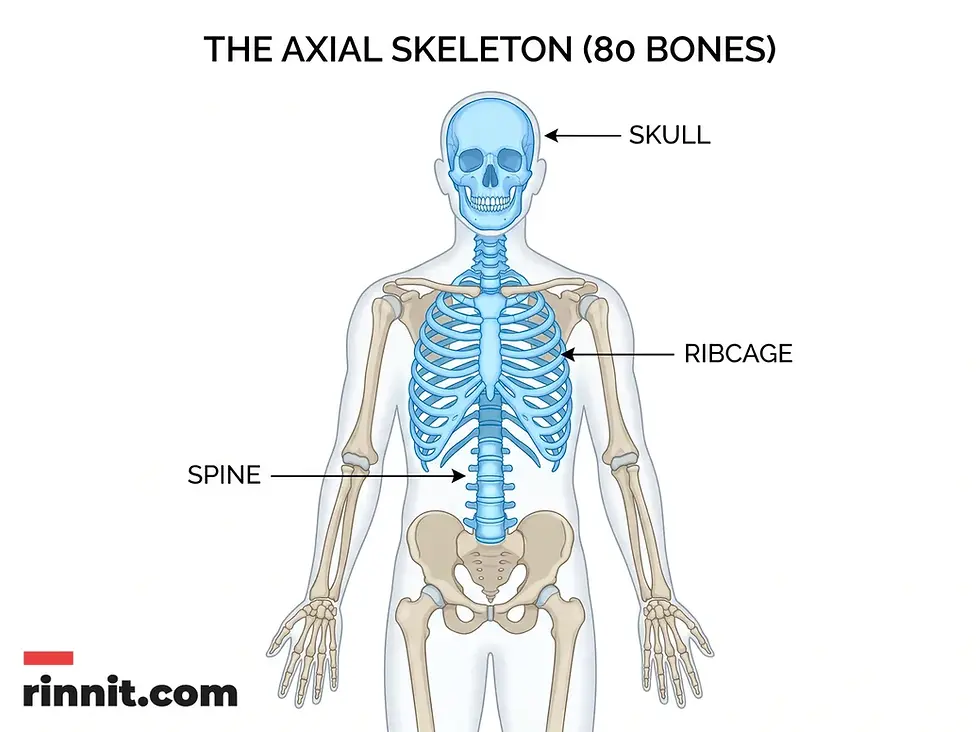
The 80 bones of the axial skeleton are organized into five main sections, each with a specialized purpose. [1]
The skull and ears
The skull is divided into cranial bones, which protect the brain, and facial bones, which shape the face and form the entrances to the digestive and respiratory tracts. The auditory ossicles in the middle ear are the smallest bones in the body, and they carry sound vibrations to the inner ear. [1]
The vertebral column and ribcage
The spine, or vertebral column, runs from the base of the skull to the pelvis [1] and provides vertical stability. The ribcage, or thoracic cage, forms a protective enclosure around the heart and lungs. It is anchored by the sternum and 12 pairs of ribs. [1]
What common conditions affect the axial skeleton?
Aging, disease, and injury can all affect the axial skeleton. These problems often involve inflammation, reduced bone density, or structural weakness.
Condition | Description |
|---|---|
Ankylosing spondylitis | A chronic inflammatory arthritis of the spine that causes back pain and stiffness. |
Osteoporosis | Fragile, brittle bones caused by loss of bone density. Risk rises with age, after menopause, and with low calcium or vitamin D intake, smoking, and inactivity. |
Paget's disease of bone | A disorder in which bone renews itself abnormally, so affected bones grow larger but weaker. [1] |
Fibrous dysplasia | Healthy bone is replaced by fibrous tissue, which increases the risk of fractures. [1] |

How can you care for the bones of the axial skeleton?
Keeping the axial skeleton healthy takes good nutrition and healthy habits. Regular weight-bearing and resistance exercise, such as walking, stair climbing, and strength training, helps maintain bone structure. Enough calcium and vitamin D supports bone strength, and not smoking protects bone. [1] Adequate sleep gives the body time to recover and rebuild tissue. [1]

Conclusion
The axial skeleton is the central framework that protects our most critical organs and supports everyday movement. By understanding its anatomy and the conditions that can affect it, you can take steps to protect your long-term bone health and physical stability.
What are the next steps for axial skeleton health?
If you have chronic back pain or are concerned about your bone density, talk to a healthcare professional. Early screening and a personalized care plan can help protect your skeletal foundation for years to come.
Trusted resources: Cleveland Clinic: Axial Skeleton · NIAMS: Bone Health and Osteoporosis
Frequently Asked Questions
How many bones are in the axial skeleton?
There are 80 bones in the axial skeleton.
What is the difference between the axial and appendicular skeleton?
The axial skeleton is the central core (head, neck, back, and chest). The appendicular skeleton includes the limbs, the shoulder girdle, and the pelvis.
What bones make up the skull?
The skull has 8 cranial bones and 14 facial bones.
What are the smallest bones in the axial skeleton?
The auditory ossicles (malleus, incus, and stapes) in the middle ear are the smallest bones in the body.
What is the function of the hyoid bone?
The hyoid sits in the neck and supports the tongue and the structures involved in swallowing and speaking.
How many vertebrae are in the human spine?
The spine has 24 movable vertebrae, plus the sacrum and the coccyx.
What does the ribcage protect?
The thoracic cage protects the heart, lungs, and other organs in the chest.
What is ankylosing spondylitis?
A type of inflammatory arthritis that mainly affects the spine and causes chronic back pain and stiffness.
How does osteoporosis affect the axial skeleton?
Osteoporosis makes bones fragile and brittle, so the vertebrae and ribs are more prone to fractures.
What is Paget's disease of bone?
A disorder in which bone renews itself abnormally, so bones grow larger but weaker than normal.
Can exercise help the axial skeleton?
Yes. Weight-bearing and resistance exercise can help maintain bone density, although the effect on bone density is usually modest.
Why is vitamin D important for bones?
Vitamin D helps the body absorb calcium, which is essential for bone strength.
How does smoking affect bone health?
Smoking is linked to lower bone density and a higher risk of fractures.
What is the sacrum?
A triangular bone at the base of the spine that forms the back wall of the pelvis.
When should I get a bone density test?
Screening is commonly recommended for women aged 65 and older and for younger postmenopausal women at higher risk. Ask your doctor whether and when you should be tested, including if you are a man with risk factors.
Related Reading
Understanding Your Spine: The Foundation of Movement and Support describes the vertebrae that form the backbone of the axial skeleton.
Skull Sutures: Anatomy, Function, and Growth explains the joints that link the skull bones as they grow.
Rib Cage (Thoracic Cage): Anatomy, Function, Bones, Joints and Common Problems describes the ribs that protect the heart and lungs.
The Sternum (Breastbone): Anatomy, Function, and Common Conditions covers the breastbone at the front of the chest.
References
Cleveland Clinic. Axial Skeleton. Cleveland Clinic. February 8, 2022. https://my.clevelandclinic.org/health/body/22344-axial-skeleton
National Institute of Arthritis and Musculoskeletal and Skin Diseases. Bone Health and Osteoporosis. NIAMS, National Institutes of Health. Accessed October 7, 2026. https://www.niams.nih.gov/health-topics/bone-health-and-osteoporosis
Xiao PL, Cui AY, Hsu CJ, et al. Global, regional prevalence, and risk factors of osteoporosis according to the World Health Organization diagnostic criteria: a systematic review and meta-analysis. Osteoporos Int. 2022;33(10):2137-2153. PMID 35687123. https://doi.org/10.1007/s00198-022-06454-3
Hejazi K, Askari R, Hofmeister M. Effects of physical exercise on bone mineral density in older postmenopausal women: a systematic review and meta-analysis of randomized controlled trials. Arch Osteoporos. 2022;17(1):102. PMID 35896850. https://doi.org/10.1007/s11657-022-01140-7
Xu Y, Bao Y, Wang M, et al. Smoking and fracture risk in men: a meta-analysis of cohort studies, using both frequentist and Bayesian approaches. Sci Rep. 2022;12(1):9270. PMID 35661791. https://doi.org/10.1038/s41598-022-13356-1
Medical Disclaimer
This article is for informational purposes only and does not constitute medical advice. Always seek the advice of your physician or other qualified health provider with any questions you may have regarding a medical condition.



Comments