Understanding the Scapula: The Anatomy and Function of Your Shoulder Blade

Updated: 2 days ago
Medically reviewed by Dr. Baraa Alnahhal, MD · Last reviewed: October 2026
Quick Answer
The scapula is a large, triangular bone on the upper back that forms the posterior part of the shoulder girdle. It connects the humerus (upper arm bone) to the clavicle (collarbone), [1] providing a stable, mobile platform for arm movement. It is connected to 17 muscles, allowing the shoulder to move in six directions, more than any other joint. [1]
What the research says
Scapular exercises add a small, real benefit for shoulder impingement. In a meta-analysis of 14 studies (666 participants), adding scapular stabilization exercises to general exercise reduced pain by a mean of 0.8 cm on a pain scale (95% CI −1.07 to −0.4) and improved function, though the certainty of the evidence was low to very low. (Brasileiro et al., Phys Sportsmed, 2025) [2]
The benefit shows up in pain and daily function, not range of motion. Across 8 randomized trials (387 participants) of subacromial pain syndrome, scapular stabilization exercises improved pain (WMD −0.94, 95% CI −1.23 to −0.65) and the Shoulder Pain and Disability Index (WMD −10.10, 95% CI −18.87 to −1.33) more than conventional physical therapy, but not range of motion. (Zhong et al., Front Neurol, 2024) [3]
Scapular fractures are uncommon, and surgery is not always better. In a systematic review of 14 studies (376 acromial or scapular spine fractures after reverse shoulder replacement), bone union was higher after surgical fixation (78% vs 59.8%), but functional outcomes were comparable and 28.2% of operations had complications. (Abukar et al., J Shoulder Elbow Arthroplast, 2026) [4]
The scapula, commonly called the shoulder blade, is a cornerstone of the shoulder joint. This guide explains what it does, how it is built, which conditions can affect it, and how to protect it.
The Functional Role of the Scapula
The scapula is one of three bones that make up the shoulder joint. [1] Its position and structural design allow it to serve as a critical junction between the upper limb and the trunk. By forming the back portion of the shoulder socket, it provides the leverage needed for lifting, reaching, and rotating.
Feature | Description |
|---|---|
Primary connections | Joins the humerus to the clavicle |
Joint formation | Creates the posterior shoulder girdle socket |
Mobility | Enables movement in six different directions |
Protection | Acts like a built-in shield for the chest |
Beyond its mechanical roles, the scapula is an anatomical hub. It serves as an attachment point for 17 muscles, 12 tendons, six ligaments and two nerves. [1] This dense network of soft tissue keeps the shoulder stable while providing the flexibility needed for tasks ranging from throwing a ball to stretching in the morning.
Detailed Anatomy of the Shoulder Blade
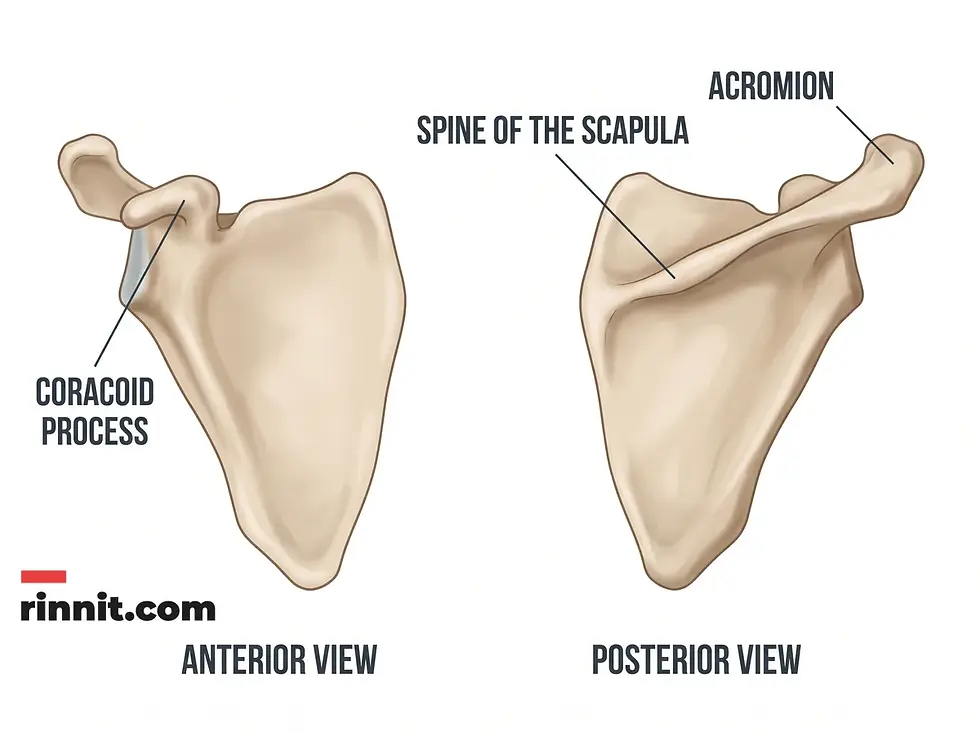
The scapula is characterized by its flat, triangular shape, which is the origin of its common name. [1] It belongs to the shoulder (pectoral) girdle, which attaches the arm to the trunk, and it sits on the back of the upper rib cage behind the collarbone. The bone is divided into three distinct surfaces, [1] each with landmarks that help muscles attach and keep the joint stable.
Anatomical Surfaces and Landmarks
The costal or anterior surface faces the ribcage and features the subscapular fossa, which supports a rotator cuff muscle. [1] The lateral surface points toward the arm and contains the glenoid fossa, the shallow socket where the upper arm bone sits. Finally, the posterior surface faces the back and includes the prominent spine of the scapula and its acromion. [1]
Surface | Key landmark | Functional importance |
|---|---|---|
Costal (anterior) | Subscapular fossa | Supports a rotator cuff muscle |
Lateral | Glenoid fossa | Forms the main shoulder socket |
Posterior | Acromion | Moves with the collarbone during motion |
Common Conditions and Clinical Importance
While the scapula is a robust bone, it is not immune to injury or disease. Most scapular issues occur together with broader shoulder problems. [1] Because the scapula is protected by a thick layer of muscle, direct fractures are rare and usually indicate severe trauma, such as a car accident or a fall from a ladder. [1]
Common conditions that can affect the shoulder blade and the shoulder around it include:
Shoulder sprains and dislocations [1]: damage to the ligaments or the joint itself.
Shoulder impingement syndrome [1]: irritation of the tendons as they pass through the shoulder joint.
Arthritis and bursitis [1]: inflammation of the joint surfaces or the fluid-filled sacs that cushion the joint.
Scapular winging [1]: a condition where the shoulder blade protrudes abnormally due to muscle or nerve issues.

Proactive Care for Shoulder Health
Maintaining the health of your shoulder blades is largely a matter of general musculoskeletal care. Since these bones support a vast array of muscles, keeping those muscles strong and flexible is essential for long-term mobility. Simple safety measures can also significantly reduce the risk of traumatic injury.
Safety and Maintenance Strategies
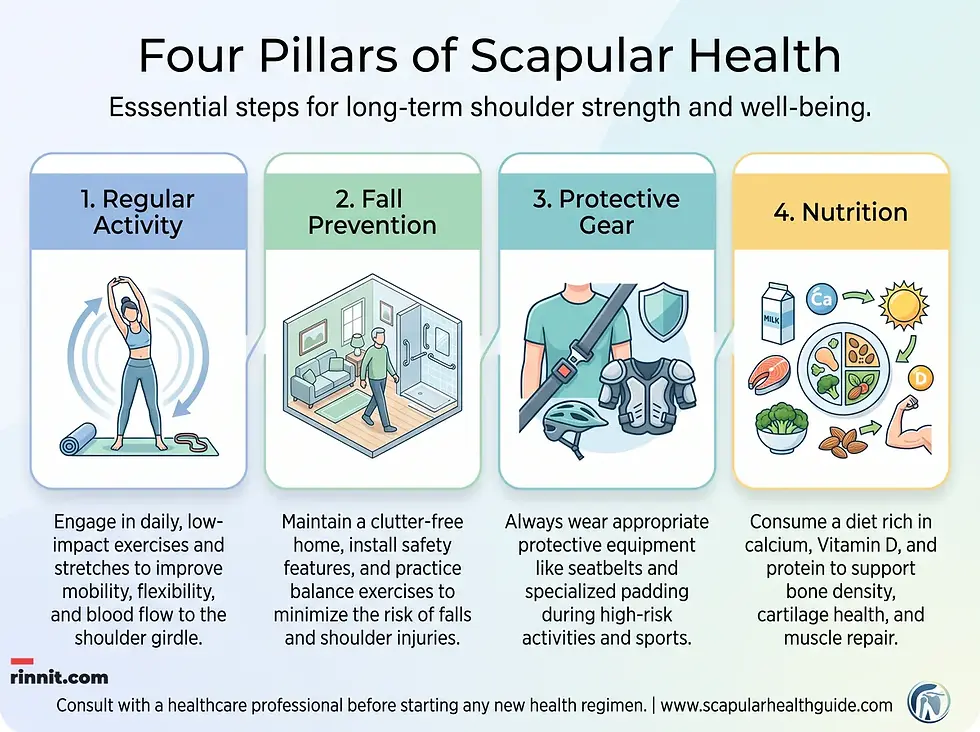
Preventing falls is one of the most effective ways to protect the scapula. This includes keeping living spaces clear of clutter and using proper equipment, such as ladders, instead of standing on unstable furniture. [1] Consistent physical activity and a balanced diet also support bone and muscle health. [1]
Pillar | Actionable step |
|---|---|
Physical activity | Engage in regular stretching and strengthening exercises |
Fall prevention | Remove tripping hazards and use proper reaching tools |
Protective gear | Wear seatbelts and appropriate sports equipment |
Nutrition | Eat a diet rich in nutrients that support bone health |
Conclusion
The scapula is far more than a simple bone in the upper back; it is a sophisticated mechanical component that enables the unique mobility of the human arm. By serving as a shield for the chest and a foundation for dozens of muscles, it plays an indispensable role in daily life. Understanding its anatomy and practicing proactive care can help keep this vital joint functional and pain-free throughout your life.
When to See a Healthcare Professional
If you are experiencing persistent shoulder pain, stiffness, or a reduced range of motion, do not ignore these symptoms, especially if pain lasts more than a week. Consult a healthcare professional to evaluate your shoulder health and discuss personalized strategies for recovery and maintenance.
Frequently Asked Questions
1. What is the scapula?
The scapula is a flat, triangular bone in the upper back commonly known as the shoulder blade.
2. What are the main functions of the scapula?
The scapula connects the arm to the body, forms part of the shoulder socket, and helps your shoulder move.
3. How many muscles attach to the scapula?
There are 17 muscles that connect to the shoulder blade, along with 12 tendons, six ligaments and two nerves.
4. Is the scapula part of the shoulder joint?
Yes. It is one of the three bones that form the shoulder joint.
5. What is the glenoid fossa?
The glenoid fossa is the indentation on the lateral side of the scapula that forms the back of the shoulder socket.
6. Can you break your shoulder blade?
Yes, but it is rare and usually requires severe trauma, such as a car accident or a fall from a ladder.
7. What is scapular winging?
Scapular winging is a condition where the shoulder blade sticks out abnormally from the back, often due to muscle or nerve problems.
8. What is the acromion?
The acromion is the part of the scapular spine that moves with the collarbone when you move your shoulder.
9. How many directions can the shoulder move?
The shoulder can move in six different directions, more than any other joint in the body.
10. What is the subscapular fossa?
The subscapular fossa is an indentation on the front (costal) surface of the scapula that supports a rotator cuff muscle.
11. Are there two scapulae?
Yes. Humans have one shoulder blade on each side of the upper back.
12. What tests are used to check the scapula?
Common tests include X-rays, CT scans, MRIs, and EMGs.
13. What is the plural of scapula?
The plural form is scapulae.
14. How does the scapula protect the chest?
Although it does not directly protect any organs, it is a strong, firm bone that absorbs contact, acting like a built-in shield for the chest.
15. What is shoulder impingement?
Shoulder impingement is a condition where tendons are irritated as they move through the shoulder joint space.
Related Reading
Shoulder Joint: Anatomy, Function, and Common Conditions describes the ball-and-socket joint formed partly by the shoulder blade.
Rotator Cuff Tear: Symptoms, Causes, and Recovery Guide explains tears in the muscles that attach to the shoulder blade.
A Comprehensive Guide to Shoulder Muscle Anatomy and Stability covers the muscles that move and steady the shoulder.
Frozen Shoulder (Adhesive Capsulitis): Symptoms, Causes & Treatment — Complete Guide explains shoulder stiffness and pain and how it slowly improves.
References
Cleveland Clinic. Scapula (Shoulder Blade). Cleveland Clinic. Last updated February 7, 2024. https://my.clevelandclinic.org/health/body/scapula-shoulder-blade
Brasileiro A, et al. Scapular stabilization exercise on pain and functional recovery in people with shoulder impingement syndrome: a systematic review and meta-analysis. The Physician and Sportsmedicine. 2025;53(3):189-196. PMID 39983700. https://doi.org/10.1080/00913847.2025.2470115
Zhong Z, et al. Effect of scapular stabilization exercises on subacromial pain (impingement) syndrome: a systematic review and meta-analysis of randomized controlled trials. Frontiers in Neurology. 2024;15:1357763. PMID 38497039. https://doi.org/10.3389/fneur.2024.1357763
Abukar A, et al. Outcomes of operative and non-operative management of acromial and scapular spine fractures after reverse shoulder arthroplasty: a systematic review. Journal of Shoulder and Elbow Arthroplasty. 2026;10(4):100081. PMID 42774521. https://doi.org/10.1016/j.jsea.2026.100081
Medical disclaimer
The information provided in this article is for educational purposes only and is not intended as medical advice. Always seek the guidance of a qualified healthcare professional regarding any medical condition or treatment.



Comments