A Comprehensive Guide to Shoulder Muscle Anatomy and Stability

Updated: 3 days ago
Medically reviewed by Dr. Baraa Alnahhal, MD · Last reviewed: October 2026
Quick Answer: What are the shoulder muscles?
The shoulder muscles are about eight voluntary skeletal muscles around the top of the arm that move and support the glenohumeral (shoulder) joint. They hold the ball-and-socket joint in place, protect it and allow movement in many directions. [1] The most important are the four rotator cuff muscles, which provide support and help raise and rotate the arm. [1]
When to call your doctor
Contact your doctor right away if you cannot move your shoulder or arm, have numbness in your shoulder or arm, or have severe, sudden pain in your shoulder or anywhere in your arm. [1]
What the research says
Exercise helps people with rotator cuff-related shoulder pain. A meta-analysis of 22 randomized trials (1,281 people) found moderate-certainty evidence that motor control exercise programs reduced disability more than nonspecific exercise in the short term (SMD −0.29, 95% CI −0.51 to −0.07) and medium term (SMD −0.33, 95% CI −0.57 to −0.09), though not short-term pain. Evidence for other exercise types was uncertain (Lafrance et al., Journal of Orthopaedic & Sports Physical Therapy, 2024) [2].
Shoulder pain is common, but estimates vary widely. A systematic review of 18 prevalence studies found point prevalence of 6.9% to 26%, one-year prevalence of 4.7% to 46.7%, and incidence of 0.9% to 2.5%, with the figures depending heavily on how shoulder pain was defined (Luime et al., Scandinavian Journal of Rheumatology, 2004) [3].
What do the shoulder muscles do?
The shoulder muscles do more than move your arm. They are the main stabilizers of the most mobile joint in the body. [1] Because the shoulder is a ball-and-socket joint, it needs a network of muscles to keep the upper arm bone (humerus) firmly in place while still allowing a very wide range of motion.
Primary Function | Description of Action |
Joint Stabilization | Holding the bones of the shoulder joint in their proper position. |
Multi-Directional Movement | Moving the arms up, down, forward, and backward. |
Rotation | Rotating the shoulder joint and arm. |
Joint Protection | Protecting the shoulder joint from injury. |
These muscles are skeletal and voluntary, which means you consciously control their movement. [1] Their fibers look striped (striated) under a microscope because of the orderly bundles of contractile proteins inside them, which let them contract for both fine movements and heavy lifting.
How are the shoulder muscles structured?
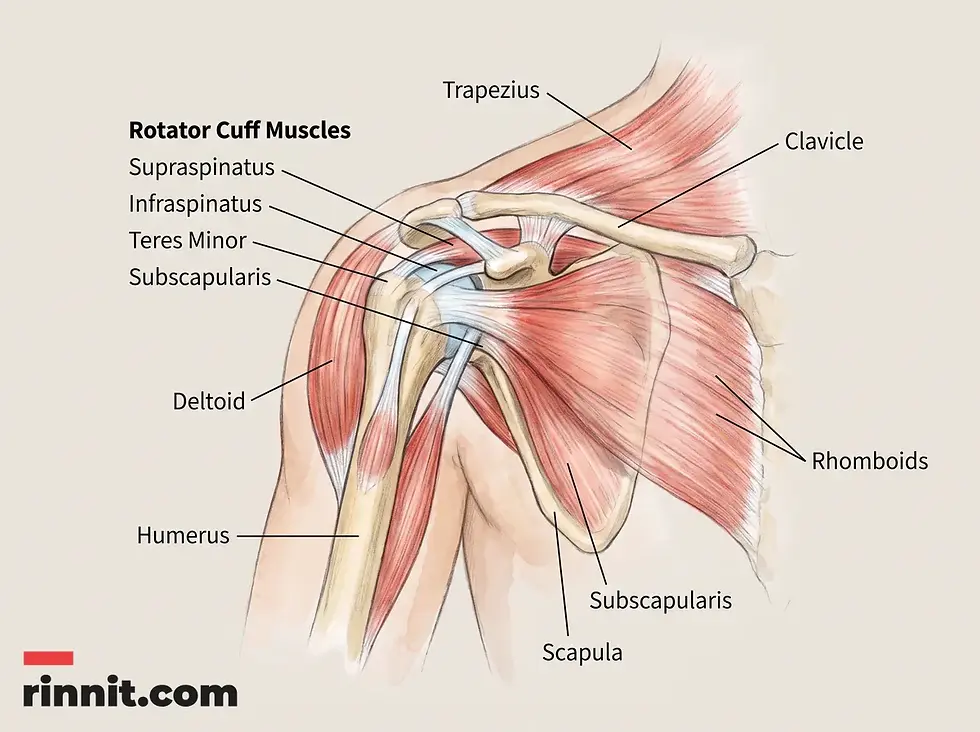
The shoulder muscles surround the top of the arm where it joins the trunk. Tendons attach them to three main bones: the scapula (shoulder blade), the humerus (upper arm bone), and the clavicle (collarbone). [1]
The rotator cuff group
The most important part of shoulder anatomy is the rotator cuff, four muscles and their tendons that surround the ball of the shoulder joint, help you raise and rotate your arm, and support the joint. [1]
Subscapularis: attaches to the middle of the scapula and stretches to the humerus; a fluid-filled bursa separates it from the scapula to reduce friction. [1]
Supraspinatus: stretches from the top of the scapula to the top of the humerus, at the ball of the shoulder joint. [1]
Infraspinatus: stretches from the bottom of the scapula and connects to the humerus behind the supraspinatus. [1]
Teres minor: attaches to the side of the scapula and connects to the humerus beneath the infraspinatus. [1]
Supporting muscles
Other large muscles add power and shape. The deltoid sits on the outside of the shoulder and moves the arm forward, backward, and to the side. At the back, the trapezius (traps) helps you lift and lower the shoulder, and the two rhomboids help lift the shoulder blade. [1]
What are common shoulder muscle conditions and injuries?
Because the shoulder joint is so flexible, the muscles and soft tissues around it go through a lot of wear and tear. They are prone to injuries and degenerative conditions, especially in people who make repeated overhead motions, such as pitchers or swimmers. [1]
Adhesive capsulitis (frozen shoulder): the capsule around the joint becomes thick and stiff, causing pain, spasms, and extreme stiffness. [1]
Bursitis: inflammation of the small fluid-filled sacs (bursae) in the shoulder, which can make movement hard and irritate nearby muscles. [1]
Shoulder impingement syndrome: also called swimmer’s shoulder; muscles or tendons rub against bone too much and become painful and inflamed. [1]
Rotator cuff injuries: such as rotator cuff tears, which usually affect tendons but can involve muscles too. [1]
Muscle strains: caused by overstretched muscle fibers. [1]
Shoulder problems are very common. In 2006, more than 7 million people saw a healthcare provider for a shoulder problem, and roughly 2 to 4 million of those cases involved the rotator cuff. [1]

How can you keep your shoulder muscles healthy?
Keeping your shoulder muscles healthy takes steady care. You use them in almost every upper-body movement, so they need regular attention to stay strong and working well. Most shoulder pain can be prevented by resting the muscles when they feel tired and keeping them strong and conditioned. [1]
Essential care pillars
Warm up and stretch: warm up and stretch your shoulder muscles before intense activity. [1]
Rest and recover: rest your shoulders between workouts or periods of heavy exertion. [1]
Listen to pain: do not push through shoulder pain, which can lead to more serious injuries such as tears or chronic inflammation.
Build strength: keep the shoulder muscles strong and conditioned. [1] A physical therapist can tailor a gradual strengthening program to you.
Maintenance Pillar | Actionable Recommendation |
Activity Preparation | Do dynamic stretches before overhead lifting or sports. |
Recovery | Allow rest periods between workouts or heavy use. |
Symptom Management | Stop and rest at the first sign of muscle irritation, and see a provider if pain persists. |
Strength Conditioning | Build up rotator cuff and shoulder-blade strength gradually, ideally with guidance. |

Conclusion
The shoulder muscles quietly support your arm’s mobility, providing the stability and power needed for everything from reaching to sports. By understanding how the rotator cuff works with the deltoid and trapezius, you can see why care matters. Regular stretching, enough rest, and paying attention to pain are the best defenses against the injuries and wear that commonly affect this hard-working muscle group.
What are the next steps for shoulder muscle health?
If you have sudden, severe shoulder pain, numbness in your arm, or you cannot move your shoulder, contact a healthcare provider right away. [1] Early care for shoulder strains and impingement can prevent long-term movement problems and the need for more invasive treatment.
Trusted resources: Cleveland Clinic: Shoulder Muscles.
Frequently Asked Questions
How many muscles are in the shoulder?
About eight muscles support and move the shoulder joint.
What is the rotator cuff?
The rotator cuff is a group of four muscles and their tendons that stabilize the shoulder and let the arm rotate.
What is the most flexible joint in the body?
The shoulder (glenohumeral) joint has more range of motion than any other joint.
What are the four rotator cuff muscles?
The subscapularis, supraspinatus, infraspinatus, and teres minor.
What does the deltoid muscle do?
The deltoid muscle helps you move your arm forward, backward, and out to the side.
What is frozen shoulder?
Also called adhesive capsulitis, it happens when the capsule around the shoulder joint becomes thick and stiff, causing pain and extreme stiffness.
What is swimmer’s shoulder?
Swimmer’s shoulder is another name for shoulder impingement syndrome, in which muscles or tendons rub against bone and become painful and inflamed.
Are shoulder muscles voluntary or involuntary?
Shoulder muscles are voluntary skeletal muscles, meaning you control how they move.
How do I prevent shoulder injuries?
Warm up and stretch before activity, rest between workouts, keep the muscles strong, and do not push through pain.
What bones do the shoulder muscles attach to?
The shoulder muscles connect through tendons to the scapula (shoulder blade), humerus (upper arm bone), and clavicle (collarbone).
What is a shoulder strain?
A shoulder strain is an injury caused by overstretched muscle fibers.
Why do overhead motions cause shoulder pain?
Repeated overhead movements put heavy wear on the shoulder’s muscles and soft tissues and can lead to impingement and rotator cuff problems.
What is the function of the trapezius?
The trapezius helps you lift and lower your shoulder.
When should I see a doctor for shoulder pain?
Contact a doctor right away if you cannot move your shoulder or arm, have numbness in your shoulder or arm, or have severe, sudden pain.
Can shoulder muscle injuries heal on their own?
Mild strains often improve with rest and care, but significant injuries such as rotator cuff tears may need medical treatment, so have persistent pain checked by a provider.
Related Reading
Rotator Cuff: Four Muscles, Function, Injuries and Care explains the four muscles that keep the shoulder joint stable.
Deltoid Muscles: Anatomy, Function, and Shoulder Health covers the rounded shoulder muscle that lifts the arm.
Shoulder Joint: Anatomy, Function, and Common Conditions describes the bones, ligaments and common problems of the shoulder joint.
Dislocated Shoulder: Symptoms, First Aid, Treatment & Recovery — Complete Guide explains first aid, treatment and recovery after a shoulder dislocation.
References
Cleveland Clinic. Shoulder Muscles. Cleveland Clinic Health Library. Last updated August 24, 2021. https://my.clevelandclinic.org/health/body/21798-shoulder-muscles
Lafrance S, Charron M, Dubé MO, et al. The efficacy of exercise therapy for rotator cuff-related shoulder pain according to the FITT principle: a systematic review with meta-analyses. J Orthop Sports Phys Ther. 2024;54(8):499-512. PMID 38848304. https://doi.org/10.2519/jospt.2024.12453
Luime JJ, Koes BW, Hendriksen IJ, et al. Prevalence and incidence of shoulder pain in the general population; a systematic review. Scand J Rheumatol. 2004;33(2):73-81. PMID 15163107. https://doi.org/10.1080/03009740310004667
Medical Disclaimer
This article is for informational purposes only and does not constitute medical advice. Always seek the advice of your physician or other qualified health provider with any questions you may have regarding a medical condition.



Comments