The Clavicle: Understanding the Anatomy and Function of Your Collarbone

Updated: 3 days ago
Medically reviewed by Dr. Baraa Alnahhal, MD · Last reviewed: October 2026
Quick Answer
The clavicle (collarbone) is a horizontal bone approximately 6 inches long [1] at the base of the neck. It connects the arm to the body’s axial skeleton. [1] It supports the upper body, holds the shoulder in position, and rotates for full arm movement. [1] It is prone to fractures from falls or contact sports, accounting for roughly 5% of adult bone breaks. [1]
What the research says
Surgery lowers the risk of nonunion, but does not clearly improve final function. A meta-analysis of 6 randomized trials (614 patients) with displaced midshaft clavicle fractures found a lower nonunion risk with plate fixation (relative risk 0.14, 95% CI 0.06–0.32), but shoulder-function scores at one year were only a few points better (Constant score 4.4 points, DASH score 5.1 points), and the authors concluded there is not enough evidence to support routine surgery for every patient. (Woltz et al., J Bone Joint Surg Am, 2017) [2]
Surgery speeds bone union but brings more complications. Across 14 randomized trials (1,546 patients), union occurred 5.1 weeks sooner with surgery, while the complication rate, including reinterventions, was higher in the surgical group (31.3% vs 20.5%). (Guerra et al., Am J Sports Med, 2019) [3]
The collarbone is one of the most commonly broken bones in children. In a Danish register study of 32,375 fractures in children aged 0–15 years treated between 1980 and 2018, fractures of the lower end of the forearm, the clavicle and the lower end of the humerus had the highest single-fracture incidence rates. (Larsen et al., Acta Orthop, 2020) [4]
The human skeleton is a masterpiece of engineering, and the clavicle—derived from the Latin word for “little key”—is one of its most essential components. Shaped like an old-fashioned key, this bone acts as a pivot point for the shoulder, enabling the complex rotations required for lifting, reaching, and carrying. Despite its importance, its location just beneath the skin makes it uniquely vulnerable to the impacts of daily life.
What is the anatomy of the clavicle (collarbone)?
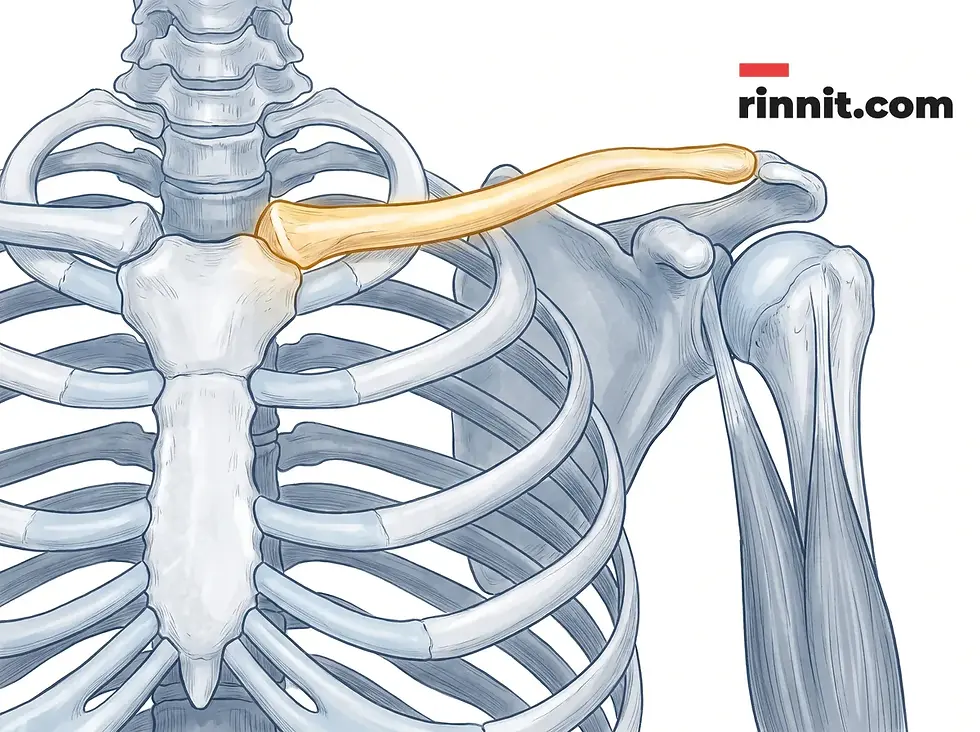
The clavicle is a long bone with a hard outer shell and a spongy inner core. [1] In an adult, it spans about 6 inches across the top of the chest. [1] It does not act alone; instead, it is secured by strong bands of tissue known as ligaments that create a stable yet flexible connection between the center of the chest and the shoulder.
Feature | Description |
|---|---|
Location | Horizontal placement at the base of the neck, running from the sternum to the shoulder. |
Connections | Linked to the sternum (breastbone) and the scapula (shoulder blade) via ligaments. [1] |
Composition | A dual-layer structure featuring a hard cortical shell and a spongy cancellous interior. |
Shape | Slightly curved, resembling an old-fashioned key to facilitate rotation. |
What vital roles does the collarbone (clavicle) play?
The clavicle is far more than just a structural bridge. It performs several active roles that allow the upper body to function efficiently. By holding the shoulder blade in the correct position, it ensures that the arm can move freely without impinging on the neck or chest. Furthermore, it acts as a shock absorber, transferring weight and force from the upper limbs to the central skeleton.
Structural Support: It maintains the distance between the shoulder and the chest, preventing the collapse of the shoulder area.
Dynamic Movement: It rotates along its own axis, much like a key turning in a lock, to permit the arm to lift above the head. [1]
Weight Transfer: It allows force from the arms to be safely distributed to the head, neck, and back. [1]
What common injuries and conditions affect the clavicle?
Because the clavicle is thin and lacks a thick layer of protective muscle or fat, it is frequently injured. Fractures are particularly common in children and athletes who participate in contact sports. In older adults, falls are a leading cause of collarbone breaks [1], often occurring when a person reaches out their arm to break a fall.
Condition | Description | Common Symptoms |
|---|---|---|
Clavicle Fracture | A break in the bone, which can be simple or comminuted (multiple pieces). | Sharp pain, swelling, and a visible lump or bump. |
Separated Shoulder | A tear in the ligaments connecting the clavicle to the shoulder blade. | Bruising, discoloration, and inability to lift the arm. |
Osteoarthritis | Wear and tear of the joints where the clavicle meets the sternum or shoulder. | Chronic stiffness and grinding sensations during movement. |

How are clavicle injuries diagnosed, and what does recovery involve?
If a clavicle injury is suspected, medical professionals typically use imaging tests such as X-rays, MRIs, or CT scans [1] to determine the severity. Treatment varies based on the type of injury. While many fractures can heal with rest and immobilization in a sling, severe displacements may require surgical intervention to reposition the bone and secure it with plates or screws.
Caring for Your Skeletal Health
Maintaining strong bones and preventing falls are the main ways to lower your risk of clavicle injuries. A combination of weight-bearing exercises and proper nutrition provides the foundation for a resilient skeletal system.

Conclusion
The clavicle is a small but mighty bone that serves as the “little key” to upper body mobility. By understanding its anatomy and the risks it faces, we can take proactive steps to protect it. Whether through wearing proper safety gear during sports or ensuring adequate intake of bone-strengthening nutrients, caring for your collarbone is an investment in your long-term physical freedom.
Next Steps for Health
To protect your clavicle, incorporate weight-bearing activities like walking or jogging into your routine for at least 30 minutes most days. [1] Ensure your diet includes sufficient calcium and Vitamin D, and take steps to prevent falls by removing tripping hazards in your home. [1] If you experience persistent pain or have suffered a fall, consult a healthcare professional for a thorough evaluation.
Frequently Asked Questions
1. What is the clavicle?
The clavicle is the scientific name for the collarbone, which connects the arm to the chest.
2. Why is it called a “little key”?
The name comes from the Latin “clavicula,” referring to its key-like shape and rotational function.
3. How long is the average adult clavicle?
The average adult clavicle is typically about 6 inches long and runs horizontally across the top of the chest.
4. Is the clavicle easy to break?
Yes, it is one of the most frequently fractured bones because it sits right under the skin.
5. What are the signs of a broken collarbone?
Common signs include sharp pain, swelling, bruising, and a visible lump or deformity.
6. How do doctors diagnose a clavicle injury?
Diagnosis is usually confirmed through imaging tests like X-rays, MRIs, or CT scans.
7. Do all clavicle fractures need surgery?
No, many heal with rest and a sling, but severe breaks may require surgery to realign the bone.
8. What is a separated shoulder?
A separated shoulder occurs when the ligaments connecting the clavicle to the shoulder blade are torn.
9. Can babies be born with a broken clavicle?
Yes, clavicle injuries can sometimes occur during a difficult birth.
10. What are clavicles made of?
Like other bones, they have a hard outer shell and a spongy inner layer of tissue.
11. How does smoking affect the clavicle?
Smoking can weaken bones and slow down the healing process after a fracture.
12. What nutrients are best for clavicle health?
Calcium and Vitamin D are essential for building and maintaining strong bones.
13. What exercises help strengthen the collarbone area?
Weight-bearing exercises like walking and resistance training like weightlifting are highly effective.
14. How long does it take for a clavicle to heal?
Healing time varies, but it often takes several weeks of immobilization for the bone to knit back together.
15. What is thoracic outlet syndrome?
Thoracic outlet syndrome is a condition that can affect the clavicle area when nerves or blood vessels are compressed.
Related Reading
Broken Collarbone: Symptoms, Causes, and Treatment explains collarbone fractures and how they heal.
Shoulder Joint: Anatomy, Function, and Common Conditions describes the shoulder joint that the collarbone helps support.
Understanding the Scapula: The Anatomy and Function of Your Shoulder Blade covers the shoulder blade that links to the collarbone.
The Sternum (Breastbone): Anatomy, Function, and Common Conditions describes the breastbone where the collarbone attaches.
References
Cleveland Clinic. Clavicle (Collarbone): Location & Anatomy. Cleveland Clinic. Last updated July 13, 2023. https://my.clevelandclinic.org/health/body/16877-clavicle
Woltz S, et al. Plate Fixation Versus Nonoperative Treatment for Displaced Midshaft Clavicular Fractures: A Meta-Analysis of Randomized Controlled Trials. Journal of Bone and Joint Surgery (American Volume). 2017;99(12):1051-1057. PMID 28632595. https://doi.org/10.2106/JBJS.16.01068
Guerra E, et al. Midshaft Clavicle Fractures: Surgery Provides Better Results as Compared With Nonoperative Treatment: A Meta-analysis. The American Journal of Sports Medicine. 2019;47(14):3541-3551. PMID 30835150. https://doi.org/10.1177/0363546519826961
Larsen AV, et al. Development of the annual incidence rate of fracture in children 1980-2018: a population-based study of 32,375 fractures. Acta Orthopaedica. 2020;91(5):593-597. PMID 32500789. https://doi.org/10.1080/17453674.2020.1772555
Medical disclaimer
This article is for informational purposes only and does not constitute medical advice. Consult a healthcare professional for diagnosis and treatment.



Comments