Understanding the Hypoglossal Nerve: The Key to Tongue Movement

Updated: 2 days ago
Medically reviewed by Dr. Baraa Alnahhal, MD · Last reviewed: October 2026
The hypoglossal nerve, also known as cranial nerve 12 (CNXII), is a critical motor nerve that controls the muscles of the tongue [1]. It originates at the base of the brain and travels through the neck to enable essential functions like speaking, swallowing, and chewing [1]. Damage to this nerve can lead to tongue weakness, atrophy, and significant difficulty with daily oral activities [1].
Quick Answer: What is the hypoglossal nerve (CNXII)?
The hypoglossal nerve (CNXII) is the 12th pair of cranial nerves and controls all motor functions of the tongue [1]. Running from the brainstem down the neck to the underside of the tongue [1], it enables clear speech, safe swallowing and chewing. Providers test it by checking tongue protrusion and strength [1], since dysfunction may signal conditions like stroke or ALS.
What the research says
Stimulating the hypoglossal nerve can reduce sleep apnea severity in selected patients. In the multicenter STAR cohort study of 126 adults with moderate-to-severe obstructive sleep apnea who had difficulty with CPAP, the median apnea-hypopnea index fell 68% (from 29.3 to 9.0 events per hour) at 12 months; in 23 participants randomized to therapy withdrawal, it rose to 25.8 events per hour, versus 8.9 in the 23 who kept using therapy (Strollo et al., N Engl J Med, 2014) [2].
A randomized trial found more patients responded to targeted hypoglossal nerve stimulation than to delayed activation. Among 138 patients with moderate-to-severe obstructive sleep apnea, 52.3% of the treatment group met the apnea-hypopnea index response criteria at month 4 versus 19.6% of the delayed-activation control group (Schwartz et al., JAMA Otolaryngol Head Neck Surg, 2023) [3].
What is the anatomy and path of the hypoglossal nerve?
The hypoglossal nerve's name is derived from the Greek words “hypo” (under) and “glossal” (tongue), accurately describing its final destination [1]. It is one of the twelve paired cranial nerves that emerge directly from the brain rather than the spinal cord.
The Journey from Brain to Tongue
The nerve begins its journey in the brainstem, specifically at the base of the brain near the top of the spinal cord [1]. From there, it follows a complex path:
The Neck: It travels downward through the cervical plexus and runs alongside major blood vessels, including the carotid artery and jugular vein [1].
The Throat: It extends past the back of the throat to reach the floor of the mouth [1].
The Tongue: Finally, it branches out to connect with the specific muscles that drive tongue movement [1].

Which tongue muscles does the hypoglossal nerve control?
The hypoglossal nerve is purely a motor nerve, meaning its sole purpose is to carry signals that trigger muscle movement. It coordinates four primary muscle groups that determine the tongue's position and shape [1].
These coordinated movements are essential for articulating speech sounds, manipulating food during chewing, and safely moving substances to the back of the throat for swallowing [1].
What conditions affect hypoglossal nerve function?
Various health conditions can disrupt the signals sent by the hypoglossal nerve, leading to functional impairment.
Neurological and Physical Causes
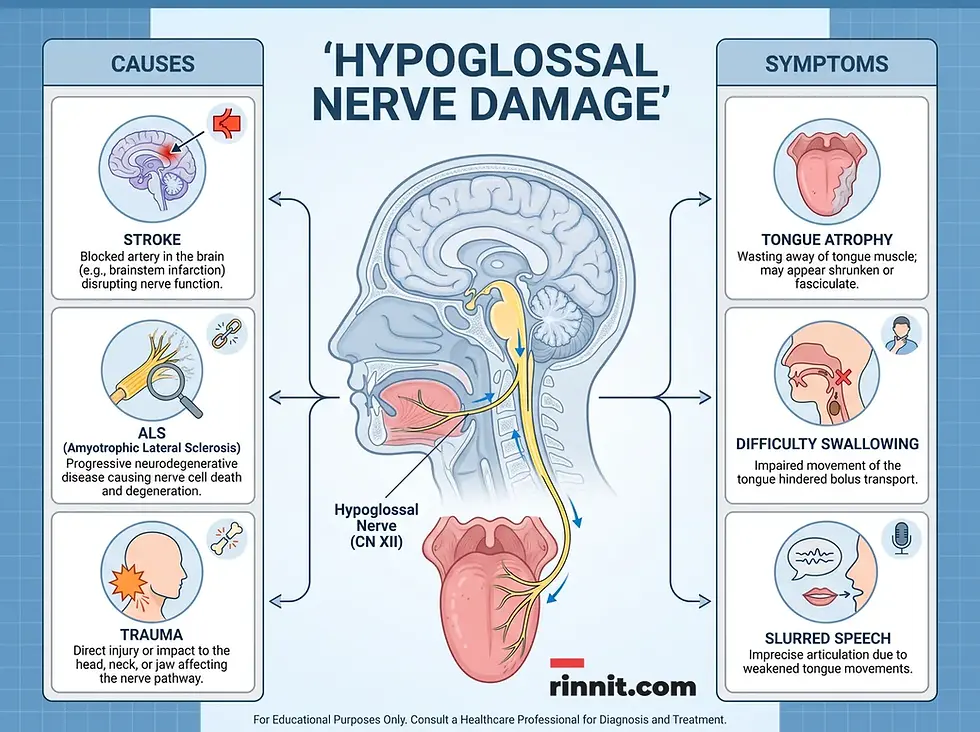
Stroke: A lack of blood flow to the brain can sever the communication between the brain and the nerve.
Amyotrophic Lateral Sclerosis (ALS): This neuromuscular disorder leads to progressive muscle weakness and nerve degeneration.
Trauma: Physical injuries from accidents or falls can physically sever or damage the nerve.
Tumors and Infections: Brain tumors or inflammation from encephalitis can put pressure on the nerve at the brainstem.
What are the symptoms of hypoglossal nerve damage, and how is it diagnosed?
When the hypoglossal nerve is damaged, the most common sign is weakness on the affected side of the tongue [1]. Over time, this lack of stimulation causes the muscle tissue to waste away, a process known as atrophy [1].
Recognizing the Signs
If you have hypoglossal nerve damage, your tongue may point toward the damaged side when you stick it out [1]. Other symptoms include difficulty chewing, uncoordinated tongue movements, and dysarthria (slurred or difficult speech) [1].
Clinical Evaluation
Healthcare providers use several methods to test nerve function:
Physical Exam: Asking the patient to protrude their tongue or push it against their cheek to test strength [1].
Imaging: Using MRI scans to look for evidence of a stroke or a tumor pressing on the nerve [1].
Lumbar Puncture: Performing a spinal tap to check for signs of infection or cancer that could be affecting the brainstem [1].
How can you protect your hypoglossal nerve and neurological health?
Many causes of hypoglossal nerve damage can be managed through proactive health choices, even though some nerve injuries are accidental. Maintaining a healthy weight and lifestyle can reduce the risk of stroke and sleep apnea [1], both of which impact the muscles controlled by the hypoglossal nerve. Quitting smoking and limiting alcohol are also critical steps in preventing head and neck cancers that could disrupt nerve function [1].

Conclusion
The hypoglossal nerve is the essential engine behind the tongue's versatility. By enabling clear communication and safe nutrition, it plays a vital role in our daily quality of life. Recognizing the symptoms of nerve dysfunction and maintaining a brain-healthy lifestyle are the best ways to ensure this critical pathway continues to function effectively.
Next step: Are you experiencing sudden changes in your speech or difficulty swallowing? Call 911 right away, because sudden changes in speech or swallowing can be signs of a stroke.
Frequently Asked Questions
What is the primary role of the hypoglossal nerve?
The hypoglossal nerve is a motor nerve responsible for controlling the movements of the tongue.
Which cranial nerve is the hypoglossal nerve?
The hypoglossal nerve is the 12th cranial nerve, often abbreviated as CNXII.
Where does the hypoglossal nerve start?
The hypoglossal nerve originates in the brainstem at the base of the brain.
Does the hypoglossal nerve help with taste?
No, it is a purely motor nerve; other cranial nerves are responsible for the sensation of taste.
What are the symptoms of hypoglossal nerve damage?
Symptoms include tongue weakness, atrophy, difficulty swallowing, and slurred speech.
Why does the tongue point to one side after damage?
The tongue points toward the damaged side because the healthy muscles on the opposite side push it in that direction.
Can a stroke affect the hypoglossal nerve?
Yes, a stroke can disrupt the brain's ability to communicate with the nerve, leading to tongue paralysis.
What is ALS's effect on the tongue?
ALS can cause tiny twitching movements on the tongue's surface and eventual muscle wasting.
How do doctors test this nerve?
Doctors test it by observing tongue movement and asking the patient to push their tongue against their cheek.
Can hypoglossal nerve function be restored?
Treatment depends on the underlying cause; some conditions can be managed with therapy or surgery.
Related Reading
Understanding Your Cranial Nerves: A Guide to the 12 Pairs describes each of the 12 cranial nerves and what they control.
Understanding Tongue Problems: Symptoms, Causes, and Care explains common tongue problems and when to get them checked.
Dysphagia (Trouble Swallowing): Symptoms, Causes, Diagnosis & Treatment — Complete Guide explains swallowing problems, their causes and treatment.
Amyotrophic Lateral Sclerosis (ALS): The Complete Guide explains the nerve disease that can weaken the tongue and swallowing.
References
Cleveland Clinic. Hypoglossal Nerve. Cleveland Clinic. Last updated August 14, 2024. https://my.clevelandclinic.org/health/body/21592-hypoglossal-nerve
Strollo PJ, Soose RJ, Maurer JT, et al. Upper-airway stimulation for obstructive sleep apnea. N Engl J Med. 2014;370(2):139-149. PMID 24401051. https://doi.org/10.1056/NEJMoa1308659
Schwartz AR, Jacobowitz O, Eisele DW, et al. Targeted Hypoglossal Nerve Stimulation for Patients With Obstructive Sleep Apnea: A Randomized Clinical Trial. JAMA Otolaryngol Head Neck Surg. 2023;149(6):512-520. PMID 37022679. https://doi.org/10.1001/jamaoto.2023.0161
Medical disclaimer
The information provided in this article is for educational purposes only and should not be used as a substitute for professional medical advice, diagnosis, or treatment. Always seek the advice of your physician or other qualified health provider with any questions you may have regarding a medical condition.



Comments