Understanding Your Cranial Nerves: A Guide to the 12 Pairs

Updated: 3 days ago
Medically reviewed by Dr. Baraa Alnahhal, MD · Last reviewed: October 2026
Quick Answer: What are cranial nerves?
Cranial nerves are 12 pairs of nerves that transmit electrical signals between your brain and your head, face, neck and torso [1]. They originate in the cerebrum or brainstem and serve sensory roles, like sight and smell, and motor roles, like moving your eyes and tongue [1]. The vagus nerve is the longest, helping regulate automatic processes like heart rate [1].
What the research says
Corticosteroids improve recovery from Bell's palsy. A Cochrane review of 7 randomized trials (895 participants) found that incomplete recovery of facial movement six months or more after treatment occurred in 79 of 452 people (17%) given corticosteroids versus 125 of 447 (28%) in the control group (risk ratio 0.63, 95% CI 0.50 to 0.80). About 10 people needed treatment to prevent one incomplete recovery, and adverse effects were not significantly different from placebo (PubMed: Madhok et al., Cochrane Database Syst Rev, 2016) [2].
Bell's palsy is the most common cause of one-sided facial paralysis, but its cause is not settled. A review reported that Bell's palsy accounts for 60% to 75% of cases of unilateral facial paralysis, with an annual incidence of 15 to 30 per 100,000 people. The cause is unknown; viral reactivation and autoimmune mechanisms have been proposed (PubMed: Greco et al., Autoimmun Rev, 2012) [3].
Two older anticonvulsants remain the standard drug treatment for trigeminal neuralgia. A systematic literature review concluded that carbamazepine and oxcarbazepine are the reference-standard drugs and are effective in most patients, but side effects lead many people to stop treatment or lower the dose to an ineffective level (PubMed: Di Stefano & Truini, Expert Rev Neurother, 2017) [4].
Where are the cranial nerves located?
The cranial nerves are unique because they emerge directly from the brain rather than the spinal cord. They are organized into 12 distinct pairs, with each pair serving both the left and right sides of the body. Their origin points within the brain determine their classification and path to target tissues.
The first two pairs — the olfactory and optic nerves — begin in the cerebrum, the largest part of the brain [1]. The remaining 10 pairs originate in the brainstem, which serves as the bridge between the brain and the spinal cord [1]. From these starting points, the nerves branch out to reach the eyes, nose, mouth, and various muscles in the face and neck.
Nerve Pair | Common Name | Primary Origin |
CN I & II | Olfactory & Optic | Cerebrum |
CN III - XII | Oculomotor to Hypoglossal | Brainstem |
CN X | Vagus (Longest Nerve) | Brainstem to Intestines |
What are the functions of the 12 cranial nerves?
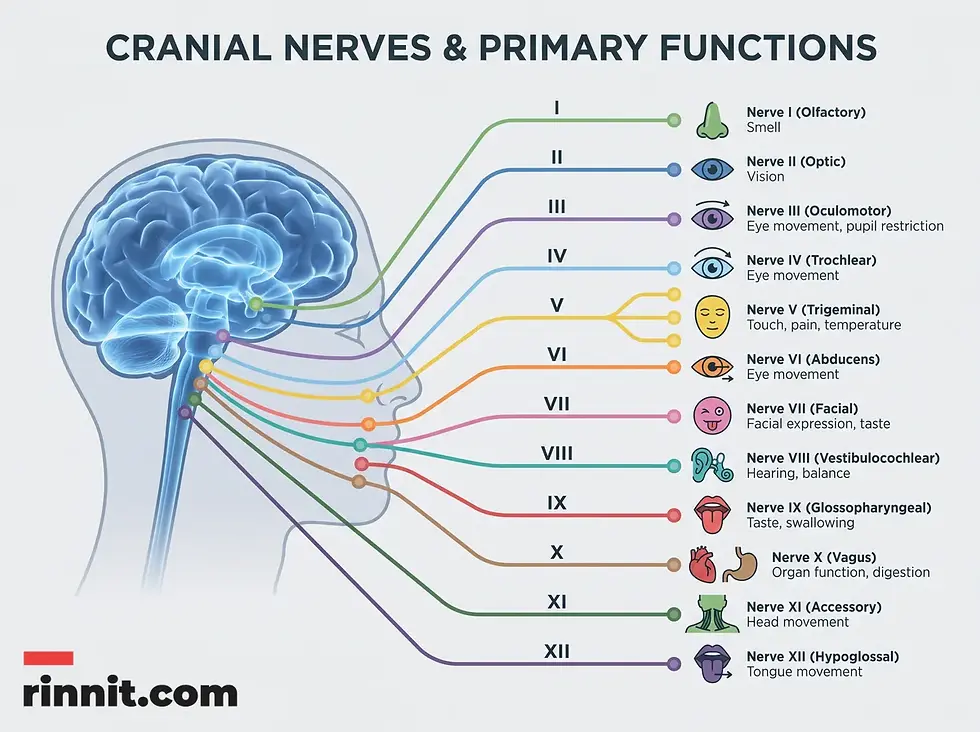
Each of the 12 cranial nerve pairs has a highly specific job. Healthcare providers categorize them based on whether they carry sensory information (like taste or touch), motor information (controlling muscle movement), or both [1].
Olfactory (CN I): Provides the sense of smell [1].
Optic (CN II): Responsible for vision [1].
Oculomotor (CN III): Moves the eyes, opens eyelids, and adjusts pupil size [1].
Trochlear (CN IV): Helps the eyes look down and toward or away from the nose [1].
Trigeminal (CN V): Provides facial sensation and controls chewing [1].
Abducens (CN VI): Moves the eye outward, away from the nose [1].
Facial (CN VII): Controls facial expressions and provides taste to part of the tongue [1].
Vestibulocochlear (CN VIII): Facilitates hearing and balance [1].
Glossopharyngeal (CN IX): Involved in taste, swallowing, and saliva production [1].
Vagus (CN X): Regulates heart rate, digestion, and breathing [1].
Accessory (CN XI): Controls shoulder and neck movements [1].
Hypoglossal (CN XII): Manages tongue movement for speaking and eating [1].
What conditions affect the cranial nerves?
When a cranial nerve is damaged by trauma, inflammation, or disease, it can no longer transmit signals correctly. This often results in a "palsy," which is a type of paralysis or weakness in the affected muscles [1]. For example, Bell's palsy is a common condition affecting the facial nerve, causing temporary drooping on one side of the face [1].
Other conditions are sensory in nature. Trigeminal neuralgia causes intense, stabbing facial pain, often triggered by a blood vessel pressing on the nerve [1]. Circulatory issues like strokes, or autoimmune conditions like scleroderma, can also interfere with nerve function [1], leading to long-term neurological challenges.

How can you protect your cranial nerves and neurological health?
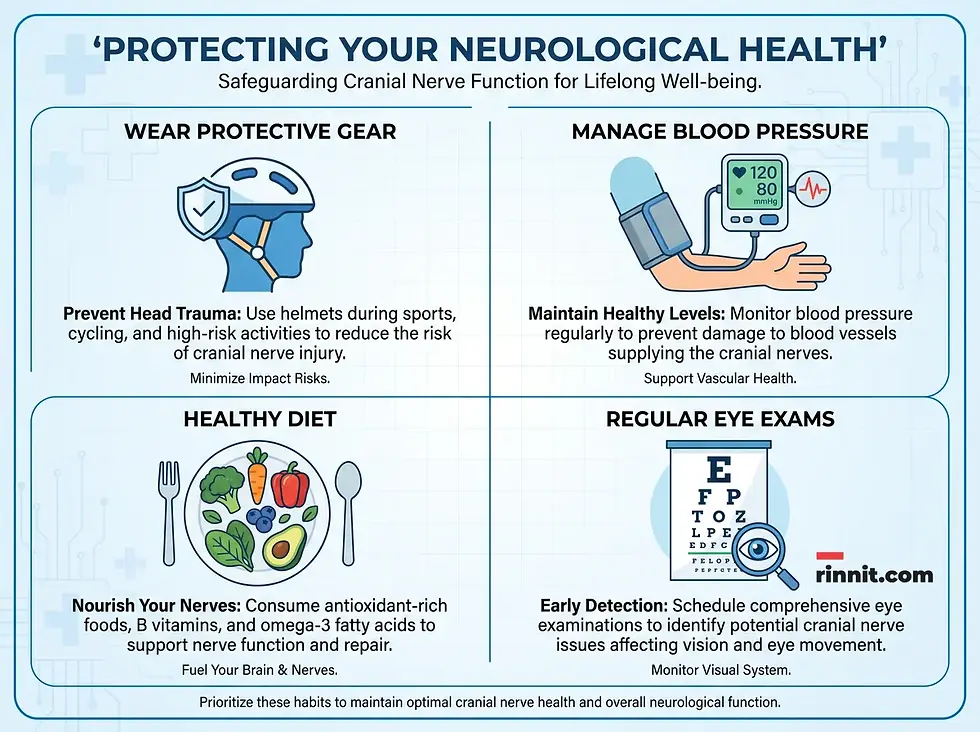
Maintaining healthy cranial nerves involves protecting the brain and managing systemic health. Head trauma is a leading cause of nerve damage, making the use of protective gear during sports or high-risk activities essential. Additionally, managing conditions like high blood pressure and diabetes can prevent circulatory issues that might otherwise lead to nerve dysfunction [1].
Regular checkups with a healthcare provider can help identify early signs of nerve issues, such as changes in vision, hearing, or facial movement. Early intervention is often key to preventing permanent damage and managing chronic conditions like glaucoma or trigeminal neuralgia.
Conclusion
Your cranial nerves are the essential links that allow your brain to interact with your environment and control your body's most basic functions. From the sight of a sunset to the beat of your heart, these 12 pairs of nerves are constantly at work. By understanding their roles and protecting them from injury, you can ensure your sensory and motor systems remain sharp and functional throughout your life.
When to Get Checked
If you notice sudden changes in your vision, hearing, or ability to move your facial muscles, contact a healthcare professional immediately. If face drooping comes on suddenly with arm or leg weakness, slurred speech or confusion, call 911 right away, because these can be signs of a stroke. A neurological evaluation can help determine if a cranial nerve issue is present and guide you toward the right treatment.
Frequently Asked Questions
1. How many cranial nerves are there?
There are 12 pairs of cranial nerves, totaling 24 individual nerves that serve both sides of your body.
2. What is the longest cranial nerve?
The vagus nerve (CN X) is the longest, extending from the brainstem all the way down to the large intestine.
3. Which nerve is responsible for vision?
The optic nerve (CN II) is the sensory nerve that provides the sense of sight.
4. What is a cranial nerve palsy?
A palsy is a type of paralysis or muscle weakness caused by damage to a specific cranial nerve.
5. What does the trigeminal nerve do?
The trigeminal nerve (CN V) provides sensation to the face and mouth and allows you to chew food.
6. Can cranial nerve damage be reversed?
In some cases, such as Bell’s palsy, the damage is temporary. However, severe trauma or disease can cause permanent issues.
7. Which nerve controls facial expressions?
The facial nerve (CN VII) is responsible for moving the muscles that create facial expressions.
8. What causes trigeminal neuralgia?
Trigeminal neuralgia is often caused by a blood vessel putting pressure on the trigeminal nerve, leading to intense facial pain.
9. Which nerve helps with balance?
The vestibulocochlear nerve (CN VIII) provides both the sense of hearing and the sense of balance.
10. Where do cranial nerves start?
Two pairs start in the cerebrum, while the other 10 pairs originate in the brainstem.
Related Reading
Understanding the Trigeminal Nerve explains the cranial nerve that carries feeling from the face.
Vagus Nerve: The Longest Cranial Nerve and Its Essential Functions describes the longest cranial nerve and the organs it controls.
Bell's Palsy: Symptoms, Causes, and Treatment covers sudden facial weakness caused by facial nerve problems.
Trigeminal Neuralgia: What Causes the Facial Pain, and How Is It Treated? explains sharp facial nerve pain and the treatments that help.
References
Cleveland Clinic. Cranial Nerves. Cleveland Clinic. August 15, 2024. https://my.clevelandclinic.org/health/body/21998-cranial-nerves
Madhok VB, Gagyor I, Daly F, Somasundara D, Sullivan M, Gammie F, Sullivan F. Corticosteroids for Bell's palsy (idiopathic facial paralysis). Cochrane Database Syst Rev. 2016;(7):CD001942. doi:10.1002/14651858.CD001942.pub5. PMID: 27428352.
Greco A, Gallo A, Fusconi M, Marinelli C, Macri GF, de Vincentiis M. Bell's palsy and autoimmunity. Autoimmun Rev. 2012;12(2):323-328. doi:10.1016/j.autrev.2012.05.008. PMID: 22684016.
Di Stefano G, Truini A. Pharmacological treatment of trigeminal neuralgia. Expert Rev Neurother. 2017;17(10):1003-1011. doi:10.1080/14737175.2017.1370375. PMID: 28829200.
Medical Disclaimer
This article is for informational purposes only and does not constitute medical advice. Always seek the advice of your physician or other qualified health provider with any questions you may have regarding a medical condition. Never disregard professional medical advice or delay in seeking it because of something you have read here.



Comments