Understanding Tongue Problems: Symptoms, Causes, and Care

Updated: 2 days ago
Medically reviewed by Dr. Baraa Alnahhal, MD | Last reviewed: October 17, 2026
Quick Answer
Tongue problems are changes in the tongue's size, color, texture, movement or sensation, often appearing as pain, swelling or unusual colors [1]. Causes include infections, inflammation, injuries and nutritional deficiencies. Diagnosis usually involves an exam and history, sometimes blood tests or a biopsy [1]. Many improve with oral care, but severe or lasting symptoms need professional evaluation.
What the research says
Burning tongue pain is uncommon but hard to treat. In an umbrella review of 24 systematic reviews, the prevalence of orofacial pain in adults ranged from 1.12% for burning mouth syndrome to 80.80% for cancer therapy-related orofacial pain (Porporatti et al., Journal of Oral & Facial Pain and Headache, 2024) [2].
Some treatments for burning mouth syndrome have favorable results. A systematic review of 22 randomized trials found that cognitive behavior therapy, topical capsaicin and clonazepam, and laser therapy showed favorable outcomes in both short- and long-term assessment, but the authors called for larger studies (Tan et al., Cephalalgia, 2022) [3].
An enlarged-looking tongue is not always a true enlargement. A systematic review of Down syndrome found that "false macroglossia" and muscle hypotonia are among its most significant craniofacial features, affecting speech, breathing, eating and swallowing, and that early interdisciplinary treatment is important (Kaczorowska et al., Advances in Clinical and Experimental Medicine, 2019) [4].
What Are Tongue Problems?
The tongue is a muscle that helps you chew, swallow and speak [1]. Tongue problems happen when it changes in size, movement, sensation or appearance. They range from short-term discomfort, such as a burn from hot food [1], to long-term conditions that affect daily life. Most are not dangerous [1], but the tongue can also give clues about your overall health. To learn more about the structure around it, see our guide to the human mouth.
Recognizing Common Symptoms
Tongue symptoms vary. You may notice a swollen or enlarged tongue that makes eating or speaking harder. You may also have trouble moving your tongue, lose some or all of your sense of taste, or feel pain or burning [1].
Symptom Category | Common Clinical Signs |
Size and Movement | Macroglossia (enlarged tongue) and limited tongue movement. |
Sensory Changes | Pain, burning and loss of taste (ageusia) [1]. |
Visual Changes | Unusual colors (white, yellow, black) and textures. |
Potential Causes and Conditions
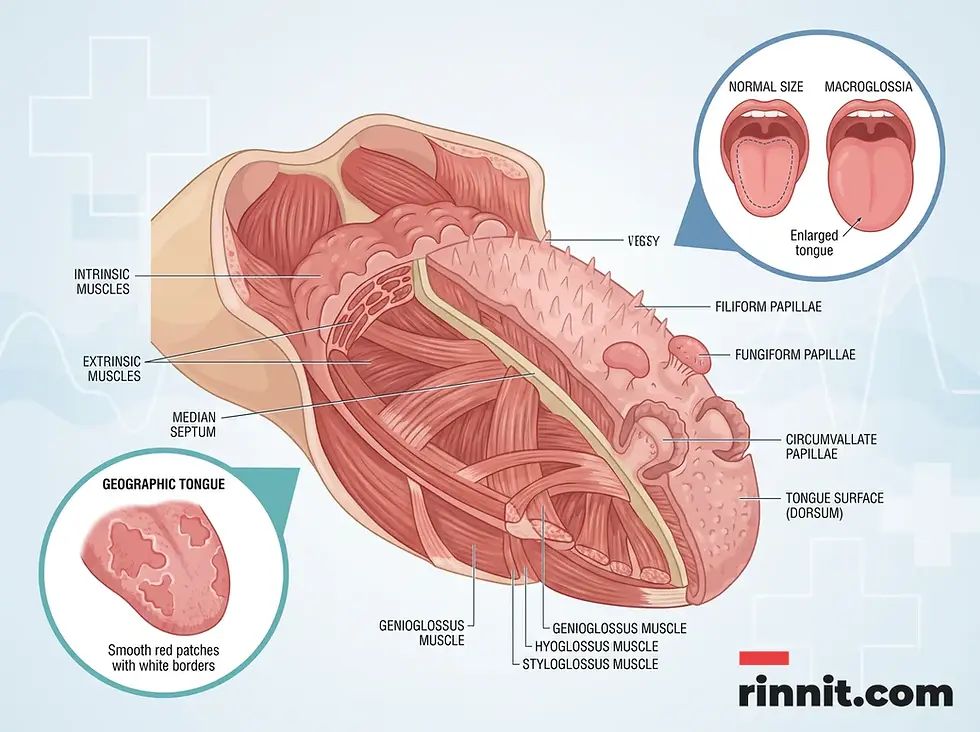
Tongue problems have many causes, including inflammation, conditions present at birth and acquired diseases. An unusually large tongue (macroglossia) can be present at birth or develop with conditions such as acromegaly, amyloidosis or an underactive thyroid [1]. You can read more in our article on macroglossia. Swelling and inflammation of the tongue (glossitis) can come from infections, injuries, allergies, dry mouth or nutritional deficiencies [1].
Low folic acid is one of the most common nutritional causes. Our guide to folate deficiency explains its symptoms and treatment. Scarlet fever can also make the tongue red and bumpy [1]; see our overview of scarlet fever.
Changes in Color and Texture
Color and texture changes are the most noticeable tongue problems. A white tongue often means a buildup of bacteria or a yeast infection such as thrush [1], and a yellow tongue is usually caused by dead skin cells [1]. A black hairy tongue can be linked to poor oral hygiene, tobacco use or certain medical treatments [1]. Geographic tongue, with red patches and white borders, is harmless [1] but often alarming. Grooves on the surface are covered in our guide to fissured tongue.
Diagnostic Procedures
A healthcare provider starts with your medical history and a physical exam of your mouth [1]. They look at the color, texture and movement of your tongue for signs of a specific condition. If they suspect an underlying cause, they may order blood tests or take a small tissue sample (biopsy) [1].

Management and Clinical Care
Treatment aims to fix the underlying cause and ease symptoms. Better oral hygiene and diet changes can clear up minor problems. When a nutritional deficiency or infection is the cause, you may need vitamin supplements, antifungal medicine or other targeted treatment [1]. Persistent symptoms need professional care so that complications can be prevented. Tongue movement problems from tongue-tie are covered in our article on the frenulum and tongue-tie.
To help prevent tongue problems:

Conclusion and Outlook
The outlook for most people with tongue problems is very good, because many conditions are short-term and respond well to care. Changes in the tongue can be upsetting, but they can usually be managed. Good oral hygiene and attention to nutrition are the main long-term strategies.
Next Steps
See a healthcare provider if you have severe symptoms or if pain, swelling or unusual changes last longer than a few weeks. Early diagnosis helps protect your oral health and overall well-being.
Frequently Asked Questions
What causes a swollen tongue?
A swollen tongue (glossitis) can be caused by infections, injuries, allergies, dry mouth or nutritional deficiencies such as low vitamin B12 or folic acid.
Is a white tongue serious?
Usually not. A white tongue often comes from a buildup of bacteria, dead cells or a yeast infection such as thrush, and it is typically treatable.
What is geographic tongue?
Geographic tongue is a harmless condition in which red patches with white borders appear on the tongue and look like a map.
Can vitamin deficiencies affect the tongue?
Yes. Low vitamin B12 or folic acid can make the tongue red, smooth and sore.
What is black hairy tongue?
Black hairy tongue is a harmless condition in which the tongue looks black and fuzzy, often linked to poor oral hygiene, tobacco use or certain treatments.
Is tongue pain common?
Yes. Tongue pain is a frequent symptom, and it often comes from a minor injury, a burn or inflammation.
What is macroglossia?
Macroglossia is the medical term for an unusually large tongue. It can be present at birth or develop later, for example with acromegaly, amyloidosis or an underactive thyroid.
Can poor hygiene cause tongue problems?
Yes. Poor oral care can lead to color changes and a buildup of bacteria or fungi on the tongue.
What is tongue-tie?
Tongue-tie (ankyloglossia) is a condition present at birth in which the tongue is attached too tightly to the floor of the mouth, which can limit movement.
Does scarlet fever affect the tongue?
Yes. It can cause a red, bumpy "strawberry tongue."
Are tongue problems contagious?
Most are not. Conditions such as geographic tongue cannot be passed to other people, although infections such as thrush can sometimes spread.
How are tongue problems diagnosed?
A provider reviews your medical history and examines your mouth and tongue. Blood tests or a biopsy are used when a deeper cause is suspected.
Can dry mouth cause tongue problems?
Yes. Dry mouth (xerostomia) can lead to inflammation and changes in how the tongue looks and feels.
When should I see a doctor?
See a provider if your symptoms are severe or last longer than a few weeks, or sooner if you have trouble breathing, swallowing or speaking.
Can tongue problems be prevented?
Many can. Brush twice a day, floss daily, clean your tongue, get regular dental cleanings and avoid tobacco.
Sources
Cleveland Clinic. Tongue Problems. Cleveland Clinic. Last updated February 14, 2023. https://my.clevelandclinic.org/health/diseases/24735-tongue-problems
Porporatti AL, Schroder ÂGD, Lebel A, et al. Prevalence of orofacial and head pain: an umbrella review of systematic reviews. J Oral Facial Pain Headache. 2024;38(3):1-14. PMID 39800567. https://doi.org/10.22514/jofph.2024.022
Tan HL, Smith JG, Hoffmann J, Renton T. A systematic review of treatment for patients with burning mouth syndrome. Cephalalgia. 2022;42(2):128-161. PMID 34404247. https://doi.org/10.1177/03331024211036152
Kaczorowska N, Kaczorowski K, Laskowska J, Mikulewicz M. Down syndrome as a cause of abnormalities in the craniofacial region: a systematic literature review. Adv Clin Exp Med. 2019;28(11):1587-1592. PMID 31778604. https://doi.org/10.17219/acem/112785
Medical disclaimer
This information is for educational purposes only and does not constitute medical advice. Always consult a healthcare professional about any concerns regarding tongue pain, swelling or unusual changes.



Comments