Fissured Tongue: Symptoms, Causes, Diagnosis, Treatment and Outlook — What You Need to Know

Updated: 2 days ago
Medically reviewed by Dr. Baraa Alnahhal, MD · Last reviewed: September 2026
Executive Summary: TL;DR
Fissured tongue is a benign, harmless condition characterized by grooves or furrows on the tongue's surface. Affecting approximately 2% to 20% of the global population, it is often a genetic trait rather than a disease. While the grooves themselves do not require medical treatment, they can occasionally trap food or bacteria, leading to bad breath or inflammation. Maintaining excellent oral hygiene, including tongue scraping, is the primary way to manage the condition and prevent discomfort.
Quick Answer: What Is Fissured Tongue?
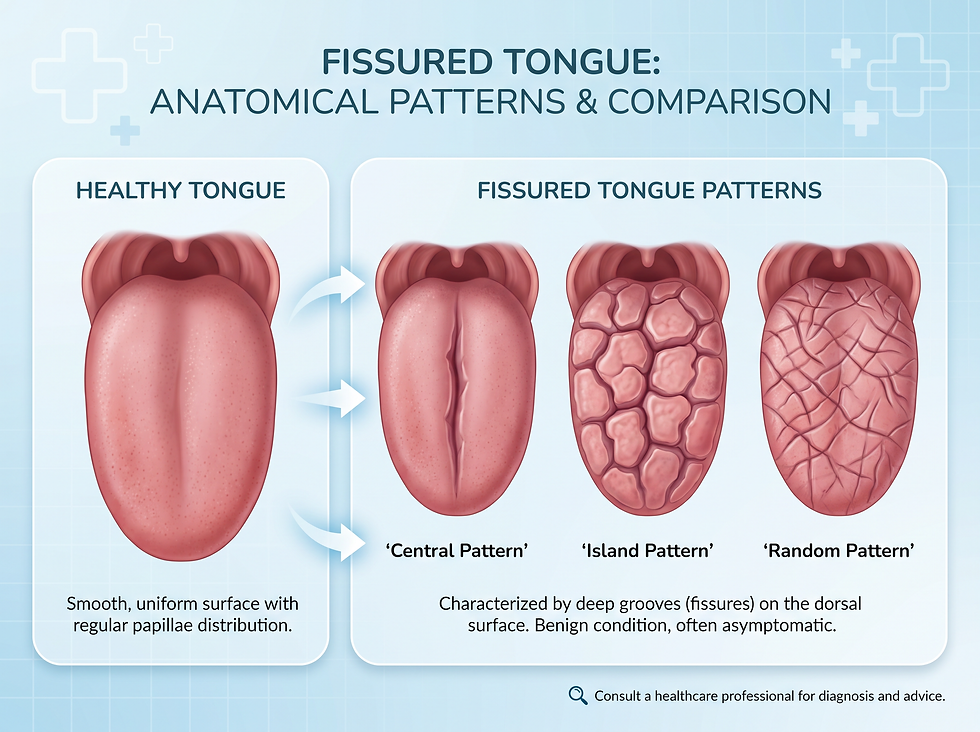
Fissured tongue is a common, non-cancerous condition where the surface of the tongue develops deep or shallow grooves, giving it a cracked or wrinkled appearance. These furrows can vary in depth from 2 to 6 millimeters and may appear as a single central line or a network of crisscrossing grooves. It is considered a healthy variation of normal anatomy rather than a sign of illness or nutritional deficiency. Although permanent, it is entirely harmless and only requires attention if trapped debris causes secondary issues like halitosis or localized inflammation.
What Exactly Is Fissured Tongue?
Fissured tongue is defined by a specific pattern of grooves or furrows on the dorsal (top) surface of the tongue. While most tongues are relatively smooth with tiny bumps called papillae, a fissured tongue features distinct indentations that can change its overall texture. This condition is also known by medical terms such as lingua plicata, furrowed tongue, or scrotal tongue.
Key facts: fissured tongue overview
Primary sign: deep or shallow grooves on the tongue's surface
Groove depth: typically 2 millimeters to 6 millimeters
Prevalence: 2% to 20% worldwide; 2% to 5% in the United States
Demographics: slightly more common in males and individuals over age 50
Nature: benign, non-contagious, and permanent variation
Identifying the Symptoms of Fissured Tongue
For most individuals, a fissured tongue is entirely asymptomatic. The condition is usually identified visually, often during a routine dental examination. However, the physical appearance of the tongue can vary significantly based on the pattern of the grooves.
Visual appearance: cracked, wrinkled, or segmented "islands" on the tongue
Groove patterns: a central vertical line with radiating branches, crisscrossing lines, or random grooves
Secondary issues: bad breath (halitosis) if food particles are trapped
Inflammation: swelling or burning (glossitis) caused by bacterial buildup
What Causes Fissured Tongue?
The exact cause of fissured tongue remains unknown to medical experts. Current research suggests a strong genetic component, as the condition frequently runs in families. This hereditary link may explain why certain geographic populations exhibit higher rates of tongue fissures than others.
Genetics: believed to be the primary driver; often inherited from parents
Aging: grooves may become deeper and more prominent as a person ages
Environment: regional variations suggest environmental or population-specific factors
Nutrition: not caused by vitamin deficiencies or poor diet
Conditions Associated with Fissured Tongue
While a fissured tongue is not a disease itself, it occurs more frequently in individuals with specific medical conditions. It is important to note that having fissures does not mean you have these conditions; rather, they are simply observed together more often.
Geographic tongue: a benign condition causing smooth, red patches on the tongue
Down syndrome: a genetic disorder that often includes tongue fissures as a feature
Psoriasis: a chronic skin condition that can manifest oral symptoms
Sjögren’s syndrome: an autoimmune disorder that causes dry mouth and eyes
Melkersson-Rosenthal syndrome: a rare neurological disorder involving facial paralysis and tongue swelling

How Is Fissured Tongue Diagnosed?
Diagnosis is straightforward and typically occurs through a visual examination by a healthcare provider or dentist. Because the condition is benign and visually distinct, no invasive tests or biopsies are usually required unless another underlying issue is suspected.
Visual inspection: identifying the depth and pattern of the grooves
Clinical history: checking for associated symptoms like burning or bad breath
Routine dental checkup: often discovered during standard cleanings or exams
Treatment and Management Strategies
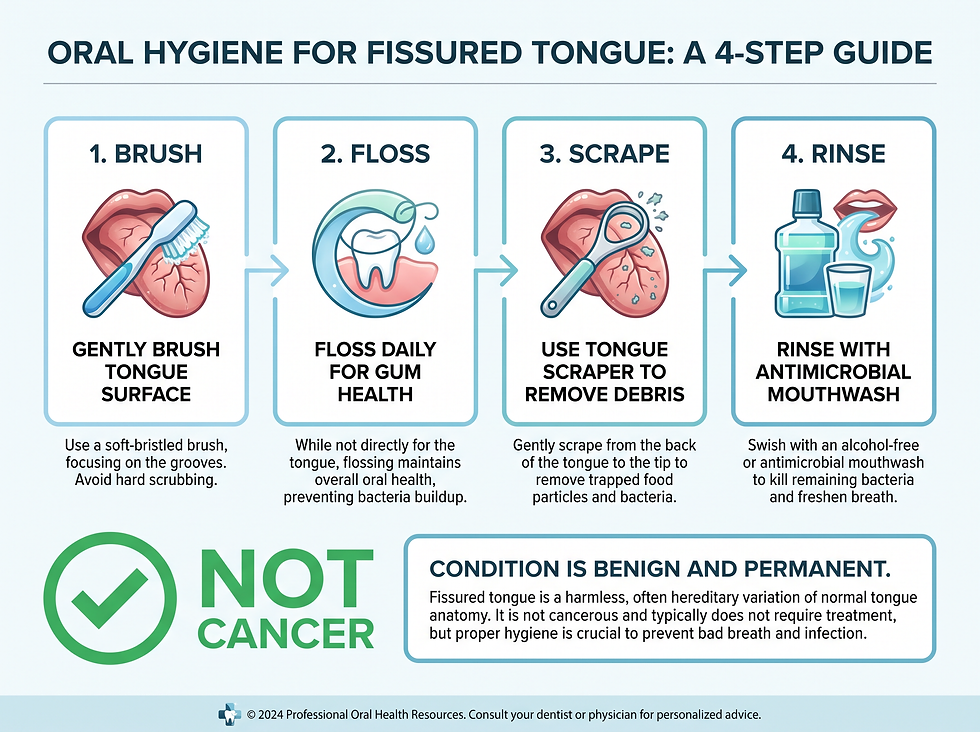
Medical treatment is rarely necessary for a fissured tongue. The grooves themselves are harmless and do not "heal" or go away. Management focuses entirely on preventing secondary complications like infections or halitosis through diligent oral care.
Tongue scraping: use a dedicated tool to remove debris from deep grooves
Brushing: gently brush the tongue surface twice daily
Rinsing: use mouthwash to neutralize bacteria trapped in fissures
Dental visits: regular cleanings to monitor for signs of inflammation or glossitis
When to See a Dental Provider
While a fissured tongue is benign, you should consult a dental professional if you notice changes in your oral health or experience persistent discomfort.
Persistent bad breath: if halitosis continues despite regular brushing and scraping
Burning sensation: if the tongue feels painful or irritated when eating spicy or acidic foods
Visible swelling: if the tongue appears unusually red, swollen, or inflamed
New growths: if you notice any lumps, sores, or patches that do not look like normal fissures
"It’s never a bad idea to ask your healthcare provider questions about parts of your body that seem unusual to you. Sometimes, what looks strange or atypical is a warning sign of a condition that requires treatment. But when it comes to tongue fissures, the difference is harmless. As long as you’ve got good oral hygiene, the grooves in your tongue shouldn’t give you trouble. If there’s a concern that bacteria may get trapped there, your provider can tell you how to keep your tongue free of debris." (Note from the Care Team)
Outlook and Long-Term Prognosis
The outlook for individuals with a fissured tongue is excellent. The condition is permanent but does not lead to serious health complications or cancer. By incorporating tongue cleaning into a daily routine, most people live entirely symptom-free.
Longevity: the condition is permanent and does not resolve over time
Health impact: zero impact on overall physical health or life expectancy
Quality of life: excellent, provided oral hygiene is maintained to prevent bad breath
Conclusion and Next Steps
A fissured tongue is a harmless, genetic variation of normal anatomy. While the grooves may look unusual, they are not a sign of disease or deficiency. The key to living comfortably with this condition is a proactive approach to oral hygiene.
Audit your routine: ensure you are brushing your tongue and using a scraper daily.
Monitor for symptoms: watch for signs of trapped bacteria, such as bad breath or burning.
Schedule a checkup: discuss your tongue fissures with your dentist during your next routine visit to ensure you are cleaning them effectively.
Frequently Asked Questions
What exactly is a fissured tongue? It is a benign condition where the surface of the tongue has grooves or furrows, often appearing cracked or wrinkled.
Is a fissured tongue contagious? No, it is not an infection and cannot be passed from person to person.
Can a fissured tongue be cured? There is no "cure" because it is not a disease; the grooves are permanent anatomical features.
Does a fissured tongue cause bad breath? It can if food or bacteria become trapped in the grooves, but regular cleaning prevents this.
Is it the same as geographic tongue? No, but the two conditions often occur together in the same individual.
Is a fissured tongue painful? The grooves themselves are not painful, but trapped debris can cause a burning sensation or inflammation.
How deep are the grooves? They typically range from 2 millimeters to 6 millimeters in depth.
What causes the cracks in the tongue? The exact cause is unknown, but it is strongly believed to be genetic.
Is it a sign of a vitamin deficiency? No, research has shown no link between tongue fissures and nutritional deficiencies.
Can children have a fissured tongue? Yes, though it often becomes more prominent and is more frequently diagnosed in older adults.
Should I be worried about cancer? No, a fissured tongue is entirely benign and is not a sign of oral cancer.
What is the best way to clean a fissured tongue? A combination of gentle brushing, tongue scraping, and using mouthwash is most effective.
Can spicy food irritate a fissured tongue? Yes, if the grooves are slightly inflamed, spicy or acidic foods may cause a temporary burning sensation.
How common is this condition? It affects between 2% and 20% of the population depending on the region.
What are other names for it? It is also known as lingua plicata, furrowed tongue, or scrotal tongue.
Does it affect my sense of taste? No, it does not typically interfere with the function of taste buds.
Can smoking make it worse? Smoking can increase oral bacteria and irritation, potentially making the grooves more prone to inflammation.
Is it related to Down syndrome? It is observed more frequently in individuals with Down syndrome, though it occurs in the general population as well.
Can I use an electric toothbrush on my tongue? Yes, many electric toothbrushes have a tongue-cleaning mode that is effective for fissured tongues.
What happens if I don't clean the grooves? You may develop halitosis (bad breath) or a painful inflammation known as glossitis.
Are the grooves always in the middle? Not always; they can crisscross the entire surface or appear in random patches.
Is it related to dehydration? No, while a dry mouth can make the tongue feel different, fissures are a structural feature.
Can I get a tongue piercing with this condition? You should consult a professional piercer and a dentist, as the grooves may complicate the procedure or healing.
Does it affect speech? No, it does not typically have any impact on speech or articulation.
Are there any specific foods to avoid? Only if you experience irritation; otherwise, no dietary restrictions are necessary.
How often should I scrape my tongue? Twice daily, ideally in the morning and evening after brushing your teeth.
Can a fissured tongue lead to other oral problems? Only minor issues like localized inflammation or bad breath if hygiene is neglected.
Is it hereditary? Yes, it often runs in families, suggesting a genetic link.
What should I do if my tongue starts burning? Clean the area thoroughly and consult your dentist to rule out a secondary infection.
Is a fissured tongue permanent? Yes, the grooves do not disappear or change significantly over time.
External Authoritative Sources
Fissured Tongue: Symptoms, Causes, and Care — Cleveland Clinic (2024)
The Prevalence and Correlates of Fissured Tongue — Hamrah MH, et al., Clin Cosmet Investig Dent (2021)
Andrews’ Diseases of the Skin, 13th edition — James WD, et al., Elsevier (2020)
Oral changes in patients with psoriasis — Sobecka-Frankiewicz M, et al., Int J Dermatol (2023)
Medical disclaimer: The information provided in this article is for educational purposes only and should not be considered medical advice. Always consult with a qualified healthcare professional or dentist for diagnosis and treatment of any oral health concerns.
Comments