Understanding Situs Inversus: Mirrored Internal Anatomy

Updated: 2 days ago
Medically reviewed by Dr. Baraa Alnahhal, MD · Last reviewed: October 2026
Quick Answer: What is situs inversus?
Situs inversus is a rare condition, affecting about 1 in 10,000 people, in which internal organs such as the heart, liver and stomach are reversed from their usual positions. [1] [2] It is usually harmless but can be linked to respiratory problems or heart defects. [1] Tell healthcare providers about it so common conditions like appendicitis are diagnosed correctly. [1]
What the research says
Situs inversus totalis is rare, slightly more common in males, and linked to many genes. A clinical review reports a frequency of about 1 in 10,000 people, a male-to-female ratio of about 1.5 to 1, and more than 100 genes linked to left-right (laterality) defects. It also notes that mirrored anatomy makes procedures such as percutaneous biliary procedures and liver transplantation technically challenging (Eitler et al., Int J Gen Med, 2022) [2].
Situs inversus is common in primary ciliary dyskinesia (PCD), but many people with PCD have typical anatomy. In a prospective study of 767 people referred for suspected PCD, 305 had classic PCD. Of these, 46.9% had typical organ arrangement, 41.0% had situs inversus totalis, and 12.1% had situs ambiguus (partly reversed or inconsistent organ placement) (Shapiro et al., Chest, 2014) [3].
What is Situs Inversus?
Situs inversus, often referred to as situs inversus totalis, is a rare developmental condition where the internal organs of the chest and abdomen are arranged in a complete mirror image of normal anatomy. [1] [2] The term “situs” refers to the position of the organs, while “inversus” signifies their reversal. In a typical body arrangement, known as situs solitus, organs follow a specific left-right pattern. In situs inversus, this pattern is flipped, much like a reflection in a mirror.
Despite this anatomical reversal, the organs themselves usually develop correctly and function normally. [1] The condition is estimated to affect roughly 1 in every 10,000 individuals. [1] [2] While the reversal itself is often harmless, it is important for those with the condition to be aware of it, as it can influence how future health issues are diagnosed and managed by medical professionals. [1]
How does situs inversus anatomy compare with typical anatomy?
In a standard anatomical arrangement, the heart, stomach, and spleen are located on the left side of the body, while the liver and gallbladder sit on the right. [1] In an individual with situs inversus, these positions are completely reversed. This means the heart’s apex points toward the right side of the chest, and the liver is positioned on the left side of the abdomen. [1]
Organ | Typical Position (Situs Solitus) | Mirrored Position (Situs Inversus) |
Heart | Left side | Right side |
Liver and gallbladder | Right side | Left side |
Stomach and spleen | Left side | Right side |
Appendix | Lower right abdomen | Lower left abdomen |
Lungs | 2 lobes (left), 3 lobes (right) | 3 lobes (left), 2 lobes (right) [1] |
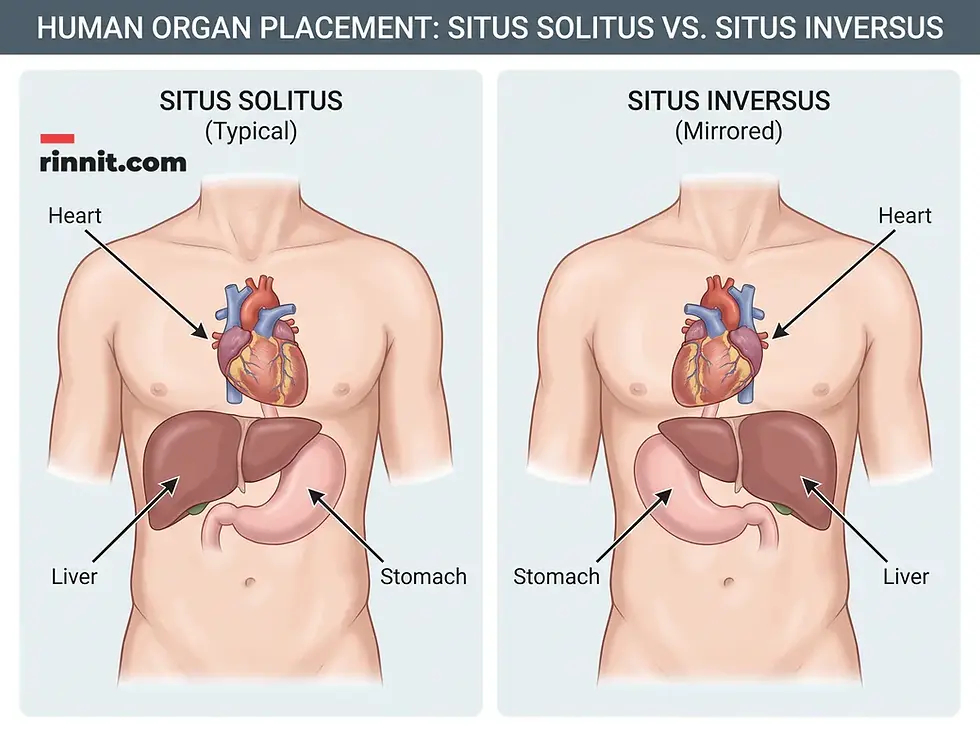
What types of organ arrangement occur in situs inversus?
Healthcare providers categorize organ positions to better understand each individual’s unique anatomy. While situs inversus totalis refers to a complete reversal, other variations exist. For instance, “situs ambiguous” is a term used when organ placement does not follow a clear or consistent mirrored pattern, with some organs reversed and others remaining in their typical positions. [1]
The position of the heart is often described separately. Dextrocardia occurs when the tip of the heart points toward the right side of the chest, a common feature of situs inversus. [1] Conversely, “levocardia” refers to the heart pointing toward the left, which is typical. In rare cases of situs inversus with levocardia, the heart remains on the left while all other abdominal organs are reversed. [1]
What causes situs inversus and how is it inherited?
Situs inversus develops very early during pregnancy as the fetus’s organs are forming and establishing their permanent positions. [1] The condition is primarily genetic, and researchers have identified more than 100 different genes that may play a role in disrupting the typical left-right development of the body. [1] [2]
The condition usually follows an autosomal recessive inheritance pattern, though other patterns and one-off cases also occur. This means that for a child to be born with situs inversus, they must inherit a specific genetic change from both biological parents. [1] While the exact triggers are still being studied, certain risk factors during pregnancy, such as maternal diabetes or smoking, may increase the likelihood of developmental anomalies. [1]
What complications and related conditions can occur with situs inversus?
For the majority of people, situs inversus does not cause any health problems or symptoms. [1] However, it is sometimes associated with other rare genetic disorders. [1] One such condition is Primary Ciliary Dyskinesia (PCD), which affects the tiny, hair-like structures in the respiratory tract. When PCD occurs alongside situs inversus, it is known as Kartagener syndrome, which can lead to chronic respiratory issues, including a persistent cough and repeated sinus infections [1] (see our guide to chronic sinusitis).
Another significant consideration is the potential for delayed diagnosis of common medical conditions. Because the organs are reversed, pain may appear on the “wrong” side of the body. For example, an individual with situs inversus might experience appendicitis pain in the lower left side of the abdomen rather than the typical lower right. [1] This makes it vital to keep healthcare providers informed of the condition to prevent delays in treatment.
Congenital heart defects can also occur with situs inversus. [1] Our guide to tetralogy of Fallot explains one example of how such defects are diagnosed and treated.
Condition or Challenge | Description | Impact |
Kartagener syndrome | Combination of situs inversus and PCD | Chronic cough and sinus infections [1] |
Congenital heart defects | Structural heart abnormalities | May require surgical intervention [1] |
Diagnostic delays | Pain manifesting on the opposite side | Risk of misdiagnosing common ailments |
Surgical planning | Mirrored anatomy during procedures |

How is situs inversus diagnosed and managed?
Since most people with situs inversus do not experience symptoms, the condition is often discovered incidentally during imaging tests for unrelated reasons. [1] A healthcare provider might first suspect the condition when listening to a patient’s heartbeat and finding it loudest on the right side of the chest. [1]
To confirm a diagnosis and determine which organs are affected, providers use various imaging technologies. These include chest X-rays, abdominal ultrasounds, CT scans, and MRI scans. [1] While the anatomical reversal itself does not require treatment, any associated heart defects or respiratory conditions are managed on a case-by-case basis. [1]

Conclusion
Living with situs inversus is, for most people, a unique but harmless anatomical variation. While the discovery of mirrored organs can be surprising, it typically does not interfere with a long and healthy life. The most important step for anyone with this condition is to ensure that all members of their healthcare team are aware of their mirrored anatomy. This simple communication helps ensure that every medical evaluation, diagnosis, and procedure is performed with the most accurate understanding of their body’s internal structure.
Trusted resource: Cleveland Clinic: Situs Inversus.
Frequently Asked Questions
What is situs inversus?
Situs inversus is a rare genetic condition where the internal organs in the chest and abdomen are reversed in a mirror image of normal anatomy.
How common is situs inversus?
The condition is estimated to affect approximately 1 in every 10,000 people worldwide.
Does situs inversus cause health problems?
For most people, it is harmless and causes no symptoms. However, it can be linked to other genetic conditions or heart defects.
What is the difference between situs solitus and situs inversus?
Situs solitus is the typical arrangement of organs, while situs inversus is the mirrored or reversed arrangement.
What is dextrocardia?
Dextrocardia is when the tip of the heart points toward the right side of the chest instead of the left. It often occurs with situs inversus.
Is situs inversus inherited?
Usually, yes. It most often follows an autosomal recessive pattern, meaning a child inherits a gene change from both parents, though other patterns occur.
What is Kartagener syndrome?
Kartagener syndrome is a condition that occurs when an individual has both situs inversus and Primary Ciliary Dyskinesia (PCD).
Can situs inversus be diagnosed before birth?
Yes, it can often be identified during prenatal ultrasound or MRI scans.
Why is it important to tell doctors about this condition?
Because organs are reversed, symptoms like pain may appear on the opposite side, which can lead to misdiagnosis of conditions like appendicitis.
Are the organs in situs inversus healthy?
In most cases, the organs develop correctly and function just as well as they would in a typical body arrangement.
Does situs inversus require surgery?
The reversal itself does not require surgery, though some related heart defects might need surgical correction.
Can someone with situs inversus live a normal life?
Yes, most individuals with this condition have a normal life expectancy and do not require special medical treatment for the reversal.
What is situs ambiguous?
Situs ambiguous is a variation where organ placement is inconsistent, with some organs reversed and others in their typical positions.
What imaging tests are used to diagnose it?
Chest X-rays, CT scans, MRIs, and ultrasounds are the primary tools used to confirm mirrored anatomy.
Is situs inversus preventable?
Currently, there is no known way to prevent the condition as it is determined by genetics early in pregnancy.
Related Reading
Understanding Primary Ciliary Dyskinesia (PCD): Symptoms and Management explains the cilia disorder often found with situs inversus.
Kartagener Syndrome: Understanding the Rare Genetic Condition describes the syndrome that combines situs inversus with chronic sinus and lung problems.
Heterotaxy Syndrome: Causes, Symptoms, and Treatment explains a related condition where organs are arranged abnormally.
Congenital Heart Disease (CHD): Types, Causes, Symptoms, and Survival Outlook covers heart defects present at birth and their long-term outlook.
References
Cleveland Clinic. Situs Inversus. Cleveland Clinic. February 4, 2026. https://my.clevelandclinic.org/health/diseases/23486-situs-inversus
Eitler K, Bibok A, Telkes G. Situs inversus totalis: a clinical review. Int J Gen Med. 2022;15:2437-2449. PMID 35264880. https://doi.org/10.2147/IJGM.S295444
Shapiro AJ, Davis SD, Ferkol T, et al. Laterality defects other than situs inversus totalis in primary ciliary dyskinesia: insights into situs ambiguus and heterotaxy. Chest. 2014;146(5):1176-1186. PMID 24577564. https://doi.org/10.1378/chest.13-1704
Medical Disclaimer
This article is for informational purposes only and does not constitute medical advice. Always seek the advice of your physician or other qualified health provider with any questions you may have regarding a medical condition. Never disregard professional medical advice or delay in seeking it because of something you have read in this article.



Comments