Understanding Nerves: The Body's Electrical Communication Network

Updated: 3 days ago
Medically reviewed by Dr. Baraa Alnahhal, MD · Last reviewed: October 17, 2026
Editorial note: This article is for general education and does not replace advice from your own doctor.
Quick Answer: What are nerves?
Nerves are bundles of fibers that act as the body's electrical wiring, carrying signals between the central nervous system and the rest of the body [1]. Sensory nerves carry touch and sight to the brain, while motor nerves command muscles [1]. Good nutrition, exercise and managing conditions like diabetes protect them [1], and persistent pain or numbness should be checked.
What the research says
Exercise improved nerve-related outcomes in people with neuropathy. A systematic review of 41 randomized trials (20 in the quantitative analysis) reported standardized mean differences favoring exercise, from 0.27 to 2.00, for static balance, the Berg Balance Scale, the Timed Up and Go test, peroneal and sural nerve conduction velocity, and HbA1c in people with diabetic peripheral neuropathy (Streckmann et al., Sports Med, 2022) [2]
Exercise also lowered blood sugar in diabetic neuropathy. In a meta-analysis of 13 randomized trials (11 measuring HbA1c), exercise training reduced HbA1c by 0.54 percentage points (95% CI −0.78 to −0.31) and fasting glucose by 32.6 mg/dL; aerobic training gave the largest HbA1c drop (−0.75%) (Gholami et al., Prim Care Diabetes, 2024) [3]
Smoking was linked to a higher risk of diabetic neuropathy. Across 75 articles and 228,699 people with diabetes, cohort studies showed a 28% higher risk of diabetic peripheral neuropathy in smokers (RR 1.28; 95% CI 1.05–1.51). These are observational studies, so they show association, not proof of cause (Bader et al., Syst Rev, 2025) [4]
According to PubMed, these are reviews and meta-analyses; results describe groups of patients, not individual outcomes.
What are the types and classifications of nerves?
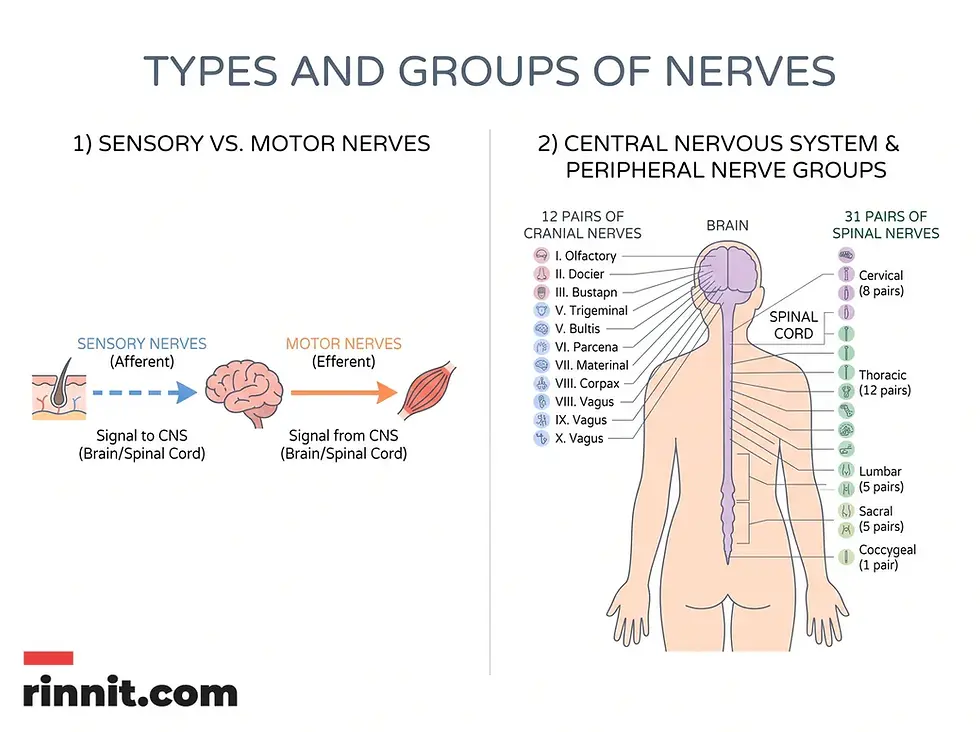
The human body contains a complex network of nerves categorized by their specific functions and points of origin. Sensory nerves are responsible for transmitting information from the environment to the brain, enabling the five senses [1]. In contrast, motor nerves carry commands from the brain to the muscles and glands, facilitating movement and internal regulation [1].
Nerves are also grouped based on where they emerge from the central nervous system. Cranial nerves originate directly from the brain and primarily serve the head and neck, while spinal nerves branch out from the spinal cord to reach the limbs and torso [1].
Nerve Group | Quantity | Primary Region | Function |
Cranial Nerves | 12 Pairs | Head, Face, Neck | Sensory, Motor, or Mixed |
Spinal Nerves | 31 Pairs | Torso, Limbs, Pelvis | Sensory, Motor, and Reflexes |
How are nerves structured and how do they transmit signals?
A nerve is not a single fiber but a bundle of axons protected by multiple layers of connective tissue [1]. The core of the nerve consists of axons, which act as the primary "wiring." These are insulated by a fatty substance called myelin, which ensures that electrical signals travel quickly and efficiently [1]. Damage to this myelin sheath can significantly slow or even stop the transmission of vital information [1].
The transmission of a signal is a multi-step process that involves both electrical and chemical changes. When an impulse reaches the end of a neuron, it triggers the release of neurotransmitters into the synapse, a small gap between cells. These chemicals then bind to receptors on the next cell, converting the message back into an electrical signal to continue its journey [1].
Structural Layer | Description |
Axon | The central fiber that carries electrical impulses. |
Myelin Sheath | Fatty insulation that speeds up signal transmission. |
Endoneurium | Connective tissue surrounding individual axons. |
Perineurium | Tissue surrounding bundles of axons (fascicles). |
Epineurium | The outermost protective covering of the nerve. |

What are common nerve conditions and how can you care for nerves?
When nerves are damaged by injury or disease, it can lead to neurological disorders [1]. Peripheral neuropathy is a common condition involving damage to the nerves outside the brain and spinal cord [1], often resulting in numbness or weakness. Sciatica is another frequent issue, characterized by pain radiating along the sciatic nerve from the lower back down the legs [1].
Maintaining nerve health is essential for preserving quality of life. Since nerves are sensitive to metabolic changes, managing conditions like diabetes is one of the most effective ways to prevent long-term damage. Healthy lifestyle choices, such as staying hydrated and ensuring adequate sleep, also support the nervous system's ability to repair and function.

Conclusion
Nerves are the indispensable conduits of the human experience, enabling everything from the simplest touch to the most complex movements. By acting as the bridge between the brain and the body, they ensure that every system remains coordinated and responsive. Through proactive care and an understanding of their anatomical importance, we can protect these vital pathways and maintain our overall health.
What steps can you take to keep your nerves healthy?
Nerve health is supported by eating whole grains and healthy fats, keeping blood sugar stable if you have diabetes, exercising regularly, quitting smoking and limiting alcohol [1].
Prioritize Nutrition: Eat a diet rich in whole grains and healthy fats to support the myelin sheaths that insulate your nerves.
Manage Chronic Conditions: Keep blood sugar levels stable if you have diabetes, as high glucose can lead to nerve damage.
Stay Active: Regular exercise improves circulation, which helps deliver essential nutrients to your nerve cells.
Avoid Toxins: Quit smoking and limit alcohol intake to reduce the risk of neurotoxic effects on your peripheral nervous system.
Frequently Asked Questions
1. What are nerves?
Nerves are cable-like bundles of fibers that carry electrical signals between the brain and the rest of the body.
2. What is the difference between sensory and motor nerves?
Sensory nerves carry information to the brain, while motor nerves carry commands to the muscles.
3. How many cranial nerves are there?
There are 12 pairs of cranial nerves that originate in the brain.
4. What is the myelin sheath?
The myelin sheath is a fatty layer of insulation that surrounds axons to speed up electrical signals.
5. What happens if a nerve is damaged?
Damage can lead to numbness, weakness, or persistent pain, a condition known as neuropathy.
6. Can nerves grow back?
While peripheral nerves have some ability to repair themselves, central nervous system nerves generally do not.
7. What is sciatica?
Sciatica is pain caused by irritation or compression of the sciatic nerve in the lower back and legs.
8. How does diabetes affect nerves?
High blood sugar can damage the small blood vessels that supply nerves, leading to diabetic neuropathy.
9. What are neurotransmitters?
Neurotransmitters are chemical messengers that carry signals across the gaps (synapses) between nerve cells.
10. How can I prevent nerve pain?
Maintain a healthy diet, exercise regularly, stay hydrated, and avoid smoking.
Related Reading
Peripheral Nervous System: Parts, Functions, Symptoms, Tests and Care explains the network of nerves outside the brain and spinal cord.
Understanding the Myelin Sheath: The Body’s Neural Insulation describes the coating that helps nerves send signals quickly.
Peripheral Neuropathy: Symptoms, Causes, and Treatment Options Explained covers the symptoms, causes and treatment of nerve damage.
Understanding Your Cranial Nerves: A Guide to the 12 Pairs explains the 12 nerve pairs that connect directly to the brain.
References
Cleveland Clinic. Nerves. Cleveland Clinic. Last updated March 22, 2022. https://my.clevelandclinic.org/health/body/22584-nerves
Streckmann F, Balke M, Cavaletti G, et al. Exercise and neuropathy: systematic review with meta-analysis. Sports Med. 2022;52(5):1043-1065. PMID: 34964950. https://doi.org/10.1007/s40279-021-01596-6
Gholami F, Naderi A, Saeidpour A, et al. Effect of exercise training on glycemic control in diabetic peripheral neuropathy: a GRADE assessed systematic review and meta-analysis of randomized-controlled trials. Prim Care Diabetes. 2024;18(2):109-118. PMID: 38286719. https://doi.org/10.1016/j.pcd.2024.01.008
Bader S, Hasan S, Magliano DJ, et al. The association between smoking and diabetic neuropathy: a systematic review and meta-analysis. Syst Rev. 2025;14(1):249. PMID: 41444672. https://doi.org/10.1186/s13643-025-02995-w
Medical disclaimer
This article is for informational purposes only and is not a substitute for professional medical advice, diagnosis, or treatment. Always seek the advice of your physician or other qualified health provider with any questions about a medical condition.



Comments