Understanding the Myelin Sheath: The Body’s Neural Insulation

Updated: 2 days ago
Medically reviewed by Dr. Baraa Alnahhal, MD | Last reviewed: October 17, 2026

Quick Answer
The myelin sheath is a protective layer of fat and protein that wraps around nerve cell axons and lets electrical signals travel quickly and efficiently. [1] Much like the plastic coating on a wire, it insulates the neuron so each impulse keeps its strength over long distances. [1] Many nerve cells rely on myelin to control movement, sensation and organ function.
What the research says
In one trial, a drug sped up nerve signals in people with long-standing myelin damage. In ReBUILD, a randomised, double-blind, placebo-controlled crossover trial of 50 people with relapsing multiple sclerosis and chronic demyelinating optic neuropathy, the antihistamine clemastine fumarate reduced the delay in the visual signal by 1.7 ms per eye (95% CI 0.5–2.9; p = 0.0048); fatigue was linked to treatment, and no serious adverse events were reported (Green et al., The Lancet, 2017) [2].
Stem cell transplantation has shown early signs of benefit in multiple sclerosis, but the evidence is still limited. A meta-analysis of 9 randomized controlled trials (422 patients) found that it reduced brain lesion volume (MD −7.05, 95% CI −10.69 to −3.4) and improved Expanded Disability Status Scale scores at 2 months (MD −0.57, 95% CI −1.08 to −0.06), but the effect on disability scores at 6 and 12 months was not significant (Nawar et al., Scientific Reports, 2024) [3].
Most myelin-repair ideas never make it from the lab to patients. A systematic review of animal studies found that 88 different therapies had been tested for remyelination, and only 25 of them (28%) had entered clinical trials (Hooijmans et al., Scientific Reports, 2019) [4].
The Structure and Composition of Neural Insulation
The myelin sheath is not a continuous covering but rather a series of individual segments known as internodes. These segments are separated by microscopic gaps called the nodes of Ranvier. These gaps play a critical role in neural transmission, as they are packed with sodium channels that let sodium ions flow in and recharge electrical signals as they “jump” from one node to the next. [1] This saltatory conduction ensures that messages do not lose their charge or strength as they travel along the long “trunk” of the nerve cell, known as the axon. [1]
Component | Description | Primary Function |
Internode | Individual sections of the myelin sheath. | Provides insulation and prevents signal leakage. |
Nodes of Ranvier | Tiny gaps between internode segments. | Recharges electrical signals using sodium ions. |
Axon | The long, trunk-like extension of a neuron. | Transports electrical impulses away from the cell body. |
The production of myelin occurs in two distinct areas of the nervous system. Within the central nervous system, which includes the brain and spinal cord, specialized cells called oligodendrocytes are responsible for creating the sheath. In the peripheral nervous system, the network of nerves connecting the rest of the body to the brain and spine, this task is performed by Schwann cells. [1] Together, these cells maintain the integrity of the body’s communication command center.
Essential Functions of the Myelin Sheath
The primary job of the myelin sheath is to facilitate high-speed communication. By providing a high-resistance, low-capacitance coating, it forces electrical impulses to move much faster than they would along an uninsulated fiber. This efficiency is vital for survival, allowing near-instantaneous reactions to environmental changes and internal biological needs.
Beyond speed, the sheath provides structural protection and insulation. Similar to how plastic encasements protect copper wiring in an electrical cord, myelin helps prevent interference from neighboring nerve cells and protects the axon from external damage. This insulation helps ensure that the message intended for a specific muscle fiber or organ reaches its destination without being diluted or redirected.
Function Type | Biological Mechanism | Outcome |
Signal Acceleration | Saltatory conduction across nodes. | Rapid response times and efficient communication. |
Protective Insulation | Fatty-protein barrier. | Prevention of signal interference and physical damage. |
Signal Maintenance | Sodium ion recharging at gaps. | Sustained signal strength over long neural distances. |
The Impact of Myelin Damage and Demyelination
When the myelin sheath is compromised, a process known as demyelination occurs. This often happens when the body’s immune system mistakes myelin for a foreign substance and produces inflammatory substances that damage the sheath and eventually kill the cells that make it. As the sheath is eroded or destroyed, electrical signals slow down or stop entirely, and the location of the attack determines the symptoms. [1] Myelin can also be damaged in adults by stroke, infections, poisons, vitamin B12 deficiency, certain drugs such as ethambutol, and excess alcohol intake. [1]
Several conditions are associated with the destruction of myelin. Multiple sclerosis is perhaps the most recognized, characterized by immune-mediated attacks within the central nervous system. [1] Other conditions, such as Guillain-Barre syndrome, target the peripheral nervous system, and symptoms can develop after an infection. [1] In a few rare cases, inherited diseases prevent the myelin sheath from forming correctly. [1]

Strategies for Protection and Recovery
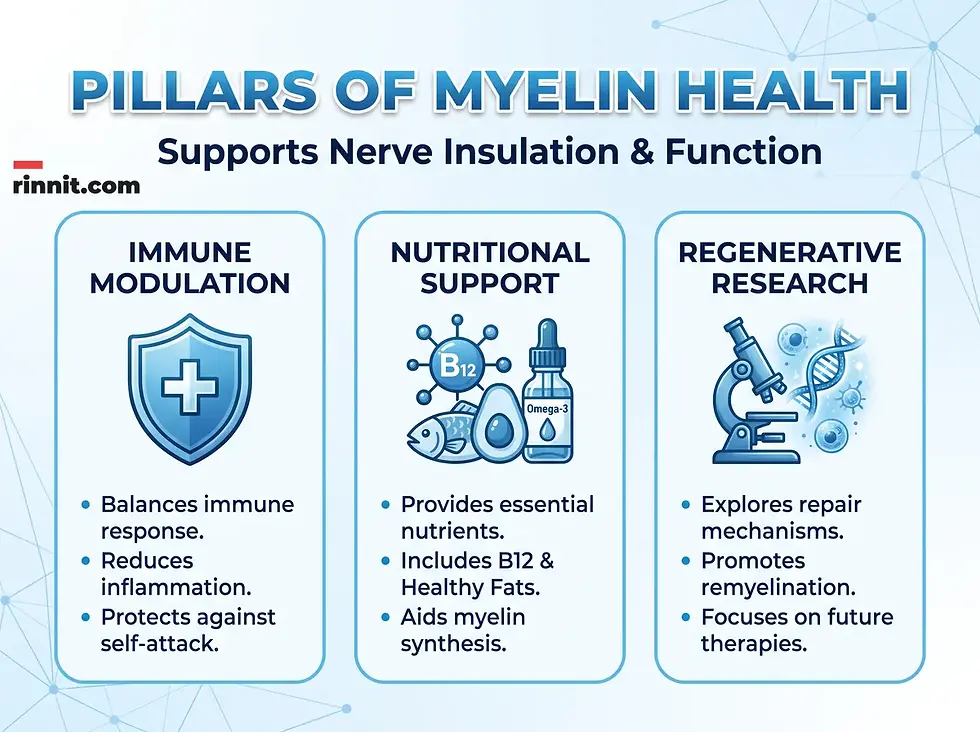
Managing myelin health involves addressing the underlying causes of damage and supporting the body’s natural repair mechanisms. Cleveland Clinic explains that damaged myelin can be repaired in both the central and peripheral nervous systems, and that it is important to control factors such as inflammation. [1] Immune suppression or modulation treatments, including steroids and intravenous immune globulin (IVIG), are commonly used for this purpose. [1] Correcting nutritional problems such as vitamin B12 deficiency and avoiding excess alcohol address two other known causes of myelin damage. [1]
Ongoing research is exploring new ways to protect and regenerate myelin, although Cleveland Clinic notes that there are currently no approved medications for myelin repair. [1] A small phase II trial found that the oral antihistamine clemastine improved signal transmission in people with multiple sclerosis who had optic nerve damage, [1] [2] and stem cell research continues to explore whether damaged oligodendrocytes and Schwann cells can be replaced to help restore function.
Conclusion
The myelin sheath is a fundamental component of the human nervous system, acting as the high-speed insulation that allows for complex biological coordination. From its structure of internodes and gaps to its production by specialized cells, every aspect of the sheath is designed for efficiency and protection. Understanding the mechanisms of demyelination and the ongoing advances in regenerative research is essential for managing the conditions that threaten this vital neural highway.
Next Steps
If you are concerned about neurological health or are experiencing symptoms related to nerve function, consulting with a healthcare professional is the most effective way to receive an accurate assessment. Early intervention and informed management strategies are key to supporting the long-term integrity of the nervous system.
Frequently Asked Questions
What exactly is the myelin sheath?
It is a protective layer of fat and protein that wraps around the axons of nerve cells to provide insulation and speed up signal transmission.
Why is myelin compared to electrical tape?
Just as electrical tape insulates a wire to prevent short circuits and maintain current, myelin insulates the axon to prevent signal loss and ensure fast transmission.
What are the nodes of Ranvier?
These are small gaps between the segments of the myelin sheath where the electrical signal is recharged by sodium ions.
Which cells produce myelin in the brain?
In the central nervous system (brain and spinal cord), myelin is produced by cells called oligodendrocytes. In the peripheral nervous system, it is produced by Schwann cells.
How does myelin affect the speed of nerve impulses?
It allows signals to “jump” between the gaps in the sheath, which is significantly faster than a signal traveling continuously along an uninsulated nerve fiber.
What is demyelination?
Demyelination is the process in which the myelin sheath is damaged or destroyed, leading to slowed or blocked nerve signals.
What causes the immune system to attack myelin?
The immune system may mistake myelin for a foreign substance and release inflammatory substances that damage the sheath and the cells that make it.
Is multiple sclerosis the only disease that affects myelin?
No. Multiple sclerosis is the best known, but other conditions such as transverse myelitis and Guillain-Barre syndrome also involve myelin damage.
Can the body repair damaged myelin?
Yes, damaged myelin can be repaired in both the central and peripheral nervous systems, and treatment focuses on controlling the inflammation that causes the damage. Cleveland Clinic notes that there are currently no approved medications for myelin repair.
What role does vitamin B12 play in myelin health?
A vitamin B12 deficiency can damage the myelin sheath, which is one reason doctors check B12 levels when nerve symptoms appear.
Are there genetic conditions that affect myelin?
Yes. In a few rare inherited diseases called leukodystrophies, such as Krabbe disease, metachromatic leukodystrophy and adrenoleukodystrophy, the myelin sheath does not form or is not maintained properly.
How many nerve cells rely on myelin in the human body?
Cleveland Clinic describes about 100 billion nerve cells in constant activity, and many of them rely on myelin to send signals quickly and reliably.
What happens if a signal is slowed by myelin damage?
Symptoms depend on where the damage occurs, but they often include muscle weakness, sensory changes, or problems with vision, walking, or thinking.
What are the latest research areas for myelin repair?
Researchers are studying stem cells, the antihistamine clemastine, and anti-inflammatory and neuroprotective drugs to protect or regenerate the sheath.
Can lifestyle factors impact myelin?
Yes. Excess alcohol intake and certain nutritional deficiencies, such as vitamin B12 deficiency, can contribute to myelin damage.
Related Reading
What Is Multiple Sclerosis? A Plain-Language Guide to Symptoms, Types, and How It's Treated explains the most common disease that damages myelin in the brain.
Demyelinating Disease: What It Is, the Types, Symptoms, Causes, Diagnosis, Treatment and Outlook — What You Need to Know covers the range of conditions that strip myelin from nerves.
Guillain-Barré Syndrome: When the Immune System Turns on Your Nerves, and How Treatment Helps You Recover explains sudden nerve damage that causes weakness and how it is treated.
What Is CIDP (Chronic Inflammatory Demyelinating Polyneuropathy)? Symptoms, Causes, Diagnosis & Treatment describes a long-lasting condition that damages myelin on peripheral nerves.
Sources
Cleveland Clinic. Myelin Sheath. Cleveland Clinic. Last updated May 9, 2022. https://my.clevelandclinic.org/health/body/22974-myelin-sheath
Green AJ, Gelfand JM, Cree BA, et al. Clemastine fumarate as a remyelinating therapy for multiple sclerosis (ReBUILD): a randomised, controlled, double-blind, crossover trial. Lancet. 2017;390(10111):2481-2489. PMID: 29029896. DOI: 10.1016/S0140-6736(17)32346-2
Nawar AA, Farid AM, Wally R, et al. Efficacy and safety of stem cell transplantation for multiple sclerosis: a systematic review and meta-analysis of randomized controlled trials. Sci Rep. 2024;14(1):12545. PMID: 38822024. DOI: 10.1038/s41598-024-62726-4
Hooijmans CR, Hlavica M, Schuler FAF, et al. Remyelination promoting therapies in multiple sclerosis animal models: a systematic review and meta-analysis. Sci Rep. 2019;9(1):822. PMID: 30696832. DOI: 10.1038/s41598-018-35734-4
Medical disclaimer
This content is for informational purposes only and is not intended as medical advice, diagnosis, or treatment. Always seek the advice of your physician or other qualified health provider with any questions you may have regarding a medical condition.



Comments