Demyelinating Disease: What It Is, the Types, Symptoms, Causes, Diagnosis, Treatment and Outlook — What You Need to Know

Updated: 2 days ago
Medically reviewed by Dr. Baraa Alnahhal, MD · Last reviewed: September 2026
Quick Answer: A demyelinating disease damages myelin — the protective sheath that surrounds nerve cells and lets electrical impulses travel between them. The damage happens when the immune system mistakenly attacks healthy myelin or the cells that make it. Multiple sclerosis (MS) is the most common demyelinating disease, but there are others, including Guillain-Barré syndrome and transverse myelitis. Symptoms vary widely — vision changes, tingling, numbness, fatigue, bladder problems, and difficulty walking — and depend on which nerves are affected. There is no cure, but medications and physical or occupational therapy can manage symptoms, and treatment works best when it starts early.
TL;DR: Myelin is the protective coating around nerve cell axons in your central and peripheral nervous system — it strengthens, protects, and insulates nerves so electrical signals can travel. In a demyelinating disease, the immune system misfires and attacks healthy myelin, causing inflammation and symptoms. MS is the most common (nearly 1 million people in the U.S. were estimated to live with it in 2019), but the group includes NMOSD, transverse myelitis, ADEM, PML, central pontine myelinolysis, Guillain-Barré syndrome, Charcot-Marie-Tooth disease, and CIDP. Common symptoms: vision changes, tingling or numbness, the "MS hug" chest squeezing, fatigue, bladder/bowel problems, electric shocks down the back when bending the neck, walking difficulty, and muscle weakness or stiffness. Diagnosis has no single test — MRI (which shows lesions), spinal tap, OCT, EMG, blood tests, and evoked potentials. Treatment varies by type: medications plus physical/occupational therapy, most effective when started early. No cure exists — outlook ranges from mild symptoms with no long-term effects to significant daily-life impact.
Limitation note: The clinical source provides only one statistic — a 2019 study estimating nearly 1 million people in the United States living with multiple sclerosis. No other prevalence numbers are given for demyelinating diseases as a group, and nothing numerical has been invented beyond this attributed figure.
What is a demyelinating disease?
A demyelinating disease is a condition that causes damage to the myelin in your brain, spinal cord, and nerves.
Myelin is a protective cover — a sheath — around the body section (axon) of nerve cells (neurons) in your central and peripheral nervous system. Myelin strengthens, protects, and insulates your nerve cells and allows electrical impulses to travel between cells.
If you have a demyelinating disease, your immune system mistakenly attacks the myelin sheath or the cells that make up your myelin. This changes the way your nerves communicate and function, which causes symptoms.

What does myelin do?
Think of myelin as the insulation around an electrical wire. It keeps nerve cells protected and functioning as expected. When myelin is damaged, signals that travel between your nerves become disrupted — which is why demyelinating disease can cause symptoms involving how you think, move, and feel.
Is demyelinating disease always MS?
No. There are several conditions classified as demyelinating diseases. MS is the one most common in North America, but it is only one of the group.
What are the types of demyelinating diseases?
The types divide by which part of the nervous system they affect:
Group | Types | What They Affect |
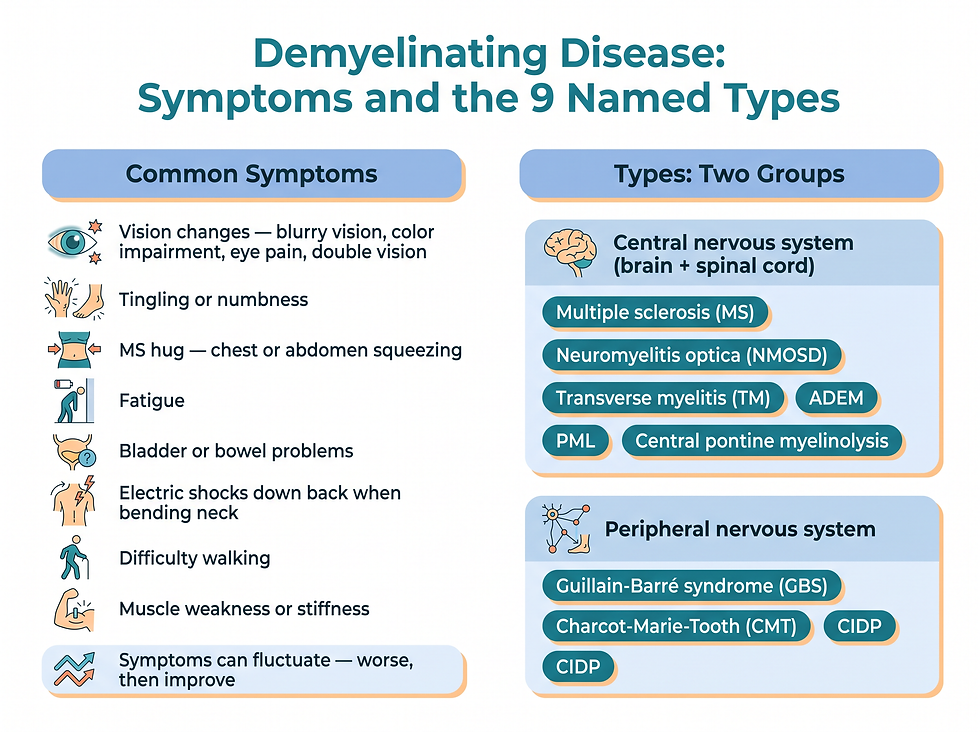
Central nervous system (CNS) | Multiple sclerosis (MS); neuromyelitis optica spectrum disorder (NMOSD); transverse myelitis (TM); acute disseminated encephalomyelitis (ADEM); progressive multifocal leukoencephalopathy (PML); central pontine myelinolysis (osmotic demyelination syndrome) | Brain and spinal cord |
Peripheral nervous system (PNS) | Guillain-Barré syndrome (GBS); Charcot-Marie-Tooth disease (CMT); chronic inflammatory demyelinating polyneuropathy (CIDP) | Nerves outside the brain and spinal cord |
How common are demyelinating diseases?
Multiple sclerosis is one of the most common demyelinating diseases. A study in 2019 estimated that there were nearly 1 million people in the United States living with MS.
What are the symptoms of a demyelinating disease?
The symptoms of demyelinating disease affect many different parts of your body. They vary based on the type of condition. Common symptoms of a central nervous system demyelinating disease may include:
Symptom | What It Looks Like |
Vision changes | Blurry vision, impaired color vision, pain with eye movement (as seen in optic neuritis), or double vision |
Tingling or numbness | In various parts of your body |
"MS hug" | A squeezing sensation around your chest or abdomen |
Fatigue | Persistent, unusual tiredness |
Bladder or bowel problems | Difficulty or hesitancy when urinating, or a feeling of urgency |
Electric shocks | Electrical tingling or shocks down your back, arms, or legs when you bend your neck forward |
Walking difficulty | Trouble walking |
Muscle problems | Muscle weakness or stiffness |
You might experience symptoms that affect only one part of your body or many at the same time. Symptoms can fluctuate in severity — meaning they can get worse (feel more intense) before improving for a period of time.
What causes a demyelinating disease?
The destruction of myelin and myelin-forming cells causes demyelinating diseases. Damage to your myelin and cells happens when your immune system mistakenly attacks healthy myelin.
Your immune system protects your body from things that can make you sick, like bacteria and viruses. Sometimes, your immune system doesn't get the correct instructions and it confuses your myelin cells for cells of something that can harm your body. When this happens, it causes inflammation, which leads to symptoms of demyelinating diseases.
A demyelinating disease can happen due to multiple factors, which can include:
Possible Factor | Description |
Viral or bacterial infection | An infection may trigger the immune misfire |
Genetic predisposition | Changes in your DNA that predispose someone to an autoimmune disorder |
Other medical conditions | Such as vitamin deficiencies |
Unknown factors | Some causes are unknown; research is ongoing |
How is a demyelinating disease diagnosed?
A healthcare provider will review your symptoms during a physical exam and take a complete medical history. If they suspect a demyelinating disease, they might refer you to a neurologist — a doctor who specializes in conditions that affect your nervous system.
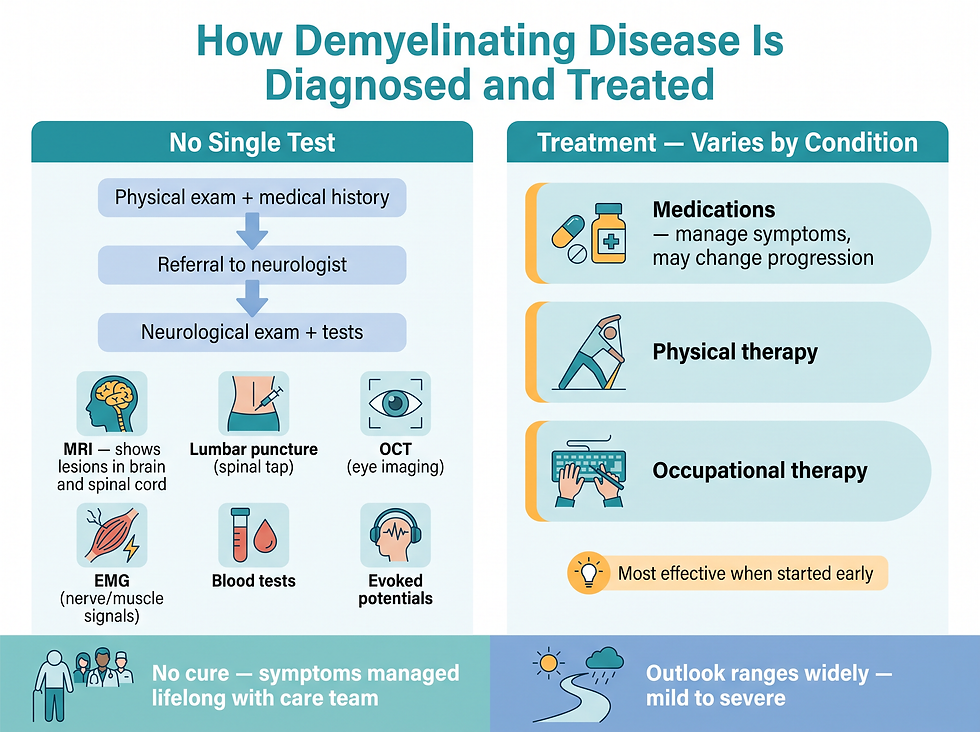
The neurologist will perform a neurological exam and testing. Importantly, there isn't one test to diagnose demyelination. Your provider may use one or several of the following tests to rule out possible conditions with similar symptoms and lead to your diagnosis:
Diagnostic Test | What It Does |
MRI (magnetic resonance imaging) | Uses magnets and radio waves to image your brain and spinal cord; shows areas of damage (lesions) |
Lumbar puncture (spinal tap) | Examines spinal fluid |
OCT (optical coherence tomography) | Images the eye's structures |
EMG (electromyography) | Measures electrical activity in muscles and nerves |
Blood tests | Screens for related conditions |
Evoked potentials test | Measures nerve signal speed |
How is a demyelinating disease treated?
Treatment for a demyelinating disease varies based on what condition you have. Your healthcare provider will work closely with you to manage symptoms and, in some cases, change the course or progression of the condition in your body. Treatment could include:
Treatment | Purpose |
Medications | To manage symptoms and, in some cases, change progression |
Physical therapy | To maintain mobility and function |
Occupational therapy | To support daily-living activities |
Your healthcare provider will evaluate your symptoms and the type of treatment plan best for your situation. Before you begin treatment, ask about the side effects and what to expect. If you notice new or worsening symptoms after starting treatment, let your healthcare provider know. Treatment is usually most effective when you start it early.
What's the outlook or prognosis for a demyelinating disease?
Your outlook varies based on the type of demyelinating disease that caused your symptoms. These conditions affect many aspects of your life, like how you think, move, and feel. You might have trouble walking or doing your daily routine, for example. Many people need assistance at home so they can live in a safe environment.
Some people may have very mild symptoms without any long-term effects, while other people's symptoms are severe and significantly impact day-to-day life. Each situation is different. Your healthcare provider can help you manage your symptoms throughout your life, as there isn't a cure.
What is the life expectancy for a demyelinating disease?
Demyelinating diseases can affect your life expectancy, but many don't have a direct impact on how long you'll live. On average, people with a demyelinating disease may have a slightly shorter life expectancy (a few years shorter) than people who don't have this condition. Your life expectancy varies based on how much damage your nerve cells receive, and this is different for each person. Your healthcare provider can give you the best answer based on how the condition affects you.
When should I see a healthcare provider?
Contact a healthcare provider if you experience symptoms of demyelinating disease like:
Symptom | Why It Matters |
Vision changes | Can signal optic nerve involvement |
Tingling or numbness | May indicate nerve damage |
Fatigue | A hallmark of CNS demyelination |
Bladder or bowel problems | Common and treatable if addressed |
Trouble walking | May worsen without treatment |
Stiff or weak muscles | Can affect safety and daily routine |
What questions should I ask my healthcare provider?
Question | Why It Matters |
What type of demyelinating disease do I have? | Nine types exist; treatment varies by type |
Will this condition get worse (progress)? | Planning depends on the trajectory |
What type of treatment do you recommend? | Options vary by condition |
Are there side effects of treatment? | Worth knowing before you begin |
What is my outlook (prognosis)? | Highly individual — ask for your case |
A note from the clinical source: "Myelin is an important part of your body that keeps your nerve cells protected and functioning as expected. Damage to this area can make you vulnerable and cause symptoms like pain, difficulty moving or trouble thinking clearly. A healthcare provider can diagnose and treat the demyelinating condition that affects you. Demyelinating conditions don't have a cure, so you'll need to manage your symptoms throughout your life with the help of your care team. Always reach out to your provider if you have questions about your condition or treatment options or experience new or worsening symptoms."
Conclusion: An umbrella of conditions with a common thread
Demyelinating diseases are a family of neurological conditions united by one mechanism: immune-driven damage to myelin, the protective insulation that lets your nerves transmit signals. The group spans the central nervous system — where MS, NMOSD, transverse myelitis, ADEM, PML, and central pontine myelinolysis live — and the peripheral nervous system, home to Guillain-Barré syndrome, Charcot-Marie-Tooth disease, and CIDP.
The good news is that while no cure exists, treatment is real and effective — especially when it starts early. Medications and physical or occupational therapy can manage symptoms, and in some cases alter the condition's course. Prognosis ranges from mild and life-changingly minimal to significant daily impact, which is why early diagnosis and an engaged care team matter so much.
Your next step: If you're experiencing unexplained vision changes, tingling or numbness, fatigue, bladder or bowel problems, trouble walking, or stiff and weak muscles, contact a healthcare provider. Ask for a referral to a neurologist, and come prepared with your full symptom history — early evaluation is your best path to an effective treatment plan.
Frequently Asked Questions (FAQ)
What is a demyelinating disease? A demyelinating disease is a condition that damages myelin — the protective sheath around nerve cell axons in your central and peripheral nervous system. Myelin strengthens, protects, and insulates nerve cells and allows electrical impulses to travel between them.
What does myelin do? Myelin is a protective cover around the axon of nerve cells. It strengthens, protects, and insulates your nerve cells and enables electrical impulses to travel between cells — like insulation on an electrical wire.
How does myelin get damaged? Your immune system mistakenly attacks healthy myelin or the cells that make it. The immune system normally fights bacteria and viruses, but sometimes it gets the wrong instructions and confuses myelin cells for harmful ones, causing inflammation and symptoms.
Is demyelinating disease the same as multiple sclerosis? No. MS is the most common demyelinating disease — the one most common in North America — but there are several other conditions in the group.
What are the types of demyelinating disease? Central nervous system types include multiple sclerosis (MS), neuromyelitis optica spectrum disorder (NMOSD), transverse myelitis (TM), acute disseminated encephalomyelitis (ADEM), progressive multifocal leukoencephalopathy (PML), and central pontine myelinolysis (osmotic demyelination syndrome). Peripheral types include Guillain-Barré syndrome (GBS), Charcot-Marie-Tooth disease (CMT), and chronic inflammatory demyelinating polyneuropathy (CIDP).
How common are demyelinating diseases? A 2019 study estimated nearly 1 million people in the United States living with MS, the most common demyelinating disease. The source does not give counts for the other conditions.
What are the symptoms of demyelinating disease? They vary by type but commonly include vision changes (blurry vision, impaired color vision, pain with eye movement, double vision), tingling or numbness, the "MS hug" squeezing sensation around the chest or abdomen, fatigue, bladder or bowel problems, electrical tingling down the back when bending the neck, walking difficulty, and muscle weakness or stiffness.
Why do I get electric shocks when bending my neck? Electrical tingling or shocks down the back, arms, or legs when bending the neck forward is a recognized symptom of central nervous system demyelinating disease.
What is the "MS hug"? The MS hug is a squeezing sensation around your chest or abdomen, listed as a common symptom of central nervous system demyelinating disease.
Do symptoms stay the same? No. Symptoms can fluctuate in severity — they can get worse (feel more intense) before improving for a period of time. They may affect one part of the body or many at once.
What causes demyelinating disease? Possible factors include a viral or bacterial infection, genetic predisposition (DNA changes that predispose someone to an autoimmune disorder), and other medical conditions such as vitamin deficiencies. Some causes are unknown, and research is ongoing.
Is demyelinating disease an autoimmune disease? The source describes the mechanism as an autoimmune misfire — the immune system mistakenly attacking healthy myelin — and lists genetic predisposition to autoimmune disorder as a possible factor.
Can vitamin deficiency cause demyelinating disease? The source lists other medical conditions such as vitamin deficiencies as a possible factor, but not a confirmed direct cause.
How is demyelinating disease diagnosed? There is no single test. A provider reviews symptoms, takes a medical history, and may refer you to a neurologist for a neurological exam plus tests: MRI, lumbar puncture (spinal tap), OCT, EMG, blood tests, and evoked potentials.
What does an MRI show in demyelinating disease? An MRI uses magnets and radio waves to image your brain and spinal cord. It will show areas of damage (lesions) in your brain and spinal cord if you have a demyelinating disease.
Who diagnoses demyelinating disease? Your healthcare provider starts with a physical exam and medical history, then may refer you to a neurologist — a doctor who specializes in nervous system conditions.
Is demyelinating disease curable? No. There isn't a cure. You manage symptoms throughout your life with the help of your care team.
How is demyelinating disease treated? Treatment varies by condition and may include medications, physical therapy, and/or occupational therapy. Your provider will manage symptoms and, in some cases, change the course or progression of the condition.
When is treatment most effective? Treatment is usually most effective when you start it early.
What is the life expectancy with demyelinating disease? Many demyelinating diseases don't have a direct impact on how long you'll live. On average, people with a demyelinating disease may have a slightly shorter life expectancy (a few years shorter). It varies based on how much damage your nerve cells receive and differs for each person.
Will demyelinating disease get worse? Your outlook varies based on the type. Some people have very mild symptoms without long-term effects; others experience severe symptoms that significantly impact day-to-day life. Ask your provider whether your specific condition will progress.
Do I need help at home with demyelinating disease? Some people do — many people with demyelinating disease need assistance at home to live in a safe environment, depending on how much the condition affects walking and daily routines.
When should I see a provider? Contact a healthcare provider if you experience vision changes, tingling or numbness, fatigue, bladder or bowel problems, trouble walking, or stiff or weak muscles.
What questions should I ask my provider? Ask: What type of demyelinating disease do I have? Will it progress? What treatment do you recommend? Are there side effects? What is my outlook?
Can demyelinating disease affect thinking? Yes — the source notes these conditions affect how you think, move, and feel, and that damage to myelin can cause trouble thinking clearly.
Does myelin ever recover? The source does not state that myelin regenerates; it states there is no cure and that symptoms are managed throughout life with a care team.
External References
Cleveland Clinic — Demyelinating Disease (primary source, medically reviewed, last updated Oct 18, 2023)
National Multiple Sclerosis Society — Signs and Symptoms Consistent with Demyelinating Disease
National Multiple Sclerosis Society — Who Gets Multiple Sclerosis? Epidemiology of MS
NIH National Institute of Neurological Disorders and Stroke — Myelin
Disclaimer: This article is for general educational purposes only and does not constitute medical advice. It is based on a single referenced clinical source and should not replace professional diagnosis or treatment. If you experience vision changes, tingling, numbness, fatigue, bladder or bowel problems, trouble walking, or stiff or weak muscles, consult a healthcare provider or neurologist.
Comments