Charcot-Marie-Tooth Disease: Symptoms & Treatment

Updated: 2 days ago
Medically reviewed by Dr. Baraa Alnahhal, MD · Last reviewed: September 2026
Charcot-Marie-Tooth (CMT) disease is a group of inherited conditions that damage the peripheral nerves in the arms and legs, causing muscle weakness, foot deformities, and loss of feeling. Symptoms usually begin in the feet and legs during the teen years or early adulthood and may spread to the hands over time. There is no cure, but the condition typically worsens slowly and most often does not shorten life. Physical therapy, occupational therapy, orthopedic devices, and daily foot care form the core of management. Some chemotherapy medicines can worsen symptoms, so always tell your healthcare professional about every medicine you take.
Quick Answer
What it is: A group of inherited conditions that damage the peripheral nerves of the arms and legs, also called hereditary motor and sensory neuropathy.
Main symptoms: Weakness and muscle shrinking in the legs and feet, high arches, hammertoes, footdrop, clumsy walking, frequent tripping, and loss of feeling.
When it starts: Most often in the teen years or early adulthood, though it can begin in toddler years or midlife.
Cause: Gene changes that damage the nerves themselves or their protective myelin sheath (the coating around a nerve).
Prevention: It cannot be prevented because it is hereditary, but genetic testing can support family planning.
Diagnosis: Medical history, physical exam, nerve conduction studies, EMG, possible nerve biopsy, and genetic testing.
Treatment: No cure exists, but physical therapy, occupational therapy, pain medicine, braces, custom shoes, and sometimes foot surgery ease symptoms and help prevent disability.
Daily care: Stretching, low-impact exercise, stability aids, and daily foot checks protect joints, bones, and skin.
What Is Charcot-Marie-Tooth Disease?
Charcot-Marie-Tooth disease (pronounced shahr-KOH-Marie-Tooth) is a group of inherited conditions — conditions that pass down through families — that cause nerve damage. The damage occurs mainly in the peripheral nerves, which are the nerves outside the brain and spinal cord that connect the arms and legs to the rest of the body. Because of this, the condition is also called hereditary motor and sensory neuropathy.
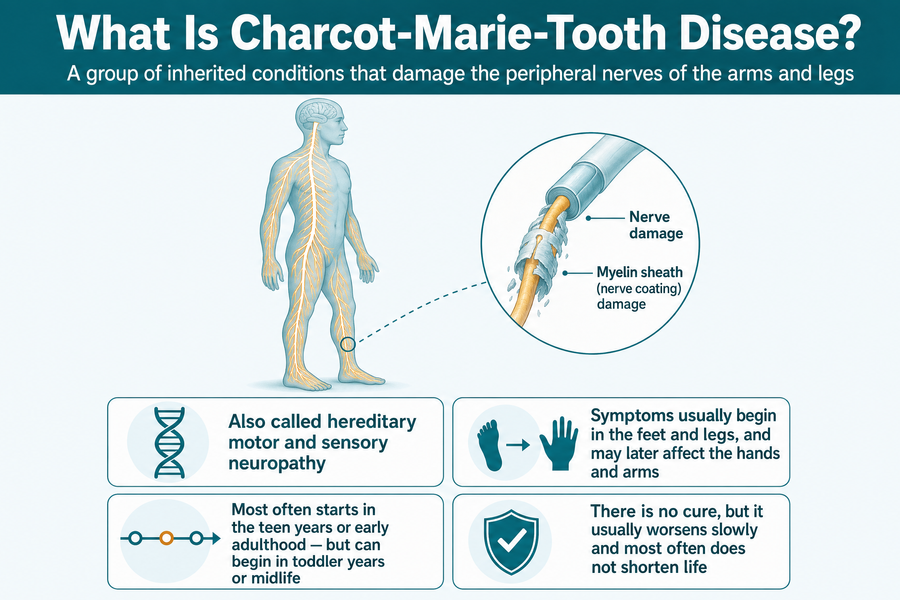
Charcot-Marie-Tooth disease damages the peripheral nerves of the arms and legs, most often beginning in the feet and legs. Both the nerve fibers and their myelin sheath can be affected.
The nerve damage leads to smaller, weaker muscles and loss of feeling, most often in the legs and feet. Over time, the condition can affect the hands and arms. Foot problems are common, including hammertoes (toes that curl downward) and high arches. Some people also cannot tense their muscles normally.
Four facts are worth knowing up front. First, CMT is one of the most common inherited nerve disorders, also known as hereditary motor and sensory neuropathy. Second, symptoms usually begin in the feet and legs before spreading to the hands and arms. Third, onset most often happens in the teen years or early adulthood, though it can start in toddler years or midlife. Fourth, there is no cure, but the disease usually worsens slowly and most often does not shorten life.
Charcot-Marie-Tooth Disease Symptoms
Symptoms most often begin in the feet and legs and worsen gradually over time. The nine most common symptoms are listed below. Severity varies greatly from person to person, even among members of the same family.
Weakness in the legs, ankles, and feet: Reduced strength in the lower limbs
Muscle shrinking (atrophy) in the legs and feet: Calves may take on the shape of an upside-down Champagne bottle
High foot arches: A raised arch in the foot caused by muscle imbalance
Hammertoes: Toes that curl downward like a claw
Footdrop: Trouble lifting the front of the foot at the ankle while walking
Clumsy walking: An unsteady, awkward gait
Tripping or falling often: A consequence of footdrop and reduced feeling
Not being able to run: Loss of lower-leg strength and speed
Loss of feeling in the legs and feet: Reduced ability to sense touch, pressure, or pain
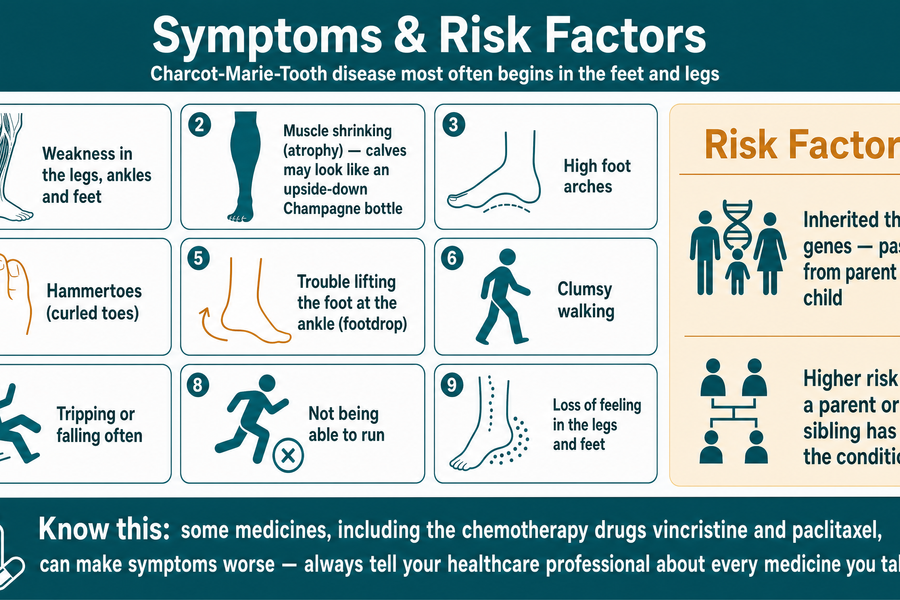
The nine most common symptoms of Charcot-Marie-Tooth disease, its two risk factors, and the important reminder that certain medicines — including the chemotherapy drugs vincristine and paclitaxel — can worsen symptoms.
As the condition progresses, symptoms can spread from the feet and legs to the hands and arms. Two important caveats apply. First, other causes of nerve damage, such as diabetes, can mimic CMT symptoms, and having another condition with similar symptoms can make CMT symptoms worse. Second, certain medicines — including the chemotherapy drugs vincristine and paclitaxel — can worsen symptoms, so it matters that your healthcare professional knows every medicine you take.
What Causes Charcot-Marie-Tooth Disease?
CMT is caused by gene changes that affect the nerves in the feet, legs, hands, and arms. These gene changes are most often passed down through families, though a new gene change can occasionally happen in someone with no family history.
Some gene changes damage the nerves themselves. Others damage the myelin sheath — the protective coating around a nerve that helps electrical signals travel quickly. Either way, the messages traveling between the arms, legs, and brain become weaker or slower, which produces the weakness and sensory loss described above.
Risk Factors
Because CMT is a hereditary disease, the main risk factor is family history. The table below summarizes what the source pages say about who is at higher risk.
Inherited condition: CMT passes from parent to child through genes
Affected parent or sibling: Higher risk if a parent or brother/sister has the condition
Since there is no way to prevent a hereditary disease, people with CMT who are planning a family may want to ask about genetic testing, which can clarify the chance of passing the condition on.
Possible Complications
Complications vary from person to person, but foot problems and walking difficulty are usually the most serious concerns. Because the disease reduces feeling in the feet, people may not sense pain the way they used to, which creates two specific risks.
First, without strong signals from the brain, foot muscles may not tighten when they should, leading to tripping and falling. Second, the brain may not receive pain messages from the feet at all — so a blister on a toe can become infected without the person ever feeling it. In rarer cases, if the disease affects the muscles used for breathing, swallowing, or speaking, those activities can become difficult.
Prevention
There is no way to prevent Charcot-Marie-Tooth disease because it is hereditary. If you have the condition, genetic testing may help with family planning decisions. Prevention efforts instead focus on preventing disability and injury: early and regular physical therapy, stretching, low-impact exercise, fall prevention, and careful daily foot care.
How Is Charcot-Marie-Tooth Disease Diagnosed?
Diagnosis starts with a medical history and a physical exam that looks for the symptoms listed above. If CMT is suspected, several specialized tests can confirm and characterize the nerve damage.
Nerve conduction studies: Electrodes on the skin deliver small electric shocks to a nerve, measuring the strength and speed of electrical signals; delayed or weak responses can indicate a nerve condition such as CMT
Electromyography (EMG): A thin needle electrode is passed through the skin into a muscle, measuring electrical activity while you relax and gently tighten the muscle, showing which muscles the condition affects
Nerve biopsy: A small piece of a peripheral nerve is taken from the back of the lower leg and tested in a lab to help find the cause of the nerve condition
Genetic testing: A blood sample is tested for the most common gene changes known to cause CMT, helping with family planning and ruling out other causes of nerve damage
A genetic counselor can talk with you about what genetic testing involves.

The pathway from first symptoms to daily management: history and exam, nerve tests, genetic testing, symptom treatment, and daily self care.
Charcot-Marie-Tooth Disease Treatment
There is no cure for CMT, and the disease most often worsens slowly. The good news is that CMT most often does not shorten life, and a strong set of management options helps most people stay mobile and independent.
Physical therapy: Low-impact exercises and stretches designed by a trained therapist to strengthen and stretch muscles, preventing muscle tightening and loss; started early and done regularly, it can help prevent disability
Occupational therapy: Training for weakness in the arms and hands that affects gripping and finger movements, such as closing buttons or writing, teaching use of assistive devices like rubber grips for doorknobs or clothes with snaps instead of buttons
Pain medicine: Prescription pain medicine as needed helps manage pain caused by muscle cramps or nerve damage
Orthopedic devices: Leg and ankle braces or splints, boots or high-top shoes, custom-made shoes or shoe inserts, and thumb splints improve walking, stair climbing, ankle support, and grip
Surgery: Operations to correct foot problems can ease pain and improve walking, though they cannot improve weakness or loss of feeling
Looking ahead, researchers are studying potential future treatments, including new medicines, supplements, gene therapy, and laboratory (in vitro, meaning done outside the body in a test tube or lab) procedures that might one day help prevent passing the disease to family members.
Self Care: Daily Habits That Help
Stretch regularly to keep and improve the range of motion in your joints, lower your risk of injury, improve balance and movement, and prevent or lessen joint problems caused by muscles pulling unevenly on bones.
Exercise daily, choosing low-impact activities such as biking and swimming that put less stress on muscles and joints; stronger muscles and bones improve balance, improve movement, and lower your risk of falls.
Pay attention to stability: muscle weakness can cause unsteadiness, so a cane, walker, or walking sticks may help, and good lighting at night helps you avoid tripping and falling.
Foot Care: A Daily Priority
Because CMT reduces feeling in the feet, foot care deserves special attention every day.
Inspect your feet daily so calluses, sores, wounds, and infections are caught early.
Take care of your toenails by cutting them often and straight across to prevent ingrown toenails and infections, and avoid cutting into the nailbed. If needed, a podiatrist (a foot specialist) can trim your toenails or suggest a safe salon.
Wear the right shoes: well-fitting, protective footwear with boots or high-top shoes for ankle support, or custom-made shoes if you have foot issues such as hammertoe.
Coping and Support
Living with a chronic condition is easier with support. Support groups connect people who are coping with the same challenges and who share common problems, and many people find they help when dealing with CMT. Ask your healthcare professional about local support groups. The internet, your local health department, and the public library can also help you find one.
Preparing for Your Appointment
You may first talk with your main healthcare professional, who may send you to a neurologist — a specialist in conditions of the brain and nervous system. Bringing a family member or friend can help you remember information. Before the visit, make a list of your symptoms and when they began, all medications, vitamins, and supplements with dosages, any family members with similar symptoms, and the questions you want to ask.
Questions to ask your healthcare professional: What's the most likely cause of my symptoms? What tests do I need? What treatments are there, and which do you suggest for me? I have other health conditions — how can I best manage them together? Do I need to restrict what I do? Are there brochures or other printed material I can have? What websites do you suggest?
Questions your healthcare professional may ask you: How bad are your symptoms? Do you have symptoms all the time, or do they come and go? Does anything seem to make your symptoms better? Does anything make your symptoms worse? Have you or others in your family had genetic testing to confirm the diagnosis?
Conclusion
Charcot-Marie-Tooth disease is a lifelong condition, but it is one that most people manage well with early, consistent care. Therapy, braces, protective footwear, and daily self care together preserve mobility, prevent injuries, and protect the parts of the body where feeling is reduced.
Your next step: If you or a family member have weakness, tripping, foot deformities, or loss of feeling in the legs or feet, schedule an evaluation with a healthcare professional. Bring a full list of your medicines — including any chemotherapy — and any family history of nerve conditions. If you already live with CMT, ask about a physical therapy referral and a daily foot care routine at your next visit.
Frequently Asked Questions
What is Charcot-Marie-Tooth disease in simple terms?
It is a group of inherited conditions that damage the peripheral nerves — the nerves in the arms and legs outside the brain and spinal cord. The damage causes muscle weakness, foot deformities such as hammertoes and high arches, and loss of feeling, most often starting in the feet and legs.
Is Charcot-Marie-Tooth disease hereditary?
Yes. CMT is an inherited disease that passes from parent to child through genes, and your risk is higher if a parent or sibling has the condition. In some cases, however, a new gene change can occur with no family history.
At what age do symptoms usually start?
Symptoms most often begin in the teen years or early adulthood, but the condition can also start in toddler years or in midlife.
Is Charcot-Marie-Tooth disease curable?
There is no cure. The disease most often worsens slowly, and it most often does not shorten life. Treatment focuses on managing symptoms and preventing disability through therapy, braces, and self care.
Can Charcot-Marie-Tooth disease affect life expectancy?
Most often, no — CMT does not shorten life. Rarely, if the disease affects muscles involved in breathing, swallowing, or speaking, those activities can become difficult.
What medicines should people with CMT avoid?
The chemotherapy drugs vincristine and paclitaxel can worsen symptoms. Always tell your healthcare professional about every medicine you take, since other nerve-damaging medicines may also be a concern for you.
How is CMT diagnosed?
A healthcare professional starts with a medical history and physical exam, then may order nerve conduction studies, electromyography (EMG), a nerve biopsy, and genetic testing. Genetic testing looks for the most common gene changes known to cause CMT and can also help rule out other causes of nerve damage.
Can people with CMT exercise?
Yes — daily low-impact exercise such as biking and swimming is recommended. It keeps bones and muscles strong, improves balance, and lowers the risk of falls, while putting less stress on weakened muscles and joints.
References
Charcot-Marie-Tooth disease — Symptoms and causes (Mayo Clinic)
Charcot-Marie-Tooth disease — Diagnosis and treatment (Mayo Clinic)
This article is based on two expert-reviewed medical reference pages last reviewed September 15, 2025. It is provided for general education and is not a substitute for professional medical advice, diagnosis, or treatment.
Comments