Understanding Hyperinflated Lungs: A Guide to Causes, Symptoms, and Management

Updated: 2 days ago
Medically reviewed by Dr. Baraa Alnahhal, MD · Last reviewed: October 2026
Quick Answer
Hyperinflated lungs are lungs that are overexpanded because air and mucus are trapped inside, most often due to chronic obstructive pulmonary disease (COPD), especially emphysema and chronic bronchitis. Symptoms include shortness of breath, shallow breathing and persistent tiredness. The added pressure on the heart can lead to heart failure. Treatment eases symptoms and widens airways, though damage is usually permanent. [1]
What the research says
Hyperinflated lungs may compress the heart as you breathe out. In a four-dimensional CT study of 31 smokers (13 with COPD), heart size was significantly smaller in people with COPD at both inspiration and expiration, and the heart appeared to shrink during expiration in COPD, a pattern that tracked with airflow limitation (FEV1/FVC, correlation 0.63). (Xu et al., International Journal of COPD, 2017)
Pursed lip plus diaphragmatic breathing improved lung function and walking distance. A meta-analysis of 15 randomized trials with 1,098 people with COPD found improvements in FEV1 (SMD 0.47, 95% CI 0.27-0.67) and in 6-minute walk distance (about 29 meters farther, 95% CI 19.35-38.83). (Yang et al., Physiotherapy Theory and Practice, 2022)
Breathing exercises ease breathlessness and improve quality of life. A systematic review of 73 randomized trials with 5,479 participants, mostly with COPD or asthma, found that pursed lip and/or diaphragmatic breathing lowered breathlessness scores by 0.40 points (95% CI -0.70 to -0.11) compared with usual care, although this was below the minimal important difference. Quality of life improved consistently, and no adverse events were reported. (Burge et al., European Respiratory Review, 2024)
What are hyperinflated lungs?

Hyperinflated lungs are lungs that stay overexpanded because air cannot be breathed out properly. This happens when the airways become narrow or blocked by mucus, which stops air from flowing out of the body. As air becomes trapped, the lungs grow larger than normal, a state known as overinflation. The condition is more than a breathing difficulty: over time it can permanently damage lung tissue and reduce the amount of oxygen circulating in the blood. [1] In COPD, trapped air can build up even during everyday activities and rises sharply with exercise or flare-ups, which makes breathlessness much worse. [2]
Hyperinflated lungs also affect the cardiovascular system. Overexpanded lungs can press on the heart and make it harder for the heart to pump blood into the lungs. This chronic strain raises the risk of heart failure. Anyone can develop hyperinflated lungs, but the condition is most common among the roughly 15 to 20 million people in the United States who live with COPD. [1]

What causes hyperinflated lungs, and who is at risk?
Hyperinflated lungs are almost always tied to an underlying respiratory condition that makes it hard to breathe out. [1]
Primary and secondary causes
Condition type | Examples |
Primary (COPD) | Emphysema (damaged air sacs) and chronic bronchitis (swollen, mucus-filled airways). |
Secondary conditions | Asthma, cystic fibrosis, bronchiectasis, and bronchiolitis. |
COPD is the most common cause. In emphysema, the tiny air sacs (alveoli) that move oxygen into the blood and carbon dioxide out are permanently damaged, so air gets trapped and is nearly impossible to breathe out fully. Risk factors include long-term smoking, which causes up to 90% of COPD cases, exposure to secondhand smoke, and air pollution. A genetic condition called alpha-1 antitrypsin deficiency can also cause emphysema and lung hyperinflation, even in people who have never smoked. [1]
What are the symptoms of hyperinflated lungs, and how are they diagnosed?
Symptoms of hyperinflated lungs overlap with other lung diseases, so a professional diagnosis is important. People often report shortness of breath (dyspnea) and shallow breathing, even when they are not active. This constant effort to breathe can cause deep fatigue and leave little energy for daily tasks. Chest congestion is another common complaint. [1]
To diagnose the condition, a healthcare provider reviews your history, listens to your heart and lungs with a stethoscope, and asks you to take several deep breaths. If hyperinflation is suspected, chest X-rays or CT scans show the size and structure of the lungs. Pulmonary function tests measure lung capacity and how well air moves in and out. You may be referred to a pulmonologist. [1]
How are hyperinflated lungs managed and treated?
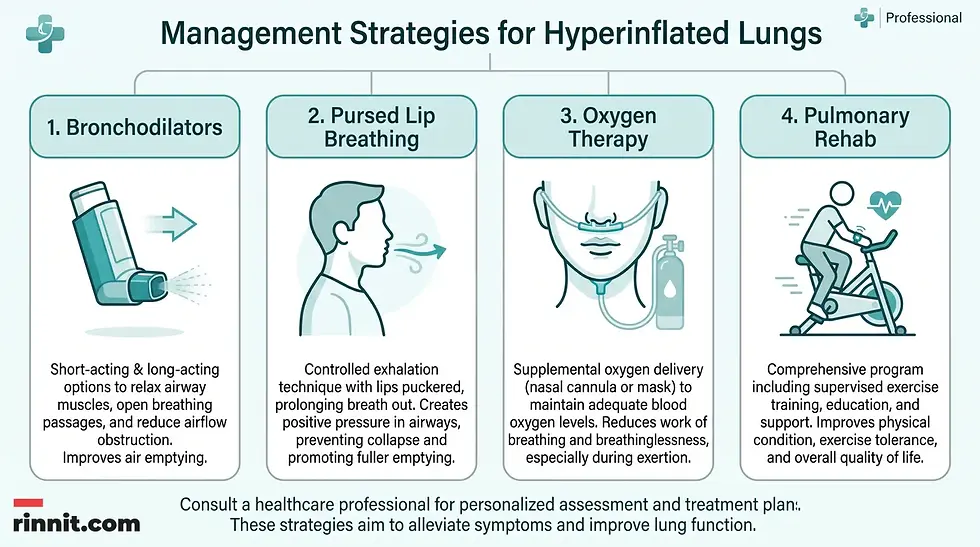
The damage from hyperinflated lungs is usually permanent, but treatment can ease symptoms and reduce hospital and emergency room visits. [1] Long-acting bronchodilators and exercise programs are two main ways to reduce hyperinflation, and using them together can help most. [2]
Treatment options
Bronchodilators: These medicines, given by inhaler or nebulizer, relax the muscles around the airways so trapped air can escape. [1]
Breathing techniques: Exercises such as pursed lip breathing can help expand your airways, and pursed lip breathing combined with diaphragmatic breathing has been shown to improve lung function, exercise capacity, breathlessness and quality of life in people with COPD. [1][4][5]
Oxygen therapy: Supplemental oxygen through a nasal cannula or face mask helps your body get the oxygen it needs. [1]
Pulmonary rehabilitation: A structured program of exercise training and education for people with COPD and other chronic lung diseases. [1]
Surgery: Lung volume reduction surgery is typically a last resort when other treatments have failed. [1]
Conclusion
Living with hyperinflated lungs takes a proactive approach to lung health. The condition can be serious and can affect daily life, but current treatments help control symptoms and protect the heart. The best way to prevent hyperinflated lungs is to avoid smoking and limit exposure to air pollutants. If you have ongoing trouble breathing, seeing a pulmonologist for a full evaluation is the first step toward easier breathing and a better quality of life. [1]
Stay informed. For more resources on lung health and managing chronic respiratory conditions, visit Rinnit.com.
Frequently Asked Questions
Can hyperinflated lungs be cured?
No. The damage to lung tissue and airways is usually permanent, but treatment can control symptoms and help prevent further damage. [1]
Is hyperinflated lungs the same as emphysema?
Emphysema is a common cause of hyperinflated lungs, but the terms are not identical. Hyperinflation is the state of the lungs being overexpanded by trapped air. [1]
Can you see hyperinflated lungs on a normal X-ray?
Yes. Providers diagnose hyperinflated lungs with chest X-rays and other imaging scans, along with a physical exam. A CT scan gives a more detailed picture of the lungs and heart. [1]
How does smoking cause hyperinflated lungs?
Smoking inflames and permanently damages the airways and air sacs, which leads to COPD, the leading cause of air trapping and hyperinflation. [1]
What does pursed lip breathing do?
It is a breathing exercise that can help expand your airways. Your provider may recommend it as part of your treatment. [1]
Can asthma cause hyperinflated lungs?
Yes. Asthma is one of the conditions that can cause the lungs to hyperinflate, because narrowed airways can trap air inside. [1]
Is hyperinflated lungs a sign of heart failure?
Not necessarily, but it is a major risk factor for heart failure because of the pressure overinflated lungs place on the heart. [1][3]
What is alpha-1 antitrypsin deficiency?
It is a genetic condition that can cause early emphysema and hyperinflated lungs, even in people who have never smoked. [1]
Does oxygen therapy help with air trapping?
Oxygen therapy does not stop air trapping itself, but it helps make sure your blood gets enough oxygen despite the trapped air.
Can I still exercise with hyperinflated lungs?
Yes, and exercise is often encouraged through pulmonary rehabilitation, but you should do it under the guidance of a healthcare professional. [1][2]
What is lung volume reduction surgery?
It is a surgical option for hyperinflated lungs. It is typically a last resort when all other treatment options fail. [1]
Can air pollutants other than smoke cause this?
Smoking is the major risk factor, but minimizing exposure to air pollutants and avoiding secondhand smoke are also recommended to help prevent COPD and hyperinflated lungs. [1]
Why do I feel tired all the time with this condition?
Feeling tired or low on energy is a common symptom. Hyperinflated lungs can make breathing harder and can decrease the oxygen in your blood. [1]
Can a CPAP machine help hyperinflated lungs?
CPAP is best known as a treatment for sleep apnea, but breathing devices such as CPAP are sometimes used in people with lung disease to support airflow. [1] Whether any device is right for you is a decision for your pulmonologist.
When is shortness of breath an emergency?
Go to the nearest emergency room if you have breathing difficulties that do not improve despite your best efforts, or if you are unable to breathe. [1]
Related Reading
What Is Chronic Obstructive Pulmonary Disease (COPD)? Symptoms, Causes, Stages, and Treatment explains COPD, the most common cause of hyperinflated lungs.
Pulmonary Function Tests (PFTs): Types, Preparation and What Your Results Mean describes breathing tests that measure trapped air and lung volume.
Pursed-Lip Breathing: Techniques for Improved Lung Function teaches a breathing method that helps empty trapped air.
Lung Volume Reduction Surgery (LVRS): Who Qualifies, Procedure, Risks and Results explains surgery that removes damaged lung to ease breathing.
References
Cleveland Clinic. Hyperinflated Lungs. Cleveland Clinic. Last updated September 28, 2023. https://my.clevelandclinic.org/health/diseases/hyperinflated-lungs
Thomas M, Decramer M, O'Donnell DE. No room to breathe: the importance of lung hyperinflation in COPD. Prim Care Respir J. 2013;22(1):101-11. PMID 23429861. https://doi.org/10.4104/pcrj.2013.00025
Xu Y, Yamashiro T, Moriya H, et al. Hyperinflated lungs compress the heart during expiration in COPD patients: a new finding on dynamic-ventilation computed tomography. Int J Chron Obstruct Pulmon Dis. 2017;12:3123-3131. PMID 29123390. https://doi.org/10.2147/COPD.S145599
Yang Y, Wei L, Wang S, et al. The effects of pursed lip breathing combined with diaphragmatic breathing on pulmonary function and exercise capacity in patients with COPD: a systematic review and meta-analysis. Physiother Theory Pract. 2022;38(7):847-857. PMID 32808571. https://doi.org/10.1080/09593985.2020.1805834
Burge AT, Gadowski AM, Jones A, et al. Breathing techniques to reduce symptoms in people with serious respiratory illness: a systematic review. Eur Respir Rev. 2024;33(174):240012. PMID 39477355. https://doi.org/10.1183/16000617.0012-2024
This article is for general educational purposes only and is not a substitute for professional medical advice, diagnosis, or treatment. Always seek the advice of your physician or other qualified healthcare provider with any questions you may have about a medical condition. Never disregard professional medical advice or delay seeking care because of something you have read here. If you think you may have a medical emergency, call your doctor or emergency services immediately.



Comments