Lung Volume Reduction Surgery (LVRS): Who Qualifies, Procedure, Risks and Results

Updated: 3 days ago
Written and medically reviewed by Dr. Baraa Alnahhal, MD · Last reviewed: November 2026 · How we review
Quick Answer: What is lung volume reduction surgery?
Lung volume reduction surgery (LVRS) removes damaged parts of the lungs that are trapping air, so the healthier parts can work better. It's for selected people with severe emphysema whose symptoms continue despite other treatment. It needs a three- to seven-day hospital stay. About half of people feel better, for two to five years, but LVRS isn't a cure. [1]
What the research says
Surgery improves exercise capacity more than medicine alone. In a trial of 1,218 people with severe emphysema, exercise capacity improved by more than 10 watts after 24 months in 15% of the surgery group versus 3% of the medical-therapy group, while overall death rates were the same. People with mainly upper-lobe emphysema and low exercise capacity had lower mortality with surgery (risk ratio 0.47). (Fishman et al., The New England Journal of Medicine, 2003) [2]
The early risk is higher, but long-term survival can favor surgery. A review of 11 randomized trials with 1,760 participants found higher short-term mortality after LVRS (odds ratio 6.16) but lower long-term mortality (odds ratio 0.76). Air leaks, pneumonia and heart complications were more common after surgery. (van Agteren et al., Cochrane Database of Systematic Reviews, 2016) [3]
Key takeaways
LVRS removes damaged, air-trapping lung tissue so air can reach the healthier parts of your lungs. [1]
It's only recommended after you've quit smoking and when medicines and pulmonary rehabilitation aren't relieving your symptoms. [1]
Surgeons remove lung tissue through small cuts between the ribs (thoracoscopy) or through the breastbone (sternotomy); valves placed through the airways are another option. [1]
You can expect a hospital stay of three to seven days and pulmonary rehabilitation before and after surgery. [1]
About half of people get symptom relief, usually lasting two to five years. [1]
What is lung volume reduction surgery?
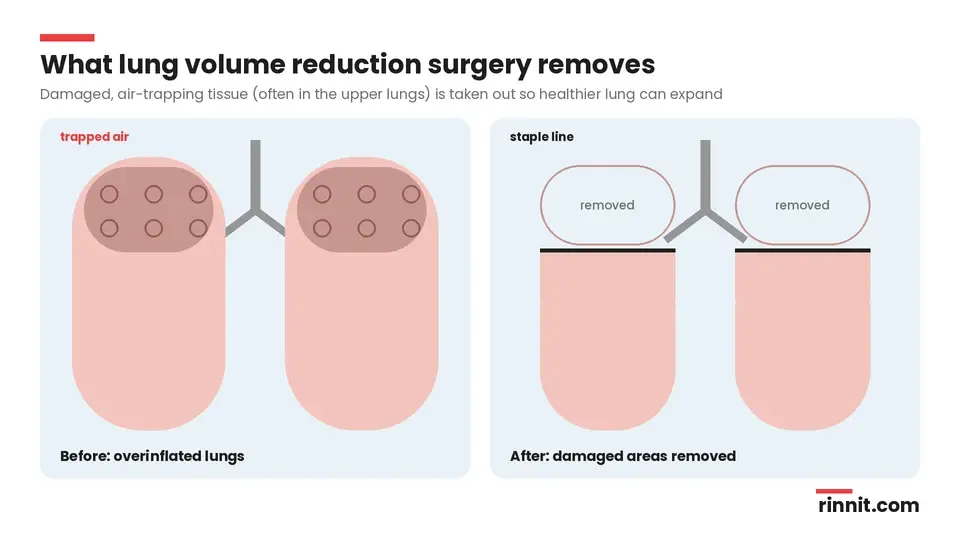
Lung volume reduction surgery is a surgical procedure that removes parts of your lungs that are damaged and trapping air. Making your lungs smaller allows air to reach the healthy parts, so more oxygen can get into your bloodstream and on to your tissues. [1]
Doctors recommend LVRS to relieve symptoms in certain people with severe emphysema, a type of chronic obstructive pulmonary disease (COPD) that can trap air in pockets in the lungs. [1]
LVRS is only an option after you've quit smoking and when medicines and pulmonary rehabilitation aren't relieving your symptoms. It isn't a cure for COPD and extends life only in some carefully selected people; the main goal is to help you feel better and improve your quality of life. [1]
Who qualifies for lung volume reduction surgery?
Studies suggest only certain people benefit from LVRS. You might be eligible if you: [1]
Are younger than 75
Have severe shortness of breath (dyspnea), even with medicines and pulmonary rehabilitation
Have the most damage in the upper area of your lungs (the apex), with less damage elsewhere
Have overinflated lungs with evidence of severe air trapping
Don't currently smoke and haven't smoked for four months or longer
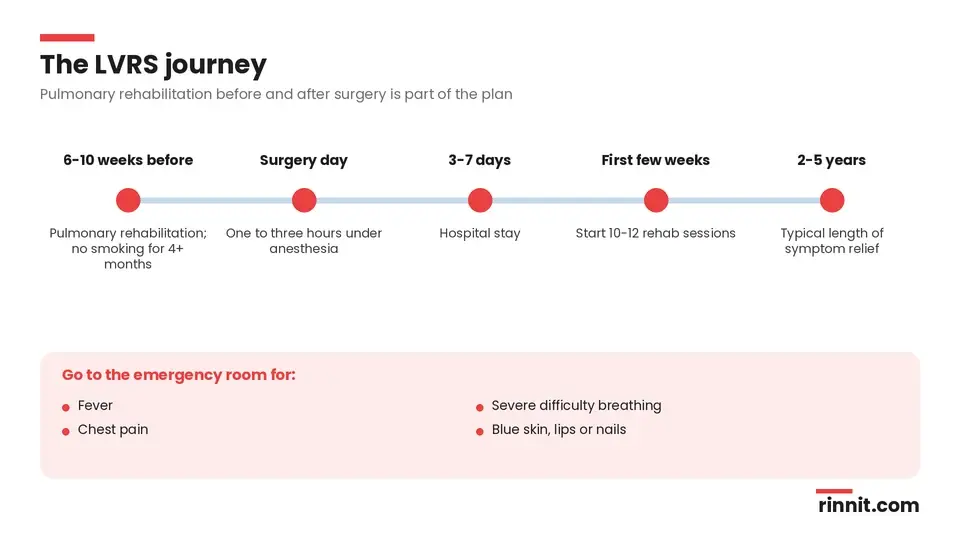
Are able to complete six to 10 weeks of pulmonary rehabilitation before surgery and 10 to 12 sessions after
Tests before lung volume reduction surgery
Test | What it tells your doctor |
Chest X-ray and high-resolution CT scan | Whether a large amount of air is trapped and where the damage is worst |
Pulmonary function tests | LVRS may be more likely to help if your FEV1 (forced expiratory volume in one second) is under 45% on spirometry |
Exercise tests | A cardiopulmonary exercise test and six-minute walk test show how much exercise you can tolerate |
Lung diffusion test (DLCO) | Your doctor may want your DLCO to be above 20% of the predicted value |
Heart tests | An EKG, echocardiogram and stress test show how well your heart is working |
V/Q scan and arterial blood gas tests | Extra information about how well your respiratory system is working |
Sources: [1]
What are the types of lung volume reduction?
To reduce lung volume, a surgeon can remove the damaged parts of your lung through incisions in your chest, or a provider can use special valves that let air escape instead of getting trapped. Your surgeon will evaluate your situation to choose the best approach. [1]
Approach | How it's done | Key point |
Thoracoscopy (VATS) | Three to five small cuts on both sides of the chest between the ribs; a videoscope lets the surgeon see the lungs | Less invasive than a sternotomy |
Median sternotomy | A cut through the breastbone opens the chest | Both lungs are reached through one incision, but recovery is usually slower and more painful than after thoracoscopy |
Bronchoscopic lung volume reduction | Special valves let trapped air escape | Doesn't remove lung tissue |
Sources: [1]
This guide focuses on surgery that removes lung tissue. For the valve option, read our full guide to bronchoscopic lung volume reduction (BLVR).
How do you prepare for lung volume reduction surgery?
Following your provider's instructions closely can lower your risk of complications. Before LVRS, you may be asked to: [1]
Not eat anything for eight hours before the procedure
Stop certain medicines or change your medicine schedule
Arrange for someone to drive you home after a few days in the hospital
Tell your provider about every medicine you take, including over-the-counter medicines and herbal supplements. [1]
What happens during lung volume reduction surgery?
Just before the procedure, you'll be positioned on your back or your side and given anesthesia that keeps you asleep. During a sternotomy or VATS, your surgeon will: [1]
Make incisions either in the middle of your chest (sternotomy) or between your ribs (VATS).
Use a surgical stapler to remove sections of your lungs. This separates the damaged section and creates a reinforced (buttressed) closure along the healthy lung.
Place tubes to drain fluid from your lungs.
Close the incisions and cover them with a surgical dressing.

Depending on the type of procedure, LVRS takes one to three hours. A team of healthcare providers monitors you until you're awake, and you recover in the hospital for several days. [1]
What are the benefits and risks of lung volume reduction surgery?
Benefits
Better quality of life
Improved lung function
Less shortness of breath
Better ability to exercise
Improved breathing mechanics
Less pressure on your diaphragm
Sources: [1]
Risks
Providers follow procedures to minimize complications, but all surgery carries risks. Complications of LVRS include: [1]
Reactions to anesthesia
Collapsed lung (pneumothorax)
Air leaking along the closure (suture) line
Pneumonia or other infections
Heart attack (myocardial infarction)
Any lung surgery is serious. The death rate from LVRS is 3% to 5%. [1]
What is recovery like after lung volume reduction surgery?
Expect to stay in the hospital for three to seven days after LVRS. You'll start pulmonary rehabilitation within the first few weeks after surgery. [1]
To take care of yourself after LVRS: [1]
Follow your provider's directions on when to rest and when to return to physical activity.
Go to all of your follow-up appointments.
Attend all recommended pulmonary rehabilitation (physical therapy) sessions.
Contact your provider with any questions.
How successful is lung volume reduction surgery?
LVRS relieves symptoms and improves quality of life in about half of the people who have it. Because it isn't a cure for emphysema, success means whether you feel better after surgery. Symptom relief usually lasts two to five years. [1]
For most people LVRS doesn't change life expectancy, though it can improve survival in some carefully selected patients, and many feel better with a better quality of life. [1]
Lung volume reduction surgery at a glance
Item | Typical detail |
Anesthesia | General (you're asleep) |
Operating time | One to three hours |
Hospital stay | Three to seven days |
Pulmonary rehabilitation | Six to 10 weeks before surgery and 10 to 12 sessions after |
Who benefits | About half of people who have it |
How long relief lasts | Usually two to five years |
Death rate | 3% to 5% |
Sources: [1]
When should you go to the emergency room after LVRS?
Call your provider with any questions or concerns before or after surgery. Go to the emergency room right away if you have signs of an infection, a collapsed lung or another serious complication, including: [1]
Fever
Chest pain
Severe difficulty breathing
Blue skin, lips or nails (cyanosis)
Conclusion
Lung volume reduction surgery removes damaged, air-trapping lung tissue so the healthier parts of the lungs can work better. For carefully selected people with severe emphysema, it can mean less shortness of breath, more energy for exercise and a better quality of life for several years.
LVRS isn't a cure and carries real risks, so it's a decision worth making with full information. If your provider recommends it, ask about the benefits and risks for you, and make sure you also feel it's the right fit.
Keep learning: Read our guides to COPD and bronchoscopic lung volume reduction (BLVR). For more, see the American Lung Association's overview of lung volume reduction surgery.
FAQ
What is lung volume reduction surgery?
It's surgery that removes damaged, air-trapping parts of the lungs in severe emphysema so the healthier lung can work better.
Who is a candidate for LVRS?
People younger than 75 with severe shortness of breath despite treatment, damage mostly in the upper lungs, overinflated lungs, no smoking for at least four months and the ability to complete pulmonary rehabilitation.
What is the difference between LVRS and bronchoscopic lung volume reduction?
LVRS removes damaged lung tissue through chest incisions, while bronchoscopic lung volume reduction uses special valves that let trapped air escape.
How long does lung volume reduction surgery take?
It takes one to three hours, depending on the type of procedure.
How long will I be in the hospital after LVRS?
Most people stay in the hospital for three to seven days.
How successful is lung volume reduction surgery?
About half of people get symptom relief and a better quality of life, and relief usually lasts two to five years.
Does LVRS cure emphysema or extend life expectancy?
No, it isn't a cure. It improves survival only in some carefully selected people, but it may help you feel better.
What are the risks of lung volume reduction surgery?
Risks include anesthesia reactions, a collapsed lung, air leaks along the staple line, pneumonia or other infections and heart attack. The death rate is 3% to 5%.
Do I need pulmonary rehabilitation for LVRS?
Yes. Candidates complete six to 10 weeks of pulmonary rehabilitation before surgery and 10 to 12 sessions after.
When should I go to the ER after LVRS?
Go right away for fever, chest pain, severe difficulty breathing, or blue skin, lips or nails.
How do I prepare for lung volume reduction surgery?
Tell your provider about every medicine you take, including over-the-counter medicines and herbal supplements. You may be asked not to eat for eight hours before the procedure, to stop certain medicines or change your medicine schedule, and to arrange a ride home after a few days in the hospital [1].
Does lung volume reduction surgery hurt, and what anesthesia is used?
You are given anesthesia that keeps you asleep during LVRS, so you do not feel the operation, and a team monitors you until you are awake. You then recover in the hospital for three to seven days [1].
Related Reading
Learn more in our guide to What Is Chronic Obstructive Pulmonary Disease (COPD)? Symptoms, Causes, Stages, and Treatment.
Learn more in our guide to Bronchoscopic Lung Volume Reduction (BLVR): Procedure, Benefits, and Recovery.
References
Cleveland Clinic. Lung Volume Reduction Surgery (LVRS): Risks & Results. Cleveland Clinic. Last updated April 22, 2024. https://my.clevelandclinic.org/health/procedures/13794-lung-volume-reduction-surgery-lvrs
Fishman A, Martinez F, Naunheim K, et al. A randomized trial comparing lung-volume-reduction surgery with medical therapy for severe emphysema. N Engl J Med. 2003;348(21):2059-73. PMID 12759479. https://doi.org/10.1056/NEJMoa030287
van Agteren JE, Carson KV, Tiong LU, Smith BJ. Lung volume reduction surgery for diffuse emphysema. Cochrane Database Syst Rev. 2016;10(10):CD001001. PMID 27739074. https://doi.org/10.1002/14651858.CD001001.pub3
Medical disclaimer
This article is for general education only and does not replace advice from a qualified healthcare professional. Talk to your doctor about your own diagnosis and treatment, and seek emergency care right away for severe or sudden symptoms.



Comments