Transcranial Magnetic Stimulation (TMS): How It Works, Who It Helps, and What to Expect

Updated: 6 days ago
Written and medically reviewed by Dr. Baraa Alnahhal, MD · Last reviewed: October 2026 · How we review
Quick Answer: What is transcranial magnetic stimulation (TMS)?
Transcranial magnetic stimulation (TMS) is a noninvasive, pain-free treatment that uses magnetic pulses from a coil on the scalp to change activity in specific brain areas. It is FDA-cleared for major depression, OCD, migraine with aura and short-term smoking cessation, needs no anesthesia, and usually causes only mild headache or scalp discomfort; seizures are very rare. [1]
What the research says
Short theta-burst sessions work as well as standard TMS for depression. In a trial of 414 adults with treatment-resistant depression, 3-minute theta-burst sessions lowered depression scores as much as 37.5-minute standard sessions (both groups fell from about 23.5 to 13.4 points), with similar dropout rates (8% vs 6%). Headache was the most common side effect in both groups (about 65%). (Blumberger et al., Lancet, 2018) [2]
Deep TMS eased OCD symptoms more than a sham treatment. Among 99 people with OCD treated daily for 6 weeks at 11 centers, 38.1% responded to active deep TMS versus 11.1% with sham; one month later, response rates were 45.2% versus 17.8%. (Carmi et al., Am J Psychiatry, 2019) [3]
An accelerated 5-day protocol cut depression scores by about half. In 29 people with treatment-resistant depression, depression scores dropped by an average of 52.5% four weeks after active accelerated treatment, compared with 11.1% after sham. (Cole et al., Am J Psychiatry, 2022) [4]
Key takeaways
TMS sends magnetic pulses through the skull to wake up underactive brain areas or calm overactive ones. [1]
It is usually offered when medicines or therapy have not helped enough. [1]
Sessions last about 3 to 40 minutes, typically 5 days a week for 4 to 6 weeks. [1]
You stay awake, need no anesthesia, and can return to your day right after. [1]
Metal implants in the head or neck and a history of seizures can rule TMS out. [1]

How does transcranial magnetic stimulation work?
Transcranial magnetic stimulation works by placing a small coil on your head that sends magnetic pulses into the brain. [1]
The pulses pass through the skull painlessly. They create tiny electrical signals in the nerve cells underneath. [1]
The pulse pattern decides the effect. Some patterns help wake up underactive areas, while others calm overactive ones. [1]
What conditions can TMS treat?
TMS is cleared in the United States for four conditions: major depression, OCD, migraine with aura and short-term smoking cessation. [1] Each uses a specific device or protocol.
Condition | Status | How TMS is used |
Major depressive disorder (including treatment-resistant depression) | FDA-cleared | Standard, theta-burst, deep and accelerated protocols |
FDA-cleared | Deep TMS with a helmet-like coil | |
FDA-cleared | Handheld single-pulse device for acute migraine pain | |
Quitting smoking | FDA-cleared | A deep TMS protocol for short-term quitting |
Source: [1]
Researchers are also testing TMS for many other conditions. These include Alzheimer's disease, bipolar disorder, chronic pain, fibromyalgia, generalized anxiety disorder, Parkinson's disease, PTSD, schizophrenia, stroke complications, tinnitus and traumatic brain injury. [1] For these, TMS is still experimental.
What are the types of TMS treatment?
The four main types of TMS differ in how the pulses are delivered, how long each session lasts and how deep the stimulation reaches. [1]
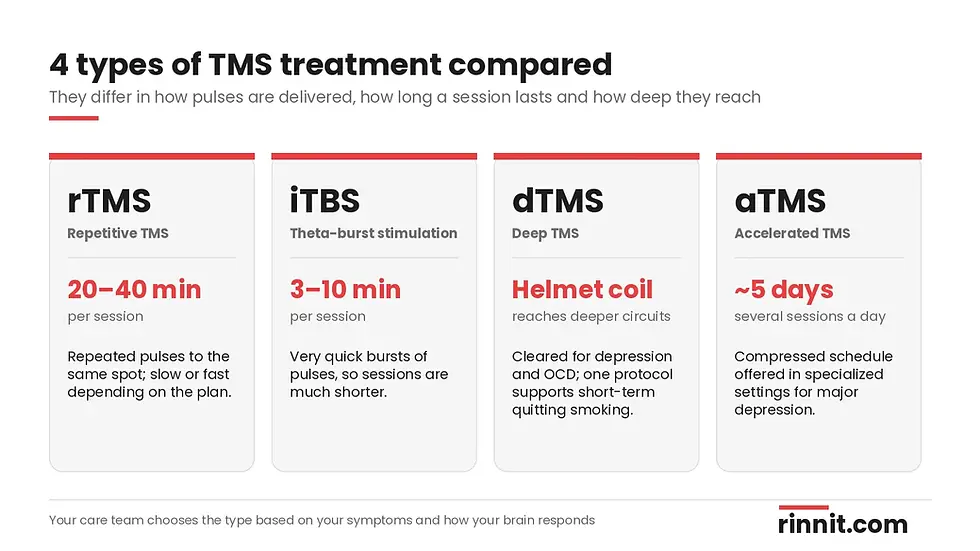
Type | How it works | Session length | Main uses |
Repetitive TMS (rTMS) | Repeated pulses to the same spot, slow or fast | 20–40 minutes | Depression |
Theta-burst stimulation (TBS/iTBS) | Very quick bursts of pulses | About 3–10 minutes | Depression |
Deep TMS (dTMS) | Helmet-like coil reaches deeper brain circuits | Varies by protocol | Depression, OCD, short-term smoking cessation |
Accelerated TMS (aTMS) | Several brief theta-burst sessions a day for about 5 days | Short, repeated daily | Major depression, in specialized settings |
Source: [1]
One well-known accelerated approach is Stanford Neuromodulation Therapy, sometimes called SAINT. In 2025, an accelerated deep TMS protocol for major depression was also cleared. [1]
Who is a good candidate for TMS?
A good candidate for TMS is an adult with depression or OCD who has not had enough relief from medicines or therapy. [1]
TMS gives you another option that avoids anesthesia and surgery. It can also be used alongside your current antidepressants and talk therapy. [1]
Who should not have TMS?
People with metal or electronic implants in the head or neck, or a history of seizures, may not be safe candidates for TMS. [1] The magnet can move metal devices and cause harm.
Situation | Why it matters |
Metal or electronic implants in the head or neck (cochlear implants, metal plates, clips or wires) | The magnet can move these devices |
Non-removable metal near the coil (aneurysm clips or coils, brain stimulators, pacemakers, defibrillators, stents, shrapnel) | Risk of device movement or damage |
History of seizures or epilepsy, or medicines that raise seizure risk | Higher chance of a seizure during treatment |
Hip or knee replacements, dental fillings | Usually safe |
Source: [1]
Your provider will review your medical history and talk through these risks before deciding. They may adjust your medicines or suggest another treatment. [1]
How do you prepare for TMS?
Preparing for TMS starts with a screening visit and exam with your provider. [1]
What happens during a TMS session?
A TMS session follows seven simple steps, from removing metal items to switching off the machine. [1] Steps can vary slightly by clinic and type.

Getting ready: You remove metal items such as jewelry or metal-frame glasses. [1]
Setting up: You sit in a reclining chair, and the coil is placed on your head, either in a helmet or on a positioning arm. [1]
Hearing protection: You wear earplugs or headphones, because the machine makes loud clicking sounds. [1]
Positioning the coil: The coil goes over the exact spot linked to your condition. [1]
Test pulses: A few test pulses set the right strength. You may feel scalp tapping or a hand or thumb twitch, which is normal. [1]
Treatment: The machine delivers repeated pulses with clicking sounds and light tapping. [1]
Finishing: The machine is switched off, the coil is removed and you take out your hearing protection. [1]
How many TMS sessions do you need?
Most people need TMS 5 days a week for 4 to 6 weeks, often about 30 to 36 sessions for depression. [1]
Schedule | Typical length |
Single session | About 3 to 40 minutes, depending on the type |
Standard course | 5 days a week for 4–6 weeks (about 30–36 sessions for depression) |
Accelerated course | Several short sessions a day for about 5 days |
Maintenance | Extra sessions or a short repeat course if symptoms return |
Source: [1]
Many people notice improvement within a couple of weeks. [1] Your provider will set the number of sessions for your diagnosis and device.
What are the benefits of TMS?
The main benefit of TMS is symptom relief without surgery, needles or anesthesia, especially when other treatments have not worked. [1]
Noninvasive: You stay awake and go back to your day after the session. [1]
Good safety record: Most side effects are mild and short-lived. [1]
Symptom relief: Many people improve in depression, OCD or other conditions. [1]
Works with other care: TMS can be combined with medicines and therapy. [1]
Another option: It may suit people who cannot have, or did not benefit from, medicines or electroconvulsive therapy (ECT). [1]
What are the side effects of TMS?
The most common side effects of TMS are headache, scalp discomfort and mild facial twitching. [1] Side effects are usually mild; in one large trial about 2 in 3 people had headaches.
Side effect | How common | What to know |
Headache or scalp discomfort | Common | Usually mild and fades soon after the session |
Mild facial twitching | Common | Happens during pulses and stops afterward |
Memory or thinking problems | Not caused by TMS | TMS does not cause memory loss |
Seizure | Very rare | Most serious risk; higher with a seizure disorder |
Source: [1]
Your provider screens your history and watches you during treatment to keep you safe. [1]
What is recovery like after TMS?
Recovery after TMS is immediate for most people, who return to normal activities right after each session. [1]
If you get a mild headache, your provider may ask you to rest for a few minutes before leaving. These symptoms usually fade quickly. [1]
Conclusion
TMS gives people with hard-to-treat depression, OCD and some other conditions a well-studied option that needs no surgery or anesthesia. Sessions are short, side effects are usually mild, and you can go straight back to your day. The right type and schedule depend on your diagnosis, your medical history and how your brain responds.
Talk to your doctor or psychiatrist if you have been struggling despite treatment and want to know whether TMS fits your situation. To compare your options, read our plain-language guides to antidepressants and OCD treatment.
FAQ
Is TMS painful?
TMS is not painful for most people and does not need anesthesia. You may feel light tapping on the scalp and hear loud clicks during the pulses. [1]
How long does it take for TMS to work?
TMS often starts to help within a couple of weeks of treatment. A full course usually runs 5 days a week for 4 to 6 weeks. [1]
Does TMS cause memory loss?
TMS does not cause memory loss or problems with thinking. The most common side effects are headache, scalp discomfort and mild facial twitching. [1]
What is the difference between TMS and ECT?
TMS uses magnetic pulses while you are fully awake and needs no anesthesia, so you can return to your day after each session. [1] ECT uses a brief, controlled seizure under general anesthesia; read our ECT guide for details.
What conditions is TMS approved for?
TMS is FDA-cleared for major depression, OCD, migraine with aura and short-term smoking cessation. Researchers are studying it for many other conditions. [1]
Can I have TMS if I have metal in my body?
TMS may be unsafe if you have metal or electronic implants in the head or neck, such as cochlear implants, aneurysm clips or brain stimulators. Metal elsewhere, like hip or knee replacements and dental fillings, is usually safe. [1]
Can I drive after a TMS session?
TMS usually lets you return to normal activities right after a session. Your provider may still suggest someone drives you to and from your first appointment. [1]
Can TMS be combined with medication?
TMS often works alongside medicines and therapy, and combining them may improve overall results. [1]
How many TMS sessions will I need?
A typical course for depression involves sessions five days a week for several weeks. Your provider will plan your schedule, and some newer programs give several sessions a day over a shorter time.
Can TMS cause seizures?
Seizures are a rare but serious risk of TMS. Providers screen for seizure risk before treatment, so tell them about any history of seizures or epilepsy.
Related Reading
Electroconvulsive Therapy (ECT): How It Works, What to Expect, and Side Effects explains ECT, another brain stimulation treatment for severe depression.
What Is Clinical Depression (Major Depressive Disorder)? Symptoms, Causes, Diagnosis and Treatment covers major depression, the main condition TMS is used to treat.
Ketamine Therapy: Uses, How It Works and Side Effects describes ketamine treatment for depression that has not responded to other care.
Obsessive-Compulsive Disorder (OCD): Symptoms, Causes & Treatment Guide explains obsessive-compulsive disorder and its treatment options.
References
Cleveland Clinic. Transcranial Magnetic Stimulation (TMS). Cleveland Clinic. Last updated January 29, 2026. https://my.clevelandclinic.org/health/treatments/17827-transcranial-magnetic-stimulation-tms
Blumberger DM, Vila-Rodriguez F, Thorpe KE, et al. Effectiveness of theta burst versus high-frequency repetitive transcranial magnetic stimulation in patients with depression (THREE-D): a randomised non-inferiority trial. Lancet. 2018;391(10131):1683-1692. PMID 29726344. https://doi.org/10.1016/S0140-6736(18)30295-2
Carmi L, Tendler A, Bystritsky A, et al. Efficacy and Safety of Deep Transcranial Magnetic Stimulation for Obsessive-Compulsive Disorder: A Prospective Multicenter Randomized Double-Blind Placebo-Controlled Trial. Am J Psychiatry. 2019;176(11):931-938. PMID 31109199. https://doi.org/10.1176/appi.ajp.2019.18101180
Cole EJ, Phillips AL, Bentzley BS, et al. Stanford Neuromodulation Therapy (SNT): A Double-Blind Randomized Controlled Trial. Am J Psychiatry. 2022;179(2):132-141. PMID 34711062. https://doi.org/10.1176/appi.ajp.2021.20101429
Medical disclaimer
This article is for general education only and does not replace advice, diagnosis or treatment from a qualified healthcare professional. Always talk to your doctor before starting, stopping or changing any treatment. If you have thoughts of harming yourself, contact your local emergency number or a crisis line right away.



Comments