Tracheomalacia: Symptoms, Causes, Diagnosis and Treatment — What You Need to Know

Updated: 2 days ago
Medically reviewed by Dr. Baraa Alnahhal, MD · Last reviewed: October 17, 2026
Editorial note: This article is provided for educational purposes only. It is not medical advice. Always consult a qualified healthcare professional for diagnosis and treatment of any condition.
Quick Answer: What is tracheomalacia and how is it treated?
Tracheomalacia is the collapse of the trachea, or windpipe, most often in babies, when the cartilage rings holding the airway open are too soft during breathing [1]. Mild cases may need no treatment and often improve as the child grows, typically by about age 2 [2]. Serious cases affecting breathing or feeding can be treated with medicines, chest physical therapy or surgery [2].
What the research says
Surgery improves symptoms in most children who need it. In a series of 143 children operated on for tracheobronchomalacia since 2012 (132 aortopexies and 18 posterior tracheopexies; seven children needed both), clinical improvement was seen in 89.1% after aortopexy and 93.8% after posterior tracheopexy. Symptoms resolved completely in 54.6% and 50%, and complications occurred in 18.9% and 16.7% (Lena et al., Journal of Pediatric Surgery, 2025) [3].
Tracheomalacia is very common after esophageal atresia, and early surgery may reduce infections. Tracheomalacia is reported in up to 87% of children with esophageal atresia, and about 30% develop severe disease. In a single-center group of 38 such children, respiratory infections occurred in 25% of the 14 who had a posterior tracheopexy during their repair versus 61% of historical comparisons (p = 0.004). A multicenter randomized trial in 78 newborns is now testing this approach (Lindeboom et al., Journal of Pediatric Surgery, 2026) [4].
When should you get emergency care for a child with tracheomalacia?
Tracheomalacia can be life-threatening when severe, so parents need to know which warning signs call for emergency care right away. Seek emergency care immediately if your child:
Warning sign | What it means |
Trouble breathing and can't speak or cry [1] | The airway may be collapsing — this is an emergency |
Can't breathe easily and ribs seem to suck inward when breathing in [1] | The chest is working hard to pull air through a collapsing windpipe |
Short stops in breathing [1] | Low oxygen can build up quickly |
Blue or gray skin, lips, or fingernails [1] | A sign of low oxygen levels; depending on skin color, these changes may be harder or easier to see |
Seems slow moving, weak, or very tired [1] | May signal that the body is not getting enough oxygen |
What Is Tracheomalacia?
Tracheomalacia (tray-key-oh-muh-LAY-shuh) is the collapse or falling in of the trachea. The trachea, also called the windpipe, is the tube that brings air from the mouth and nose to the lungs [1].
Firm rings made of cartilage hold the windpipe open during breathing. Tracheomalacia occurs most often in babies, when the cartilage in the windpipe has not developed as it should. This soft cartilage makes the windpipe floppy, so it is not stiff enough to keep the airway open [1].
Another cause is when a blood vessel presses on the windpipe so that it can't open enough with breathing. Less often, tracheomalacia affects older children and adults [1].

Tracheomalacia can be life-threatening and make it difficult to breathe. Trouble breathing can make it hard to be active. Also, the collapse can cause repeated airway and lung infections [1].
Your child may not need treatment if tracheomalacia symptoms are mild. Symptoms sometimes improve on their own as a child grows and the windpipe gets stronger. If symptoms are more serious and limit a child's quality of life, medicine, therapy and surgery can help [1].
Tracheomalacia may affect the whole windpipe or only a small section. When tracheomalacia includes the airways in the lungs, also known as the bronchi, it's called tracheobronchomalacia (tray-key-oh-brong-koh-muh-LAY-shuh) [1]. Our guide to Understanding Tracheobronchomalacia (TBM) covers this form in more detail.
What Does Tracheomalacia Look and Sound Like?
Symptoms can range from mild to severe. Symptoms may be seen at birth, but they may be mild and not noticed until an infant is about 4 to 8 weeks old [1]. Symptoms may get worse when a child is eating [1].
Symptom | What to watch for |
Frequent coughing | The cough may sound like a barking seal [1] |
Noisy breathing | High-pitched wheezing or rattling sounds [1] |
Trouble getting enough air | Gets worse with crying, coughing, eating or activity [1] |
Trouble clearing mucus | Mucus gets stuck in the airway [1] |
Frequent airway infections | Such as pneumonia or bronchitis [1] |
Trouble swallowing or eating | May include choking during feeds [1] |
Shortness of breath when active | For example, playing with other children or playing sports |

What Causes Tracheomalacia?
Tracheomalacia has four main causes, each related to how the windpipe is supported or how something presses on it.
Cause | How it leads to tracheomalacia |
A trachea that is not fully developed | In newborns, the cartilage may not be developed enough. The soft cartilage causes the windpipe to be floppy, and it doesn't stay open when breathing [1] |
Changes in how the trachea develops | In some infants the trachea doesn't develop in the typical way — it might not have enough cartilage, and some infants are born with an opening between the esophagus and the trachea [1] |
Pressure on the trachea from a blood vessel | A blood vessel, such as the aorta or the main branches of the aorta, may press on the windpipe so it doesn't open enough with breathing [1] |
Damage to the trachea from injury or illness | The windpipe can be damaged from surgery, medical procedures, or having a breathing tube for a long time; illnesses include COPD, GERD and frequent lung infections [1] |
What Increases the Risk?
Risk factors for tracheomalacia include being born too early, when the windpipe may not be fully developed and the cartilage is not strong enough to hold the airway open [1]. Differences in the main blood vessels that bring blood from the heart to the rest of the body increase risk because pressure on the windpipe from these vessels is a known cause [1].
Being born with a passage between the trachea and the esophagus — an opening called a tracheoesophageal fistula — also increases risk [1]. Injury to the windpipe from surgery, medical procedures or a long-term breathing tube can injure it so that it collapses with breathing. And illnesses that affect the windpipe, such as frequent airway and lung infections (bronchitis and pneumonia) and GERD, can irritate and weaken it [1].
Related reading: See our guides to Premature Birth: Complete Guide to Signs, Causes, and Care, Double Aortic Arch: The Most Symptomatic Vascular Ring - Symptoms, Surgery, Recovery and Outlook, Acid Reflux & GERD: Symptoms, Causes, Diagnosis, and Treatment, Pneumonia: Complete Guide to Symptoms, Causes, and Treatment, Croup: The Barking Cough, Symptoms, Causes, Home Care and When to Go to the ER — What Parents Need to Know and Allergic Asthma: The Breathing Condition Triggered by the Air Around You.
Why Tracheomalacia Can Be Dangerous
Tracheomalacia can be life-threatening if severe. It can result in low oxygen in the body; blue or gray skin color due to low oxygen levels — depending on skin color, these changes may be harder or easier to see; short stops in breathing; choking during eating; losing weight or not gaining enough weight; breathing trouble with activity; and severe and frequent lung infections [1].
Infants born with tracheomalacia may have other conditions at birth, including changes in the development of the heart, lungs or esophagus [1].
How Is Tracheomalacia Diagnosed?
To diagnose tracheomalacia, a healthcare professional talks with you about symptoms and other health conditions. The professional also does a physical exam, which includes listening to the chest with a stethoscope [2].
One or more of these tests may be needed:
Test | What it shows |
Chest X-ray | Pictures of the airway and lungs; sometimes the chest X-ray does not show any changes [2] |
CT scan of the chest | Combines a series of X-ray images to create 3D pictures of the airway and lungs; images can show what happens to the windpipe during breathing [2] |
Laryngoscopy | A tool with a light is used to look at the back of the throat and voice box (larynx) [2] |
Bronchoscopy | A thin tube with a camera is passed through the nose or mouth, down the throat, through the windpipe and into the lungs; a sedative is given so the child relaxes and doesn't feel or remember the procedure [2] |
Upper endoscopy | A thin tube with a camera is passed into the esophagus; a sedative is given [2] |
Lung function tests | Also called pulmonary function tests; they find out how well the lungs are working [2] |
Tracheomalacia sometimes occurs along with other conditions. Other tests or a referral to other specialists may be needed — for example, a specialist for changes in the heart, digestive system, or growth and development [2].
How Is Tracheomalacia Treated?
Treatment of tracheomalacia can vary depending on how severe symptoms are. Multiple specialists may work together with you to decide on the best treatment options [2]. In some infants, symptoms improve as the child grows. By about age 2 years, the windpipe gets stronger, so symptoms may get better [2].
When needed, treatment may include medicine, therapy and surgery.
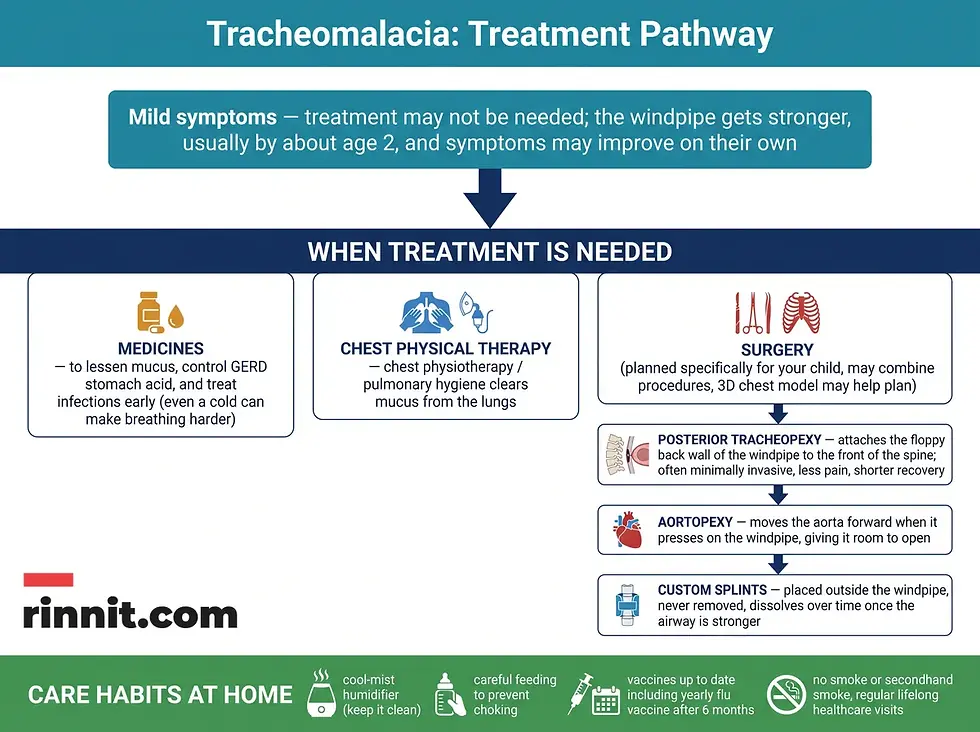
Medicines
Your healthcare professional may recommend medicine to lessen mucus, because mucus can clog the windpipe and make breathing harder, and medicines that cause the body to make less mucus can help make breathing easier [2]. Medicines can also control GERD — these help control stomach acid and keep it from irritating the windpipe [2]. Finally, medicines treat infections: even minor airway infections, such as a cold, can make breathing more difficult, so treating airway infections as soon as possible can help [2].
Therapy
Therapy includes chest physical therapy, also called chest physiotherapy or pulmonary hygiene. This therapy can help clear mucus from the lungs [2].
Surgery
Sometimes children need surgery to treat tracheomalacia. The type of surgery depends on the cause and how severe the symptoms are [2]. A plan for surgery is designed specifically for your child and may involve a combination of procedures. The healthcare team may create a 3D model of your child's chest organs to help plan for surgery [2].
Surgery option | How it works |
Posterior tracheopexy | Attaches the floppy back wall of the windpipe to the front of the spine for support, preventing collapse; often done with minimally invasive techniques through tiny cuts in the skin, which result in less pain and shorter recovery time than open surgery [2] |
Aortopexy | If the aorta is pushing on the front of the windpipe, this surgery moves the aorta forward, giving the windpipe more room to open; often minimally invasive; if the aorta pushes on the back of the windpipe, the procedure is called posterior descending aortopexy [2] |
Custom splints | A splint made to fit properly is placed on the outside of the windpipe to prevent collapse; it keeps the windpipe open, does not need to be removed, and dissolves over time after the airway is stronger [2] |
What Can Parents Do at Home?
Parents can help a child with tracheomalacia at home by using a humidifier, taking care with feeding, keeping vaccinations up to date, avoiding smoke and keeping regular healthcare visits.
Use a humidifier. If the air in your child's room is dry, a cool-mist humidifier or vaporizer can moisten the air. This may help loosen mucus and lessen coughing. Be sure to keep the humidifier clean so that bacteria and mold don't grow in the machine [2].
Take care with feeding so choking doesn't happen. Talk with a doctor or other healthcare professional, such as a dietitian, for advice if your child chokes when eating, is losing weight or is not gaining enough weight [2].
Keep vaccinations up to date. Any airway or lung illness can be more severe for someone with tracheomalacia. Get the usual childhood vaccines. Also get the flu vaccine every year for children over 6 months of age [2], plus any other vaccines your healthcare professional recommends. Stay away from people with colds or flu [2].
Stay away from smoke. Don't smoke, and stay away from secondhand smoke. Talk with your healthcare professional if you smoke and need help quitting [2].
Get regular healthcare visits. Lifelong care with regular healthcare visits is important to find issues early and adjust treatment as needed [2].
When should you see a doctor about tracheomalacia?
If you have concerns about your child's growth and development, talk with your healthcare professional. Make an appointment if your child has trouble with breathing, such as making high-pitched wheezing or grunting noises when breathing; trouble with choking when eating; or lost weight or is not gaining enough weight [1].
Go to the emergency room at a hospital if your child has trouble breathing and can't speak or cry; can't breathe easily and the ribs seem to suck inward when breathing in; has short stops in breathing; has blue or gray skin, lips and fingernails due to low oxygen levels (depending on skin color, these changes may be harder or easier to see); or seems slow moving, weak or very tired [1].
How can families cope with tracheomalacia and find support?
If your child is diagnosed with tracheomalacia, your family may face some challenges. Three supports are recommended: learn about tracheomalacia, which helps you know what to expect and what treatment options can help; find support, since talking openly about how you feel can help, as can talking with others dealing with the same issues; and talk with a healthcare or mental health professional about your feelings and coping strategies [2].
How should you prepare for a first tracheomalacia appointment?
Symptoms of tracheomalacia may be found at birth, or you may first bring up the concerns with a healthcare professional. After an exam, your child may be referred to one or more specialists for testing and treatment. You may want to ask a trusted family member or friend to join you for the appointment to offer emotional support and help you remember all the information you get [2].
Before your appointment, make a list of any symptoms your child has and how long your child has had them; key medical information, including other health or developmental concerns; all medicines, vitamins, herbs and other supplements your child takes, including doses; information about your family history; and questions to ask the healthcare professional [2].
Questions you may want to ask include: What likely is causing the symptoms? Are there any other possible causes for these symptoms? What tests does my child need? Should my child see a specialist? What treatment do you recommend? What are options other than the treatment you're recommending? Are there print materials or websites that you'd suggest to help me learn more?
A healthcare professional is likely to ask you: What are the symptoms? When did you first notice these symptoms? How severe are the symptoms? What, if anything, makes these symptoms worse? What, if anything, makes these symptoms better? Being ready to answer gives you time to talk about what's most important to you [2].
Key Takeaways
Tracheomalacia is a floppy-windpipe condition that most often affects babies and usually traces back to soft, underdeveloped cartilage — though a pressing blood vessel or injury can also be the cause. The barking-seal cough, noisy breathing, and feeding or weight problems are the signs to act on, and mild cases often resolve as the windpipe strengthens by about age 2. If your child shows any of the warning signs in this article — especially breathing pauses, ribs sucking inward, or blue or gray coloring of the skin, lips or fingernails — treat it as an emergency. Talk to your child's healthcare team about the right mix of medicines, therapy and, when needed, surgery.
Next step: If you've noticed any of the symptoms described here, don't wait for your next routine visit — schedule an appointment with your child's healthcare professional today. For urgent breathing trouble, go to the nearest emergency room.
Frequently Asked Questions
1. What is tracheomalacia in simple terms?
Tracheomalacia means the windpipe (trachea) collapses or falls inward during breathing. The windpipe is normally held open by firm cartilage rings; when that cartilage is too soft or floppy — most often in babies — the airway can't stay open.
2. Is tracheomalacia common?
It is uncommon. It is seen most often in babies, especially those born early or with other airway or heart conditions.
3. What does a tracheomalacia cough sound like?
It is a cough that may sound like a barking seal, often occurring together with noisy, high-pitched wheezing or rattling breathing sounds.
4. When do symptoms of tracheomalacia first appear?
Symptoms may be seen at birth, but they may be mild and not noticed until an infant is about 4 to 8 weeks old. They may get worse when a child is eating.
5. Does tracheomalacia go away on its own?
Often, yes. Symptoms sometimes improve on their own as a child grows and the windpipe gets stronger, and by about age 2 years the windpipe typically strengthens enough that symptoms may get better. Mild cases may not need any treatment at all.
6. Is tracheomalacia life-threatening?
It can be, if severe. Complications include low oxygen in the body, blue or gray skin coloring, short stops in breathing, choking during eating, weight loss or poor weight gain, breathing trouble with activity, and severe and frequent lung infections. Severe cases need prompt treatment, and certain signs — such as breathing pauses or blue or gray coloring — require emergency care right away.
7. What causes a baby's windpipe to be floppy?
There are four main causes: cartilage that did not fully develop in a newborn; unusual development of the trachea, including being born with an opening between the esophagus and the trachea; a blood vessel (such as the aorta) pressing on the windpipe; and damage from surgery, medical procedures, a long-term breathing tube, or illnesses like COPD, GERD and frequent lung infections.
8. Does tracheomalacia affect boys more than girls?
No clear difference between boys and girls has been shown. It can affect any child.
9. What is tracheobronchomalacia?
Tracheomalacia may affect the whole windpipe or only a small section. When it includes the airways in the lungs — the bronchi — it is called tracheobronchomalacia.
10. Can tracheomalacia be present without symptoms at birth?
Yes. Symptoms may be mild and not noticed until an infant is about 4 to 8 weeks old, and infants born with tracheomalacia may have other conditions at birth involving the heart, lungs or esophagus.
11. How is tracheomalacia diagnosed? Is there a single test?
There is no single test. Diagnosis starts with a symptom discussion and physical exam (including listening to the chest with a stethoscope), followed by one or more tests: chest X-ray, chest CT scan, laryngoscopy, bronchoscopy, upper endoscopy, and lung function tests. A chest X-ray sometimes shows no changes at all.
12. Does a chest X-ray always show tracheomalacia?
No. Sometimes the chest X-ray does not show any changes. A chest CT scan can show what happens to the windpipe during breathing, and bronchoscopy lets a camera look at the windpipe and lungs during breathing.
13. What medicines are used for tracheomalacia?
Medicines are used for three main purposes: medicines that lessen mucus so the windpipe is less clogged; medicines that control GERD so stomach acid does not irritate the windpipe; and medicines that treat infections quickly, because even a cold can make breathing more difficult.
14. What is chest physical therapy for tracheomalacia?
Also called chest physiotherapy or pulmonary hygiene, this therapy helps clear mucus from the lungs, which matters because mucus can clog the floppy windpipe and make breathing harder.
15. What surgeries treat tracheomalacia?
Three options are described: posterior tracheopexy (attaching the floppy back wall of the windpipe to the front of the spine for support), aortopexy (moving the aorta forward when it presses on the windpipe, giving it more room to open), and custom splints placed on the outside of the windpipe that dissolve over time once the airway is stronger. Several can be done minimally invasively, with less pain and shorter recovery.
16. Do tracheomalacia splints need to be removed?
No. The splint does not need to be removed — it dissolves over time after the airway is stronger.
17. Should a child with tracheomalacia get vaccinated?
Yes. Keep vaccinations up to date, because any airway or lung illness can be more severe for someone with tracheomalacia. This includes the usual childhood vaccines, the yearly flu vaccine for children over 6 months of age, and any other vaccines a healthcare professional recommends.
18. Can secondhand smoke affect tracheomalacia?
Stay away from smoke entirely: don't smoke, avoid secondhand smoke, and talk with a healthcare professional if you smoke and need help quitting.
19. When should I take my child to the emergency room?
Go to the emergency room if your child has trouble breathing and can't speak or cry; can't breathe easily and the ribs seem to suck inward when breathing in; has short stops in breathing; has blue or gray skin, lips and fingernails due to low oxygen levels (depending on skin color, these changes may be harder or easier to see); or seems slow moving, weak or very tired.
20. What questions should I ask at my child's first appointment?
Consider asking: what is likely causing the symptoms, are there other possible causes, what tests does my child need, should my child see a specialist, what treatment is recommended, what are the alternatives, and are there print materials or websites to help me learn more. Bring a list of symptoms, medical information, medicines and doses, and family history, and consider bringing a trusted friend or family member.
Related Reading
References
Mayo Clinic Staff. Tracheomalacia - Symptoms and causes. Mayo Clinic. August 15, 2025. https://www.mayoclinic.org/diseases-conditions/tracheomalacia/symptoms-causes/syc-20587222
Mayo Clinic Staff. Tracheomalacia - Diagnosis and treatment. Mayo Clinic. August 15, 2025. https://www.mayoclinic.org/diseases-conditions/tracheomalacia/diagnosis-treatment/drc-20587240
Lena F, Santoro F, Ribera E, et al. Surgical management of tracheobronchomalacia in children: indications, results and techniques based on a large case. Journal of Pediatric Surgery. 2025;60(9):162415. PMID 40513654. https://doi.org/10.1016/j.jpedsurg.2025.162415
Lindeboom MYA, Bittermann AJN, Tytgat SHAJ. Primary posterior tracheopexy in esophageal atresia with tracheomalacia: from innovation to multicenter RCT. Journal of Pediatric Surgery. 2026;61(2):162608. PMID 40885378. https://doi.org/10.1016/j.jpedsurg.2025.162608



Comments