TNF Inhibitors: Uses, Types, Side Effects and What to Expect

Updated: 6 days ago
Written and medically reviewed by Dr. Baraa Alnahhal, MD · Last reviewed: October 2026 · How we review
Quick Answer: What are TNF inhibitors?
TNF inhibitors are biologic medicines that block tumor necrosis factor alpha, a protein that drives chronic inflammation. They treat rheumatoid arthritis, psoriatic arthritis, ankylosing spondylitis, psoriasis, Crohn's disease, ulcerative colitis and uveitis. You take them by self-injection under the skin or by IV infusion. Because they weaken immune defenses, they raise infection risk. [1]
What the research says
Anti-TNF drugs help Crohn's disease stay in remission. A review of 27 placebo-controlled trials of biologic therapy found anti-TNF antibodies cut the risk of relapse in Crohn's disease that was already calm by about 29% (relative risk 0.71). Infliximab also helped bring moderate to severe ulcerative colitis into remission (relative risk of no remission 0.72). (Ford et al., Am J Gastroenterol, 2011) [2]
The infection risk is real and measurable. Across 71 randomized trials with 22,760 adults with rheumatoid arthritis, psoriatic arthritis or ankylosing spondylitis, anti-TNF drugs raised the rate of any infection by 20%, serious infections by 40% and tuberculosis by 250% compared with placebo or no treatment. (Minozzi et al., Expert Opin Drug Saf, 2016) [3]
Heart risk looks lower than with older standard DMARDs. In 14 observational studies of people with rheumatoid arthritis, conventional DMARDs including methotrexate carried 45% higher odds of major heart and blood vessel events than TNF inhibitors (odds ratio 1.45). Across 11 cohorts with 135,053 patients, stroke odds were also higher with conventional DMARDs (odds ratio 1.17). (Singh et al., Arthritis Care Res, 2020) [4]
Key takeaways
TNF inhibitors block TNF alpha, a chemical messenger that switches on inflammation in certain immune disorders.
They are approved for inflammatory arthritis, psoriasis, hidradenitis suppurativa, Crohn's disease, ulcerative colitis and uveitis.
Five main drugs are in use: infliximab, adalimumab, etanercept, certolizumab pegol and golimumab, plus many biosimilars.
You take them by injection under the skin (weekly to monthly) or by IV infusion (every 1 to 2 months).
The main downside is a weaker defense against infections. Some people also stop responding over time.
What are TNF inhibitors?
TNF inhibitors are medications that treat autoimmune and autoinflammatory diseases by blocking a protein called tumor necrosis factor (TNF) alpha. You may also see them called anti-TNF drugs, TNF blockers or TNF alpha inhibitors.
TNF alpha plays a central role in keeping chronic inflammation going in certain immune system disorders. When a TNF inhibitor blocks it, the process that produces that inflammation slows or stops. [1]
How do TNF inhibitors work?
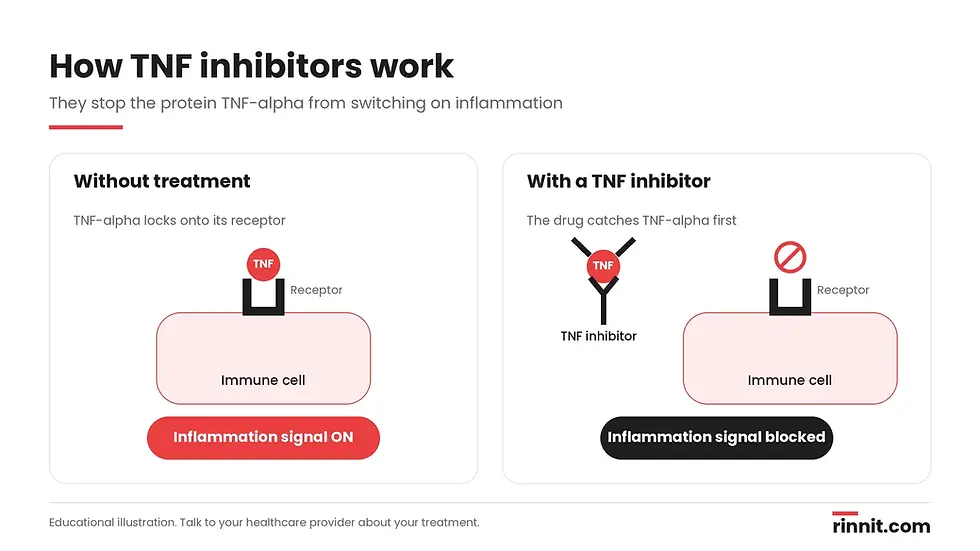
TNF inhibitors work by stopping TNF alpha from attaching to its receptors on your cells. TNF is a type of cytokine, a protein that acts as a chemical messenger in your immune system.
Here is the process, step by step:
Your immune system releases TNF.
TNF binds to receptors on your cells.
That binding sends a signal that switches on inflammation.
There are two types of TNF, alpha and beta. Both take part in inflammation, but anti-TNF therapy targets TNF alpha specifically. With the messenger blocked, the inflammation signal never fires. Learn more about how your body keeps immune responses in balance in our guide to regulatory T cells. [1]
What conditions do TNF inhibitors treat?
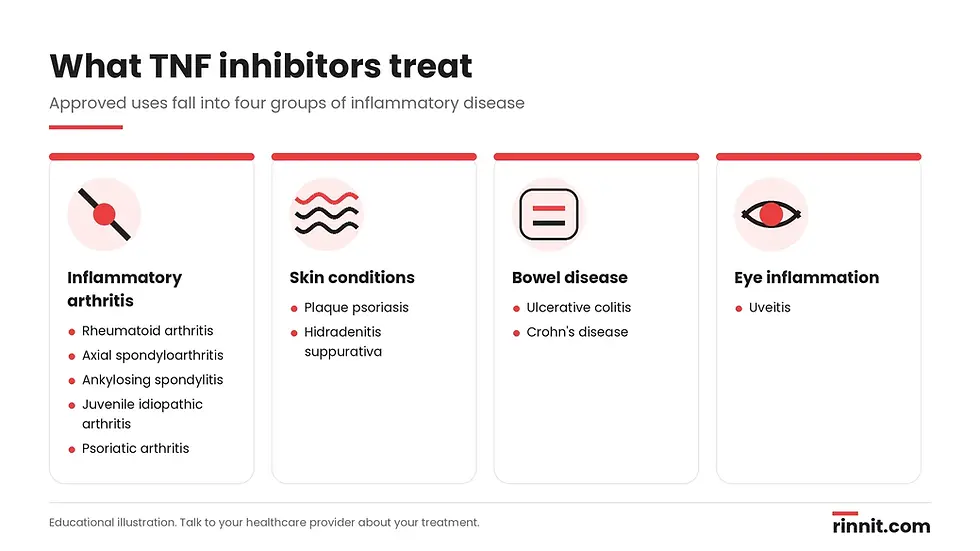
TNF inhibitors are approved to treat inflammatory arthritis, inflammatory skin conditions, inflammatory bowel disease and eye inflammation. They are especially useful when one disease causes inflammation in several parts of the body.
Group | Approved conditions |
Inflammatory arthritis | Rheumatoid arthritis, axial spondyloarthritis, ankylosing spondylitis, juvenile idiopathic arthritis, psoriatic arthritis |
Inflammatory skin conditions | Plaque psoriasis, hidradenitis suppurativa |
Inflammatory bowel disease | Ulcerative colitis, Crohn's disease |
Eye inflammation | Uveitis |
Off-label uses
Healthcare providers sometimes prescribe TNF inhibitors for conditions outside the approved list when they believe the drug may help. This is called off-label use. Examples include:
Graft vs. host disease
Behçet's disease
Sarcoidosis
Polyarteritis nodosa
Takayasu's arteritis
Pustular psoriasis
Pyoderma gangrenosum
Which drugs are TNF inhibitors?
Five TNF inhibitors are currently approved: infliximab, adalimumab, etanercept, certolizumab pegol and golimumab. [1]
Generic name | Brand name |
Infliximab | Remicade® |
Adalimumab | Humira® |
Etanercept | Enbrel® |
Certolizumab pegol | Cimzia® |
Golimumab | Simponi® |
Biosimilars
Biosimilars are close alternatives that mimic the original biologic drug, much like generics do for standard medicines. Several are approved for infliximab and adalimumab, and more are in development for the other TNF inhibitors.
Original drug | Approved biosimilars |
Infliximab (Remicade®) | Inflectra® (infliximab-dyyb), Renflexis® (infliximab-abda), Avsola® (infliximab-axxq) |
Adalimumab (Humira®) | Amjevita® (adalimumab-atto), Cyltezo® (adalimumab-adbm), Hyrimoz® (adalimumab-adaz), Hadlima® (adalimumab-bwwd), Abrilada® (adalimumab-afzb), Hulio® (adalimumab-fkjp), Yusimry® (adalimumab-aqvh), Idacio® (adalimumab-aacf), Yuflyma® (adalimumab-aaty), Simlandi® (adalimumab-ryvk) |
For a plain-language overview of how biosimilars compare with the original drugs, see this guide to biosimilars.
What type of drug is a TNF inhibitor?
A TNF inhibitor is a biologic DMARD, which stands for disease-modifying antirheumatic drug. DMARDs treat rheumatic diseases by reducing chronic inflammation in your tissues.
Biologics are medicines made from living organisms. Compared with traditional DMARDs, biologic DMARDs are:
More effective at controlling inflammation
Harder to produce, which makes them more expensive
Biosimilars are biologics too, with slightly different formulas. A biologic can never be copied exactly, but biosimilars are made in a similar way and are not meaningfully different. They work just as well and often cost less to produce. In theory, that can mean lower prices for you, although many factors affect what you actually pay. [1]
How do you take a TNF inhibitor?
You take a TNF inhibitor either by injecting it under your skin or by receiving it through a vein (IV infusion). These drugs are given by injection because they need to reach your bloodstream to work.
Feature | Self-injection | IV infusion |
How it's given | A small needle delivers the dose just under the skin | The medicine flows into a vein |
Where | Usually at home, by yourself | At your healthcare provider's office |
How often | Weekly, every 2 weeks or monthly | Every month or every 2 months |

What are the benefits of TNF inhibitors?
TNF inhibitors have transformed the treatment of rheumatic diseases by stopping inflammation before it starts. For rheumatoid arthritis they are usually added when a standard medicine such as methotrexate has not worked well enough, and for some people they work so well that symptoms seem to disappear.
Many people can keep taking them during pregnancy and breastfeeding, but the plan is individual, and babies exposed late in pregnancy may need to delay some live vaccines. Long-term use also brings some added benefits:
Less severe COVID-19 infection
A lower rate of osteoporosis caused by inflammatory arthritis
A lower risk of cardiovascular disease and heart attack
If you are pregnant, planning a pregnancy or breastfeeding, review your treatment plan with your provider. [1]
What are the side effects and risks of TNF inhibitors?
The main risk of TNF inhibitors is a weaker immune defense, which makes infections more likely. All TNF inhibitors carry an FDA boxed warning for serious infections, including tuberculosis, and for lymphoma and other cancers. You will be tested for tuberculosis and usually hepatitis B before starting, and should call your provider right away for fever, cough or other signs of infection. Because the drugs suppress part of your immune system, your body is less able to fight off infectious diseases.
Other drawbacks and side effects include:
Not working for everyone. Some people's immune systems make antibodies that target and remove the drug.
Losing effect over time. These antibodies can also appear after many years, making treatment weaker or ineffective.
Skin reactions where you inject the medicine.
Allergic reactions, which are rare.
For official safety information, see the U.S. drug safety page on TNF blockers. [1]
TNF inhibitors at a glance
Benefits | Drawbacks |
Stop inflammation before it starts | Higher risk of infections |
Help when inflammation affects many body areas | May not work for everyone |
Often usable long term, including in pregnancy and breastfeeding, with a personal plan | Can lose effect after years of use |
Linked to less severe COVID-19, less osteoporosis and lower heart risk | Injection-site skin reactions; rare allergic reactions |
How long do TNF inhibitors take to work?
Most people notice their symptoms improving after the first few doses of a TNF inhibitor. Others need a few months of treatment before they can tell it is working.
For a small number of people, the drug never works. If that happens, your provider may suggest:
A different TNF inhibitor, or
A different type of biologic DMARD that targets another cytokine [1]
Will you need to take TNF inhibitors for life?
Most conditions treated with TNF inhibitors are lifelong, so you will likely need some form of medical care for life, whether that is medication or monitoring. Stopping treatment was once not a realistic goal.
Today, if your symptoms disappear completely and stay away for several years, you may be able to slowly taper off your TNF inhibitor. Your provider will monitor you closely as you do. Never stop or reduce your dose without your provider's guidance. [1]
Conclusion
TNF inhibitors are biologic medicines that block TNF alpha, one of the main drivers of chronic inflammation in arthritis, psoriasis, inflammatory bowel disease and uveitis. They are effective options, often used when standard medicines are not enough, and many people see results within a few doses. The trade-off is a higher risk of infection and the chance that the drug stops working over time. No single treatment works for everyone, so if a TNF inhibitor is not right for you, your provider will have other options.
Living with an inflammatory condition? Write down your symptoms and questions, and bring them to your next appointment with your rheumatologist, dermatologist or gastroenterologist. To keep learning, explore our guides to DMARDs and corticosteroids.
FAQ
What are TNF inhibitors used for?
TNF inhibitors are used to treat inflammatory diseases, including rheumatoid arthritis, psoriatic arthritis, ankylosing spondylitis, plaque psoriasis, hidradenitis suppurativa, Crohn's disease, ulcerative colitis and uveitis. Providers sometimes use them off-label for conditions such as sarcoidosis and Behçet's disease.
What are the names of TNF inhibitor drugs?
TNF inhibitor drugs include infliximab (Remicade®), adalimumab (Humira®), etanercept (Enbrel®), certolizumab pegol (Cimzia®) and golimumab (Simponi®). Many biosimilars of infliximab and adalimumab are also approved.
Are TNF inhibitors immunosuppressants?
Yes, TNF inhibitors suppress part of your immune system. That calms inflammation, but it also weakens your defenses against infections.
How are TNF inhibitors given?
TNF inhibitors are given either as a self-injection under the skin, weekly, every 2 weeks or monthly, or as an IV infusion at your provider's office every 1 to 2 months.
How long does it take for a TNF inhibitor to work?
Most people feel better after the first few doses of a TNF inhibitor, while some need a few months of treatment. If it never works, your provider can switch you to another TNF inhibitor or a different biologic.
Are biosimilars as effective as the original TNF inhibitors?
Yes, biosimilars are equally effective as the original TNF inhibitors. They are made in a similar way, are not meaningfully different and often cost less to produce.
Can you take TNF inhibitors during pregnancy?
Many people can keep taking TNF inhibitors during pregnancy and breastfeeding, but the plan is individual, and babies exposed late in pregnancy may need to delay some live vaccines. Review your treatment plan with your provider if you are pregnant, planning a pregnancy or breastfeeding.
Can you ever stop taking a TNF inhibitor?
You may be able to taper off a TNF inhibitor if your symptoms disappear completely for several years. This should only happen under your provider's supervision, with close monitoring.
Do I need a TB test before starting a TNF inhibitor?
Yes. TNF inhibitors can reactivate a hidden tuberculosis infection, so providers test for TB before treatment and may check again over time. You will usually be screened for hepatitis B as well.
Can I get vaccines while taking a TNF inhibitor?
Most inactivated vaccines, such as the flu shot, are safe and recommended. Live vaccines are generally avoided while taking a TNF inhibitor, so check with your provider before any vaccine.
Related Reading
Biologics: What They Are, Types, Uses and Side Effects explains biologic medicines and how they target the immune system.
Biosimilars: What They Are, Safety and How They Compare to Biologics describes biosimilar versions of biologic drugs and how they compare.
Rheumatoid Arthritis — Symptoms, Causes, Diagnosis, Treatment & Complete Guide covers a common autoimmune condition treated with TNF inhibitors.
Crohn's Disease: Symptoms, Causes, Flares vs. Remission and Treatment — What You Need to Know explains Crohn's disease, its flares and treatment options.
References
Cleveland Clinic. TNF (Tumor Necrosis Factor) Inhibitor: What It Is & Types. Cleveland Clinic. Last updated July 2, 2025. https://my.clevelandclinic.org/health/treatments/tnf-tumor-necrosis-factor-inhibitors
Ford AC, Sandborn WJ, Khan KJ, et al. Efficacy of biological therapies in inflammatory bowel disease: systematic review and meta-analysis. Am J Gastroenterol. 2011;106(4):644-659. PMID 21407183. https://doi.org/10.1038/ajg.2011.73
Minozzi S, Bonovas S, Lytras T, et al. Risk of infections using anti-TNF agents in rheumatoid arthritis, psoriatic arthritis, and ankylosing spondylitis: a systematic review and meta-analysis. Expert Opin Drug Saf. 2016;15(sup1):11-34. PMID 27924643. https://doi.org/10.1080/14740338.2016.1240783
Singh S, Fumery M, Singh AG, et al. Comparative Risk of Cardiovascular Events With Biologic and Synthetic Disease-Modifying Antirheumatic Drugs in Patients With Rheumatoid Arthritis: A Systematic Review and Meta-Analysis. Arthritis Care Res (Hoboken). 2020;72(4):561-576. PMID 30875456. https://doi.org/10.1002/acr.23875
Further reading
American College of Rheumatology. Tumor Necrosis Factor (TNF) Inhibitors. American College of Rheumatology. Last updated April 2025. https://rheumatology.org/patients/tumor-necrosis-factor-tnf-inhibitors
Gerriets V, Goyal A, Khaddour K. Tumor Necrosis Factor Inhibitors. StatPearls. Last updated July 3, 2023. https://www.ncbi.nlm.nih.gov/books/NBK482425/
Disclaimer
This article is for educational purposes only and is not a substitute for professional medical advice, diagnosis or treatment. Always talk to a qualified healthcare provider about your symptoms and before starting, changing or stopping any medication.



Comments