Thyroidectomy: Types, Preparation, Risks and Recovery

Updated: 6 days ago
Written and medically reviewed by Dr. Baraa Alnahhal, MD · Last reviewed: October 2026 · How we review
Quick Answer: What is a thyroidectomy?
A thyroidectomy is surgery to remove all (total) or part (partial) of the thyroid gland, the butterfly-shaped organ in the neck. It treats thyroid cancer, suspicious nodules, goiters that press on the windpipe or food pipe, and an overactive thyroid. It is done under general anesthesia, and full recovery usually takes two to three weeks. [1]
What the research says
Low calcium after surgery is common but usually short-lived. A review of 115 studies found a median rate of 27% for temporary low blood calcium after thyroidectomy, compared with about 1% for permanent low calcium. (Edafe et al., Br J Surg, 2014) [2]
Lasting voice-nerve injury is rare. Across 73,325 nerves at risk in prospective studies, temporary nerve injury occurred in 3.15% and permanent injury in 0.42%; using nerve monitoring during surgery did not change these rates. (Cozzi et al., J Pers Med, 2023) [3]
Partial surgery can still lead to thyroid hormone pills. A meta-analysis of 66 studies found that 29% of people developed an underactive thyroid after removal of one lobe, and 23% needed thyroid hormone replacement. (Cooper et al., Thyroid Res, 2024) [4]
Key takeaways
A thyroidectomy removes all or part of the thyroid gland. [1]
The two main types are total thyroidectomy (all or most of the gland) and partial thyroidectomy (one lobe). [1]
Doctors recommend it for thyroid cancer, nodules that may be cancer, large goiters or nodules that press on the windpipe or food pipe, and nodules or goiters that make too much thyroid hormone. [1]
Removing the whole thyroid usually takes one to three hours under general anesthesia. [1]
Complications are uncommon but include bleeding, a hoarse voice and low calcium. [1]
Most people recover fully in two to three weeks. [1]
Thyroidectomy at a glance
Topic | What to know |
What it is | Surgery to remove all or part of the thyroid gland [1] |
Main types | Total thyroidectomy and partial thyroidectomy (lobectomy or hemithyroidectomy) [1] |
Common reasons | Thyroid cancer, suspicious nodules, large goiters, overactive thyroid [1] |
Anesthesia | General anesthesia with a breathing tube [1] |
Surgery time | One to three hours for a total thyroidectomy; often less for a partial one [1] |
Hospital stay | Usually one night [1] |
Full recovery | About two to three weeks [1] |
Scar | Usually 1 to 2.5 inches; fades over 12 to 18 months [1] |
What are the types of thyroidectomy?
The two main types of thyroidectomy are total thyroidectomy and partial thyroidectomy. [1]
A total thyroidectomy removes all or most of the thyroid gland. A partial thyroidectomy removes the right or left lobe of the thyroid. A partial thyroidectomy is also called a hemithyroidectomy or a lobectomy. [1]
The right type depends on why you need surgery. You, your endocrinologist and your surgeon decide on the plan together. [1]
Type | What is removed | Other names |
Total thyroidectomy | All or most of the thyroid gland | — |
Partial thyroidectomy | The right or left lobe | Hemithyroidectomy, lobectomy |
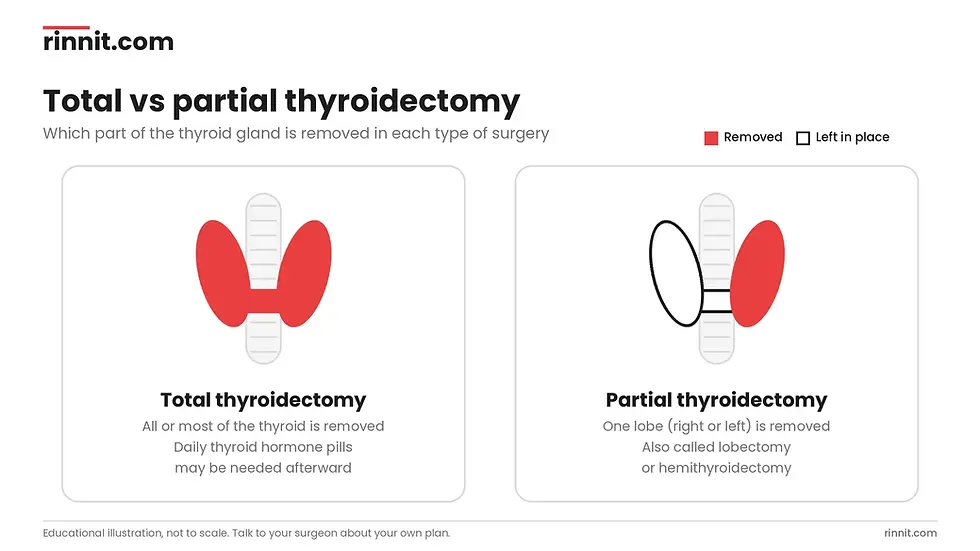
Total thyroidectomy removes all or most of the gland; partial thyroidectomy removes one lobe.
Why would someone need a thyroidectomy?
A thyroidectomy is recommended to treat thyroid cancer and certain other thyroid conditions. [1] Your doctor may suggest it if:
You have a thyroid nodule (growth) that might be thyroid cancer
You have been diagnosed with thyroid cancer
A large nodule or goiter is pressing on your windpipe (trachea) or food pipe (esophagus), making it hard to breathe or swallow
A nodule or goiter is releasing too much thyroid hormone [1]
Condition | What it means | Why surgery may help |
A growth of cells in the thyroid; usually not cancer, but sometimes cancerous or hormone-producing | Removes a growth that may be cancer or that makes excess hormone [1] | |
Goiter | An enlarged thyroid, with or without nodules | Relieves pressure on the windpipe or food pipe [1] |
The thyroid makes more hormone than the body needs | Surgery is one of several treatment options [1] | |
Thyroid cancer | Cancer that starts in the thyroid | Removes the cancer and, if needed, nearby lymph nodes [1] |
Conditions such as Graves' disease and papillary thyroid cancer are among the thyroid problems where surgery may be discussed. For a wider overview, see our guide to thyroid disease.
What questions should you ask before a thyroidectomy?
Asking a few clear questions before a thyroidectomy helps you understand your plan. [1] Consider asking your endocrinologist or surgeon:
Why do I need a thyroidectomy?
Are there other treatments for my condition?
What are the risks of a thyroidectomy?
How much of my thyroid needs to be removed?
Will I need thyroid hormone replacement after surgery? [1]
How do you prepare for a thyroidectomy?
Preparing for a thyroidectomy usually involves tests in the weeks before surgery, a medicine review at least one week before, and fasting for several hours on the day. [1] Your care team will give you instructions that fit your situation.
In the weeks before surgery, you may:
Have imaging, most often a thyroid ultrasound, to find exactly where the abnormal growth is
Have a fine needle aspiration (a type of needle biopsy) to check whether a nodule is cancer
Have your vocal cord function checked
Take medicine to control high thyroid hormone levels
Be advised to quit smoking, if you smoke [1]
At least one week before surgery:
Tell your provider about every medicine you take, including non-prescription drugs, herbs and supplements, and ask which ones to take on the day of surgery
You may be asked to stop blood thinners for a short time — stop them only if your provider tells you to [1]
On the day of surgery: you will need to fast (nothing to eat or drink except water) for several hours. Your provider will tell you exactly when to start. [1]

From the first tests to a fading scar: what usually happens around a thyroidectomy.
What happens during a thyroidectomy?
During a thyroidectomy, you are asleep under general anesthesia while the surgeon removes all or part of the thyroid through an incision. [1] An anesthesiologist gives the anesthesia to relax your muscles, prevent pain and put you to sleep, and a breathing tube is placed in your throat. [1]
Surgeons can reach the thyroid in several ways:
Approach | How it works |
Conventional | A standard incision in the neck |
Minimally invasive video-assisted (MIVAT) | A smaller neck incision with help from a camera |
Scarless or hidden-incision | Access through the mouth, armpit, shoulder blade, breast or ear |
Through the breastbone | Only in very rare cases when a goiter extends low into the chest |
Source for table: [1]
If surgery is for thyroid cancer, the surgeon may take a sample of the lymph nodes around the thyroid. A pathologist checks this sample during the operation. If cancer cells are found, nearby lymph nodes in the neck may also be removed. [1]
At the end, the incision is closed with dissolvable stitches and covered with skin glue. Removing the whole thyroid usually takes one to three hours; removing only part of it may take less time. [1]
What are the risks of a thyroidectomy?
A thyroidectomy is generally very safe, but it is major surgery, and complications — while uncommon — can happen. [1] The main risks are:
Bleeding that is heavy enough to block the airway and make breathing hard
Nerve injury that leads to vocal cord paralysis and a hoarse voice
Damage to the parathyroid glands, which can cause hypoparathyroidism (low parathyroid hormone) and lead to low blood calcium [1]
These complications are more likely if:
The tumor is invasive or the cancer has spread to nearby lymph nodes in the neck
This is a second thyroid surgery
The goiter is very large [1]

Know the three main complications and the warning signs that mean you should call your doctor.
What happens after a thyroidectomy?
After a thyroidectomy, most people eat something light once they are fully awake and spend one night in hospital for monitoring. [1] Your throat may feel sore from the breathing tube used during surgery. [1]
After a total thyroidectomy you will need a daily thyroid hormone pill (levothyroxine) for life, and after a partial one you may need it — your provider will discuss this with you before surgery. If your whole thyroid is removed, your surgeon will likely prescribe calcium pills for several weeks to prevent low blood calcium. [1] Learn more about life with an underactive thyroid in our hypothyroidism guide.
How long does recovery from a thyroidectomy take?
Full recovery from a thyroidectomy takes about two to three weeks. [1] Before you go home, your provider will explain how to care for your incision and which complications to watch for. [1]
Recovery milestone | Typical timing |
Light food and drink | Once you are fully awake after anesthesia |
Hospital stay | Usually one night |
Vigorous activity (exercise, heavy lifting) | Wait at least one to two weeks |
Full recovery | About two to three weeks |
Scar healing | 12 to 18 months |
Source for table: [1]
What does a thyroidectomy scar look like?
A thyroidectomy usually leaves a small scar on the front of the neck, most often 1 to 2.5 inches long, depending on how large the thyroid was. [1] The scar starts dark and gradually lightens. It may look raised or puffy for several months before it smooths out, and it can take 12 to 18 months to heal. Your surgeon can tell you how to care for it. [1]
When should you call a doctor after a thyroidectomy?
Call your healthcare provider after a thyroidectomy if you notice any of the following: [1]
Swelling, bleeding or pus at the incision
A fever of 38 °C (100.4 °F) or higher
Numbness or tingling in your face, hands or lips
If you have trouble breathing after surgery, seek emergency care right away, as heavy bleeding in the neck can block the airway. [1]
Conclusion
A thyroidectomy is a common, generally safe surgery that removes all or part of the thyroid to treat cancer, suspicious nodules, large goiters or an overactive thyroid. [1] Knowing the type of surgery you need, how to prepare, the main risks and the warning signs to watch for can make the process feel far less overwhelming. Many people recover well and feel much better afterward. [1]
Have a thyroidectomy coming up? Write down the questions in this guide and bring them to your next appointment with your endocrinologist or surgeon. Then keep learning with our physician-reviewed guides to thyroid nodules, thyroid cancer and hypocalcemia — and bookmark this page to check your recovery milestones.
FAQ
What is a thyroidectomy?
A thyroidectomy is surgery to remove all or part of the thyroid gland in the neck. A total thyroidectomy removes all or most of the gland, while a partial thyroidectomy removes one lobe. [1]
Why would I need a thyroidectomy?
A thyroidectomy is usually recommended for thyroid cancer, a nodule that might be cancer, a large nodule or goiter that makes breathing or swallowing hard, or a nodule or goiter that makes too much thyroid hormone. Your endocrinologist and surgeon will explain which reason applies to you. [1]
How long does a thyroidectomy take?
A total thyroidectomy typically takes one to three hours. Removing only part of the thyroid may take less time. [1]
How long is recovery after a thyroidectomy?
Recovery after a thyroidectomy takes about two to three weeks for most people. Wait at least one to two weeks before vigorous activity such as exercise or heavy lifting. [1]
Will I need medication after a thyroidectomy?
After a total thyroidectomy you will need a daily thyroid hormone pill (levothyroxine) for life; after a partial thyroidectomy you may need it. After a total thyroidectomy, calcium pills are also usually prescribed for several weeks. [1]
What are the risks of a thyroidectomy?
The main risks of a thyroidectomy are heavy bleeding that can affect breathing, nerve injury that causes a hoarse voice, and parathyroid damage that lowers blood calcium. These complications are uncommon. [1]
Will a thyroidectomy leave a scar?
A thyroidectomy usually leaves a small scar on the front of the neck, most often 1 to 2.5 inches long. The scar starts dark and gradually lightens over 12 to 18 months. [1]
When should I call a doctor after a thyroidectomy?
Call a doctor after a thyroidectomy if you have swelling, bleeding or pus at the incision, a fever of 38 °C (100.4 °F) or higher, or numbness or tingling in your face, hands or lips. Trouble breathing needs emergency care right away. [1]
Will my voice change after a thyroidectomy?
A hoarse or weak voice is common for a few days to weeks after surgery. Rarely, injury to a nerve near the thyroid causes longer-lasting voice changes, so tell your surgeon if hoarseness does not improve.
Why can calcium drop after a thyroidectomy?
The parathyroid glands, which control calcium, sit next to the thyroid and can be bruised or removed during surgery. Call your doctor if you have tingling around your mouth or in your fingers, or muscle cramps, which can be signs of low calcium.
Related Reading
Papillary Thyroid Cancer (PTC): Symptoms, Diagnosis, and Treatment explains the most common thyroid cancer and how surgery treats it.
Goiter: What a Neck Bulge Means, the 7 Causes, and How Treatment Protects Your Thyroid covers an enlarged thyroid and when it needs surgery.
Hypoparathyroidism: Symptoms, Causes & Treatment Guide explains low parathyroid hormone, a possible effect of thyroid surgery.
Hypothyroidism: Symptoms, Causes & Treatment Guide describes low thyroid hormone and how replacement pills treat it.
References
Cleveland Clinic. Thyroidectomy (Thyroid Surgery): What It Is & Recovery. Cleveland Clinic. Last updated June 5, 2025. https://my.clevelandclinic.org/health/treatments/7016-thyroidectomy
Edafe O, Antakia R, Laskar N, et al. Systematic review and meta-analysis of predictors of post-thyroidectomy hypocalcaemia. Br J Surg. 2014;101(4):307-320. PMID 24402815. https://doi.org/10.1002/bjs.9384
Cozzi AT, Ottavi A, Lozza P, et al. Intraoperative Neuromonitoring Does Not Reduce the Risk of Temporary and Definitive Recurrent Laryngeal Nerve Damage during Thyroid Surgery: A Systematic Review and Meta-Analysis of Endoscopic Findings from 73,325 Nerves at Risk. J Pers Med. 2023;13(10):1429. PMID 37888040. https://doi.org/10.3390/jpm13101429
Cooper D, Kaur R, Ayeni FE, et al. Hypothyroidism after hemithyroidectomy: a systematic review and meta-analysis. Thyroid Res. 2024;17(1):18. PMID 38972987. https://doi.org/10.1186/s13044-024-00200-z
Further reading (external)
American Thyroid Association. Thyroid Surgery. American Thyroid Association. Accessed November 3, 2026. https://www.thyroid.org/thyroid-surgery/
American Cancer Society. Surgery for Thyroid Cancer. American Cancer Society. Last revised August 24, 2024. https://www.cancer.org/cancer/types/thyroid-cancer/treating/surgery.html
Medical disclaimer
This article is for educational purposes only and is not a substitute for professional medical advice, diagnosis or treatment. Always talk to your doctor or surgeon about your own health and treatment plan. If you have trouble breathing or another emergency, seek emergency care immediately.



Comments